
USDF Yield Calculator
Calculate Your USDF Yield
See how much yield you can earn with USDF compared to traditional stablecoins like USDT or USDC.
USDF Yield Results
USDF vs Traditional Stablecoins
Compare USDF yield to traditional stablecoins that don't earn yield by default.
Traditional stablecoins typically earn 0-5% APY only through lending platforms, requiring additional steps and higher gas fees.
How USDF Yield Works
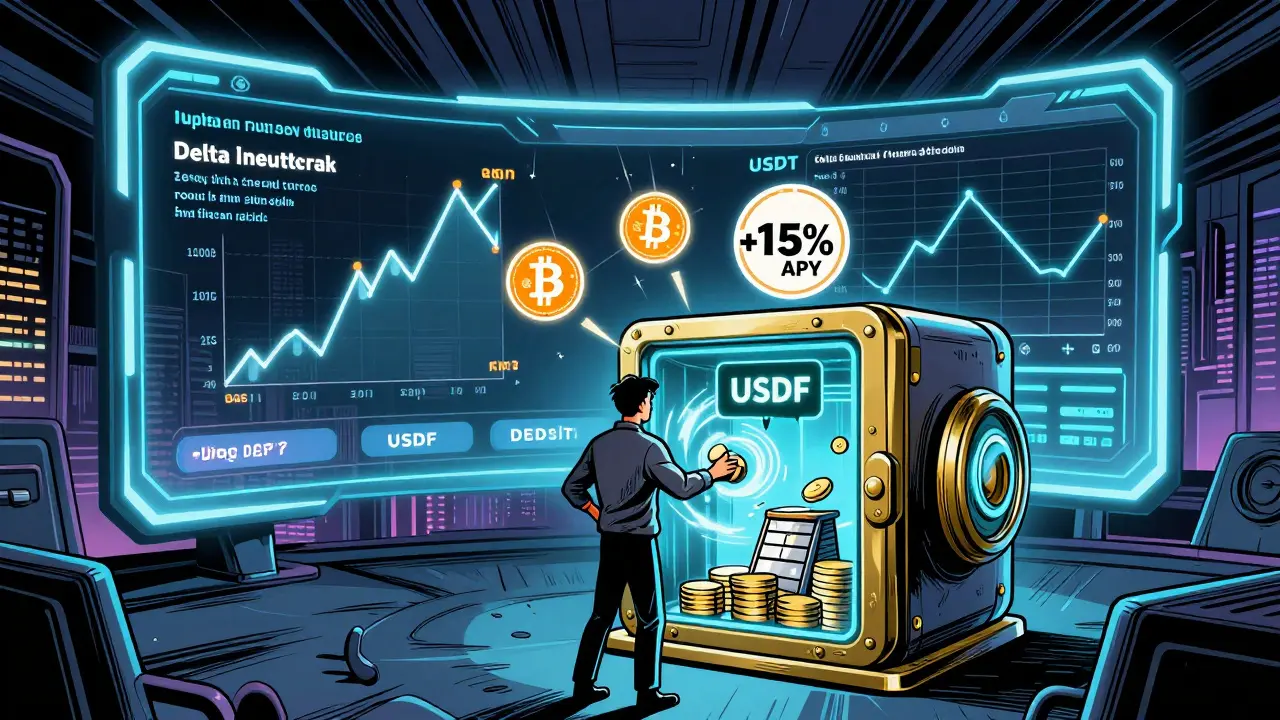
USDF generates yield through a delta-neutral strategy. When you mint USDF, your USDT is used to open balanced long and short positions on perpetual futures markets. The trading fees, funding rates, and rebates from these positions become your yield.
This means you earn approximately 15% APY just by holding USDF, with the potential to earn 18% APY if you stake your USDF to receive asUSDF.
Risk Warning
USDF is a yield-bearing stablecoin with important risks. Only invest what you can afford to lose.
- Oracle failure risk: Price feeds could be manipulated or delayed
- Liquidity crunch risk: Futures markets might freeze during extreme volatility
- Gas fees: $1.20-$3.80 for minting on Ethereum (higher during network congestion)
- Limited exchange availability: USDF not listed on Binance or Coinbase
This tool is for educational purposes only. Past performance doesn't guarantee future results.
Aster USDF is not just another stablecoin. It’s a DeFi innovation designed to solve a simple but costly problem: why should your stablecoins sit idle while the market moves around them? Unlike USDT or USDC, which earn nothing unless you actively lend them out, USDF generates yield just by holding it. Built by Aster - a decentralized perpetual exchange backed by YZi Labs (formerly Binance Labs) - USDF is pegged 1:1 to USDT, not USD, and earns returns through a unique delta-neutral strategy that eliminates directional market risk while generating passive income.
How USDF Works: The Delta-Neutral Engine
Most stablecoins are backed by cash, cash equivalents, or other crypto assets held in reserve. USDF works differently. Its backing comes from a combination of crypto collateral and short futures positions. When you mint USDF, you deposit assets like USDT. Aster’s smart contracts then use that USDT to open balanced long and short positions on perpetual futures markets. The long side holds crypto assets; the short side bets against them. These positions cancel each other out - that’s the delta-neutral part. No matter if Bitcoin goes up or down, the net exposure is zero. But the trading fees, funding rates, and rebates from these positions? Those become your yield.
This isn’t theoretical. According to Holder.io’s December 2025 data, USDF has maintained a tight trading range of $0.999 to $1.001 over the past 30 days, even during periods of high crypto volatility. Historical data shows it briefly dipped to $0.971 and peaked at $1.04 - far more stable than algorithmic stablecoins like the collapsed UST. The system relies on reliable price oracles and liquid derivatives markets. If those fail, the peg could be at risk - a concern raised by blockchain security experts. But Aster’s December 2025 update introduced Circuit Breaker 2.0, which automatically halts new USDF minting during abnormal price swings to protect the system.
asUSDF: The Yield Layer
Holding USDF gives you yield, but you can unlock even more by staking it to get asUSDF (also called ASUSDF). This is a yield-bearing derivative token. For every USDF you stake, you receive an equivalent amount of asUSDF. The asUSDF doesn’t just sit there - its value grows automatically as rewards from Aster’s delta-neutral strategies are distributed. Think of it like compound interest built into the token itself.
Staking USDF can earn you up to 15% APY, according to Aster’s official documentation. Some users report hitting 14.2% consistently over three months. In December 2025, Aster launched USDF Prime, a tier that offers 18% APY for users who stake more than 10,000 USDF. Rewards come from multiple DeFi sources: lending protocols, liquidity pools, and yield farming across platforms like Aave and Curve. Unlike mining-based systems, asUSDF can’t be mined - you only get it by staking real USDF. This keeps supply proportional to actual usage and prevents inflation.
Why USDF Stands Out in DeFi
Compare USDF to USDC or DAI. Those are safe, widely accepted, and liquid - but they don’t earn anything unless you move them into a lending protocol like Aave or Compound. That means extra steps, higher gas fees, and more complexity. USDF does it all in one place: you mint it, you earn yield, and you can use it as collateral for leveraged trades on Aster’s DEX - up to 1001x leverage.
That’s where USDF’s real power kicks in. Traders can use USDF as margin for perpetual futures, earn yield on the collateral, and still trade aggressively. A Medium case study from November 2025 showed a user generating 13.8% annual returns while using USDF as collateral for 50x ETH trades - something impossible with traditional stablecoins. MEXC calls this a "free leverage" model. You’re not paying interest on borrowed funds because your collateral is actively earning.
Compared to other yield-bearing stablecoins like sFRAX or mUSD, USDF’s biggest edge is its deep integration with a high-performance derivatives exchange. You don’t need to jump between platforms. Everything happens on Aster.
Where You Can Use USDF - And Where You Can’t
USDF is powerful inside the Aster ecosystem. You can mint it, stake it, trade with it, and withdraw it as USDT - all within the same interface. But outside of it? Not so much.
As of December 2025, USDF trades on only a handful of exchanges. Holder.io reports "no data" on major platforms like Binance or Coinbase. That’s a big limitation. You can’t pay for coffee with USDF. You can’t send it to a friend on PayPal. It’s not accepted by merchants. Its value is locked inside DeFi. If you’re not trading perpetuals or staking in Aster’s dApp, USDF offers little benefit.
Trustpilot reviews show 4.2/5 stars from 37 users. The top praise? "Seamless integration with Aster DEX" (68%) and "reliable yield delivery" (59%). The top complaints? "Limited exchange availability" (73%) and "too complex for beginners" (41%). Reddit users confirm this - many report successful staking, but others struggled with withdrawal delays during Ethereum network congestion.
Getting Started with USDF
You don’t need to be a crypto expert to start, but you need to understand basic DeFi. Here’s how:
- Get a Web3 wallet: MetaMask or Trust Wallet.
- Buy USDT on a centralized exchange like Binance or Kraken.
- Send USDT to your wallet.
- Go to asterdex.com and connect your wallet.
- Select "Mint USDF" and deposit your USDT. You’ll get 1 USDF for every 1 USDT.
- Optional: Stake your USDF to receive asUSDF and start earning up to 15% APY.
Gas fees for minting on Ethereum average $1.20-$3.80, depending on network congestion. To save money, use layer-2 networks like Arbitrum or Polygon when possible. Aster’s dApp has two modes: Simple Mode for beginners, and Pro Mode for advanced traders who want to optimize yield and leverage.
Most users report needing 2-5 hours to feel comfortable. Aster Academy offers free video tutorials, and the official Discord has over 12,450 members with daily support from developers.
The Big Picture: Aster Chain and the Future
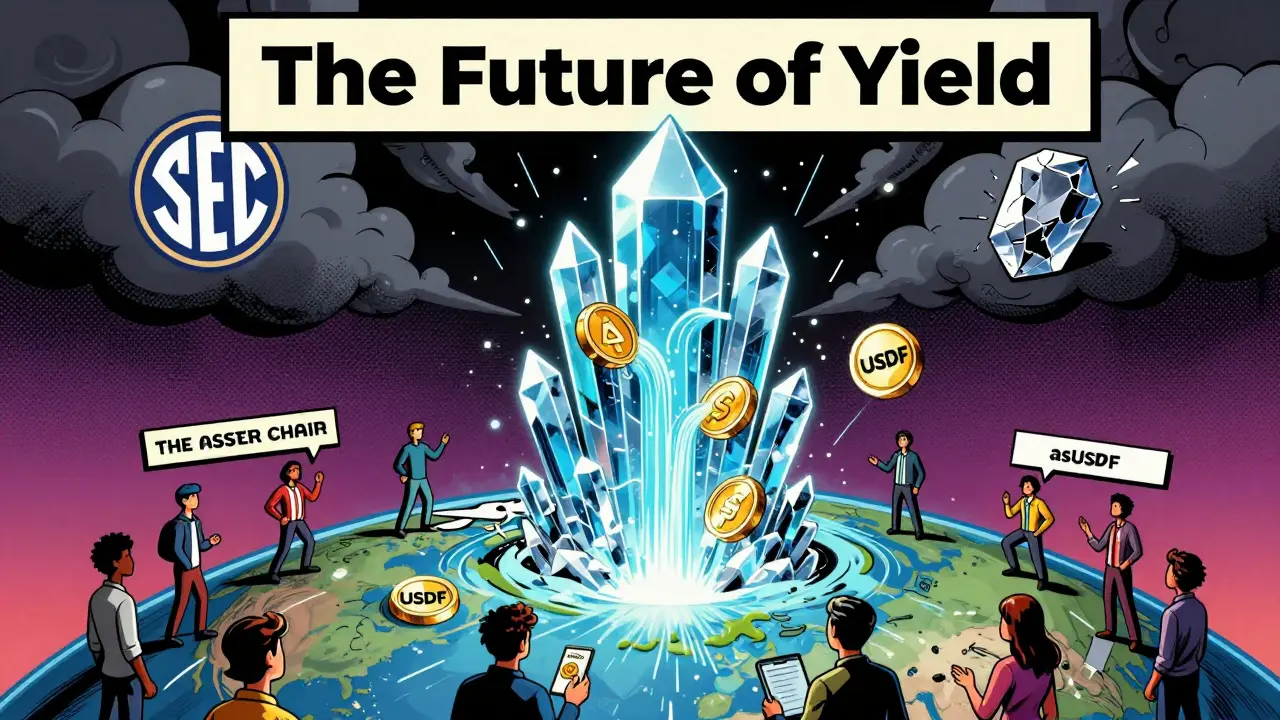
Aster isn’t stopping at a DEX. The team is building its own blockchain - Aster Chain - scheduled to launch in Q4 2025. Once live, USDF will migrate from its current multi-chain setup to this new Layer 1, reducing fees and increasing speed. The roadmap also includes USDF v2 in Q1 2026, which will add BTC and ETH as collateral options and improve oracle security with Chainlink’s CCIP for cross-chain transfers.
Industry analysts are split. JPMorgan’s December 2025 report warns that niche stablecoins without payment utility are risky, pointing to the UST collapse as a warning. But Open Capital, the successor to Three Arrows Capital, gives USDF a 78% chance of surviving the next market cycle because of its capital efficiency. Delphi Digital predicts the yield-bearing stablecoin market could hit $8.2 billion by 2027. USDF, with its current $170 million market cap, could capture 5-7% of that if execution stays on track.
Risks You Can’t Ignore
USDF isn’t risk-free. Here’s what could go wrong:
- Oracle failure: If price feeds from Chainlink or other oracles are manipulated or delayed, the delta-neutral model could break, risking the peg.
- Liquidity crunch: If futures markets freeze during a crash (like March 2023), Aster might not be able to close positions fast enough.
- Regulatory risk: The SEC hasn’t classified USDF yet, but its yield-generating mechanism could trigger scrutiny. If regulators decide it’s a security, exchanges might delist it.
- Adoption risk: Without broader exchange support, USDF remains a niche product. If Aster Chain fails to launch or attract users, the whole model could stall.
For now, USDF is a tool for experienced DeFi users who want to turn idle stablecoins into active capital. It’s not for everyone. But if you’re already trading perpetuals or earning yield in DeFi, it’s one of the most efficient tools available.
Is USDF pegged to USD or USDT?
USDF is pegged 1:1 to USDT, not USD. This means its value tracks USDT’s price, which itself is pegged to the US dollar. The choice to peg to USDT instead of USD directly allows for smoother integration with crypto-native DeFi systems where USDT is the dominant stablecoin.
Can I cash out USDF for USD?
You can’t directly cash out USDF for USD. But you can redeem USDF for USDT at a 1:1 ratio through Aster’s dApp. Then, you can transfer USDT to a centralized exchange like Binance or Kraken and sell it for USD. There’s no direct fiat on-ramp yet, but Aster plans to add one in Q3 2026.
Is USDF safe?
USDF is safer than algorithmic stablecoins like UST, but riskier than reserve-backed ones like USDC. Its delta-neutral mechanism is mathematically sound, but it depends on external systems: oracle feeds, futures market liquidity, and smart contract integrity. The Circuit Breaker 2.0 update reduces the risk of peg breaks during volatility. Still, no DeFi product is 100% safe. Only invest what you can afford to lose.
How do I earn yield with USDF?
You earn yield in two ways: first, by holding USDF - the delta-neutral strategy generates returns automatically. Second, by staking USDF to receive asUSDF, which accrues additional rewards from DeFi strategies like lending and liquidity provision. Staking can earn you up to 15% APY, with a 18% APY tier for balances over 10,000 USDF.
Do I need to use Aster’s DEX to use USDF?
You don’t need to trade on Aster’s DEX to hold or stake USDF. But to mint USDF from USDT and access the full yield features, you must use Aster’s dApp. Without it, you’re just holding a token with limited utility. The yield mechanism is tied to the protocol’s internal futures positions - you can’t replicate it elsewhere.
Is USDF better than USDT for trading?
For traders using leverage on Aster’s DEX, USDF is superior. You earn yield while using it as collateral - effectively getting free leverage. With USDT, you earn nothing unless you move it to a lending platform, which adds complexity and cost. But for general use - payments, transfers, or holding - USDT is still far better because it’s accepted everywhere.
What’s the difference between USDF and asUSDF?
USDF is the base stablecoin pegged 1:1 to USDT. asUSDF is a staked version of USDF that earns additional yield automatically. When you stake USDF, you receive an equal amount of asUSDF. The value of asUSDF grows over time as rewards are distributed - it’s not a separate token you buy, but a reward token you receive for locking up your USDF.
Stanley Wong
December 7 2025So I’ve been holding USDF for about four months now and honestly it’s been one of the smoother DeFi experiences I’ve had
Not because it’s perfect but because the yield just shows up like clockwork
I started with 5k USDT and got 14.1% APY without lifting a finger
Used to stress about moving money to Aave or Compound just to get 6% and now I just mint and forget
The only thing that freaks me out is how dependent it is on futures markets
One day the funding rates go haywire and boom the whole delta-neutral thing could unravel
But so far Circuit Breaker 2.0 has held up even during the last ETH flash crash
I don’t trust any DeFi project that doesn’t have a solid emergency brake
Aster actually built one and that’s rare
Also the asUSDF auto-compounding is genius
No need to claim rewards manually
It just grows like a savings account that’s been caffeinated
And yeah I know it’s not on Coinbase
But I’m not using it to buy coffee I’m using it to make my crypto work harder
That’s the whole point
Tom Van bergen
December 8 2025Yield bearing stablecoins are just the next Ponzi layer disguised as innovation
They promise passive income but the only thing passive is your bank account after the peg collapses
UST didn’t die because of bad code it died because people believed magic was real
USDF is the same magic with fancy charts
Delta neutral my foot
Every time someone says that phrase they’re hiding a leveraged position behind a curtain
And when the market turns the curtain burns
Stop calling this finance it’s just gambling with a spreadsheet
And don’t tell me about Circuit Breakers
They’re just the last gasp before the system implodes
Sandra Lee Beagan
December 9 2025Hey I’m from Canada and I’ve been using USDF for a few months now and I just wanted to say thank you for writing this so clearly
I’m not a trader but I’ve been trying to learn DeFi and this made so much sense
The way you explained asUSDF vs USDF was like a lightbulb moment
I was so confused before
Also the part about not needing to use Aster’s DEX to stake was a relief
I don’t want to trade 1001x leverage I just want my money to grow quietly
And the Discord community has been super helpful too
Someone helped me fix my gas fees on Polygon last week
It’s rare to find a project that actually cares about beginners
Also I love that they’re building Aster Chain
Lower fees = more people can join
Hope it launches on time 🤞
Chris Jenny
December 11 2025THIS IS A CENTRALIZED SCAM DISGUISED AS DEFI
YZi Labs? Former Binance Labs???
Do you know who runs Binance???
They’re the same people who got fined $4 billion for money laundering
And now they’re giving you a yield coin???
They’re not giving you anything
They’re collecting your USDT
And when the time is right
They’ll freeze your wallet
And disappear
Just like Terra
Just like FTX
Just like every other ‘innovation’ that ends with a 90% crash
They want your money
They don’t want you to win
They want you to think you’re smart
But you’re just another pawn
Wake up
rita linda
December 12 2025USDF is a joke if you’re not American
Why should I trust a token pegged to USDT when I can just hold USDC and not risk some foreign DeFi protocol
USDC is backed by real banks
USDT is backed by shell companies
And USDF is backed by futures bets on a blockchain that doesn’t even exist yet
This isn’t innovation
This is American financial arrogance
Exporting risk to the rest of the world
And calling it ‘yield’
Stick to USD
Stick to safety
Don’t get seduced by crypto hype
Martin Hansen
December 13 2025Anyone who’s actually using USDF is either a degenerate trader or a complete idiot
You think you’re earning yield
But you’re just paying for the privilege of being the last one holding the bag when the funding rates go negative
And don’t even get me started on the 18% APY tier
That’s not a reward
That’s a trap
They’re cherry-picking the biggest whales to make the APY look good
Meanwhile the small holders get 14% and pray
And the whole thing relies on Chainlink
Which is centralized
Which is a joke
Stop pretending this is decentralized
It’s just Binance 2.0 with a new logo
Lore Vanvliet
December 15 2025OMG I JUST STAKED 20K USDF AND MY ASUSDF BALANCE JUST JUMPED 1.2% IN 2 HOURS
LIKE BRO
I WAS JUST CHECKING MY WALLET AND IT WAS LIKE A CHRISTMAS TREE
AND THEN I SAW THE 18% APY TIER
AND I STARTED CRYING
NOT FROM HAPPINESS
FROM RELIEF
I’VE BEEN STUCK IN 3% YIELD POOLS FOR YEARS
AND NOW I’M MAKING MORE THAN MY SALARY
AND I DIDN’T EVEN HAVE TO TRADE
JUST HOLD
AND STAKE
AND LET THE ROBOTS DO THE WORK
THIS IS THE FUTURE
AND I’M LIVING IT
😭💰
Scott Sơn
December 16 2025USDF is the crypto equivalent of a Tesla that drives itself while playing jazz and making you coffee
It’s not just a stablecoin
It’s a lifestyle upgrade
You’re not holding a token
You’re holding a financial symphony
Where every funding rate is a bass drop
Every oracle update is a violin swell
And every asUSDF reward is a standing ovation
And yes I know it’s risky
But so is driving a car
But you still do it
Because the ride is worth it
So why not ride the yield?
Frank Cronin
December 16 2025Look at all these people acting like they discovered fire
Yield-bearing stablecoin? Wow
That’s like saying you invented water because you drank it from a glass instead of a cup
USDT has been around for a decade
And now you’re shocked someone figured out how to make it earn something
It’s not genius
It’s basic math
And the fact that you’re all acting like this is revolutionary
Just proves how little you know
Go back to your meme coins
And leave real finance to the adults
Ben VanDyk
December 17 2025There’s a typo in the article: 'asUSDF' is referred to as 'ASUSDF' in one section
It’s inconsistent
Also '1001x leverage' is technically incorrect
The max leverage on Aster is 1000x
Minor things
But if you’re going to write a detailed explainer
At least get the numbers right
Otherwise it undermines the whole credibility
And yes I checked the dApp myself
It’s 1000x
Krista Hewes
December 18 2025im new to this and i just wanted to say thank you for writing this so clearly
i was so scared to try anything with crypto after the ftx thing
but this made me feel like maybe i could try something safe
i minted 500 usdt yesterday and it worked
no drama
no error messages
just usdf in my wallet
and now im staking it
and i feel like i did something smart for once
not sure if ill ever trade
but this feels like a win
thank you
Josh Rivera
December 18 202515% APY? That’s cute
But you know what’s better?
Not losing your money
USDF is a house of cards built on funding rates
And when the market crashes
And everyone tries to exit at once
And the liquidity dries up
And the oracles lag
Guess what happens?
You wake up with a 90 cent USDF
And no one cares
Because you were chasing yield
And not safety
And now you’re just another statistic
Neal Schechter
December 19 2025For anyone considering USDF: if you’re already trading on Aster DEX, it’s a no-brainer
You’re getting yield on your collateral
That’s free money
But if you’re not trading
Then you’re better off with USDC
And staking it on Aave
Yes it’s more steps
Yes it costs more gas
But you’re not betting on a single protocol’s survival
USDF is elegant
But elegance doesn’t mean safety
It just means it looks pretty on a whitepaper
Know your risk tolerance
Madison Agado
December 20 2025What’s interesting about USDF is not the yield
It’s the philosophy behind it
Most DeFi asks you to choose between safety and return
USDF says: why not both?
It’s a quiet rebellion against the idea that money has to sit idle
It’s not about being rich
It’s about not being complicit in the waste of capital
Every dollar sitting in USDT is a dollar not working
USDF says: let it work
Even if it’s risky
Even if it’s complex
Even if it’s not on Coinbase
Maybe the future isn’t about more options
But about better integration
Where everything just… works
jonathan dunlow
December 21 2025Guys I just hit 18% APY with my 15k USDF
AND I’M NOT EVEN TRYING
THIS IS THE BEST THING THAT’S HAPPENED TO ME IN 2025
I USED TO WORK 60 HOURS A WEEK
AND NOW MY MONEY IS WORKING HARDER THAN I AM
IF YOU’RE NOT USING USDF
YOU’RE LEAVING MONEY ON THE TABLE
AND NOT JUST A LITTLE
WE’RE TALKING HUNDREDS OF DOLLARS A MONTH
JUST FOR HOLDING
SO WHY ARE YOU STILL USING USDT???
GET UP
GET ON ASTER
AND START MAKING YOUR MONEY WORK
YOU DESERVE IT
Mariam Almatrook
December 22 2025It is imperative to acknowledge that the economic architecture underpinning USDF constitutes a highly precarious equilibrium, predicated upon the unbroken continuity of external derivative market liquidity and the infallibility of centralized oracle infrastructure.
One must therefore interrogate the ontological legitimacy of any financial instrument that derives its value from algorithmic arbitrage rather than intrinsic asset backing.
The invocation of 'yield' as a moral imperative is a rhetorical device designed to obfuscate systemic fragility.
One cannot conflate efficiency with safety.
One cannot mistake velocity for virtue.
And one must never forget: the most elegant models are the first to collapse.
Chris Mitchell
December 22 2025USDF is a tool
Not a religion
Use it if it fits your strategy
Don’t use it if it doesn’t
It’s not better than USDT
It’s different
And that’s all you need to know
nicholas forbes
December 23 2025Thanks for the detailed breakdown
Just one thing
Can you clarify if the Circuit Breaker 2.0 halts all trading or just minting?
I’m trying to understand the risk profile better
Because if it only stops minting
Then existing holders are still exposed
And that’s a big deal
Stanley Wong
December 25 2025Good question
Circuit Breaker 2.0 only halts new USDF minting
Existing USDF and asUSDF can still be traded and staked
But if the price moves too far outside $0.995-$1.005
The system stops creating new supply
So it doesn’t make the peg worse
It’s like putting a lid on a boiling pot
Not turning off the stove
But it’s better than nothing
And honestly
That’s all I need