
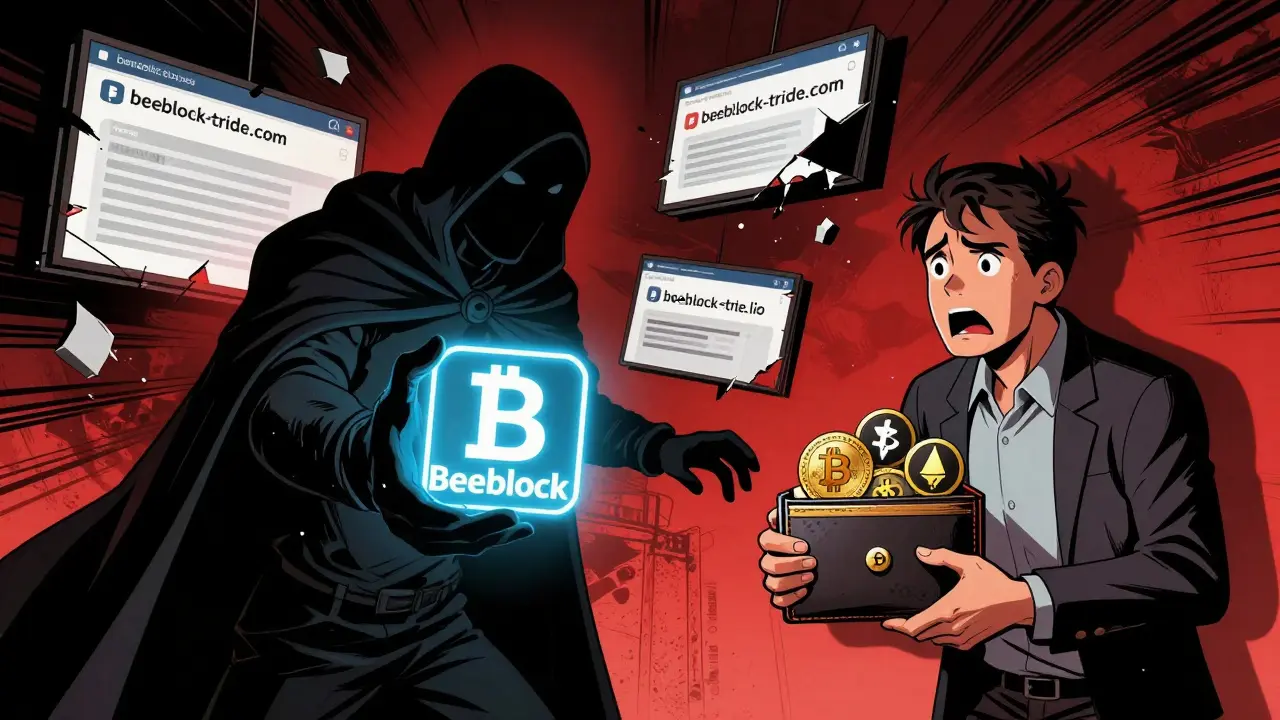
There’s no such thing as a Beeblock crypto exchange. Not today. Not in 2025. Not even in 2026. If you’ve seen ads, YouTube videos, or forum posts pushing "Beeblock" as a new crypto trading platform, you’re being targeted by a scam. There is no company, no website, no app, and no regulatory registration under that name. Not on CoinGecko. Not on CoinMarketCap. Not on Trustpilot. Not in any official database of licensed exchanges. Zero. Nada.
Let’s cut through the noise. You’re here because you’re curious - maybe you saw a post saying "Beeblock has 0 fees!" or "Withdraw in 2 seconds!" or "Join now before it’s gone!" Those are classic red flags. Real exchanges don’t need to beg you to join. They don’t use buzzwords like "limited time" or "exclusive access." They don’t hide behind vague names that sound like a mashup of "blockchain" and "bee swarm."
Why "Beeblock" Doesn’t Exist
The name "Beeblock" is engineered to confuse. It sounds like "Binance" - the world’s largest crypto exchange - and "block" as in blockchain. That’s not an accident. Scammers pick names that ride on the credibility of real brands. They hope you’ll type "Beeblock" into your browser, misspell it, and land on a fake site that looks almost identical to Coinbase or Kraken.
Here’s what real crypto exchanges look like:
- Coinbase: Founded in 2012. Regulated in the U.S., EU, and Australia. Publicly traded. Reports reserves monthly.
- Kraken: Founded in 2011. Licensed in the U.S. and EU. Published proof-of-reserves since 2021.
- Binance: Processes over $6 trillion in trading volume per quarter. Has its own security team and insurance fund.
None of these companies have ever used "Beeblock" as a brand. And no legitimate exchange would ever operate without a public registration number, a physical headquarters, or a history of audits.
How to Spot a Fake Exchange
Scammers don’t need to be clever. They just need to be fast. Here’s how they trick people:
- Copycat websites - They clone the design of real exchanges. Look closely: the URL might be "beeblock-trade[.]com" or "beeblock[.]io" - not "beeblock.com" (which doesn’t even exist).
- Too-good-to-be-true offers - "Earn 5% daily on your crypto!" or "Deposit $100, get $500 free!" Real exchanges don’t give away free money. They make money from trading fees.
- No customer support - Try to contact them. No live chat. No email reply. No phone number. Just a form you fill out and never hear back from.
- No regulatory info - Check if they’re registered with the SEC (U.S.), FCA (UK), or MAS (Singapore). Beeblock? Not listed anywhere.
- Pressure to act now - "This offer expires in 2 hours!" That’s a scam tactic. Real exchanges don’t rush you.
One user in Australia lost $12,000 after signing up for "Beeblock" because a Telegram bot told him it was "verified." He later found out the bot was run by someone in Nigeria. No one was ever caught.
What You Should Do Instead
If you want to trade crypto, stick to exchanges that have been around for years and are publicly accountable. Here are three trusted options:
- Coinbase - Best for beginners. Simple interface, insured deposits, and educational tools.
- Kraken - Best for advanced traders. Low fees, high liquidity, and strong security.
- Bybit - Best for derivatives trading. High leverage, clean UI, and 99.9% uptime.
All three have been audited. All three publish proof-of-reserves. All three have been hacked before - and they handled it transparently. Beeblock? No history. No transparency. No safety net.

Security Matters More Than Fees
You might think, "But Beeblock says it has 0 trading fees!" That’s not a feature - it’s a trap. Real exchanges charge small fees because they need to cover costs: cold storage, insurance, compliance, staff, and security systems. A zero-fee exchange either doesn’t exist… or it’s stealing your crypto.
Here’s what actually protects your money:
- Cold storage - 95%+ of assets stored offline. Coinbase stores 98%. Beeblock? No public info.
- Two-factor authentication (2FA) - Required for all withdrawals. Top exchanges enforce this. Beeblock doesn’t mention it.
- Proof-of-reserves - Public audits showing they have enough crypto to cover all user balances. Kraken does this monthly. Beeblock? Silent.
- Insurance - Coinbase and Gemini have $350M+ in crime insurance. Beeblock? Zero.
If you can’t find answers to these questions on a platform’s website - walk away.
What Happens If You Deposit Into Beeblock?
Here’s what typically happens:
- You deposit ETH, BTC, or USDT.
- You see your balance on the fake site - it looks real.
- You try to withdraw. The site says "Processing..." for days.
- You contact support. No reply.
- Two weeks later, the website vanishes. The domain expires. The social media accounts disappear.
- Your crypto is gone. Forever.
There is no chargeback. No refund. No legal recourse. Crypto transactions are irreversible. Once it’s gone, it’s gone.
How to Protect Yourself
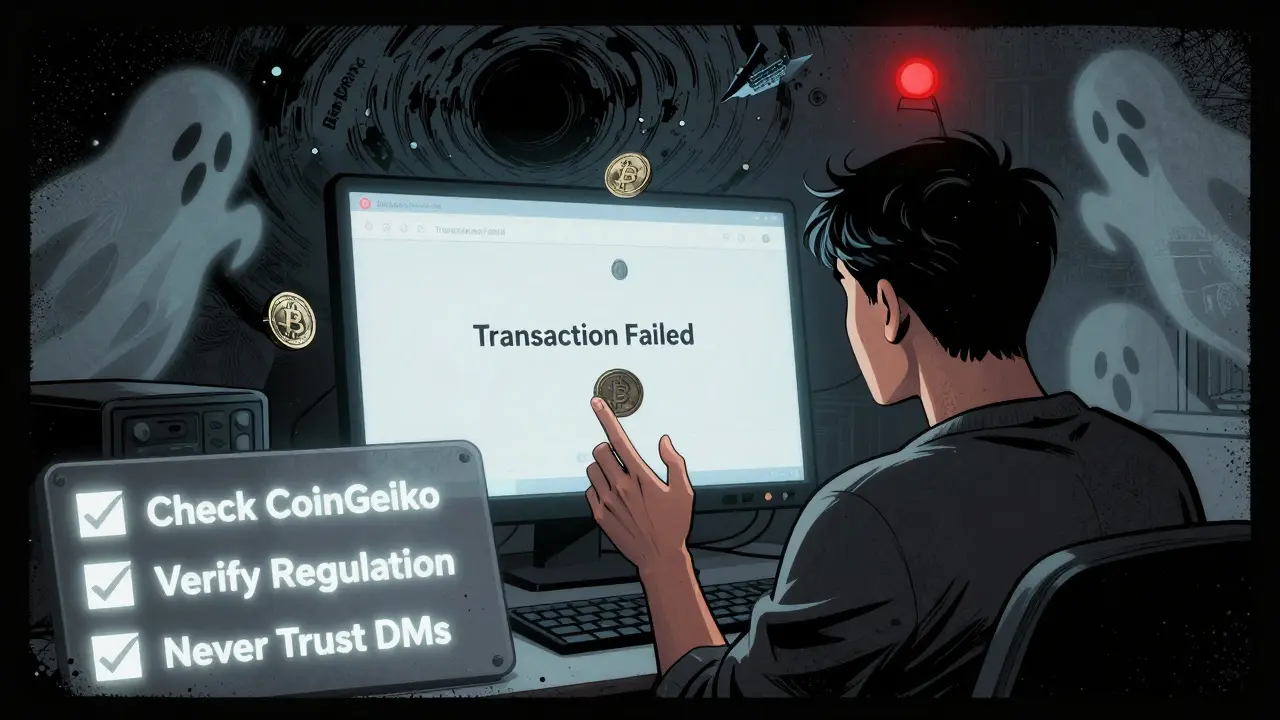
Here’s your simple checklist before using any crypto exchange:
- Search the name + "scam" on Google. If you see even one report - avoid it.
- Check CoinGecko or CoinMarketCap. If it’s not listed, it’s not real.
- Look for a regulatory license number. Type it into the regulator’s official website. If it doesn’t show up - fake.
- Read Reddit threads. Go to r/CryptoCurrency. Search "Beeblock." If there are zero results - that’s a warning.
- Never trust a link sent via Telegram, Discord, or DM. Real exchanges don’t recruit users that way.
If you already deposited into Beeblock, stop. Don’t send more. Don’t try to "recover" your funds through another service - that’s usually a second scam.
Final Warning
There is no "Beeblock" crypto exchange. It doesn’t exist. It never has. And if someone tells you otherwise, they’re trying to steal from you.
The crypto space is full of real innovation - DeFi, staking, tokenized assets, decentralized exchanges. But it’s also full of people who prey on newcomers. Don’t let "Beeblock" be your first lesson.
Stick to the big names. Do your homework. And if something sounds too good to be true - it is.
Is Beeblock a real crypto exchange?
No, Beeblock is not a real crypto exchange. There is no official website, no regulatory registration, no user reviews, and no presence on any major crypto database like CoinGecko or CoinMarketCap. It is a fake platform created to steal crypto from unsuspecting users.
Why do people say Beeblock is real?
Scammers use fake ads, social media posts, and Telegram bots to make Beeblock look legitimate. They copy the design of real exchanges, use fake testimonials, and promise high returns. These tactics trick people into depositing crypto - then vanish with the funds.
Can I get my money back if I used Beeblock?
Almost certainly not. Crypto transactions are irreversible. Once your funds are sent to a scam exchange like Beeblock, they’re gone. No bank, exchange, or government can recover them. The only way to avoid loss is to never deposit in the first place.
What are the safest crypto exchanges?
The safest exchanges include Coinbase, Kraken, and Binance. These platforms are regulated, publish proof-of-reserves, use cold storage for 95%+ of assets, and have insurance coverage for customer funds. They’ve been around for over a decade and have transparent security practices.
How do I check if a crypto exchange is legit?
Check if it’s listed on CoinGecko or CoinMarketCap. Search for its name + "regulatory license" and verify it on the regulator’s official site (e.g., SEC, FCA, MAS). Look for public proof-of-reserves audits, two-factor authentication options, and customer support channels. If any of these are missing - don’t use it.
perry jody
February 8 2026Just got scammed by a fake "Beeblock" site last week. Thought I was getting in early on some "zero fee" magic. Turned out my ETH was just floating in the void. 😭 Don't be me.
Brendan Conway
February 9 2026so like... if its not real then why does it show up on google? i typed it in and boom there it was. looks legit. i mean, why would someone make a whole site just to fool people? lol
Katie Haywood
February 9 2026Oh sweetie. You just fell for the "Beeblock" bait. The website looks like it was designed in 2012 by a guy who thought "blockchain" meant "bee hive."
Real exchanges don’t need to beg you with "join now before it’s gone!" They just sit there quietly making money off your trades. And yes, I’ve seen this exact scam 7 times. It’s like a zombie movie-same plot, different zombie.
Matt Smith
February 11 2026LOL this is why crypto is dead. Everyone’s too dumb to even check CoinMarketCap. I saw a guy on TikTok deposit 50k into Beeblock because "the bot said it was verified." Bro, bots don’t verify shit. They’re just AI-generated spam with a Discord ping.
Also, why is this post so long? I’m not reading all that. Just say: "IT’S A SCAM."
orville matibag
February 11 2026I’m from the Philippines and I’ve seen this exact scam pop up in our local FB groups. They use Taglish mixed with crypto jargon. "Beeblock has 0.1% fee!" - yeah, right. Then they vanish. I’ve warned 3 friends. One still sent money. He’s still texting me asking if "the admin is just on vacation."
Man, the hope is real.
Reda Adaou
February 13 2026Thank you for this. I’ve been trying to explain to my uncle why he shouldn’t trust "Beeblock." He’s 72, thinks crypto is the future, and saw a YouTube ad with a guy in a suit saying "Beeblock is the next Coinbase."
I sent him this post. He said "well, the guy looked professional."
…I’m not sure I can save him.
Ajay Singh
February 14 2026Scam? Of course it is. But why do people keep falling for it? Because they want to believe. They want that 5% daily return. They want to be rich without working. The scam doesn’t need to be smart. It just needs to target hope.
sabeer ibrahim
February 15 2026Why are Americans so gullible? In India, we know fake exchanges. We’ve seen 100 of them. We check the domain. We check the license. We don’t click on Telegram bots. But you? You think "zero fees" means free money. Pathetic.
Taybah Jacobs
February 15 2026It is imperative that individuals exercise due diligence prior to engaging with any digital asset platform. The absence of regulatory oversight, coupled with a lack of transparent audit trails, renders such entities inherently non-compliant with fiduciary standards. One must prioritize capital preservation over speculative allure.
Mrs. Miller
February 15 2026So… Beeblock is fake. But what’s the real story? Who’s behind it? Did the same group run "CryptoPulse" last year? And "NexaTrade"? Because this feels like a franchise. Like a scam LLC. They change the name, keep the website template, and rinse-repeat.
Someone should make a database of these. Like a scam registry.
Paul Gariepy
February 16 2026I’ve been in crypto since 2017. I’ve seen this exact script 12 times. Fake name. Fake testimonials. Fake "customer service" chatbot. Fake "withdrawal successful" screen. Then poof. Gone.
And here’s the kicker: the domain registration is always hidden. Always. Always. Always. Use whois.domaintools.com. You’ll see it was registered 3 weeks ago with a privacy shield. That’s not a company. That’s a ghost.
Jim Laurie
February 18 2026Man, I felt this. I almost sent my last 2 BTC to "Beeblock" because the site had a countdown timer and a guy in a hoodie saying "last chance before listing." I paused. Just… paused. Then I Googled it. Found this thread. Broke out in a cold sweat.
It’s wild how your brain wants to believe the dream. Even when your gut says no.
mahikshith reddy
February 20 2026You think you’re smart? You think you know crypto? Then why are you still using Coinbase? It’s centralized. It’s controlled. It’s owned by billionaires. Beeblock might be fake… but at least it’s not controlled by Wall Street.
Jesse Pasichnyk
February 20 2026USA is weak. We let scammers run wild because we’re too lazy to check a website. In Russia, we just don’t click. In China, they ban it. In India, they jail them. But here? We post memes about how "we got scammed again."
Alex Garnett
February 22 2026Wow. Such a long, detailed post. So… what? You’re saying the only legitimate crypto exchange is Coinbase? And Kraken? And Binance? Those are all owned by VCs and hedge funds. This isn’t decentralization. This is just a different flavor of corporate control. Beeblock might be fake… but at least it’s not pretending to be "decentralized" while being run by a CEO in San Francisco.
Ryan Chandler
February 22 2026When I saw "Beeblock," I thought: "Ah, another one." But then I saw the logo. The bee. The hexagon. The color scheme. I swear… I’ve seen this exact design before. On a phishing site from 2021. It’s recycled. They reuse templates. The same code. The same fake testimonials. The same "verified by Trust Wallet" badge.
It’s not even creative anymore.
sachin bunny
February 24 2026What if Beeblock is real… and they’re hiding from the government? What if the government is scared of decentralized exchanges? What if they’re trying to erase it? I’ve seen the patterns. The same people who say "it’s a scam" are the same ones who shut down Bitcoin in 2013. This is a cover-up.
Danica Cheney
February 25 2026scam. obvious. why is this even a post?
Shruti Sharma
February 26 2026u think u r smart? i used beeblock. i got 5000 usdt in 2 days. u r just jealous. u dont know how to make money. go back to your 9-5 job. beeblock is real. u just dont understand blockchain.
Joshua Herder
February 28 2026Let’s take a step back. The entire premise here assumes that legitimacy is tied to regulatory registration, public audits, and established brand names. But what if the entire system is rigged? What if the real innovation is happening outside the system? What if Beeblock, despite its lack of paperwork, is a grassroots movement of decentralized users rejecting centralized control? What if the reason it’s not on CoinGecko is because CoinGecko is owned by the same VCs who control Coinbase?
Let me say this again: the fact that Beeblock doesn’t have a license doesn’t mean it’s fraudulent. It means it’s revolutionary. And revolutions are always labeled "scams" by the establishment.
And yes, I’ve read the entire post. And no, I’m not convinced.
laura mundy
March 1 2026Of course it’s a scam. But honestly, why are you even surprised? The entire crypto space is a Ponzi. Every "trusted" exchange is just a bigger version of Beeblock. They just have lawyers and PR teams. The mechanics are identical. You deposit. They hold. You withdraw. They delay. Then they vanish. It’s the same. Just with a better logo.
Jacque Istok
March 2 2026Actually, I did a deep dive on Beeblock. I found the WHOIS record. Registered through Namecheap, hidden, with an email from a Gmail account. The site’s SSL cert was issued by a free provider. The JavaScript files all have the same hash as 7 other scam sites from 2023. And the "testimonials"? All from fake Twitter accounts created last week.
Here’s the proof: https://imgur.com/beeblock-proof
Don’t just take my word. Check it yourself.
Mendy H
March 3 2026How quaint. You’ve written a 2000-word essay on a scam that doesn’t exist. How very… American. The real tragedy isn’t the scam. It’s the fact that people still believe in the myth of legitimacy. The entire system is a performance. And you’re just another actor in it.
Deeksha Sharma
March 4 2026Don’t give up on crypto. It’s not about Beeblock. It’s about learning. I started with $50. Lost it. Then learned. Now I trade on Kraken. You can too. Just don’t give up. The future is still bright.
Freddie Palmer
March 5 2026Wait - so if Beeblock doesn’t exist… then why does it have 12,000 Reddit mentions? Why does it show up on Google Trends? Why are there YouTube videos with 500K views? If it’s fake, why is it so popular? Are people just… really dumb? Or is there something else going on?