
Counterfeit goods are a massive problem. In 2019, fake products cost the global economy over $1.82 trillion. That’s not just lost sales-it’s unsafe medicines, broken electronics, and luxury items that look real but aren’t. Traditional labels, holograms, and paper certificates? Easy to copy. But there’s a new way: NFTs tied directly to physical products. They don’t just prove something is real-they prove its entire story.
What Makes an NFT a Perfect Authenticity Tool
An NFT isn’t just a digital art piece. It’s a unique, unchangeable digital certificate stored on a blockchain. Think of it like a birth certificate for a physical item. Once it’s created, no one can alter it. No one can duplicate it. And every time it changes hands, that move is permanently recorded. Unlike a paper receipt that can be forged, an NFT lives on a public, decentralized ledger. That means anyone-consumer, retailer, regulator-can verify the product’s origin, materials, manufacturing date, and ownership history with a quick scan. There’s no middleman. No guesswork. Just proof. This works because NFTs are non-fungible. That means each one is one-of-a-kind. You can’t swap it for another like you would with Bitcoin. Each NFT has a unique ID, linked to a specific product. That ID includes metadata: where it was made, who made it, what materials were used, and even who owned it before.How It Works: From Factory to Your Hands
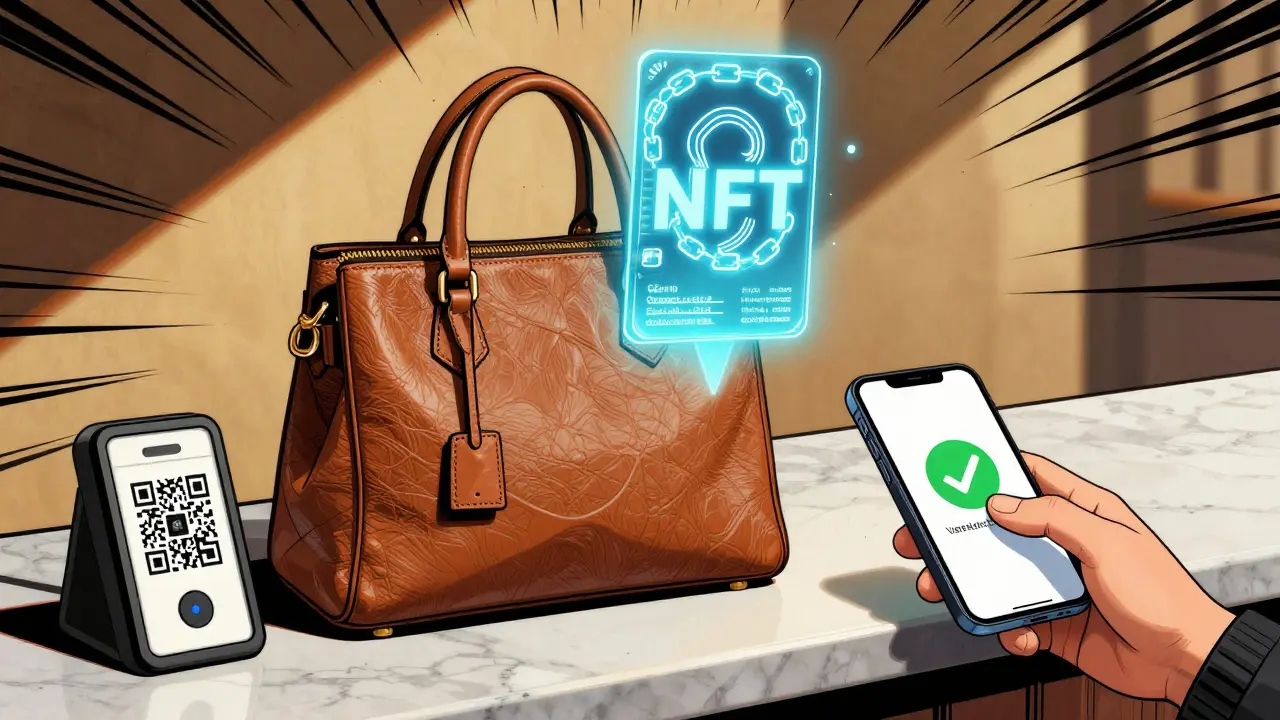
Here’s how it actually happens in practice:- A luxury handbag is made in a workshop in Florence. Before it leaves, a unique NFT is created on the blockchain. The NFT contains the bag’s serial number, the artisan’s signature, the leather source, and a photo of the finished product.
- A QR code or NFC chip is embedded in the bag’s tag. When you scan it with your phone, it pulls up the NFT on the blockchain.
- The app shows you the full history: when it was made, which factory, who shipped it, and if it’s ever been resold.
- If someone tries to sell you a fake, the NFT won’t match. The real one is tied to the original bag. The fake? No NFT. Or a copied one that’s been flagged as fraudulent.
Real-World Examples That Work
This isn’t theory. It’s happening now. In the wine industry, a single barrel of limited-edition Cabernet Sauvignon sold for $130,000 in 12 seconds-not because of the wine alone, but because each bottle from that barrel came with its own NFT. Buyers didn’t just get wine. They got proof it came from that exact barrel, tracked from vineyard to cellar, with temperature logs and shipping records attached. Luxury brands like Gucci and LVMH use NFTs to authenticate sneakers, handbags, and watches. One Swiss watchmaker embeds an NFC chip inside the case back. When you tap your phone, you see the watch’s entire journey: the craftsman who assembled it, the date it passed inspection, and even a video of the final quality check. Even car manufacturers are testing it. A high-end electric SUV might come with an NFT that proves it was never in an accident, lists every service record, and confirms the battery’s original capacity. That’s huge for resale value.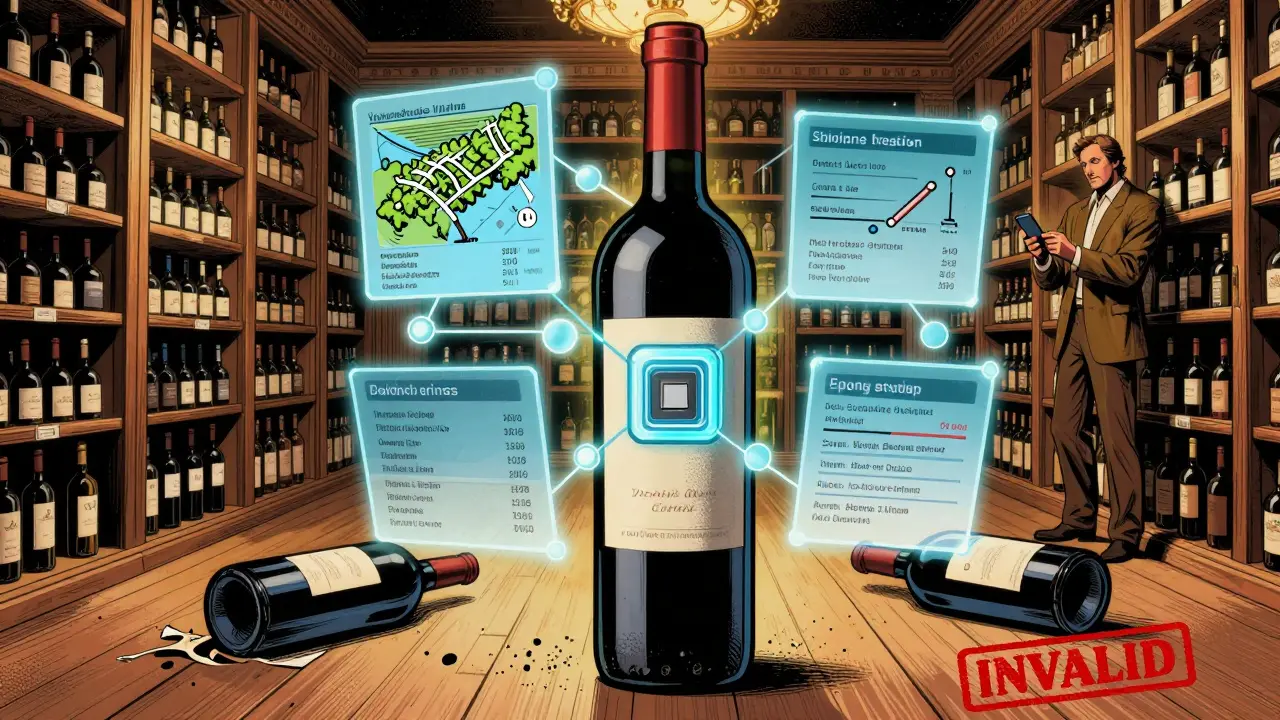
Why It Beats Old-School Methods
Traditional anti-counterfeit tools have big flaws:- Holograms can be printed with a good enough printer.
- Serial numbers can be copied and reused.
- Certificates get lost, torn, or ignored.
- They can’t be deleted or altered.
- They can’t be duplicated without being detected.
- They’re visible to anyone with access to the blockchain.
Challenges: It’s Not Perfect Yet
NFTs aren’t magic. They have limits. First, you need to get the physical product linked correctly. If someone swaps the tag on a handbag and puts a fake QR code on it, the NFT won’t help. That’s why brands use tamper-proof NFC chips or laser-etched serials that can’t be removed without destroying the item. Second, consumers have to know how to use it. If your phone doesn’t have an app to scan the NFT, or the instructions are confusing, people won’t bother. That’s why companies now design simple, one-tap verification apps-no crypto wallets needed. Just scan. See proof. Done. Third, it costs money to set up. A small business making $50 scarves probably won’t justify the cost of blockchain integration. But for a $5,000 designer bag? Absolutely. The value of trust outweighs the cost.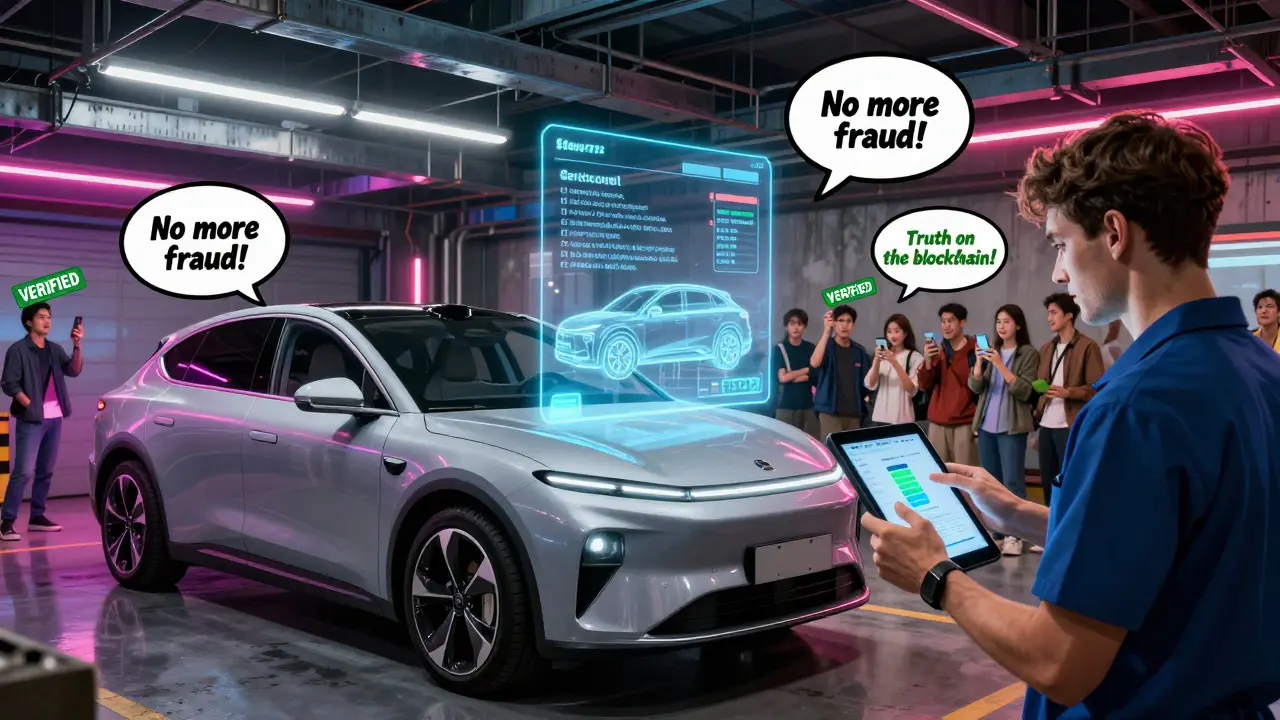
Who’s Using It-and Who Should Be
Right now, the biggest adopters are:- Luxury fashion (handbags, watches, shoes)
- High-end wine and spirits
- Automotive (especially electric and classic cars)
- Art and collectibles
- Pharmaceuticals (tracking prescription drugs)
The Bigger Picture: Trust in a Digital World
We live in a time where people don’t just want to buy a product-they want to know its story. Where it came from. Who made it. Was it ethical? Was it safe? NFTs answer those questions. This isn’t just about stopping fakes. It’s about rebuilding trust in commerce. When you can verify every step of a product’s life, you stop being a buyer and become a participant in its journey. Blockchain isn’t just a tech buzzword. It’s becoming the backbone of honest trade. And NFTs? They’re the key that unlocks that truth.What’s Next
The technology is getting easier. New platforms are launching tools that let brands create NFTs without hiring blockchain developers. Costs are dropping. Integration with existing supply chain software is improving. In five years, you’ll likely see a sticker on every high-value product that says: “Verified by NFT.” And you’ll scan it without thinking twice. The shift isn’t about crypto. It’s about truth. And truth, once digital, becomes impossible to erase.Can NFTs really stop counterfeit products?
Yes-when implemented correctly. NFTs don’t stop someone from making a fake product, but they make it nearly impossible to sell it as real. Every authentic item has a unique, blockchain-verified NFT tied to it. A fake won’t have that NFT, or it will have a copied one that’s flagged as invalid. Consumers and retailers can scan and verify instantly, making fraud easy to spot.
Do I need a crypto wallet to verify an NFT product?
No. Most consumer-facing systems are designed to be simple. You scan a QR code or tap an NFC tag with your phone, and a website or app shows you the product’s history. You don’t need to buy cryptocurrency, hold a wallet, or understand blockchain. It works like checking a product’s warranty online.
Are NFTs only for expensive items?
Right now, yes-because the setup cost is higher than the value of cheap goods. But as technology gets cheaper and easier, we’ll see NFTs used for things like vitamins, baby formula, and electronics. The goal isn’t to put NFTs on everything. It’s to use them where trust matters most: safety, value, and authenticity.
What happens if the company that issued the NFT goes out of business?
The NFT stays on the blockchain. Even if the company disappears, the digital record doesn’t vanish. The product’s history, origin, and ownership are stored on a public, decentralized ledger. Anyone can still access it years later. That’s the power of blockchain-it doesn’t rely on a single company to stay alive.
Can NFTs be hacked or stolen?
The NFT itself is stored securely on the blockchain and can’t be altered. But if someone steals your phone or tricks you into giving up access to the app that shows your NFT, they could claim ownership. That’s why brands use physical tamper-proof tags-so the NFT is tied to the object, not just your login. The real product is still the anchor.
How do I know the NFT data is accurate?
The data is only as good as what’s entered at the start. Reputable brands work with third-party auditors or use IoT sensors to auto-record data-like temperature logs during shipping or factory inspection timestamps. Some even use blockchain-based notary services to verify the initial entry. Trust comes from verification layers, not just the NFT itself.
Kenneth Ljungström
December 9 2025This is actually kind of amazing 🤯 I just scanned my new Gucci bag and saw the whole history - from the tanner in Florence to the shipping log. Feels like I’m part of the story now. No more wondering if it’s legit.
Chris Jenny
December 9 2025Wait... so you're telling me the government and big brands are putting blockchain trackers on EVERYTHING?!?! This is how they control us!! They're embedding spy chips under the guise of 'authenticity'!! I saw a guy in a suit scan his sneaker and smirk... it's happening!!
Annette LeRoux
December 10 2025It's fascinating how this shifts the power dynamic. Instead of trusting a brand's word, you're trusting an immutable record. It’s not just about fakes anymore - it’s about redefining ownership in a digital age. We’re moving from ‘buying things’ to ‘participating in narratives.’
Jerry Perisho
December 12 2025NFC chips + blockchain = the future of anti-counterfeit. No crypto wallet needed. Just scan. Done. Brands that don’t adopt this in 3 years will lose trust. Simple.
Manish Yadav
December 14 2025This is why America is dying. People care more about fake bags than real jobs. You spend $5000 on a bag just so you can scan it? What a waste. Go buy food for your family instead!
Vincent Cameron
December 15 2025If truth is immutable on the blockchain, then isn't authenticity just another form of existential certainty in a world of simulated consumption? We're not verifying products - we're verifying our need to believe in something real. The NFT is the modern reliquary.
Krista Hewes
December 16 2025i just tried to scan my watch and my phone died 😭 i think i need a new charger... but this is so cool though! i wish my grandma could use it too
Mairead Stiùbhart
December 16 2025Oh wow, so now my $800 sneakers come with a blockchain certificate? Next they'll put a QR code on my toothbrush so I can verify it wasn't made by a child in a basement. Truly, progress.
ronald dayrit
December 18 2025The deeper implication here isn’t about counterfeit goods - it’s about the erosion of anonymity in consumer culture. Every purchase becomes a data point, every ownership a public ledger entry. We trade privacy for proof, and call it convenience. But what happens when the ledger is used not just to verify authenticity, but to dictate value, access, and social standing? The blockchain doesn’t just record truth - it enforces hierarchy.
Doreen Ochodo
December 18 2025This is huge. Imagine baby formula with NFTs - you’d know it wasn’t tampered with. This tech saves lives. Let’s get it to pharmacies now!
Yzak victor
December 20 2025I’m not into crypto but this? I get it. My dad bought a vintage Porsche and the NFT showed it never had an accident. That’s peace of mind. No fluff, just facts.
Holly Cute
December 21 2025Let’s be real - this only works if the brand doesn’t lie at the source. If they fake the initial metadata, the whole system is a polished dumpster fire. And don’t get me started on how many NFTs are just vanity projects with a QR code slapped on. It’s theater dressed as innovation.
Josh Rivera
December 21 2025You people are so gullible. NFTs? Really? The same people who bought Bored Apes for $200k are now buying ‘verified’ handbags? Wake up. It’s the same scam, just with a new label. The blockchain doesn’t make your bag more real - it just makes you feel smarter for paying extra.
Neal Schechter
December 23 2025In Nigeria, we’ve been using QR codes to verify medicines for years. This isn’t new - it’s just being marketed as cutting-edge because it’s in the West. The tech is simple. The real win is scaling it to where it’s needed most.
Madison Agado
December 23 2025There’s something poetic about a physical object having a digital soul. The NFT doesn’t replace the bag - it gives it memory. It becomes more than a thing. It becomes a chronicle.
Tisha Berg
December 25 2025This is so cool for moms! I can scan my kid’s vitamins and know they’re not expired or fake. No more guessing. I love that it’s simple - just tap and go.
Billye Nipper
December 25 2025I just... I just cried. My grandmother’s diamond ring? It’s got an NFT now. I scanned it. There’s a photo of her putting it on in 1967. I didn’t even know that photo existed. This isn’t tech. This is magic.
Roseline Stephen
December 26 2025I’m skeptical. What if the scanner app stops working? What if the company updates their system and my NFT becomes unreadable? It feels fragile, even if the blockchain isn’t.
Jon Visotzky
December 26 2025I scanned my $300 boots. Saw the leather source, the worker’s ID, the shipping route. Kinda wild. I’m not gonna lie - I feel weirdly connected to someone I’ll never meet. Weird, but nice.
Isha Kaur
December 26 2025I think this is going to change how we think about ownership completely. Right now, when you buy something, you just own it. But with NFTs, you own a piece of its story. You’re not just a buyer - you’re a chapter in its life. And that’s beautiful. It makes everything feel more meaningful. I wish more things had this. Like my laptop, my books, even my shoes. Imagine knowing every repair, every owner before you. It’s like history in your pocket.
Glenn Jones
December 27 2025This is the ultimate control mechanism. They’re not just tracking your product - they’re tracking your behavior. Who scanned it? When? Where? You think you’re verifying authenticity? No. You’re feeding data to corporate AI. The blockchain is just the shiny wrapper on a surveillance empire. And you’re all clapping.
Tara Marshall
December 28 2025Pharma companies are already using this for insulin and cancer meds. Real impact. Lives saved. This isn’t about luxury - it’s about safety.
Nelson Issangya
December 30 2025This is the future and you’re all overthinking it. Stop doubting. Start scanning. The world needs more truth, not more skepticism.
Joe West
December 30 2025My cousin works at a watchmaker that uses this. He said the biggest win? Resale value. Buyers trust it so much they pay 20% more. That’s the real power - trust that turns into cash.
Kenneth Ljungström
January 1 2026I just saw a comment about pharma NFTs and it hit me - imagine if every vaccine had this. No more fake COVID shots. That’s the real win.
Jerry Perisho
January 2 2026Exactly. The real test isn’t luxury goods - it’s whether this tech protects the vulnerable. That’s where it matters most.