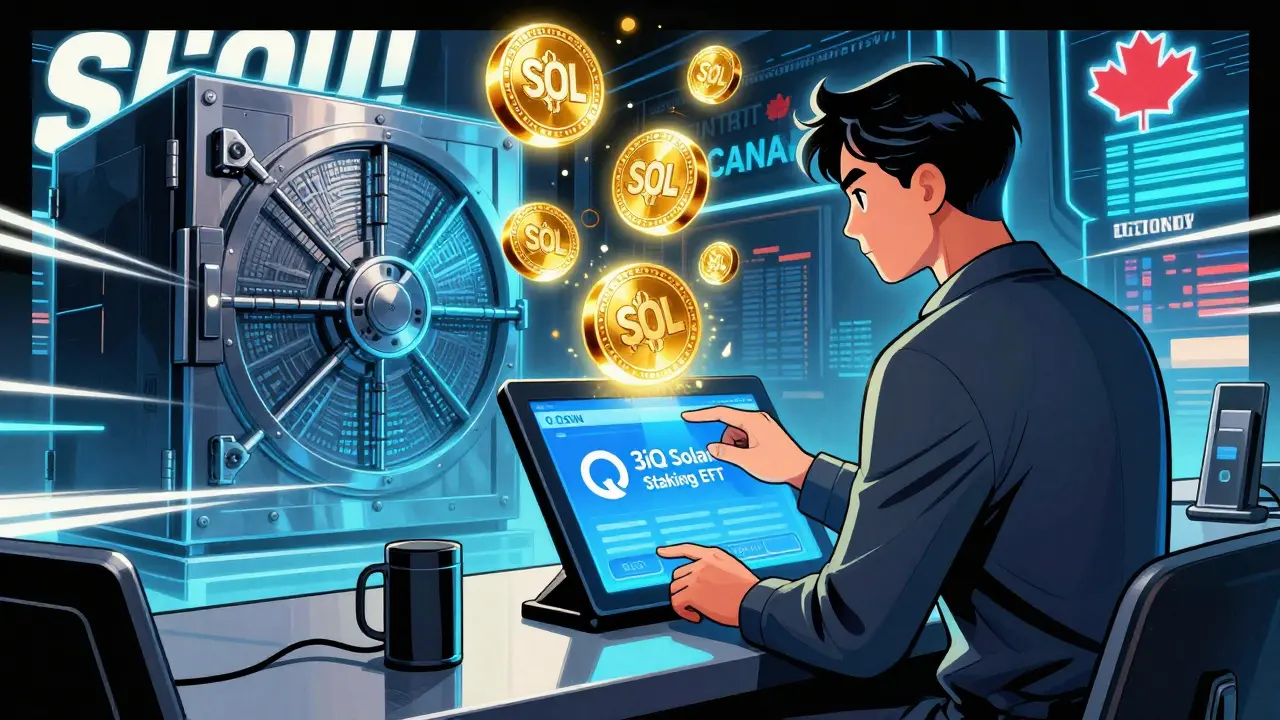
On April 16, 2025, Canada became the first country in the world to launch publicly traded exchange-traded funds (ETFs) tied directly to Solana (SOL). This wasn’t just another crypto product-it was a regulatory breakthrough that changed how everyday investors can access one of the fastest-growing blockchains. Unlike the U.S., where the SEC still blocks altcoin ETFs, Canada’s Ontario Securities Commission (OSC) approved four Solana ETFs from Purpose Investments, Evolve Funds Group, CI Financial, and 3iQ Corp. These aren’t speculative tokens you buy on an exchange. These are regulated, exchange-listed funds you can trade like Apple or Tesla stock-through your regular brokerage account.
How Solana ETFs Work in Canada
These ETFs don’t require you to own Solana tokens, manage private keys, or worry about exchange hacks. Instead, the fund holds actual SOL coins in secure custody and lets you buy shares that track its price. The biggest twist? Canada allows these funds to stake the Solana they hold. That means the ETF earns rewards by helping secure the Solana network, then passes those rewards directly to investors. This isn’t just price appreciation-it’s yield generation, like a savings account for crypto.
The 3iQ Solana Staking ETF (ticker: QSLN) launched with a $13.97 CAD price and zero management fees for the first year. By October 2025, it had grown to over $258 million CAD in assets under management. Purpose’s PSOL and Evolve’s ESOL followed similar models. All trade on the Toronto Stock Exchange. You don’t need a crypto wallet. You don’t need to understand blockchain. If you can buy an ETF in your RRSP or TFSA, you can buy one of these.
Why Canada Got There First
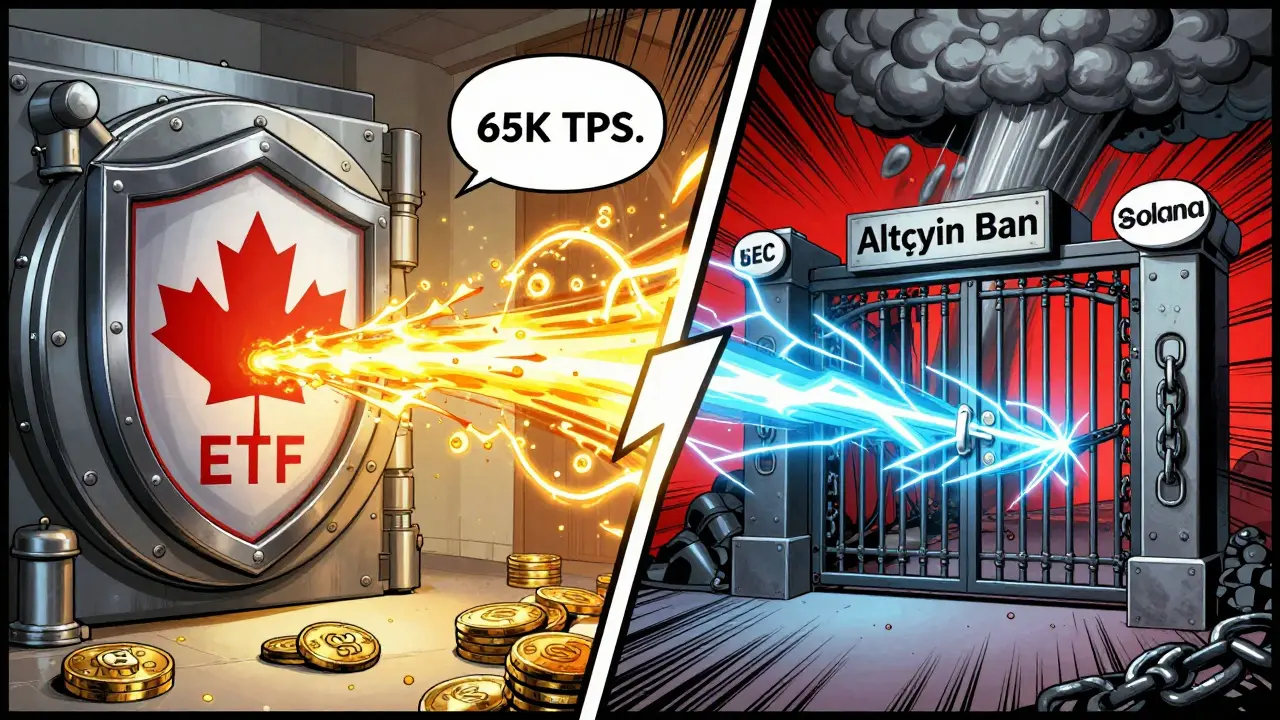
Canada didn’t get lucky. It built a clear, provincial-based system that lets Ontario’s OSC approve products without waiting for federal approval. In January 2025, the OSC updated its rules specifically for crypto ETFs, making it clear: if the fund holds assets securely, discloses risks, and doesn’t commingle investor funds with operator wallets, it’s approved. The U.S. SEC, by contrast, still treats all altcoins as securities under heavy scrutiny. As of late 2025, the SEC has only approved Bitcoin and Ethereum spot ETFs. Solana? XRP? Cardano? Still blocked.
Canada’s move was strategic. Solana has a $69 billion market cap as of April 2025-bigger than most Fortune 500 companies. It processes 65,000 transactions per second, far faster than Ethereum’s 30. It’s not just a gamble on price-it’s an investment in infrastructure. Canadian regulators saw that and said: let’s give investors safe access.
The Staking Advantage: A Game-Changer
Staking is the core differentiator. In the U.S., crypto ETFs are forbidden from staking because regulators fear it turns the fund into a lending platform. In Canada, it’s allowed-and carefully regulated. The 3iQ ETF uses experienced validator operators, keeps SOL in segregated cold storage, and reports daily yield accruals to its net asset value (NAV). That means your share price doesn’t just rise with Solana’s price-it also grows slightly every day from staking rewards.
Staking Solana is simple: validators help verify transactions and earn new SOL coins and fees in return. The unbonding period? Just 2-3 days. Compare that to Ethereum’s 2-14 days. That speed means less risk and faster returns. The yield isn’t huge-around 4-6% annually-but it compounds. Over time, that’s hundreds of dollars in extra returns for a $10,000 investment.
TFSA and RRSP Eligibility: The Hidden Superpower
This is where Canadian ETFs crush direct crypto holdings. If you buy SOL on Coinbase or Binance, you can’t put it in a TFSA or RRSP. The Canada Revenue Agency (CRA) doesn’t allow it. But these ETFs? They’re structured as traditional investment funds. That means you can hold them in tax-free or tax-deferred accounts. That’s huge. A $10,000 investment in QSLN inside a TFSA grows without ever being taxed. No capital gains. No reporting. No paperwork. Just growth.
For retirees, students, or anyone saving for the future, this is a rare chance to get exposure to a high-growth asset class without the tax headaches. No other country offers this combination: regulated ETF + staking yield + registered account access.
How It Compares to U.S. Crypto ETFs
| Feature | Canada (2025) | United States (2025) |
|---|---|---|
| Solana ETF Available? | Yes (4 products) | No |
| Staking Allowed? | Yes | No | TFSA/RRSP Eligible? | Yes | N/A |
| Regulatory Body | Ontario Securities Commission | Securities and Exchange Commission |
| Trading Platform | Toronto Stock Exchange | Not available |
| Management Fees (Year 1) | 0% (for QSLN) | N/A |
| Market Cap of Underlying Asset | $69B (April 2025) | $69B (but no access) |
The gap isn’t just about rules-it’s about opportunity. In the U.S., investors can’t access Solana through a regulated ETF at all. In Canada, they can do it with lower fees, higher yields, and tax advantages. It’s not even a close comparison.

What Investors Are Saying
Early feedback from Canadian investors has been overwhelmingly positive. On Reddit’s r/CryptoCanada, users like "MapleCrypto101" wrote: "Finally can hold SOL in my TFSA without worrying about exchange risks." That’s the real win: removing complexity and risk.
But there are warnings. Solana’s network had an 11-hour outage in December 2024. Analysts like "CryptoWatcher2025" on X reminded people: "Solana ETFs are great but remember the downtime-infrastructure risks remain." That’s true. No blockchain is perfect. Solana’s speed comes with trade-offs in stability. But the ETF structure helps. The fund holds SOL across multiple validators and custodians. One outage doesn’t wipe out your investment-it just slows yield for a day.
Who Should Buy This?
- You’re already investing in ETFs and want crypto exposure without the hassle.
- You have a TFSA or RRSP and want to grow crypto tax-free or tax-deferred.
- You believe in Solana’s tech-fast, low-cost transactions for apps, gaming, DeFi.
- You want yield, not just price swings.
Don’t buy this if:
- You think crypto is a get-rich-quick scheme. Solana ETFs aren’t gambling-they’re long-term investments.
- You’re uncomfortable with volatility. Solana’s price swung between $194 and $203 in late 2025.
- You’re waiting for U.S. approval. If you’re in the U.S., you’re still locked out.
What’s Next?
Canada’s next move? XRP ETFs are already in the pipeline. Cardano and Polkadot are next on analysts’ lists. The OSC has shown it’s willing to approve staking for Proof-of-Stake assets. That means more yield opportunities are coming.
Meanwhile, the U.S. might catch up. Bloomberg’s James Seyffart suggested Ethereum ETFs could be allowed to stake by mid-2025. But Solana? Still blocked. That leaves Canadian investors with a unique, early-mover advantage.
The Solana ETF launch didn’t just add a new product. It redefined what a crypto investment can be: regulated, tax-efficient, yield-generating, and simple enough for anyone with a brokerage account. Canada didn’t just lead the pack-it built a new track.
Can I buy a Solana ETF in the U.S.?
No. As of February 2026, the U.S. Securities and Exchange Commission (SEC) has not approved any Solana ETFs. Only Bitcoin and Ethereum spot ETFs are allowed. Investors in the U.S. must use crypto exchanges to buy Solana directly, which means managing private keys and facing higher tax reporting burdens.
Is the Solana ETF a good investment?
It depends on your goals. If you believe Solana’s technology will grow-especially for real-time apps, DeFi, and NFTs-and you want exposure without the complexity of crypto wallets, then yes. The staking yield adds steady returns, and holding it in a TFSA or RRSP gives you tax advantages. But Solana is volatile. Its price can swing 20% in a week. Only invest what you can afford to lose.
How do I buy a Solana ETF in Canada?
Open a brokerage account with any Canadian provider like Questrade, Wealthsimple, or TD Direct Investing. Search for the ticker symbol: QSLN (3iQ), PSOL (Purpose), or ESOL (Evolve). Buy shares like you would for any stock or ETF. No crypto wallet needed.
Are Solana ETFs safe?
They’re safer than buying SOL on an exchange because the fund holds the tokens in secure, regulated custody with cold storage and insurance. The ETFs are also audited and regulated by the Ontario Securities Commission. But they’re not risk-free. Solana’s blockchain can still have outages, and the price of SOL can drop sharply. You’re still exposed to crypto market volatility.
Do Solana ETFs pay dividends?
Not exactly. They don’t pay cash dividends. Instead, staking rewards are added directly to the fund’s net asset value (NAV), which increases your share price over time. You don’t get a separate payout-you just own a slightly more valuable share each day.
Can I hold Solana ETFs in my TFSA?
Yes. All four approved Solana ETFs in Canada are eligible for Tax-Free Savings Accounts (TFSAs) and Registered Retirement Savings Plans (RRSPs). This is a major advantage over holding SOL directly on an exchange, which the Canada Revenue Agency doesn’t allow in registered accounts.
Why does Solana have higher transaction speed than Ethereum?
Solana uses a unique consensus system called Proof-of-History (PoH), which timestamps transactions before they’re validated. This lets it process up to 65,000 transactions per second. Ethereum, even after switching to Proof-of-Stake, still processes around 30 per second due to its design for security and decentralization over speed. Solana trades some decentralization for performance, which makes it better for apps that need fast, cheap transactions.