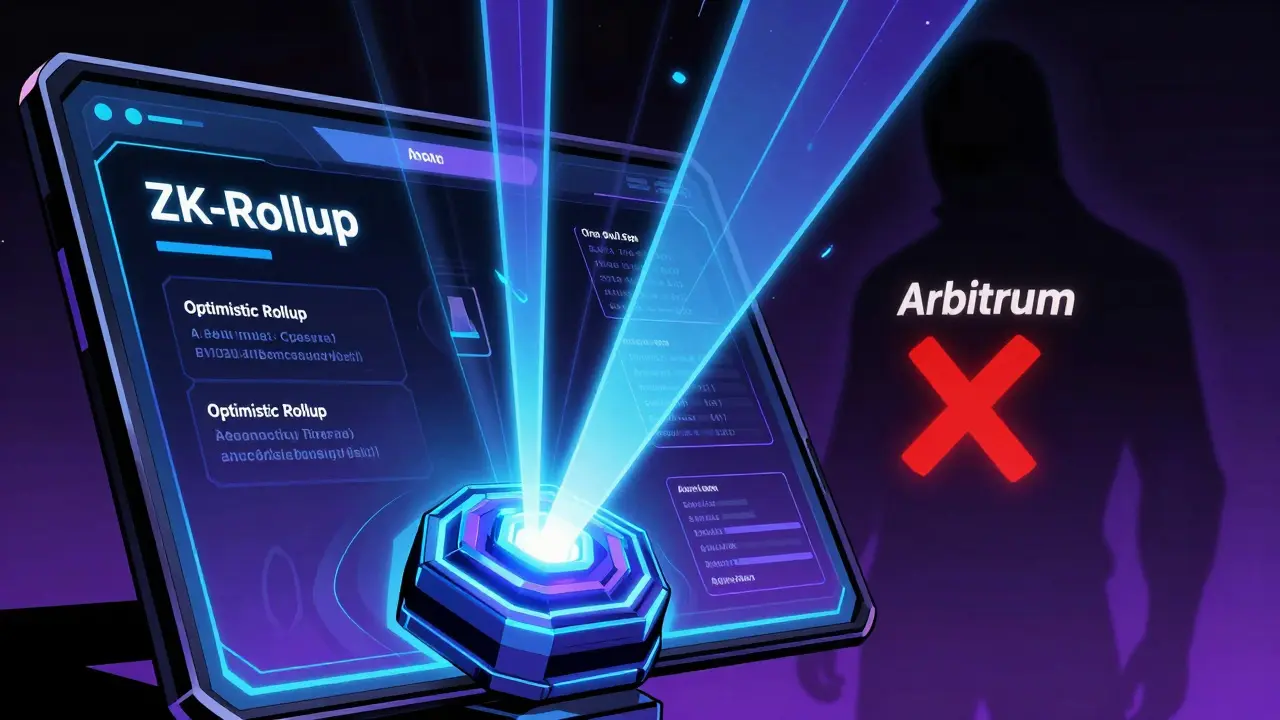
Most people assume ZigZag Exchange runs on Arbitrum because it’s a Layer 2 crypto platform. But that’s not true. ZigZag doesn’t use Arbitrum at all. It runs on its own ZK-Rollup technology - a completely different system from Arbitrum’s Optimistic Rollups. If you’re looking to trade crypto with low fees and fast settlements, understanding this difference isn’t just helpful - it’s critical.
How ZigZag Actually Works
ZigZag Exchange is a decentralized exchange built on zero-knowledge rollups. That means every batch of trades gets verified with cryptographic proofs before being added to Ethereum. Unlike Optimistic Rollups (like Arbitrum), which assume transactions are valid until someone challenges them, ZK-Rollups prove validity upfront. This eliminates the 7-day waiting period for withdrawals you see on Arbitrum-based platforms.
Transaction finality on ZigZag happens in seconds. Gas fees? They average around $0.05 per trade. Compare that to Arbitrum, where fees hover around $0.15 - still cheap, but not as low. ZigZag’s trading fees are also lower than most DEXs: just 0.3% per swap, while Uniswap or SushiSwap charge 0.5%-1%. That’s a real savings if you’re swapping frequently.
The platform supports swaps between dozens of tokens, including ETH, USDC, WBTC, and lesser-known altcoins. You don’t need to bridge assets from Ethereum - you can deposit directly from your wallet. No KYC. No intermediaries. Just a non-custodial interface that connects to MetaMask or WalletConnect.
The $ZZ Token: More Than Just Governance
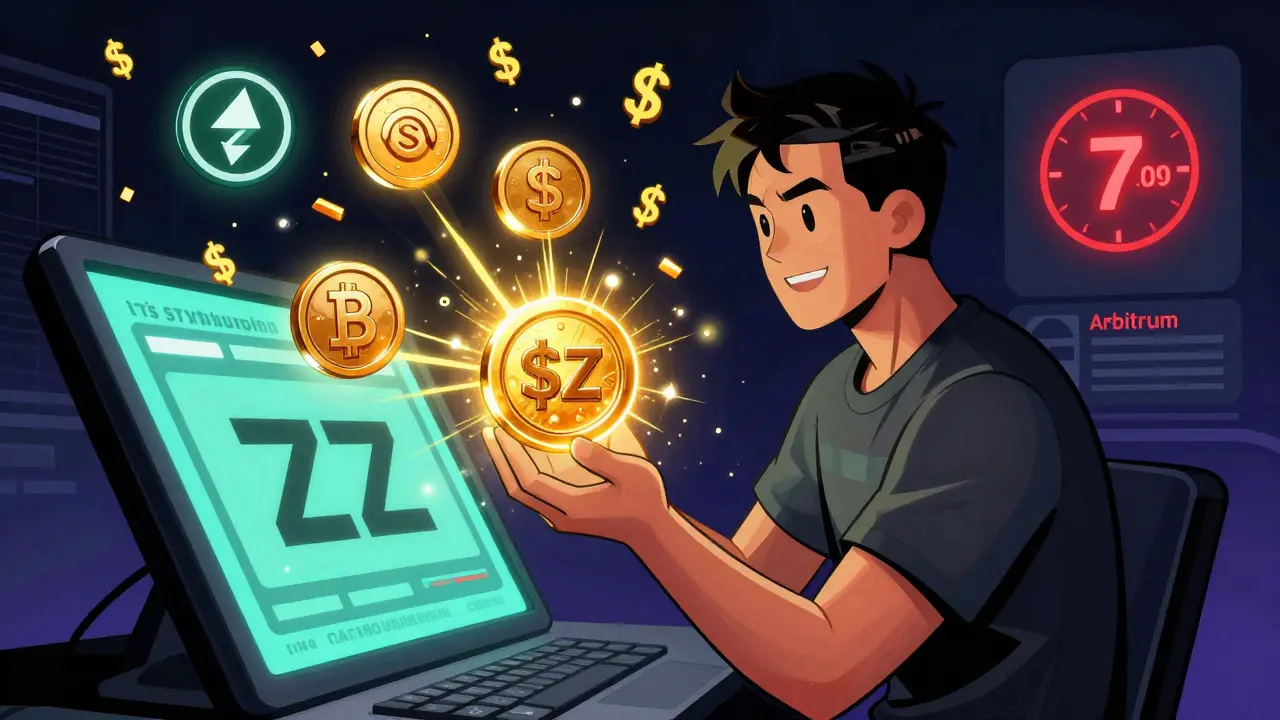
ZigZag launched its native token, $ZZ, in September 2025. Total supply: 100 million. Of that, over 60% went to the community through airdrops and incentives. The first airdrop in December 2022 rewarded 92,000 addresses. If you traded at least four times over a month, with trades spaced 30+ days apart, you got 300 $ZZ. Active traders from late 2021 got 600 $ZZ.
But $ZZ isn’t just a reward token. It’s a revenue-sharing mechanism. Every time someone trades on ZigZag, 30% of the trading fees are distributed to $ZZ holders. That’s rare. Most DEXs don’t share profits. Even Uniswap’s UNI token doesn’t do this. $ZZ holders vote on protocol upgrades, fee structures, and new token listings. It’s a true hybrid of governance and economics.
Why ZigZag Isn’t on Arbitrum
Arbitrum is an Optimistic Rollup. It’s fast, cheap, and has a massive ecosystem - Uniswap, GMX, Aave, and Radiant all run on it. Its TVL (total value locked) sits at over $3.2 billion. It’s the #1 Layer 2 by usage.
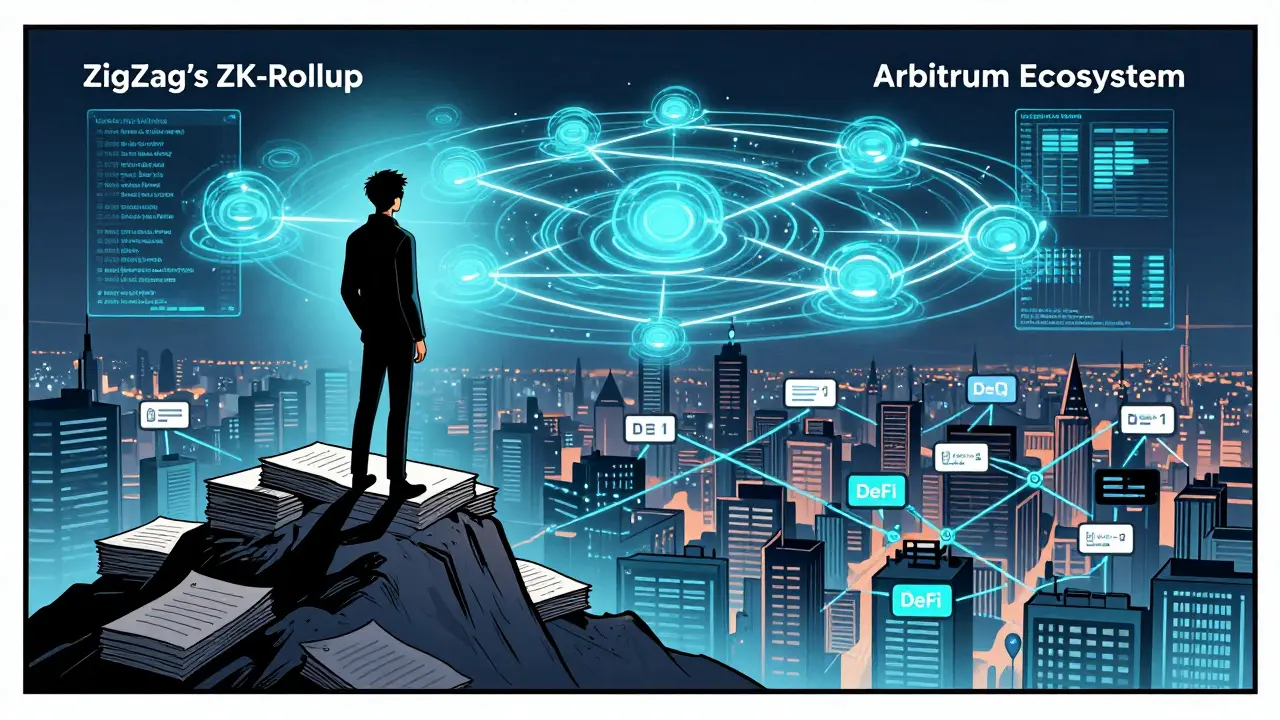
ZigZag? It’s standalone. No integration with Arbitrum. No bridge. No shared liquidity. That’s intentional. ZigZag chose ZK-Rollup because it prioritizes privacy and instant finality over ecosystem compatibility. If you want to interact with Aave or borrow against your NFTs, Arbitrum is better. If you just want to swap tokens quickly, quietly, and cheaply, ZigZag wins.
There’s also a developer gap. Arbitrum has 147 API endpoints and 83 sample code repositories. ZigZag has none publicly listed. Building on ZigZag requires understanding ZK proofs - a steep learning curve. That’s why most DeFi projects stick with Arbitrum. ZigZag is for traders, not builders.
Real-World Performance: Speed, Cost, Privacy
Let’s break it down:
- Speed: ZigZag settles trades in under 5 seconds. Arbitrum takes 1-2 minutes for finality (no challenge period, but still slower than ZK).
- Cost: ZigZag: $0.05 per trade. Arbitrum: $0.15. Ethereum mainnet? $2.50+.
- Privacy: ZigZag hides trade details in its ZK proofs. Arbitrum transactions are public on-chain. If you care about anonymity, ZigZag wins.
- Security: Both inherit Ethereum’s security. But ZK-Rollups are mathematically proven to be secure. Optimistic Rollups rely on economic incentives to catch fraud.
There’s a trade-off. ZigZag’s ZK proofs require more computational power. That’s why it’s not as scalable as Arbitrum yet. Arbitrum handles over 40,000 transactions per second. ZigZag? Estimates put it around 8,000-10,000 TPS. It’s not built for mass adoption - yet.
Who Should Use ZigZag?
Use ZigZag if:
- You trade crypto daily and want the lowest possible fees
- You care about privacy and don’t want your trades visible on block explorers
- You hold $ZZ and want passive income from trading fees
- You’re not relying on DeFi apps like lending or yield farming
Don’t use ZigZag if:
- You need to interact with Aave, Uniswap, or GMX
- You’re a developer trying to deploy a smart contract
- You want a large, active community with 24/7 support
For most users, ZigZag isn’t a replacement for Arbitrum. It’s a specialized tool - like using a scalpel instead of a hammer. If your job is precision trading, it’s perfect. If you need ecosystem access, stick with Arbitrum.
Future Outlook
ZigZag plans six more airdrops through 2026. That’s a clear signal: they’re still growing the user base. But there’s no roadmap for cross-chain bridges, partnerships, or app integrations. Meanwhile, Arbitrum is rolling out Arbitrum Orbit - a Layer 3 framework - and has $215 million in funding for gaming and DeFi projects. The ecosystem is expanding. ZigZag is staying focused.
Industry analysts say ZK-Rollups will dominate long-term because of their security advantages. But adoption depends on usability. Right now, Arbitrum has the edge. ZigZag is a quiet contender - not flashy, not integrated, but brutally efficient for one thing: trading.
Is ZigZag Exchange built on Arbitrum?
No, ZigZag Exchange is not built on Arbitrum. It operates on its own ZK-Rollup infrastructure, which is fundamentally different from Arbitrum’s Optimistic Rollup technology. ZigZag does not use Arbitrum’s network, bridges, or ecosystem.
What’s the difference between ZK-Rollup and Optimistic Rollup?
ZK-Rollups (like ZigZag) use cryptographic proofs to verify transactions instantly. Optimistic Rollups (like Arbitrum) assume transactions are valid and only check them if challenged - which can take up to 7 days. ZK-Rollups are faster and more private, but harder to build. Optimistic Rollups are easier for developers but slower for withdrawals.
Does ZigZag have lower fees than Arbitrum DEXs?
Yes. ZigZag charges 0.3% per trade, while most Arbitrum-based DEXs like MM Finance charge 0.25%-0.5%. But the bigger saving is in gas: ZigZag averages $0.05 per trade, while Arbitrum averages $0.15. For high-frequency traders, that adds up.
Can I use ZigZag to access Uniswap or Aave?
No. ZigZag is a standalone exchange. It doesn’t integrate with Arbitrum or any other Layer 2 ecosystem. You can’t lend, borrow, or farm yield on ZigZag. It’s designed only for token swaps.
Is $ZZ a good investment?
$ZZ isn’t designed as a speculative asset - it’s a utility token. Holders earn 30% of ZigZag’s trading fees. If usage grows, your share grows. But unlike ARB, $ZZ has no ecosystem backing, no major partnerships, and no clear roadmap beyond airdrops. Its value depends entirely on ZigZag’s trading volume.
How do I get $ZZ tokens?
You can earn $ZZ through future airdrops, which ZigZag plans to run through 2026. You can also buy it on supported DEXs like Uniswap or SushiSwap. The token is not available on centralized exchanges. Early users who traded on ZigZag in 2022 received allocations, but new users must wait for the next airdrop cycle.