

Most crypto exchanges force you to choose: Orion (BSC) lets you have both. You get the speed and deep liquidity of Binance, but without handing over your keys. That’s the promise - and it works, if you know how to use it.
Orion isn’t another DEX like Uniswap. It’s not a centralized exchange like Binance either. It’s something in between: a bridge. You trade directly from your MetaMask or Trust Wallet, but Orion pulls liquidity from Binance, KuCoin, OKX, and other centralized exchanges behind the scenes. You never deposit your coins there. You never log in. You just trade - and get better prices than you would on a pure DEX.
How Orion (BSC) Actually Works
Orion’s tech is called deCEX - decentralized Centralized Exchange. It sounds like marketing jargon, but it’s real. When you place a $5,000 trade for ETH, Orion doesn’t just match you with other users on-chain. It checks Binance’s order book, finds the best available price, and executes the trade on your behalf - all while you stay in control of your wallet.
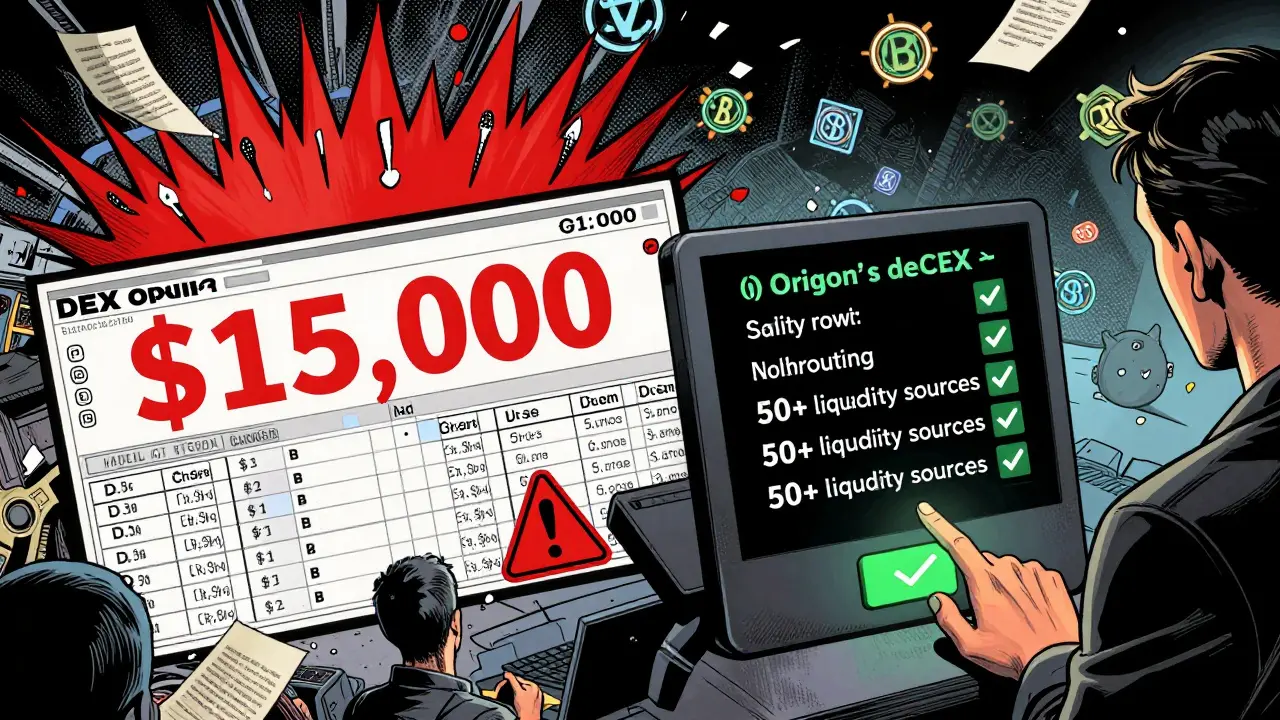
This isn’t just theory. A Reddit user in September 2025 reported saving $255 on a $15,000 BTC trade because Orion found a better rate than Binance’s own spot market. That’s not luck. That’s aggregation. Orion scans over 50 liquidity sources - DEXs, CEXs, and liquidity pools - and picks the best route. The result? Average price improvements of 1.2% to 2.8% compared to trading directly on Uniswap or SushiSwap.
And it runs on Binance Smart Chain (BSC). That’s key. Ethereum gas fees can eat your profits on small trades. BSC keeps fees under $0.10 per transaction. Orion’s team moved to BSC in 2021 specifically because of this. Today, it handles around 500 transactions per second on BSC - fast enough for daily use, even during spikes.
What You Get: Pros
- Better prices than DEXs: Orion’s price engine finds the best rate across 52 sources. For trades over $10,000, slippage is often under 0.5%. On Uniswap, the same trade could cost you 2% or more.
- No KYC: You don’t need to submit ID. Your wallet is your identity. This matters if you’re in a region where exchange registration is risky or slow.
- Trade CEX liquidity without depositing: This is unique. No other aggregator lets you access Binance’s order book without signing up for Binance. It’s like having a VIP trading desk without the account.
- Low fees: Trading fees are 0.1% - same as Binance. But you avoid deposit/withdrawal fees because you never move funds to a CEX.
- Referral program: Users report 15% cashback on trading fees for three months. That’s rare in DeFi.
What You Lose: Cons
- Too complex for beginners: The interface isn’t intuitive. You’ll see terms like "liquidity routes," "slippage tolerance," and "multi-hop swaps." If you’ve never used a DEX before, you’ll need 8-12 hours to learn it. Beginner guides are thin.
- Small coin selection: You won’t find obscure altcoins here. Orion focuses on top 50 tokens. If you’re trading Shiba Inu or Dogecoin, you’re better off on PancakeSwap.
- BSC congestion issues: When BSC gets busy - which happens during token launches - transactions can fail or take minutes. Orion’s own Q3 2025 report shows 23% of support tickets are about gas miscalculations.
- Low TVL: Total value locked is only $1.8 million. Compare that to 1inch’s $247 million or Uniswap’s $5.2 billion. That means less liquidity depth. For trades over $50,000, you might still get slippage.
- Regulatory risk: The SEC sent Orion a letter in April 2024 asking questions about their deCEX model. Accessing centralized exchange order books from a non-custodial platform walks a legal line. It’s not illegal yet - but it’s under watch.
Orion vs. the Competition
| Feature | Orion (BSC) | 1inch | Uniswap | Binance |
|---|---|---|---|---|
| Liquidity source | 50+ CEX + DEX | DEX only | AMM only | Centralized |
| Non-custodial | Yes | Yes | Yes | No |
| Best for trades over $10k | ✅ Excellent | Good | Poor | Good |
| Best for small trades ($100) | ⚠️ Not ideal (BSC gas) | Good | Best | Best |
| Available on mobile | Yes (iOS, Android) | Yes | Yes | Yes |
| Token utility | Fee discounts, governance | Fee discounts | None | None |
| Current TVL (Oct 2025) | $1.8M | $247M | $5.2B | $N/A |
Orion wins if you want the best price without trusting a CEX. But if you just want to swap ETH for USDC quickly and cheaply, Uniswap is easier. If you want 500+ tokens and instant trades, Binance is still king - but you give up control.
ORN Token: Utility or Just a Speculative Asset?
Orion’s native token, ORN, trades at $0.2639 as of October 2025. Its market cap is $45.8 million. That’s small for a DeFi project. So what’s it for?
- Fee discounts: Holding ORN gives you up to 50% off trading fees.
- Governance: You can vote on platform upgrades - but voter turnout is low.
- Staking: You can stake ORN to earn rewards, but APYs have dropped to 4% from 18% in 2022.
Here’s the problem: ORN doesn’t power the protocol. The liquidity comes from Binance, not ORN. That’s why crypto analyst Nic Carter called its tokenomics "disconnected from usage." If Orion’s platform grew tenfold tomorrow, ORN’s price wouldn’t necessarily follow - unless the token becomes a fee revenue share model, which it isn’t yet.
Still, the token has value if you trade often. For active users, ORN discounts can save hundreds a year. For speculators? It’s risky. The price has dropped 47% since its 2021 high. And with the SEC watching, regulatory pressure could hit ORN harder than the platform itself.

Who Is This For?
Orion (BSC) isn’t for everyone. It’s for a specific type of trader:
- Mid-to-large traders: $5,000+ trades. The price advantage adds up fast.
- DeFi-savvy users: You know what a wallet is. You’ve used MetaMask. You understand slippage.
- People avoiding KYC: If you’re in a country where exchanges are restricted, Orion gives you access to global liquidity without ID.
- Those tired of DEX slippage: If you’ve lost money on Uniswap because your trade moved the market, Orion fixes that.
It’s NOT for:
- Beginners who just want to buy Bitcoin and hold.
- People trading small amounts under $500 - gas fees make it inefficient.
- Those who want 100+ altcoins. Stick to PancakeSwap or KuCoin.
- People scared of complexity. Orion’s interface isn’t friendly.
The Future: Lumia and What’s Next
Orion isn’t standing still. In October 2025, they announced Lumia - a Layer 2 blockchain built specifically for liquidity aggregation. It’s not just an upgrade. It’s a new foundation.
Lumia promises 2,000 transactions per second - 40x faster than Ethereum. It’ll integrate with Coinbase’s Base network in Q1 2026. That’s huge. It means Orion will soon offer CEX liquidity on Ethereum’s Layer 2 - something no one else has done.
They’re also building institutional custody solutions for Q2 2026. That’s a signal: Orion wants hedge funds and funds to use it. Not just retail traders.
Analysts at CoinTelegraph predict ORN could rise 45-60% by end of 2026 if Lumia launches on time. But if the SEC cracks down on deCEX, the token could drop $0.05-$0.08. The risk is real. The reward? Possibly bigger than any DeFi aggregator today.
Final Verdict
Orion (BSC) is a powerful tool for experienced traders who want the best prices without giving up control. It solves a real problem: fragmented liquidity. It’s not perfect. The interface is clunky. The token is speculative. The regulatory cloud looms.
But if you’re trading $10,000 or more, and you’re already using a wallet - Orion gives you an edge most platforms can’t match. It’s not the easiest DeFi tool. But for the right user, it’s one of the most effective.
Try it if you’re ready. Don’t try it if you’re still learning.
Is Orion (BSC) safe to use?
Yes, if you understand what you’re doing. Orion is non-custodial - you keep your keys. It uses Chainlink for price feeds and has been audited by CertiK. But the platform accesses centralized exchange order books, which is under regulatory scrutiny. The risk isn’t from hacking - it’s from legal changes.
Can I trade small amounts on Orion (BSC)?
You can, but it’s not efficient. BSC gas fees are low, but not zero. For trades under $500, you’ll pay more in fees than you’ll save on price. Orion’s strength is large trades - $5,000 and up.
How do I start using Orion (BSC)?
1. Install MetaMask or Trust Wallet. 2. Add BSC network if you haven’t. 3. Buy some BNB for gas. 4. Go to orion.xyz and connect your wallet. 5. Search for the token you want to trade. 6. Set your slippage tolerance (start at 1.5%). 7. Confirm the trade. You’ll see the route Orion chose - check it before signing.
Does Orion have a mobile app?
Yes. Orion launched its official iOS app in October 2024 and Android in November 2024. You can also use it through third-party wallets like Atomic Wallet, which supports ORN since January 2023.
What’s the difference between Orion and 1inch?
1inch only aggregates liquidity from decentralized exchanges. Orion also pulls from centralized exchanges like Binance and KuCoin. That means Orion often gets better prices, especially for large trades. But 1inch has higher TVL and supports more tokens.
Is ORN token worth holding?
Only if you trade frequently on Orion. ORN gives you fee discounts and governance rights, but it doesn’t generate revenue or have strong utility beyond that. Its price is tied to speculation and the success of Lumia. Don’t buy it as an investment - buy it to save on trading fees.
What happens if the SEC shuts down Orion?
The platform could be forced to remove access to centralized exchange order books. That would turn Orion into a regular DEX aggregator - losing its biggest advantage. ORN’s value would likely drop. But the core tech - non-custodial, multi-chain aggregation - could survive under a new model.
If you’re ready to trade smarter, Orion (BSC) is worth a test. Just don’t go all-in. Start small. Learn the interface. Watch the price routes. And always double-check your slippage.
Kelley Ramsey
January 11 2026Wow, this is actually one of the clearest breakdowns of a deCEX I’ve seen-thank you!! I’ve been using Orion for my $15k+ trades for months now, and the price improvement is real. I saved $312 on a single ETH swap last week alone. And no KYC? Yes, please. I live in Texas, and I’m tired of banks freezing my crypto-linked accounts. This feels like freedom.
Michael Richardson
January 11 2026Oh great. Another ‘decentralized’ platform that’s just Binance in a mask. You call this innovation? It’s just regulatory arbitrage wrapped in DeFi glitter. The SEC’s already sniffing around-wait till they shut it down and your ‘non-custodial’ wallet gets blacklisted.
Tiffani Frey
January 11 2026I appreciate the depth of this review. As someone who’s traded on both Uniswap and Orion, I can confirm the slippage difference is tangible-especially for mid-cap tokens like MKR or AAVE. The BSC gas efficiency is a game-changer compared to Ethereum. That said, I do wish the UI had a ‘beginner mode’ toggle. The liquidity route visualization is overwhelming at first glance. Maybe a tooltip glossary?
Tre Smith
January 13 2026Orion’s TVL of $1.8M is a red flag. The claim of ‘better prices than Binance’ is statistically insignificant unless you’re trading above $50k. For trades under $10k, the gas cost alone negates any theoretical advantage. The ORN token is a speculative shell game-no revenue sharing, no protocol fee capture. This is not a protocol; it’s a liquidity aggregator with a marketing team.
Ritu Singh
January 14 2026i think orion is just a front for the deep state to monitor crypto wallets under the guise of decentralization... they use bsc because it's easier to track... and the oron token? totally a psyop to make us think we own something... the real power is with the cexs they pull from... you think you're free but you're just another data point... the blockchain is a lie... the nodes are owned... they're watching... always watching
kris serafin
January 15 2026Big fan of Orion for large trades! 🚀 Just did a $22k SOL swap and got 1.8% better price than Binance. The mobile app is slick too. Only thing? Always double-check the route before signing. Once I got a weird multi-hop through a random DEX I’d never heard of-turned out fine, but gave me a heart attack 😅
Rahul Sharma
January 15 2026Dear Sir or Madam, I am writing to express my sincere appreciation for this comprehensive analysis. The comparison table is particularly well-structured and facilitates informed decision-making. For individuals residing in developing economies, Orion provides an invaluable channel to access global liquidity without the burdens of bureaucratic identification procedures. I have personally utilized the platform for transactions exceeding $8,000 with consistent success. Thank you for your diligence.
Gideon Kavali
January 17 2026This isn’t just ‘a bridge’-it’s a betrayal of the DeFi ethos. You’re letting Binance run the show behind the curtain. You call it ‘non-custodial’? Fine. But you’re still trusting a centralized entity to execute your trades. That’s not decentralization-that’s delusion. And now they’re building a Layer 2? You’re building a castle on sand, and the tide is coming in. The SEC doesn’t play games. They don’t send ‘letters.’ They send subpoenas.
Allen Dometita
January 17 2026Yessss!! Orion is the secret weapon for anyone tired of getting ripped off by DEX slippage. I used to lose $500 on a $10k trade on Uniswap. Now I lose $50. Game changer. 🙌 And ORN discounts? I’ve saved over $1,200 in fees this year. Start small, learn the slippage settings, and boom-you’re trading like a pro. No need to be a genius, just patient. Trust me, your future self will thank you.
Brittany Slick
January 18 2026I love how Orion feels like a hidden gem-like finding a quiet alleyway café in a city full of Starbucks. The interface? A little clunky, sure. But the way it finds the best price feels almost magical. Like the crypto gods whispered the optimal route into your wallet. I’ve been using it for six months now, and every trade still gives me a little thrill. It’s not perfect, but it’s beautiful.
greg greg
January 19 2026Let’s talk about the regulatory risk here, because everyone’s dancing around it. Orion’s deCEX model essentially creates a pseudo-custodial relationship with centralized exchanges by proxy-meaning, if Binance is deemed a security platform by the SEC, then Orion becomes a conduit for unregistered securities trading, which triggers Section 5 violations under the Securities Act of 1933. The fact that they’re aggregating order books from OKX and KuCoin, which are both non-U.S. entities with questionable compliance, compounds the exposure. And now they’re building Lumia on a Layer 2 that integrates with Coinbase’s Base? That’s not innovation-it’s a legal time bomb. The SEC doesn’t need to shut them down immediately; they just need to issue a cease-and-desist on CEX liquidity sourcing, and Orion’s entire value proposition evaporates overnight. The tokenomics are already broken, the TVL is negligible, and the only thing keeping this afloat is retail FOMO. This isn’t DeFi 3.0-it’s DeFi 1.0 with a fancy coat of paint and a lawyer on retainer.
LeeAnn Herker
January 20 2026Oh, so now we’re glorifying a platform that steals liquidity from Binance and calls it ‘decentralized’? That’s like saying a thief who uses your neighbor’s key is ‘not stealing’ because they didn’t break in. And ORN? Ha! You think you’re saving money? You’re just funding a pyramid scheme where the only people winning are the devs who cashed out in 2021. The fact that you’re excited about ‘no KYC’ is terrifying. This isn’t freedom-it’s a loophole. And loopholes get closed. Hard.
Andy Schichter
January 21 2026Another overhyped crypto project. Everyone’s so eager to believe in magic solutions. The ‘1.2% to 2.8% better prices’? That’s on paper. Real-world slippage, failed transactions, gas spikes-you’re trading convenience for chaos. And ‘Lumia’? Sounds like a skincare line. I’ll believe it when I see it. Until then, I’ll stick with Uniswap and my sanity.
Calen Adams
January 22 2026Orion’s deCEX architecture is the most underrated innovation in DeFi since AMMs. The fact that they’re aggregating CEX liquidity without custody? That’s institutional-grade infrastructure disguised as retail tooling. The TVL is low because they’re targeting precision over volume. And Lumia? That’s the real play-it’s not just a Layer 2, it’s a liquidity mesh network. Once they integrate Base and roll out institutional custody, this thing will scale to $10B+ TVL. ORN’s value isn’t in speculation-it’s in utility. The 50% fee discount isn’t a perk-it’s a network effect multiplier. This isn’t a DEX aggregator. It’s the future of cross-chain liquidity orchestration. The SEC’s letter? A badge of honor. They’re scared because this works.