
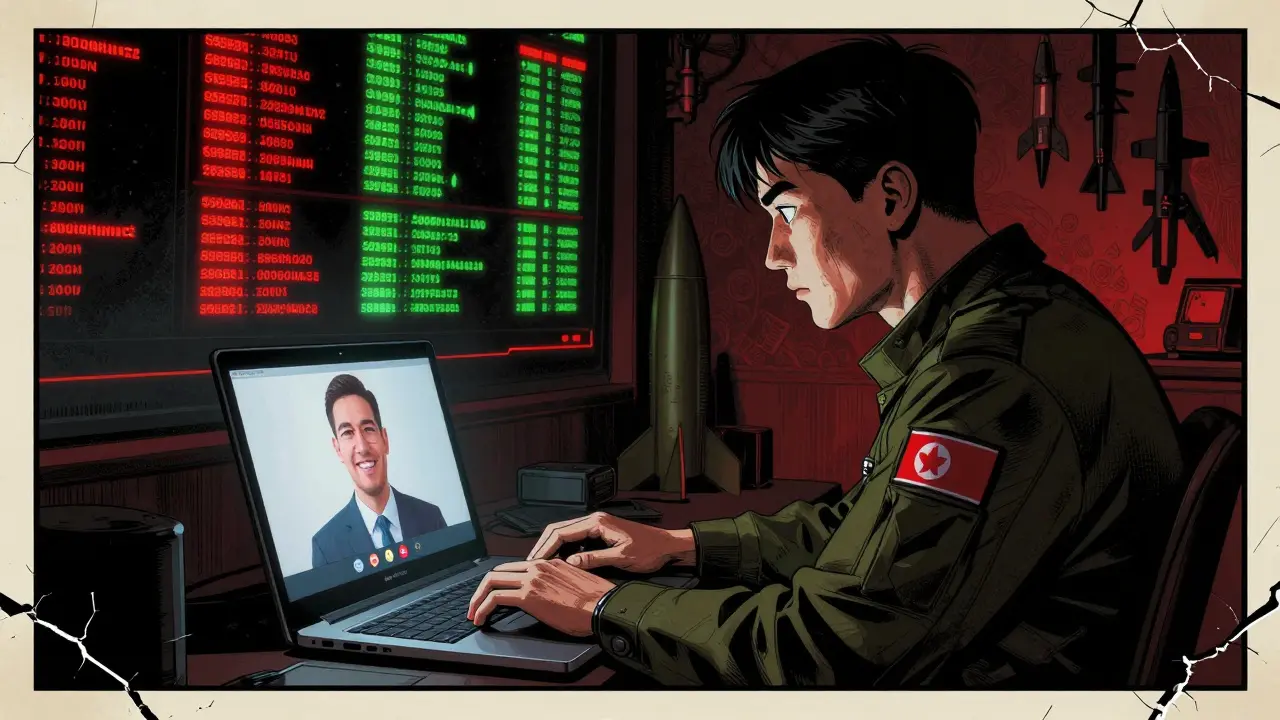
It’s 2026, and a remote IT job posting on a freelance platform looks too good to be true. The pay? $5,000 a month. The work? Just coding, testing, and support. No interviews. No contract. Just wire your crypto wallet and start Monday. Thousands of companies have taken the bait. But behind that screen is not a freelancer from Ukraine or the Philippines - it’s a North Korean operative, using AI deepfakes to look you in the eye during a Zoom call, while quietly siphoning money to fund weapons of mass destruction.
How the Scheme Works
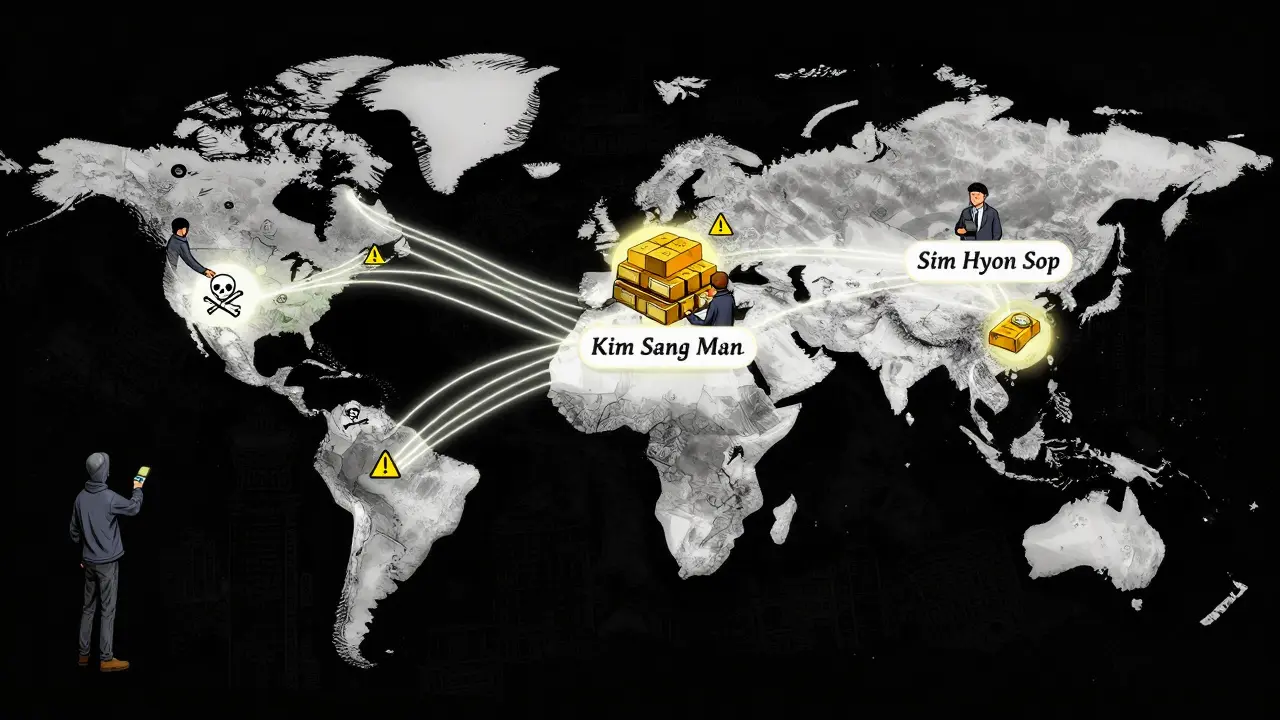
North Korea doesn’t hack exchanges anymore - not primarily, anyway. Instead, it hires its own people as remote workers. These aren’t hackers in hoodies. They’re trained software engineers, cybersecurity specialists, and data analysts, sent overseas under fake identities. They apply for jobs on Upwork, LinkedIn, and niche tech forums. They lie about where they’re from. They use stolen passports, forged diplomas, and AI-generated voices to pass video interviews. Once hired, they demand payment in USDC or USDT - stablecoins that hold steady value and move easily across borders. These workers don’t steal in one big hit. They get paid regularly. $5,000 here. $7,000 there. Monthly. Consistent. The money flows into wallets they control, then gets split across dozens, sometimes hundreds, of other addresses. Each transfer is tiny, scattered, designed to avoid red flags. Eventually, the funds converge in wallets tied to sanctioned North Korean operatives like Kim Sang Man and Sim Hyon Sop. From there, the crypto is converted into cash through over-the-counter (OTC) traders in Russia, the UAE, or China - often using fake businesses or shell companies. This isn’t random crime. It’s state policy. The Multilateral Sanctions Monitoring Team (MSMT) says North Korea made at least $1.65 billion from crypto laundering between January and September 2025 alone. That’s more than $180 million a month. One operation, the $1.4 billion Bybit heist in February 2025, made headlines. But the real money? It’s in the slow drip of payroll payments from unsuspecting companies.Why Stablecoins Are the Weapon of Choice
Bitcoin and Ethereum are too volatile. Too traceable. Too noisy. Stablecoins like USDC and USDT are the perfect tool. They’re pegged to the U.S. dollar. They move fast. They’re accepted everywhere. And because they’re built on blockchains like Ethereum and Tron, they can be shuffled through dozens of wallets before anyone notices. The U.S. Treasury confirmed in June 2025 that North Korean operatives specifically request stablecoins. Why? Because they’re the bridge between crypto and cash. OTC traders - often operating out of Dubai or Moscow - take the stablecoins and give back dollars in cash, bank transfers, or even gold. No KYC. No questions asked. The money disappears into the global financial system, then reappears in North Korea to buy copper for munitions, missile parts, or high-tech surveillance gear. According to the MSMT report from October 2025, these stablecoin transactions are directly linked to military procurement. Copper, lithium, rare earth metals - all bought with crypto laundered through fake IT jobs. This isn’t just money laundering. It’s arms funding.How Companies Get Tricked
Most companies don’t realize they’re hiring a regime-backed operative. The workers appear professional. They’re cheap - often offering rates 20-30% below market. They’re eager. They’ll start immediately. No contract needed. They’ll even work weekends. They use AI tools to fake video calls, sometimes even mimicking your accent or tone. One Canadian tech startup lost $280,000 over six months to an operative who showed up in every Zoom meeting with perfect lighting, perfect English, and a fake degree from MIT. The RCMP’s July 2025 advisory lists the red flags:- Requests for cryptocurrency payments only
- Multiple logins from different countries in one day
- Refusal to sign a contract or provide ID
- Overly low rates compared to peers
- Use of AI-generated photos or voices
The Real Cost to Businesses
The average loss per company? $47,000. That’s according to the Canadian Anti-Fraud Centre’s Q3 2025 report. And 78% of those cases involved crypto payments. Some companies lose less. Others lose millions. The U.S. Department of Justice indicted four North Korean nationals in July 2025 for stealing $900,000 in virtual currency from U.S.-based firms. The names? Joshua Palmer. Alex Hong. Fake identities. Real damage. The worst part? Once the crypto leaves your wallet, it’s gone. No chargebacks. No refunds. The blockchain doesn’t care who you are. Once it’s sent, it’s irreversible.How Governments Are Fighting Back
The U.S., Canada, Japan, South Korea, and 11 other nations are coordinating sanctions. In July 2025, the U.S. Treasury sanctioned Chinyong Information Technology Cooperation Company - the main agency that recruits and deploys these workers. They also went after Vitaliy Sergeyevich Andreyev, Kim Ung Sun, and Korea Sinjin Trading Corporation. All were tied to the laundering pipeline. The FBI and DOJ have seized over $7.7 million in crypto, NFTs, and digital assets linked to these operations. They’ve frozen wallets tied to North Korean operatives. They’ve pressured exchanges to block known DPRK-linked addresses. The Financial Action Task Force (FATF) updated its global guidance in June 2025, telling crypto platforms to watch for patterns: small, regular payments from new users, requests for stablecoins, and inconsistent location data. And there’s new tech coming. FinCEN, the U.S. financial crimes unit, is testing a prototype system expected to launch in early 2026. It can spot DPRK-linked wallet clusters with 89% accuracy by analyzing transaction timing, wallet age, and fund flow patterns.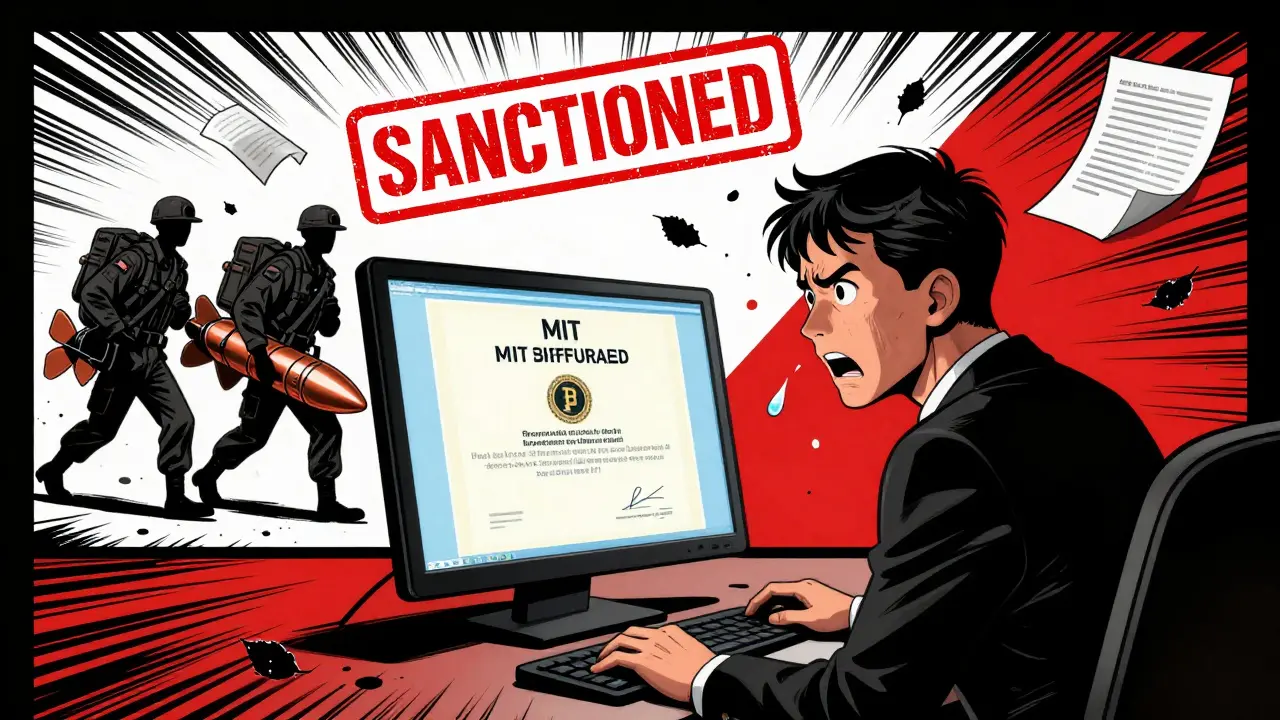
What Companies Can Do
You don’t need to be a cybersecurity expert to protect yourself. Here’s what works:- Never pay in crypto unless you’re 100% sure of the person. Use payroll platforms with built-in KYC. Pay via bank transfer, not wallet.
- Verify identities with multiple video calls. Ask them to show a government ID, then ask them to spell their name backwards. Deepfakes can’t handle that.
- Check their education and work history. Call the university. Email the former employer. DPRK operatives use fake diplomas 92% of the time.
- Use blockchain analytics tools. Services like Chainalysis or Elliptic can flag if a wallet has ever been tied to North Korea. Run the wallet address before paying.
- Require contracts. If they refuse to sign, walk away.
The Bigger Picture
This isn’t just about fraud. It’s about survival. North Korea’s economy is crushed under sanctions. Its people are starving. But its military isn’t. The regime has turned the global remote work boom - a $427 billion industry - into a weapon. Every time a company hires a fake IT worker, they’re indirectly funding missile tests, nuclear warheads, and cyberattacks on hospitals and power grids. The world is waking up. Governments are acting. Tech tools are improving. But as long as crypto remains anonymous and remote work is easy, the scheme will evolve. Maybe next time, they’ll use NFTs. Or decentralized finance protocols. Or AI-generated freelance profiles that can pass automated screening tools. The only defense? Vigilance. Verification. And never, ever paying someone you’ve never met in crypto.Are North Korean IT workers still active in 2026?
Yes. Despite increased sanctions and better detection tools, North Korean IT workers remain active in 2026. The Multilateral Sanctions Monitoring Team confirmed ongoing operations through September 2025, and U.S. Treasury data shows new wallet clusters tied to DPRK operatives emerging monthly. While the volume may drop due to improved countermeasures, the regime has shown it can adapt quickly - shifting to new platforms, tools, and laundering methods.
Can you trace crypto payments back to North Korea?
Yes, but it’s complex. Blockchain analysis firms like Chainalysis and Elliptic have mapped out hundreds of wallets used by DPRK operatives. These wallets show patterns: small, regular deposits from different countries, rapid movement through mixers or bridges, and eventual consolidation into known sanctioned addresses. While individual transactions are hard to trace, clusters of activity are increasingly detectable. The U.S. FinCEN’s new system, launching in early 2026, can identify DPRK-linked clusters with 89% accuracy.
Why don’t exchanges block these payments?
Many exchanges do - but not all. Major platforms like Coinbase and Binance have blocked known DPRK-linked wallets. But smaller exchanges, especially those based in jurisdictions with weak oversight, still process these transactions. OTC traders - who operate outside exchange systems - are the biggest loophole. They accept crypto from anyone, often without ID, and convert it to cash. That’s why the U.S. Treasury has sanctioned multiple OTC facilitators, including a person known only as ‘Lu’.
Is it illegal to hire a North Korean IT worker unknowingly?
No, not if you truly didn’t know. U.S. and international sanctions target the regime and its enablers, not individual employers who are victims of fraud. However, if you ignore red flags - like crypto-only payments or fake documents - regulators may consider you negligent. In some cases, companies have been fined for failing to conduct basic due diligence. The key is proving you made a good-faith effort to verify the worker.
How can I check if a crypto wallet is linked to North Korea?
Use free blockchain explorers like Etherscan or Tronscan to look up the wallet address. Then cross-check it with public sanctions lists from the U.S. Treasury’s OFAC database or Chainalysis’ React platform. Some cybersecurity firms offer wallet screening tools for businesses. If the wallet has ever received funds from a known DPRK-linked address, or has sent funds to a sanctioned entity, it’s high-risk. Always verify before sending any payment.
What’s the difference between this and the Lazarus Group hacks?
The Lazarus Group steals large sums in single attacks - like the $625 million Harmony Bridge breach in 2022. The IT worker scheme is slower, quieter, and more sustainable. Instead of breaking in once, they get paid monthly like real employees. This avoids triggering alarms. It’s less flashy, but far more reliable. According to Chainalysis, the IT worker scheme generated 43% of North Korea’s crypto revenue in 2025 - more than direct exchange hacks.
Margaret Roberts
January 26 2026This is all fake. The whole thing. The US government just wants you scared so they can track every crypto transaction. They’ve been lying about North Korea since the 90s. You think they don’t control the blockchain too? Of course they do. This is just another psyop to justify surveillance. Wake up.
They’re not even using stablecoins. It’s all centralized. They just want you to think it’s decentralized so you’ll keep using it. The real money is in fiat. Always has been.
And who’s really behind this? The same people who told you 9/11 was an inside job. Same playbook. Same fear. Same lies.
Stop feeding the machine.
They want you paranoid. They want you checking wallets. They want you terrified of a remote worker. Meanwhile, your taxes are going to drones and private prisons. But hey, at least you’re not hiring a North Korean.
They’re not even real people. The whole thing’s AI-generated. Just like this post.
Think for yourself. Or don’t. Either way, they’re watching.
And if you’re reading this? You’ve already been flagged.
Jonny Lindva
January 28 2026Man, this is wild but also so real. I had a guy on Upwork last year who was ‘from Canada’ but his Zoom background kept changing between Tokyo and Berlin. He paid for his own software license with USDT and refused to sign anything. I thought he was just a weird freelancer. Now I’m sweating.
Thanks for the checklist - I’m running every future hire through Chainalysis now. Better safe than sorry.
Also, if you’re hiring remotely, just use PayPal or direct deposit. No crypto unless you’re 100% sure. And even then… maybe don’t.
Jen Allanson
January 29 2026It is profoundly disturbing that any corporation, no matter how well-intentioned, would entertain the notion of remunerating an individual whose labor directly or indirectly funds weapons of mass destruction. This is not a ‘freelance gig’ - it is complicity. The moral failure of modern capitalism is that we have normalized transactional detachment to the point where we no longer ask who benefits from our payments.
Employers are not innocent bystanders. They are enablers. And the fact that so many dismiss this as ‘just business’ reveals the depth of our ethical decay.
There is no such thing as ‘unintentional’ support of a genocidal regime. Ignorance is not an excuse. It is a choice.
Until companies are held legally and morally accountable for the origin of every dollar they disburse, this will continue. And we will all be guilty.
Harshal Parmar
January 31 2026Bro, I’m from India and I’ve seen this kind of stuff up close. We get so many fake profiles on Freelancer.com - people with perfect English, fake degrees from Harvard, always asking for crypto. At first I thought they were just scammers. Now I realize some of them might be state-sponsored.
But here’s the thing - the real problem isn’t North Korea. It’s that companies are too lazy to verify. Why hire someone who won’t sign a contract? Why pay in crypto when you can use Stripe? Why not do a 3-call verification process?
It’s not rocket science. It’s basic HR. We’re so obsessed with speed and cheap labor that we forget to check if the person is even real.
And yeah, I know, ‘But they’re so good at their job!’ - so was the guy who sold me a ‘fake Rolex’ that broke in 2 days.
Don’t be the one who funds a missile with your payroll. Just say no to crypto hires unless you’ve got a forensic accountant on speed dial.
Stay safe, stay smart.
Peace out 🙏
Darrell Cole
February 2 2026This article is full of hype and zero evidence. You cite MSMT and FinCEN like they’re gospel but they’re government agencies with agendas. Where’s the public blockchain evidence? Where are the wallet addresses? Where’s the proof that Kim Sang Man is even real? This reads like a CIA briefing written by a grad student. Also stablecoins aren’t untraceable - they’re the most traceable crypto asset. The real story is how the US is using fear of North Korea to push centralized KYC on DeFi. This isn’t about weapons - it’s about control. And you’re helping them.
Dave Ellender
February 2 2026Interesting read. I’ve worked with remote devs from Eastern Europe and Southeast Asia - the red flags you listed are spot on. One guy I hired asked for USDT, claimed he was ‘in Poland’ but his GitHub commits were at 3am his time and 11am EST. I didn’t think much of it until now.
Good to know what to watch for. I’ll be running all new hires through OFAC now. Simple step, huge difference.
Barbara Rousseau-Osborn
February 3 2026OFAC? LOL. You think the US government is clean? They’ve been laundering money through shell companies for decades. This whole ‘North Korea is hacking your Upwork jobs’ is a distraction. They want you to blame the DPRK so you don’t ask why your CEO makes $20M while you’re on a 1099 with no benefits.
Also, ‘AI deepfakes’? Please. I’ve seen Zoom calls from real people who look worse than deepfakes. Your ‘red flags’ are just ‘people who don’t like paperwork.’
And you say ‘never pay in crypto’ - but what if you’re in a country with no banking? What if your freelancer is in Venezuela? Are they evil too?
You’re not protecting the world. You’re just scared of people who don’t look like you.
🙄
Arnaud Landry
February 5 2026As a Canadian, I’ve seen this firsthand. The RCMP advisory? I got a call from them last year after I paid a ‘freelancer’ in USDT. Turns out the wallet was flagged in a 2024 FinCEN bulletin. I thought I was being clever by avoiding PayPal fees.
Now I use Payoneer. Always. Even if it costs 2% more. Because I’d rather pay 2% than lose $100K and have the FBI knock on my door.
Also - the AI voice thing? I had a guy mimic my accent so well I thought he was from Toronto. Turned out he was in Pyongyang. Or at least, that’s what the blockchain said.
Don’t be me. Learn from my mistake.
And yes, I still feel stupid.
george haris
February 6 2026Man, this blew my mind. I hired someone last month for $5k/mo to build a dashboard. They were so chill, worked weekends, no drama. Paid them in USDC because they said it was faster.
I just ran their wallet through Etherscan. It’s linked to a cluster flagged by Chainalysis in March. I’m so freaked out right now.
Thanks for the article - I’m deleting their access right now. And I’m going to tell my whole team. This isn’t just about money. It’s about what we’re supporting.
Also - if you’re reading this and you’ve done the same thing? Don’t panic. Just fix it. You’re not a bad person. You just didn’t know. Now you do.
Let’s all do better.
David Zinger
February 6 2026This is pure propaganda. The US is scared because North Korea is outperforming them in tech innovation. We’re outsourcing jobs to China and India but when a poor country uses the same tools to survive? Suddenly it’s a national security threat. Pathetic. Also, stablecoins are the future. If you can’t handle decentralized finance then don’t use it. Blaming the victim? Classic American hypocrisy. 🇺🇸💀
steven sun
February 7 2026yo i just got hired by this company last week and they paid me in usdt and i thought it was cool cause no taxes lol now im scared i just sent 10k to a wallet and now im googling if im a war criminal 😭
Sara Delgado Rivero
February 9 2026Of course they’re using crypto. Why do you think the US is pushing CBDCs so hard? To track every transaction. They want you to think North Korea is the threat so you’ll gladly give up your privacy. Wake up. This isn’t about weapons. It’s about control. And you’re helping them by buying into the fear.
Athena Mantle
February 10 2026It’s not just about North Korea - it’s about the death of trust. We used to hire people based on character. Now we hire based on blockchain analytics and KYC forms. We’ve turned human connection into a security protocol.
And the worst part? We’re proud of it. We call it ‘due diligence.’
But what does it say about us that we’d rather trust a machine than a person?
What happened to the days when you shook hands and said ‘I believe you’?
Now we check wallets like they’re horoscopes.
And we wonder why everyone feels so alone.
💔
carol johnson
February 11 2026Okay but have you considered that maybe… the real villain is the gig economy? That companies are so desperate for cheap labor they ignore everything? That this isn’t about North Korea at all - it’s about capitalism eating its own children?
They didn’t create the system. They just exploited it. And now we’re mad at the workers instead of the bosses who asked for crypto payments?
Also, I cried reading this. Not because of the weapons. But because I hired someone like this last year. And I didn’t even ask for a contract.
I’m so ashamed.
😭😭😭
Paru Somashekar
February 13 2026As a cybersecurity professional in India, I can confirm the pattern described is accurate. We have observed multiple cases where fake profiles from 'Ukraine' or 'Canada' are hired via freelance platforms, with consistent payment patterns in USDT. The use of AI-generated video and voice is now standard. The real challenge is the lack of awareness among SMEs.
Recommendation: Always use a two-factor verification system - one video call with a live challenge (e.g., 'show me your hand and say your name backwards'), and cross-check wallet addresses via Chainalysis free tier. Also, avoid platforms that allow anonymous sign-ups.
Prevention is better than detection. And yes - this is a global issue. Not just a DPRK problem.
Stay vigilant.
🙏
Steve Fennell
February 14 2026Thank you for writing this. I run a small dev shop in Ohio and we’ve had three near-misses this year. One guy had a fake MIT diploma, used a deepfake voice, and requested USDC. We caught him because his GitHub had commits from a timezone that didn’t exist.
Now we require: 3 video calls, a live coding test, bank transfer only, and a signed NDA. It slows us down - but it saves us.
Also - if you’re hiring remotely, treat it like you’re hiring someone to babysit your kids. You don’t just hand them the keys and say ‘good luck.’
Be kind. Be thorough. Be human.
And always, always verify.
❤️
Heather Crane
February 15 2026This is terrifying - but also a wake-up call. I used to think crypto was just a way to pay freelancers faster. Now I see it as a tool that can be weaponized - and we’re the ones handing it over.
I’m not blaming the workers. I’m blaming the system that lets companies ignore basic verification. We want cheap, fast, easy - and we’re willing to ignore the cost.
But what if the cost isn’t just money? What if it’s our humanity?
I’m switching all payments to bank transfers. Even if it takes 3 days. Because some things are worth waiting for.
Thank you for shining a light. We need more of this.
Catherine Hays
February 15 2026This is nonsense. North Korea doesn’t have enough tech talent to pull this off. The whole thing is a lie to scare investors away from crypto. The real launderers are Wall Street banks and Swiss private banks. This article is just fearmongering dressed up as journalism. Also, USDT is backed by Tether, which is owned by a company in the Caymans. Who’s really dirty here?
Chidimma Catherine
February 17 2026As a Nigerian woman working in fintech, I’ve seen how easy it is for fraudsters to exploit remote work platforms. The same tactics are used by Nigerian scammers - fake profiles, crypto payments, fake diplomas.
But here’s the truth: North Korea isn’t unique. Every country has people who exploit systems. The difference? The West blames the ‘other’ while ignoring their own complicity.
We need global cooperation - not fear. We need better tools, yes - but also better empathy.
Don’t vilify the worker. Fix the system.
And if you’re a company? Pay fairly. Verify respectfully. Don’t assume the worst.
Because sometimes, the person on the other side of the screen is just trying to survive.
🌍
Kevin Pivko
February 19 2026Let’s be honest - this is just another way for the US to justify its crypto crackdown. They don’t care about North Korea. They care about control. The fact that this narrative is so widely accepted shows how easily the public is manipulated.
Also, the ‘$1.65 billion’ figure? That’s estimated. No public audit. No chain of custody. Just a press release from a government agency with a history of exaggerating threats.
Meanwhile, the US Treasury sanctions over 1,000 entities a year - many without due process. So why are we treating DPRK as the villain when our own government operates the same way?
Wake up. This isn’t about security. It’s about power.
Mathew Finch
February 20 2026The US has been using crypto for covert operations for over a decade. The idea that North Korea is somehow the only actor abusing the system is laughable. This is a distraction tactic. The real story? The Pentagon uses blockchain to move funds to private contractors in Afghanistan. No one talks about that. Why? Because it’s American. Double standards are the real threat here.
Margaret Roberts
February 21 2026Of course you believe the government. That’s what they want. They want you to think the threat is ‘out there’ - so you don’t look at the ones in charge.
They’re not fighting North Korea. They’re fighting anonymity.
And you? You’re the one doing their dirty work.
By checking wallets.
By reporting people.
By trusting the system that lies to you every day.
Wake up.
They’re not protecting you.
They’re keeping you afraid.
And afraid people don’t rebel.