
WillyBumBum (BUM) isn’t your typical cryptocurrency. You won’t find it powering smart contracts, funding decentralized apps, or moving billions in daily volume. Instead, it’s a meme coin built on humor, community, and a very strange market structure. If you’ve ever seen a viral cartoon character with a wild name and thought, “That should be a token,” then you’ve already got the idea behind WillyBumBum.
Where did WillyBumBum come from?
The story starts with a cartoon character created by someone going by the name ALIEN REd WOLf - real name Daniel Fowler. In 2021, a version of WillyBumBum launched on the Binance Smart Chain. But that version mostly faded away. Then, in 2024, it came back - not as a reboot, but as a full migration to the Base a Layer 2 blockchain built by Coinbase that focuses on low-cost, fast transactions. This new version is the one people talk about today.
The team behind it is international, anonymous in parts, but clearly driven by meme culture. They didn’t set out to compete with Bitcoin or Ethereum. Their goal? To inject real laughter into the crypto world. Think of it like Dogecoin’s wild cousin who showed up at a party wearing a neon onesie and started dancing on the table.
How many BUM tokens exist? (Spoiler: Almost none are out there)
Here’s where things get weird - and honestly, a little alarming.
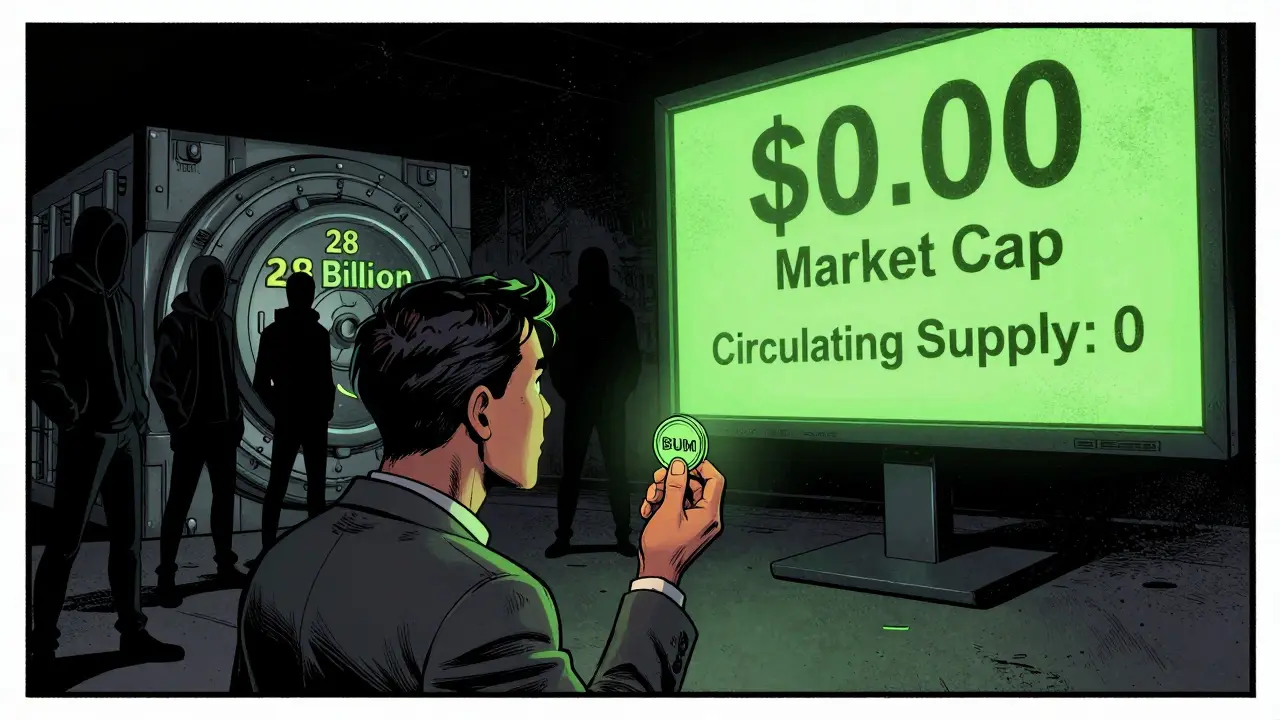
WillyBumBum has a total supply of 28 billion BUM tokens. That sounds like a lot, right? But here’s the twist: the circulating supply is zero.
That means, as of now, not a single BUM token is being traded, held, or used by anyone in the open market. All 28 billion are locked up - either in team wallets, development funds, or some kind of future release schedule that hasn’t happened yet. This isn’t normal. Most coins release a big chunk at launch. Even the most obscure tokens have at least some liquidity.
Why does this matter? Because your market cap is calculated by multiplying price × circulating supply. Zero circulating supply? That means your market cap is $0.00. And that’s exactly what it is. No trading volume. No buyers. No sellers. Just a number on a screen that doesn’t reflect reality.
What’s the price of BUM? And why does it vary?
Prices for WillyBumBum are all over the place. Coinbase says it’s around $0.00000462. Binance lists it at $0.000009. That’s a nearly double difference. Why? Because there’s no real market. These prices are likely pulled from tiny, one-off trades on decentralized exchanges - or worse, simulated data from low-traffic pools.
The all-time high was $0.000206. That’s over 97% higher than today’s price. If you’d bought at the peak, you’d be down more than 97%. And even that peak was probably fueled by hype, not real demand.
The 24-hour trading volume? $0.00. Across every exchange. That’s not a glitch. That’s a signal. No one is trading BUM. Not because it’s too expensive - it’s not. Not because it’s too complicated - it’s not. It’s because nobody has access to the tokens. They’re not out there to buy.
What can you do with BUM?
According to the project’s docs, BUM is meant to be used for:
- Staking to earn rewards
- Voting on future project updates
- Buying NFTs within their ecosystem
- Playing games or joining community challenges
But here’s the catch: you can’t stake what you don’t have. You can’t vote if you don’t hold any. You can’t buy an NFT if no one’s selling one. The whole ecosystem is built on a promise - that tokens will be released someday. But there’s no timeline. No roadmap. No public wallet address showing where the 28 billion are stored.
It’s like being told you’ll get a free pizza next month… but no one’s made the dough yet.
Is WillyBumBum on any exchanges?
It’s listed on Base a Layer 2 blockchain built by Coinbase and a few decentralized exchanges (DEXs), but there’s only one active trading pair reported - on Coinbase’s DEX. No centralized exchanges like Binance, Kraken, or KuCoin list it. That’s a red flag.
Centralized exchanges have strict listing standards. They check for liquidity, team transparency, and security audits. WillyBumBum meets none of those. Its presence on DEXs means it’s accessible - but only to people who know how to use wallets like MetaMask, connect to Base, and find the token manually. It’s not user-friendly. It’s not beginner-safe.
Who is this for?
WillyBumBum isn’t for investors looking for returns. It’s not for developers building apps. It’s not even for long-term crypto holders.
This is for meme lovers. People who enjoy the absurdity of crypto. Those who buy Dogecoin because Elon tweets about it. Who laugh at Shiba Inu’s dog-themed branding. WillyBumBum is that, but louder. It’s a joke with a blockchain attached.
If you’re here because you think BUM will go to $1 tomorrow? You’re wrong. If you’re here because you want to be part of a weird, funny community that might someday release tokens and throw a virtual party? Then maybe - just maybe - you’re in the right place.
The risks are extreme
Let’s be clear: WillyBumBum is one of the riskiest assets in crypto right now.
- No circulating supply - means no liquidity, no price discovery.
- Zero trading volume - means you can’t sell if you buy.
- Team is anonymous - no public identity, no accountability.
- Price dropped 97% - even from its own low bar.
- No audits - no third-party security checks on the smart contract.
There’s no regulatory oversight. No legal protection. No recourse if the team vanishes tomorrow. This isn’t a startup. It’s a meme with a token.
Final verdict: Fun, but not an investment
WillyBumBum (BUM) is a fascinating case study in how far meme culture can stretch in crypto. It’s a creative project. It’s got personality. It’s trying to make blockchain fun.
But it’s not a currency. It’s not a store of value. It’s not even a speculative asset you can reasonably trade.
If you’ve got spare cash you’re okay losing - and you want to support a goofy, joke-driven project - then sure, keep an eye on it. Maybe someday the 28 billion tokens will be released. Maybe the community will grow. Maybe it’ll become something real.
But if you’re looking for returns, safety, or even basic functionality? Walk away. This isn’t crypto. It’s performance art with a wallet address.
Is WillyBumBum (BUM) a scam?
There’s no proof WillyBumBum is a scam - but there’s also no proof it’s legitimate. The team hasn’t stolen funds, but they also haven’t released any tokens. It’s in a gray zone: not fraudulent, but not functional. It’s more like a project stuck in development limbo.
Can I buy WillyBumBum right now?
Technically, yes - if you find a decentralized exchange that lists it and you have Base network tokens to pay for gas. But there’s no real market. You might be able to buy a few tokens for a few cents, but you won’t be able to sell them later. Liquidity is nonexistent.
Why is the circulating supply zero?
The project hasn’t released any tokens into the public market yet. All 28 billion are still locked in wallets controlled by the team. This is unusual. Most projects release at least 30-50% at launch. WillyBumBum hasn’t done that, which makes trading impossible and raises questions about their long-term plans.
Is WillyBumBum on Binance or Coinbase?
It’s not listed on Binance or Coinbase’s main platforms. It only exists on the Base blockchain - which is owned by Coinbase - and on a few decentralized exchanges. You can’t buy it through the Coinbase app. You need a Web3 wallet, Base network access, and manual token searching.
Will WillyBumBum ever become valuable?
It’s possible - but extremely unlikely. For BUM to become valuable, the team would need to release a large portion of the 28 billion tokens, create real utility (like games or NFTs), and attract serious buyers. So far, there’s no sign of any of that. The project’s future depends entirely on community hype, not on technical progress.

Sharon Tuck
March 13 2026Okay but like… if no one can buy it, how is this even a thing? I get the meme, but it feels like someone made a digital art piece and called it currency. I’m here for the chaos though. 🤷♀️
karan narware
March 15 2026Zero circulating supply? Really? So… it’s a ghost coin? A digital phantom? A blockchain haiku? I’m not sure whether to laugh or cry. In India, we have gods who vanish mid-ritual-this is just crypto’s version of Ganesha after the modak are gone.
Michael Suttle
March 15 2026THIS IS A CRYPTO PUMP AND DUMP OPERATION. I SWEAR TO GOD, THE TEAM IS JUST HOLDING THE TOKENS UNTIL SOMEONE BUYS IN, THEN THEY VANISH. THEY’RE USING BASE BECAUSE IT’S EASY TO LAUNCH AND HARD TO TRACK. DON’T TRUST THEM. THEY’RE ALL IN A DISCORD SERVER LAUGHING AT US RIGHT NOW. 😈
Grace van Gent-Korver
March 15 2026I don’t get it. If you can’t trade it, what’s the point? It’s like having a key to a door that doesn’t exist.
Lindsay Girvan
March 16 2026You call this innovation? It’s a joke wrapped in a whitepaper. The only thing being staked here is your sanity. And your money. And your dignity. You’re not investing-you’re donating to a clown show.
Douglas Anderson
March 16 2026Look, I’ve seen a lot of weird crypto projects, but this one’s special. It’s not trying to be serious, and honestly? That’s kind of refreshing. The fact that it’s zero supply means it’s still a blank canvas. Maybe the team is waiting for the right moment. Or maybe they’re just lazy. Either way, I’m watching.
Tina Keller
March 17 2026There’s something beautiful about a project that refuses to play by the rules. BUM isn’t trying to be Bitcoin. It’s trying to be a party. A weird, glitter-covered, bass-thumping, meme-fueled party where the bouncer is a cartoon with no pants. And maybe… just maybe… that’s the future of crypto. Not utility. Not ROI. Just joy. Even if it’s a little broken.
vasantharaj Rajagopal
March 18 2026The economic implications of a zero-circulating-supply asset are non-trivial. The absence of liquidity renders price discovery impossible, and without market depth, the asset class cannot be classified under traditional financial instruments. Furthermore, the reliance on decentralized infrastructure without regulatory compliance introduces systemic counterparty risk that is not adequately mitigated by community governance mechanisms.
ann neumann
March 19 2026They’re not releasing the tokens because they’re scared. Scared someone will find out the truth. Scared the smart contract has a backdoor. Scared the whole thing is just a server in someone’s basement running on a Raspberry Pi. I’ve seen this before. I’ve seen the emails. I’ve seen the panic. They’re waiting. Waiting for the perfect moment to disappear. And when they do… we’ll all be left holding digital confetti.
William Montgomery
March 19 2026This isn’t crypto. It’s a cult. You don’t buy BUM. You join. You chant. You believe. And then you pray for tokens that may never come. That’s not investing. That’s worship.
Mara Alves Mariano
March 20 2026USA is the only country that gets this. You think this is a scam? Nah. This is art. This is rebellion. This is America. We don’t need liquidity. We need vibes. And BUM? BUM has vibes. If you can’t feel it, you’re part of the problem. 🇺🇸
Adam Ashworth
March 21 2026Someone’s gotta say it: if you’re not buying, you’re part of the problem. This is the next big thing. The team is building in silence. Wait until the tokens drop. You’ll be kicking yourself for not being early.
Allison Davis
March 22 2026It’s not about the tokens. It’s about the community. I’ve been in crypto for 8 years. I’ve seen projects die. I’ve seen them rise. BUM is quiet right now, but quiet doesn’t mean dead. Sometimes the best movements start with a whisper.
Tom Jewell
March 23 2026There’s a philosophy here: if a token exists but no one can trade it, does it have value? Or is value just a story we tell ourselves? BUM isn’t a currency-it’s a mirror. It reflects our obsession with speculation, our hunger for meaning, our willingness to believe in something that makes no sense. Maybe that’s the real innovation.
Sherry Kirkham
March 23 2026It’s okay to laugh. But don’t laugh too hard. You might miss the signal.
Jennifer Pilot
March 24 2026…I’m… I’m not sure I understand… the… the… the… *sigh*… this… is… not… how… one… should… conduct… a… financial… venture…
Jenni James
March 25 2026You’re all missing the point. This isn’t about crypto. It’s about control. The team owns 100% of the supply. That means they control the narrative. And if they control the narrative… who controls them? The answer: no one. That’s not a project. That’s a power play. And we’re all just NPCs.
Chelsea Boonstra
March 25 2026Wait-so if I buy 1 BUM right now, I can’t sell it? So why would I even bother? Is this a charity? A social experiment? Or just a really bad joke?
Alex Thorn
March 27 2026Let me tell you something. The most powerful thing in crypto isn’t the code. It’s the story. WillyBumBum isn’t a coin. It’s a legend. And legends don’t need liquidity. They need believers. So if you’re here… you’re already part of it.