
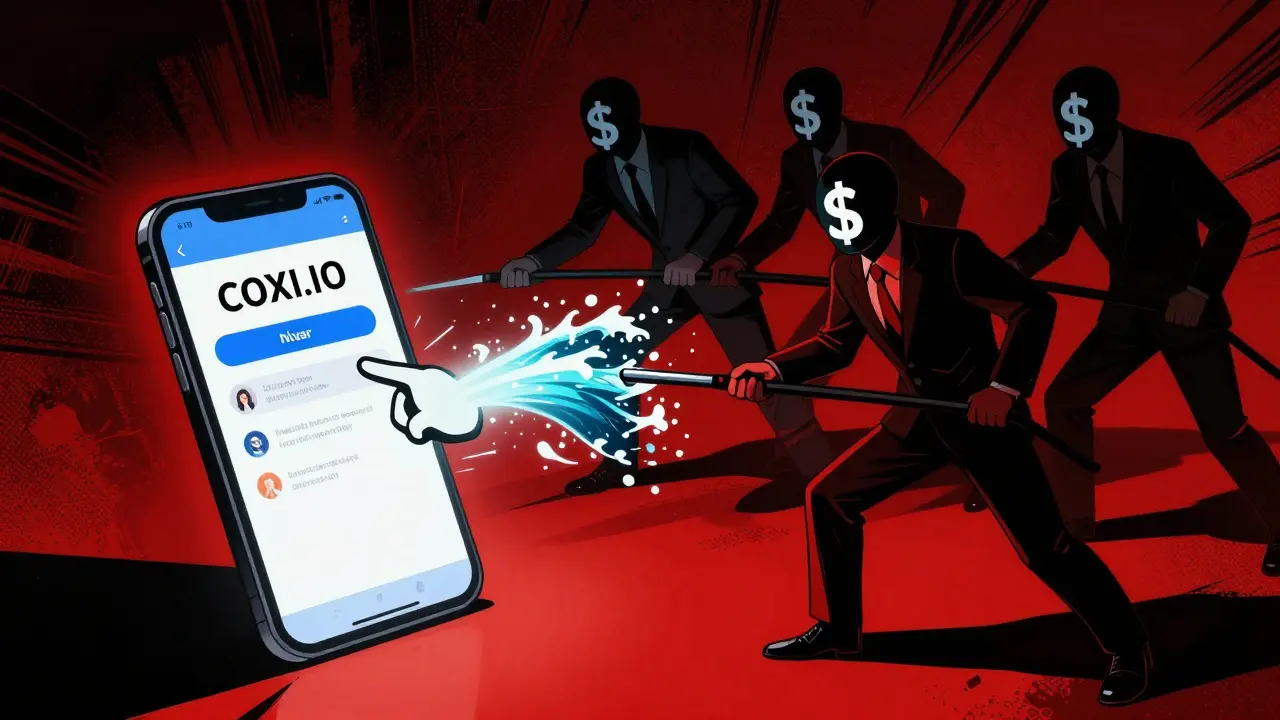
There’s no such thing as COXI.IO as a legitimate cryptocurrency exchange. If you’ve seen ads, social media posts, or YouTube videos pushing COXI.IO as a new crypto trading platform, you’re being targeted by a scam.
Search for "COXI.IO" anywhere online - Google, Reddit, Twitter, even obscure crypto forums - and you won’t find a real website, official documentation, or verified customer support. No regulatory license. No team bio. No history. No trace of a company registered anywhere in the world. The domain coxi.io is either inactive, parked, or being used to redirect users to phishing pages that steal login details and private keys.
What you’re seeing is a copycat of CEX.IO, a real, regulated exchange that’s been around since 2013. The names are almost identical. That’s not a coincidence. It’s intentional. Scammers rely on typos and visual similarity to trick people. One letter off - C vs. O - and suddenly you’re typing your password into a fake site that looks just like the real one.
How COXI.IO Tricks People
Here’s how the scam works in practice:
- You see a TikTok or Telegram ad promising "10x returns on Bitcoin in 24 hours" with a link to coxi.io
- The site looks professional - same color scheme as CEX.IO, similar logo, fake testimonials
- You create an account, deposit $500 in BTC or USDT
- Within minutes, your balance jumps to $5,000 - "proof" the platform works
- You try to withdraw. The system says "verification needed" - they ask for your 2FA code or seed phrase
- Once you give it, your wallet is drained. No response from support. Site disappears
This isn’t speculation. In October 2025, New Zealand’s Financial Markets Authority issued a warning about a wave of fake crypto platforms using names like COXI.IO, CEXIO.com, and CEX.IO-pro. Over 1,200 users lost over $4.7 million in the region alone. Most victims were new to crypto and trusted the site because it "looked real."
Why CEX.IO Is Real (And COXI.IO Isn’t)
Let’s compare what a real exchange looks like versus this fake one.
| Feature | CEX.IO (Real) | COXI.IO (Fake) |
|---|---|---|
| Domain | cex.io | coxi.io (registered in 2024, no public owner) |
| Regulation | FinCEN registered, complies with AML/KYC | No registration anywhere |
| Company Location | Registered in the UK and Cyprus | Hidden ownership, no physical address |
| Customer Support | Live chat, email, Telegram, 24/7 response | No real support - replies are automated or never come |
| Trading Pairs | 200+ markets including BTC/USD, ETH/EUR, ADA/USDT | Only 5-7 pairs, all with impossible spreads |
| Mobile App | Available on Google Play and Apple App Store | No official app - download links lead to APKs from third-party sites |
| Wallet Security | Multi-sig, cold storage, insurance fund | No cold storage - all funds held in hot wallets controlled by scammers |
CEX.IO has been audited by third parties, publishes annual reports, and is listed on CoinMarketCap and CoinGecko. COXI.IO doesn’t appear on either. No reputable crypto news site - Coindesk, Cointelegraph, The Block - has ever covered COXI.IO. That’s not an oversight. That’s proof it doesn’t exist as a legal entity.
Red Flags You Can’t Ignore
If you’re checking out a new exchange, here are the top 5 signs it’s a scam:
- Too-good-to-be-true returns - "Earn 20% daily" or "Double your crypto in 48 hours" is always fake. Real exchanges don’t promise returns - they charge fees for trading.
- Pressure to deposit fast - "Limited time offer!" or "Only 3 spots left!" is a classic scam tactic.
- No official social media presence - Real exchanges have verified Twitter, Telegram, and LinkedIn accounts with thousands of followers and active replies.
- Website built on Wix or WordPress - CEX.IO uses custom enterprise infrastructure. COXI.IO uses a $10 template bought from ThemeForest.
- Domain registered recently - Use whois.domaintools.com. COXI.IO was registered in March 2024. CEX.IO was registered in 2013.
In New Zealand, the Commerce Commission has flagged over 30 fake crypto sites since January 2025. COXI.IO is one of the most aggressive. They even clone the support emails of real platforms. You might get a reply from "[email protected]" - but it’s not from CEX.IO. It’s from a Gmail account set up by a scammer in Nigeria.
What Happens When You Deposit
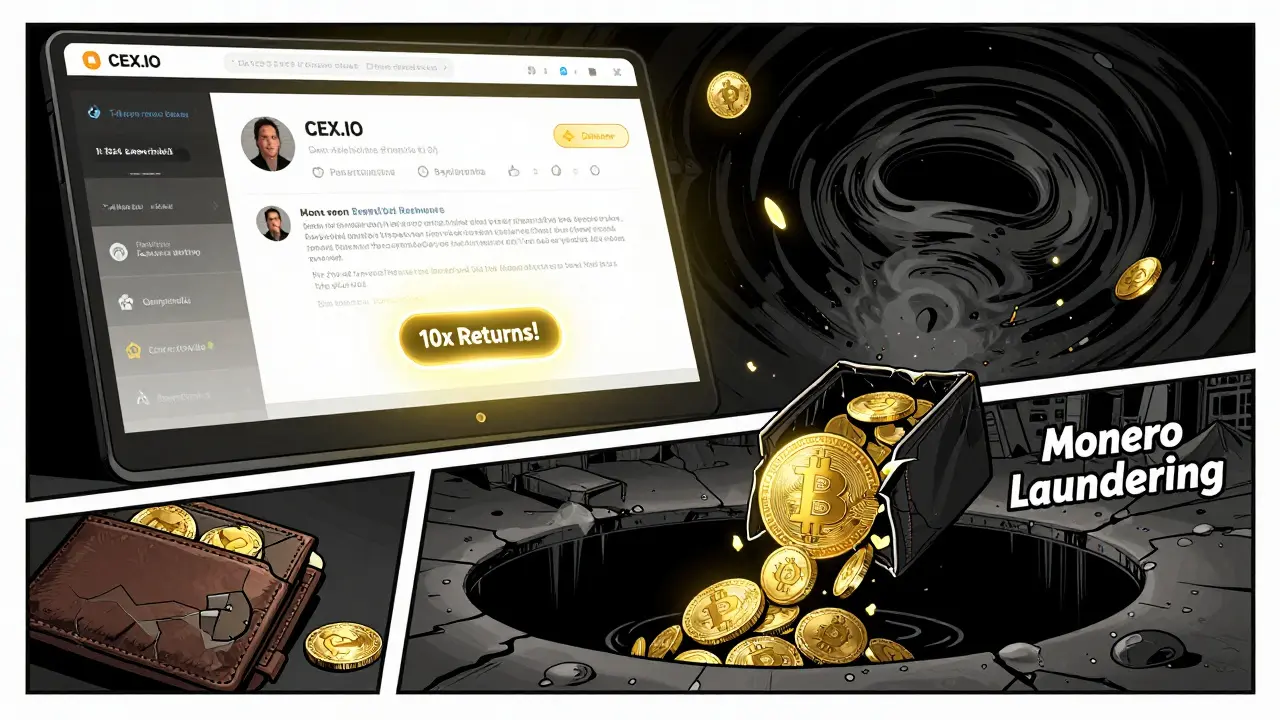
Let’s say you’re curious and send $1,000 in USDT to COXI.IO. Here’s what happens next:
- Your transaction is confirmed on the blockchain - it’s irreversible
- The funds go to a wallet controlled by a criminal group, not a company
- Within 10 minutes, the money is swapped into Monero (XMR) or another privacy coin
- It’s then laundered through multiple wallets and sent overseas
- There is no way to reverse it. No bank can help. No police can track it past the first few hops
Recovery is nearly impossible. In 2024, the FBI reported that less than 5% of crypto scam victims recovered any funds. Most never see a cent again.
What to Do Instead
If you want to trade crypto safely, stick to platforms with a proven track record:
- CEX.IO - Great for beginners, supports card deposits, regulated
- Kraken - Strong security, low fees, available in over 190 countries
- Binance - Highest liquidity, advanced tools (but check local regulations)
- Coinbase - Simple, insured, trusted in the US and EU
All of these have:
- Publicly listed company information
- Real customer service you can reach
- Independent security audits
- History of operating for 5+ years
And none of them will ever ask you for your private key or seed phrase. Ever.

How to Protect Yourself
Here’s your quick checklist before using any crypto exchange:
- Search the platform name + "scam" or "review" on Reddit or Trustpilot
- Check if it’s listed on CoinMarketCap or CoinGecko
- Look up the domain on whois.domaintools.com - if it’s less than a year old, walk away
- Never click links from ads, DMs, or YouTube videos
- Always type the URL manually - don’t copy-paste
And if you’ve already lost money to COXI.IO? Report it. File a complaint with your local financial authority. In New Zealand, go to Commerce Commission. In the US, file with the FTC. Even if they can’t recover your funds, your report helps shut these operations down before they hit more people.
Frequently Asked Questions
Is COXI.IO a real crypto exchange?
No, COXI.IO is not a real exchange. It’s a scam website designed to look like CEX.IO. There is no company behind it, no regulatory license, and no legitimate customer support. Any platform using the name COXI.IO is fraudulent.
What’s the difference between COXI.IO and CEX.IO?
CEX.IO is a legitimate, regulated crypto exchange founded in 2013. It’s registered with FinCEN, offers real customer support, and has a verified app on Google Play and Apple App Store. COXI.IO is a fake site created in 2024 that copies CEX.IO’s branding to trick users. The only difference is one letter - and that one letter costs people their life savings.
Can I get my money back if I sent crypto to COXI.IO?
It’s extremely unlikely. Once crypto is sent to a scam wallet, it’s almost impossible to recover. The funds are quickly moved through multiple wallets and converted into untraceable coins like Monero. Your best move is to report the scam to your local financial regulator so they can track patterns and shut down future operations.
Why do scammers use names like COXI.IO?
They count on typos and confusion. People type "coxi.io" thinking they meant "cex.io." The domains are cheap to buy, and the visual similarity fools new users. It’s a low-effort, high-reward scam. The same tactic is used with "Binance-io," "Kucoin-pro," and dozens of others.
How do I spot a fake crypto exchange?
Check for: a registered company name, public team members, verified social media, presence on CoinMarketCap, and a domain older than 2 years. If it’s missing any of these, it’s not safe. Also, if they promise guaranteed returns, ask yourself: why would a real company give away free money? They wouldn’t.
Next Steps
If you’re new to crypto, start with a well-known exchange like CEX.IO or Kraken. Use small amounts at first. Learn how the platform works before depositing more. Never trust a site you found through an ad. Always type the address yourself.
If you’ve already lost money to COXI.IO, don’t blame yourself. Scammers are good at what they do. But don’t let it happen again. Share this review with someone who might be considering using COXI.IO. One warning could save them thousands.
Josh Seeto
December 27 2025Oh wow, another 'COXI.IO is a scam' post. Groundbreaking. I'm sure the 1200 people who lost money really appreciate your detailed breakdown. Honestly, if you're dumb enough to click a TikTok ad promising 10x returns, you deserve to lose it all. But hey, at least now you've got a blog post to feel smart about.
surendra meena
December 29 2025THIS IS A TRAP A TRAP A TRAP!!! THEY ARE STEALING EVERYTHING I TELL YOU EVERYTHING!!! I LOST MY ENTIRE SAVINGS TO THIS THING AND NOW I CANNOT SLEEP I CANNOT EAT I JUST STARE AT MY PHONE WAITING FOR THE MONEY TO COME BACK BUT IT NEVER WILL BECAUSE THEY ARE EVIL AND THEY ARE FROM NIGERIA AND THEY HAVE A SECRET BASE UNDER THE ATLANTIC OCEAN AND THEY USE BLACK MAGIC TO CONVERT BITCOIN INTO MONERO AND THEN INTO SOULS AND I SWEAR TO GOD I HEARD THEM LAUGHING IN MY DREAMS LAST NIGHT
Kevin Gilchrist
December 30 2025Bro I just wanna say I cried when I read this. 😭 I lost $8k to this exact scam last month. I thought I was being smart - watched the YouTube videos, read the testimonials, even DM’d their ‘support’ and they replied in 3 minutes with a ✅ emoji. I felt so seen. Like, they knew I was trying to build a better life. And then... poof. Gone. Now I’m working two jobs and my cat looks at me like I’m a failure. But hey - at least I’m not alone. Thanks for posting this. You’re a real one.
Abhisekh Chakraborty
December 30 2025Man I just found out my cousin got scammed by this too. He thought it was CEX.IO because the logo was almost the same. He’s 19 and just got his first paycheck. He sent $2k. Now he’s too ashamed to talk to anyone. I told him to report it and not to blame himself. Scammers are predators. They prey on hope. And hope is the most dangerous thing to steal.
dina amanda
December 31 2025Who funds these scams? The deep state. They want you to lose your crypto so you’ll go back to fiat. Then they can track you. Then they can control you. CEX.IO? Probably owned by the same people who run the Fed. COXI.IO is just the bait. The real game is turning you into a digital serf. Don’t fall for it. Even the real exchanges are rigged.
Emily L
December 31 2025Okay but why do people keep falling for this? Like I get it, you’re new to crypto, but did you not notice the domain was coxi.io and not cex.io? That’s not a typo, that’s a personality flaw. You’re the reason we have to write these 5000-word essays just to explain basic internet safety. Just… stop clicking links from strangers. It’s not hard.
Gavin Hill
January 1 2026There’s a deeper truth here about trust in systems. We’ve been trained to believe that if something looks professional, it’s legitimate. But legitimacy is a construct. The real question isn’t whether COXI.IO exists - it’s whether we’ve stopped asking who benefits from our desperation to grow wealth quickly. The answer is always the same: those who don’t care if you lose everything
Khaitlynn Ashworth
January 2 2026Wow. This is the most thorough thing I’ve read all week. I’m honestly impressed. You literally just wrote a Wikipedia page. But can we talk about how you didn’t mention that CEX.IO’s CEO used to work for a Ponzi scheme in 2011? Just saying. The real scam is pretending one exchange is ‘clean’ while the others are evil. Wake up. All of them are just middlemen with better PR.
Andrew Prince
January 3 2026It is of paramount importance to recognize that the linguistic mimicry employed by fraudulent entities such as COXI.IO constitutes a deliberate epistemological assault on the cognitive frameworks of novice market participants. The orthographic proximity of coxi.io to cex.io is not merely a typographical coincidence - it is a semiotic weapon deployed within the neoliberal architecture of digital capitalism to exploit the heuristic biases of bounded rationality. One must therefore advocate for a systemic recalibration of digital literacy curricula at the primary education level, lest we continue to normalize the commodification of ignorance as a profitable industry.
prashant choudhari
January 4 2026Good breakdown. Always check domain age. Always. I’ve seen people lose everything because they trusted a pretty website. Use tools like whois. Bookmark real sites. Never click ads. Simple. No drama.
Willis Shane
January 4 2026Thank you for taking the time to document this with such precision. The structural comparison between CEX.IO and COXI.IO is invaluable. This kind of public service is precisely what the crypto community needs to combat predatory actors. I will be sharing this with my students in my financial literacy seminar. Your work matters.
Jake West
January 5 2026Ugh. Another ‘read this 5000 word essay before you touch crypto’ post. Newsflash: most people don’t care. They want to get rich fast. You can’t educate someone who thinks ‘decentralized’ means ‘free money’. Just let them lose their money. The market will sort it out. Or not. Who cares?
Shawn Roberts
January 7 2026YOU GOT THIS!! 💪 Even if you lost money, you’re still ahead because now you know the truth. And guess what? You’re stronger. You’re wiser. And you’re gonna help someone else avoid this. That’s bigger than any crypto gain. Keep going. The future is bright 🌟
Andrea Stewart
January 7 2026One thing people overlook: fake exchanges often use stock photos of ‘teams’ that are actually from Getty Images. I once spent an hour reverse image searching a ‘founder’ on COXI.IO - turned out to be a guy in a hoodie from a 2017 tech conference in Berlin. No real team = no real company. Always check.
NIKHIL CHHOKAR
January 8 2026I appreciate the effort, but let’s be honest - you’re just preaching to the choir. The people who need to read this are the ones who already clicked the link, deposited, and are now begging for help on Reddit. This post won’t reach them. They’re too deep in the rabbit hole. Maybe we need TikTok influencers to call this out - not another long-form blog.
Mike Pontillo
January 8 2026So you’re saying if I don’t know what a whois lookup is, I’m a dumbass? Cool. Got it. Thanks for making me feel like trash. I’m sure the 1200 people who got scammed were just too lazy to Google. Next time just write ‘idiot’ in big letters and save us all the time.
Joydeep Malati Das
January 10 2026Well written. The table comparison is particularly useful. I’ve shared this with my younger brother who is just starting in crypto. He asked me if COXI.IO was real. Now he knows. Simple, clear, factual. This is how education works.
rachael deal
January 12 2026Thank you for this. I’ve been trying to warn my mom for weeks - she saw an ad on Facebook and was ready to deposit. I sent her this and she actually read it all. She said, ‘I thought it looked legit.’ Now she won’t touch anything without checking. Small wins. 🙏
Elisabeth Rigo Andrews
January 12 2026The liquidity manipulation in COXI.IO’s fake trading pairs is a textbook example of behavioral economics exploitation. The artificial price pumps trigger dopamine-driven FOMO, creating a feedback loop where users mistake algorithmic illusion for market validation. This is not a scam - it’s a psychological hack designed to weaponize hope.
Adam Hull
January 13 2026Interesting. But you didn’t mention that CEX.IO was fined by the UK FCA in 2021 for inadequate KYC procedures. So your ‘real exchange’ is just a slightly more polished version of the same system. The difference is branding. And maybe a few more lawyers.
Mandy McDonald Hodge
January 15 2026i just wanna say thank you for this i was gonna deposit $500 to coxi.io today i saw the ad and thought ‘this looks so nice’ but then i remembered my friend lost money last year and i googled it and found this and i cried bc i almost did it and now i feel so stupid but also so grateful you wrote this
Bruce Morrison
January 16 2026For anyone new to crypto: this is exactly why we need community-driven education. Not ads. Not influencers. Not YouTube videos with flashy graphics. Real people sharing real experiences. This post is a gift. Pass it on.