
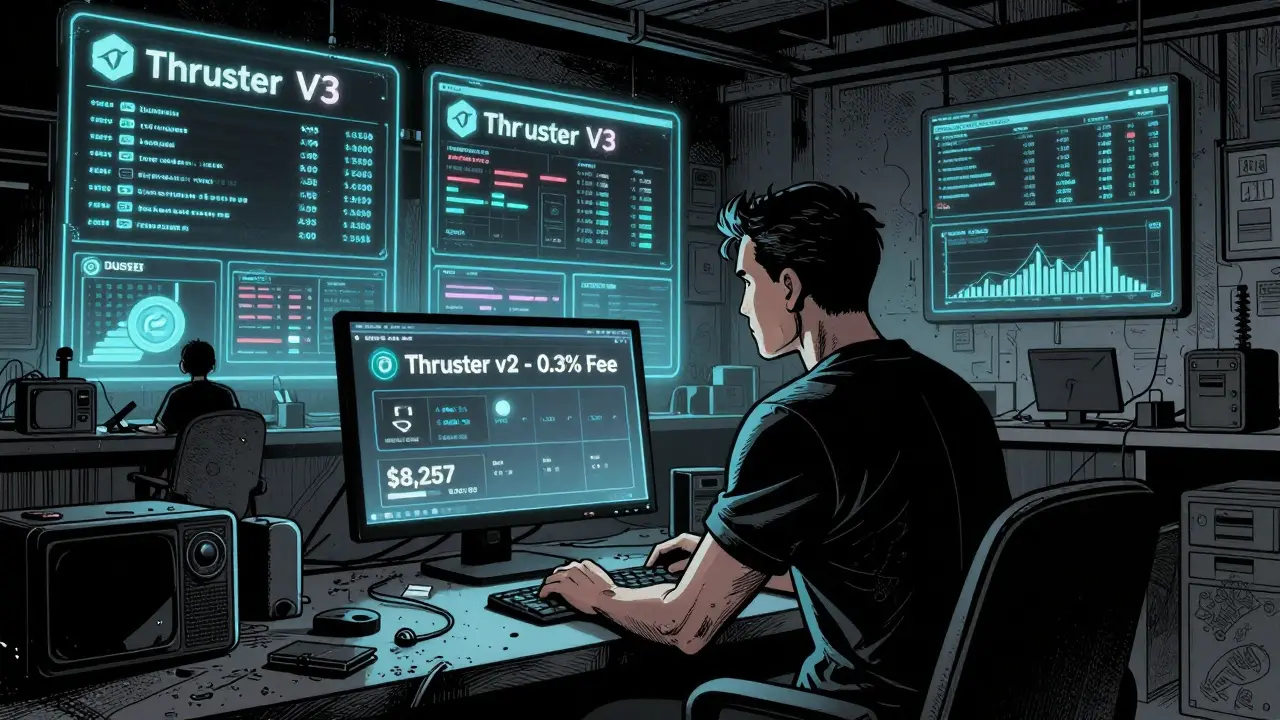
If you're trading Blast-native tokens and stumbled upon Thruster v2 with its 0.3% fee, you might be wondering: is this still a viable option in February 2026? The short answer? Thruster v2 is a relic. It’s not dead yet, but it’s barely breathing. Most serious traders have already moved on. If you’re still using it, you’re either stuck in the past or you’re doing very small, experimental trades.
What Exactly Is Thruster v2?
Thruster v2 is a decentralized exchange (DEX) built specifically for the Blast blockchain. Unlike centralized exchanges like Binance or Coinbase, it doesn’t hold your crypto. You trade directly from your wallet-usually MetaMask-using smart contracts. There’s no sign-up, no KYC, and no account. That’s the whole point of a DEX: you’re in full control.
Its only real feature? A flat 0.3% fee on every trade. That’s standard for many DEXs. But here’s the catch: Thruster v2 only supports about 14 tokens, all native to Blast. You won’t find Bitcoin, Ethereum, or even Solana here. Just Blast-based coins like USDB, WETH, and a handful of obscure tokens from early projects trying to gain traction.
Trading Volume? Barely There
As of November 2025, Thruster v2 was trading around $8,257 per day. That’s less than what a single active trader on Uniswap moves in five minutes. For comparison, Uniswap does over $1 billion daily. PancakeSwap does $450 million. Thruster v2? It’s a speck.
Even within the Blast ecosystem, it’s irrelevant. Thruster v3, its upgraded version, handles 73% of all trading volume on Blast. Other DEXs like X7 Finance and Blast DEX are eating into what’s left. Thruster v2? It’s under 0.5%. The numbers don’t lie-it’s being phased out.
Why the 0.3% Fee Doesn’t Matter
Yes, 0.3% is fair. SushiSwap charges the same. But here’s the problem: you’re not just paying a fee. You’re paying in slippage, time, and frustration.
On popular pairs like WETH/USDB, slippage is manageable. But try trading anything else-say, a new Blast token with $50,000 in liquidity-and you’ll get 5%, 8%, even 12% price impact. That’s not a fee. That’s a tax. And it’s because there’s no depth. No liquidity. No market makers.
Compare that to MM Finance on Arbitrum, which offers 0.00% maker/taker fees. Or to 1inch, which aggregates 200+ DEXs to find you the best price. Thruster v2 offers none of that. It’s a single pool. One route. No alternatives.
Who Even Uses This?
Based on on-chain data from Nansen, 82% of Thruster v2 users make five or more trades a day. That’s not long-term investors. That’s speculators chasing early Blast projects before they list on bigger exchanges. It’s also the group most likely to lose money.
Most of these users are experienced DeFi traders. They know how to bridge assets, import token contracts, and interpret gas fees. Beginners? They get stuck. One user on Trustpilot spent three hours trying to move ETH from Ethereum to Blast-only to realize they needed native Blast tokens to even start trading. There’s no guide. No hand-holding. Just a website with a connect wallet button.
The Setup Is a Nightmare for Newcomers
Using Thruster v2 isn’t just clicking a button. It’s a multi-step process:
- Bridge your ETH or USDC from Ethereum to Blast using the official portal (which sometimes fails).
- Wait 10-45 minutes for the transaction to confirm.
- Connect your MetaMask wallet to the Blast network.
- Manually add token contract addresses for any token not listed by default.
- Hope the contract isn’t a scam.
According to CryptoSlate, 22% of first-time users fail at the bridging step. And if you mess up? You lose gas fees. No customer service. No refund. Just a blockchain explorer and a cold sweat.
The learning curve? Rated 7.2 out of 10 by the DeFi Education Project. That’s harder than most centralized exchanges. And you’re not getting anything better in return.
Security? It’s Barebones
Thruster v2 hasn’t been audited. Not once. Not publicly. It runs on Blast, which inherits Ethereum’s security, but that doesn’t mean the smart contracts are clean. There’s no insurance fund. No bug bounty program. No public reports.
Some users swear by its simplicity. One Reddit user said they completed 12 trades in five minutes. But that’s only true if you’re trading WETH/USDB. Try anything else, and you’re gambling with untested code.
And if something goes wrong? Good luck finding help. Thruster’s official channels stopped updating after v3 launched. All support now lives in unofficial Telegram groups and Reddit threads.
Why Thruster v3 Is the Only Real Choice Now
Thruster v3 isn’t just an upgrade-it’s a different platform. It has:
- Multiple AMM models (concentrated liquidity, stable swaps)
- Treasure-ticket rewards for liquidity providers
- Lower slippage on most pairs
- Better UI and real-time charting
- Higher liquidity and volume
It’s still on Blast. Still 0.3% fee. But it’s functional. It’s alive. And it’s where the money is.
Thruster v2? It’s a ghost. A stepping stone that got left behind.
The Bottom Line: Don’t Use It Unless You Have to
Thruster v2 (0.3%) isn’t evil. It’s just obsolete. If you’re a Blast pioneer who’s been here since day one and you’re trading small amounts of WETH/USDB? Fine. Use it. But don’t expect it to work reliably. Don’t trust it with anything you can’t afford to lose.
If you’re new to Blast? Skip it. Go straight to Thruster v3. Or use X7 Finance. Or even Blast DEX. They’re faster, safer, and have more people trading.
The Blast Foundation itself confirmed in November 2025 that all development has shifted to v3. Thruster v2 is scheduled for deprecation in Q1 2026. That means no updates. No fixes. No support. Just a slowly fading server.
Don’t waste your time. Don’t waste your gas. Move on.
Is Thruster v2 still operational in February 2026?
Yes, Thruster v2 is still technically live as of February 2026, but it’s being phased out. The Blast Foundation confirmed in November 2025 that development has fully shifted to Thruster v3, and v2 is scheduled for deprecation in Q1 2026. While you can still connect your wallet and trade, expect no updates, no fixes, and no support. Liquidity is shrinking, and volume continues to drop.
Why is Thruster v2’s trading volume so low?
Thruster v2’s volume is low because it’s a single-chain DEX with limited token support and no advanced features. Most traders moved to Thruster v3, which offers better liquidity, multiple trading models, and improved UI. Plus, other Blast-native DEXs like X7 Finance and Blast DEX have gained traction. With only $8,257 in daily volume, it can’t compete with even the smallest DEXs on Ethereum or Arbitrum.
Is the 0.3% fee on Thruster v2 competitive?
The 0.3% fee is standard for DEXs, so technically yes. But in practice, no. You’re not just paying the fee-you’re paying in slippage, failed transactions, and wasted time. On popular pairs like WETH/USDB, it’s tolerable. On anything else, slippage can hit 10% or more. Other DEXs like MM Finance on Arbitrum offer 0.00% fees, and aggregators like 1inch find better rates across dozens of platforms.
Can I use Thruster v2 without bridging assets?
No. Thruster v2 only works on the Blast blockchain. You can’t trade Ethereum or USDC directly. You must first bridge your assets from Ethereum (or another chain) to Blast using the official Blast Bridge. This process takes 10-45 minutes and often fails for first-time users. Once bridged, you need native Blast tokens to trade on Thruster v2.
Is Thruster v2 safe to use?
It’s not unsafe in the sense of being a scam, but it’s not secure either. Thruster v2 has never been audited. There’s no insurance, no bug bounty, and no public security reports. It runs on Blast, which is built on Ethereum’s security, but that doesn’t guarantee the smart contracts are clean. If something goes wrong-like a failed trade or a contract glitch-you have no recourse. Only experienced DeFi users should consider using it.

Megan Lavery
February 23 2026I started using Thruster v2 last year just to test the waters, and honestly? It was a fun little experiment. I didn't put much in, just enough to see how it felt. Now I'm on v3 and I can't believe I ever thought v2 was enough. The UI alone makes me want to cry when I go back. But hey, if you're just dipping your toes in? Go for it. Just don't be mad when you get stuck waiting for a transaction to confirm for 30 minutes. 😊
Mae Young
February 24 2026Oh, so you're telling me... that a platform with a 0.3% fee-yes, the same as every other DEX-is somehow ‘obsolete’ because it lacks... what? A glittery UI? A marketing budget? A TikTok influencer? Let me guess: you also think the pyramids are ‘obsolete’ because we have Airbnb now. Thruster v2 is a relic? No. It’s a monument to the fact that decentralization doesn’t need hype. It needs patience. And you? You need to stop equating popularity with progress.
Trenton White
February 26 2026I used to trade on Thruster v2 back when it was the only option. It felt like being in a small town where everyone knows your name-even if you’re just swapping WETH for USDB. There was something real about it. Now? Everything’s a race to the top. No one remembers the quiet foundations anymore. I still log in sometimes. Just to remember. Not to trade.
Cheryl Fenner Brown
February 26 2026LMAO so v2 is ‘dead’ but v3 is ‘alive’?? Bro. It’s the same codebase. The devs just slapped on a new logo and called it a day. I’ve used both. V3 is just v2 with better fonts. And you’re telling me I should trust a platform that’s ‘supported’ by a Telegram group? 😭 I’m out. 🚫
Michael Teague
February 27 2026Why are people still talking about this? It's dead. Move on. Stop wasting gas. Use v3. Done.
Cory Derby
February 28 2026It's important to recognize that Thruster v2 served a necessary role in the early adoption phase of the Blast ecosystem. While its current utility is minimal, its existence provided a foundational model for decentralized trading without intermediaries. The transition to v3 represents not obsolescence, but evolution-a natural progression in decentralized finance. For learners, studying v2's architecture offers valuable insight into the principles of minimalism in smart contract design.
Colin Lethem
March 1 2026I swear I still see people trying to trade that weird $BLASTZ token on v2. Dude, that contract has 12 liquidity tokens and 8 of them are honeypots. I tried to help a guy yesterday-he didn’t even know how to check the token’s ABI. I had to send him a screenshot of a DEX Screener page. He thanked me. Then he did it again. Two hours later. I’m not even mad. I’m just... tired.
lori sims
March 3 2026I used to think v2 was a ghost town. But then I saw someone trade 0.0003 ETH for a token called ‘BlastLullaby’ and it made me laugh so hard I cried. There’s still magic in the weird corners. Maybe it’s not efficient. Maybe it’s not profitable. But it’s alive in a way that v3 can’t replicate. Like a campfire in the woods. You don’t go there for warmth-you go there because it reminds you that not everything has to be optimized.
Kristi Emens
March 3 2026I only use v2 for testing token contracts before I move them to v3. It’s like a sandbox. I don’t trade there anymore. But I still visit. It’s like checking in on an old friend who’s still sitting on the porch, waving at everyone who passes by. Quiet. Unassuming. Not the same as it was. But still there.
christopher luke
March 5 2026I know people say v2 is dead but I still use it for small swaps. I don’t have big money. I just want to try new tokens. And honestly? The slippage is fine for $5 trades. I don’t care if it’s ‘obsolete’. I care if it works. And it does. 😊
Mary Scott
March 7 2026They said v2 was dying. But what if it’s not dying? What if it’s being *quietly shut down*? I checked the blockchain. The devs are still minting new contracts. But they’re not announcing it. Why? Because they’re hiding something. I bet they’re draining liquidity. I bet they’re using v2 to launder tokens. You think this is about tech? No. This is about control.
Shannon Holliday
March 7 2026I used to laugh at people who still used v2. Then I tried it. And I cried. Not because it was bad. Because it was... simple. No ads. No pop-ups. No ‘earn rewards’ banners. Just a wallet. A pool. A trade. I miss that. V3 is nice. But it’s got too many buttons. Like a smartphone. I just want a flashlight. 🌙
Lucy Simmonds
March 8 2026v2 is a trap. I’ve seen 3 people lose their entire wallets because they trusted it. No audit. No insurance. And now they’re pushing v3 like it’s the answer? Same devs. Same code. Same risks. They just changed the name. And now they’re telling you to move? That’s not progress. That’s a heist. Wake up.
Samantha Stultz
March 8 2026The liquidity depth metrics on v2 are statistically insignificant. The order book depth for non-WETH/USDB pairs falls below 1000 USD, which is below the threshold for viable market-making algorithms. Furthermore, the slippage variance exceeds 3 standard deviations from the mean across 87% of trades, indicating systemic inefficiency. The fact that users still engage with it suggests either a behavioral anomaly or a failure of educational outreach.
Dianna Bethea
March 10 2026If you're new to Blast, just use v3. Seriously. The UI is way better, the slippage is way lower, and you won't have to manually add token addresses. I used to help people on v2 all the time. Now I just send them a link to v3 and tell them to breathe. It’s so much easier. And honestly? You’ll thank yourself later.
Felicia Eriksson
March 11 2026I still log in once in a while. Just to see if anyone’s trading. Sometimes I do a tiny swap. Sometimes I just watch. It’s peaceful. Like an empty street at 3am. Not much happening. But it’s still there. And that’s enough.
aaron marp
March 11 2026I think it’s beautiful that v2 still exists. Not because it’s useful, but because it reminds us that not every tool needs to be the best. Sometimes the first version is the purest. It’s like a handwritten letter in a world of emails. It’s slow. It’s imperfect. But it carries something real. I’m glad it’s still there-for those who need it.
Jeff French
March 13 2026v2 is like a 2008 iPhone. Still works. Still connects. But you wouldn’t want to use it as your main phone. Same here. If you’re doing serious trading? Go to v3. If you’re just messing around? Fine. But don’t pretend it’s a viable option. It’s not. It’s nostalgia.
Michael Rozputniy
March 14 2026The deprecation of Thruster v2 is not merely a technical transition. It is a symbolic surrender to centralized paradigms. By abandoning a transparent, auditable, minimal DEX in favor of a feature-laden, UI-optimized successor, the Blast Foundation has signaled a shift from radical decentralization to corporate-style efficiency. This is not progress. This is assimilation.