
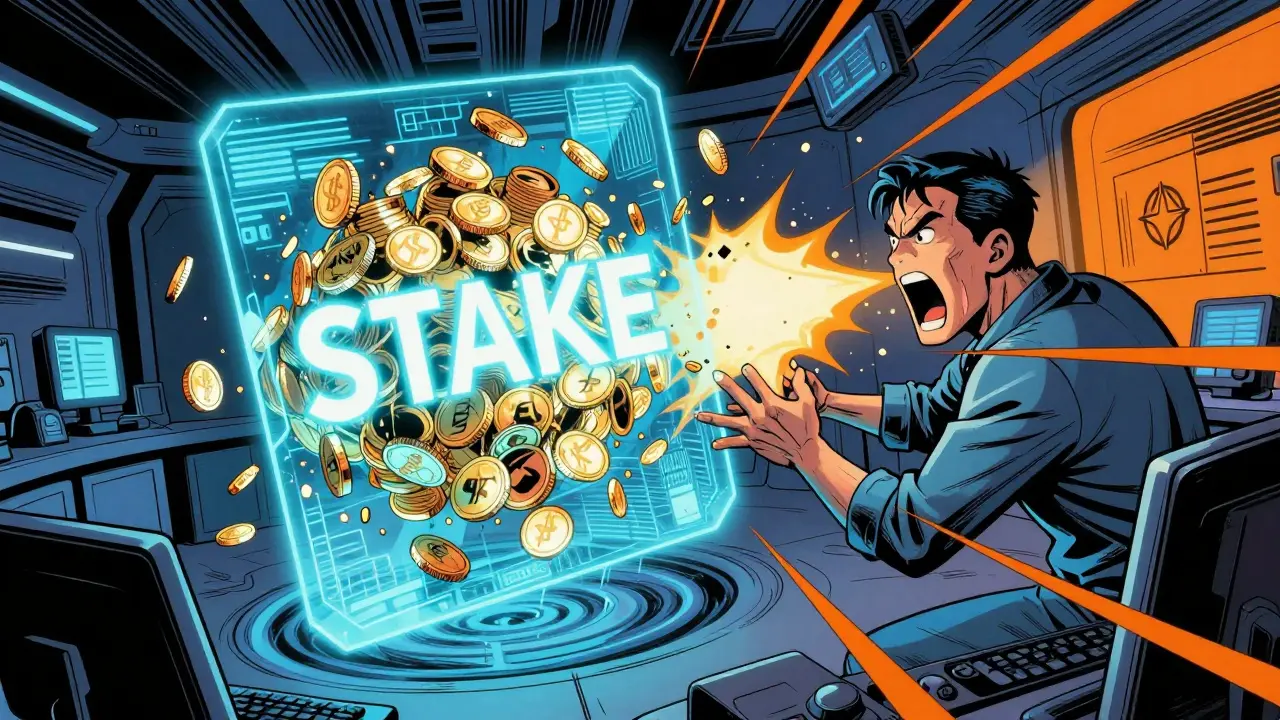
Imagine putting up a massive cash deposit to get a job, only to have your boss take a huge chunk of it away because you made a mistake or tried to cheat the system. That is essentially how slashing penalties is a mechanism in proof-of-stake blockchains that removes a portion of a validator's staked cryptocurrency as punishment for violating network rules. It is the "stick" that balances the "carrot" of staking rewards, ensuring that those running the network stay honest and attentive.
In a Proof-of-Stake (PoS) is a consensus mechanism where block creators are chosen based on the number of coins they hold and lock up as collateral system, validators don't use electricity-hungry hardware like miners do. Instead, they use capital. If there were no penalties for lying or disappearing, a validator could try to attack the network without any risk. Slashing changes that math, making it financially irrational to act maliciously.
Why Blockchains Use Slashing
The core goal of slashing is to maintain "skin-in-the-game." When a validator locks up tokens, they are essentially signing a contract: "I will follow the rules, and if I don't, you can take my money." This creates a powerful economic deterrent. If a validator thinks about double-signing a block to steal funds, they have to weigh the potential gain against the certain loss of their stake.
Slashing doesn't just target malicious hackers; it also discourages negligence. While some networks distinguish between a deliberate attack and a technical glitch, the financial hit remains a signal that the operator needs to improve their infrastructure. This keeps the entire network lean and reliable, as only those capable of maintaining high uptime and security can thrive.
Common Types of Slashable Offenses
Not all mistakes are created equal. Most blockchains categorize offenses by the level of threat they pose to the network's integrity. Some are simple "slaps on the wrist," while others result in total financial ruin.
- Double Signing: This is the cardinal sin of staking. It happens when a validator signs two different versions of the same block. This can lead to chain splits (forks) and is usually met with the harshest penalties, sometimes ranging from 5% to 100% of the stake.
- Surround Voting: A more complex error where a validator signs a vote that contradicts a previous vote they made on the same block's history.
- Downtime/Inactivity: This is less an "attack" and more of a failure. If a validator's server goes offline, they miss their chance to propose or vote on blocks. These "leaks" are usually small but add up over time.

How Ethereum Handles Slashing
Ethereum has one of the most sophisticated slashing pipelines. It doesn't just take the money and move on; it uses a multi-stage process to ensure the penalty fits the crime. When a Validator is a node operator responsible for proposing blocks and voting on them to maintain the Ethereum network commits a slashable offense, the protocol triggers an immediate response.
First, the validator is marked as slashed and forced to exit the active set. They are put into an exit queue for roughly 36 days. During this window, they stop earning rewards and start losing a small amount of ETH-about 8,000 GWei-for every single epoch (6.4 minutes) they miss. This effectively drains their balance further while they are being removed.
The initial hit for a standard 32 ETH stake is usually around 1 ETH. However, the real danger lies in the correlation penalty. If one validator gets slashed, it might be a fluke. If 1,000 validators get slashed at the exact same time, it looks like a coordinated attack. In these cases, the penalty scales up aggressively, potentially wiping out the entire stake.
| Penalty Phase | Amount/Cost | Trigger/Condition |
|---|---|---|
| Initial Slash | ~1 ETH | Immediate proof of offense |
| Inactivity Leak | ~0.07 ETH | Missed epochs during exit queue |
| Whistleblower Reward | ~0.0625 ETH | Paid to the reporter from the penalty |
| Correlation Penalty | Variable (Up to 100%) | High number of simultaneous slashes |
The Role of Whistleblowers
The network doesn't just rely on a central authority to catch cheaters. It turns the community into a police force. Participants who find evidence of a validator's misbehavior and submit it to the blockchain are called "slashers" or whistleblowers.
To make this worth their while, the protocol pays them. In Ethereum, a small portion of the slashed funds (about 0.0625 ETH) goes to the person who reported the crime. This creates a positive incentive loop: the more people hunt for bad actors, the safer the network becomes. It transforms security from a chore into a profitable activity.
Slashing Across Different Blockchains
While the concept is the same, not every network handles punishment the same way. Different protocols have different philosophies on how to handle failure.
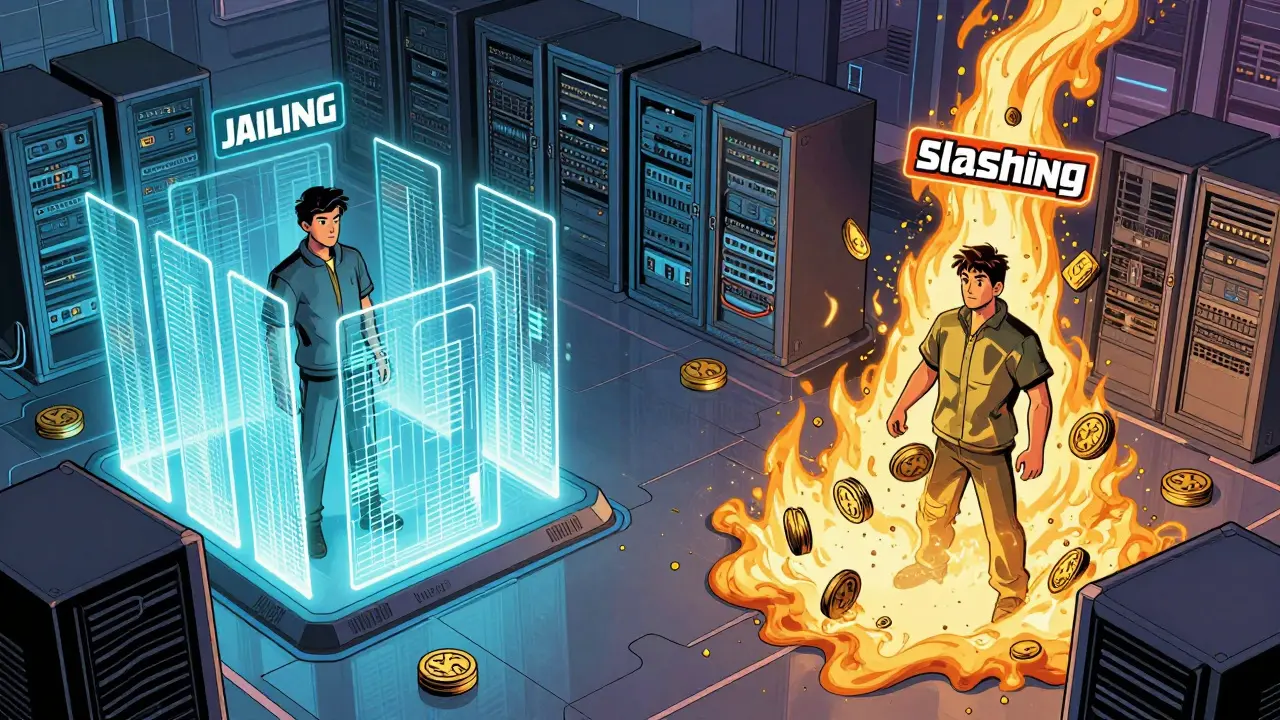
Cosmos is a decentralized network of independent parallel blockchains uses a "jailing" mechanism. Instead of immediately burning tokens, a validator might be jailed-meaning they are suspended from participating and earning rewards-until they can prove they've fixed their issues and pay a set fine.
Polkadot employs an "offender-count" formula. This means the more people who fail together, the higher the penalty. They also use ejections for poor performance, which removes the validator from the set without necessarily taking their money, treating it more like a performance review than a criminal trial.
Tezos combines both worlds, using slashing for active misbehavior and ejections for those who simply can't keep their servers running. Some networks even use "tombstoning," which permanently bans a validator's identity from ever returning to the network.
Practical Tips for Avoiding Slashing
If you are running a node, you aren't just managing software; you are managing a financial risk. Most slashing isn't caused by evil intent, but by bad setups. To protect your stake, focus on these areas:
- Avoid "Double-Stacking": Never run two different validator clients using the same private keys on two different machines. This is the fastest way to trigger a double-signing event.
- Use Reliable Hardware: While downtime penalties are small, they eat into your profit. Use enterprise-grade SSDs and a stable internet connection.
- Stay Updated: Protocol upgrades can change how voting works. An outdated client might sign a block in a way that the new network sees as a violation.
- Consider Staking Services: If you aren't a technical expert, using a professional staking provider can shift the risk. Many providers offer "slashing insurance" or guarantees to cover your losses if they mess up.
Can I get slashed for a power outage?
Usually, no. A power outage causes "inactivity," which leads to a small penalty (leak) because you aren't earning rewards. However, it won't trigger a full "slashing" event unless your machine comes back online and accidentally signs a conflicting block due to a synchronization error.
Does slashing happen automatically?
Yes. Slashing is baked into the protocol's code. Once a valid piece of evidence (like two conflicting signatures) is included in a block, the smart contracts automatically deduct the funds. No one has to manually "vote" to slash you.
What is the difference between jailing and slashing?
Slashing is the permanent loss of tokens. Jailing is a temporary suspension. Think of slashing as a fine and jailing as a temporary ban from the workplace. You can often return from jail once you meet certain criteria, but slashed tokens are gone forever.
Why is the penalty higher if many validators are slashed together?
This is the "correlation penalty." If a few validators fail, it's likely a coincidence. If a huge percentage fails at once, it suggests a coordinated attack or a massive systemic failure. To discourage groups from colluding to attack the network, the protocol makes the cost of coordinated failure exponentially higher.
Who gets the money when a validator is slashed?
Depending on the network, the funds may be partially burned (destroyed to reduce supply), sent to a community treasury, or given to the whistleblower who provided the proof of the violation.

Jason Davis
April 9 2026Most peple forget that hardware failures are way more common than actual malice in these setups. I've seen folks get hit just cause they had a cheap ssd that died mid-write, which is why enterprise-grade stuff isn't just a suggetion but a necessity if you don't want to lose your shirt.
Carroll Foster
April 11 2026Oh wow, imagine thinking a 'whistleblower reward' is a revolutionary security feature and not just a glorified bounty program for people to snitch on each other for a few crumbs of ETH while the whales keep their billions safely tucked away in multi-sig vaults. Totally 'decentralized' of them to turn the network into a digital panopticon where everyone is just waiting for a synchronization error to make a quick buck.
ssjuul z
April 13 2026The correlation penalty is the real MVP here! 🚀 Keeps the big players from just colluding in a dark room to take over the chain. Love seeing the math actually work to keep things fair for the little guys! 😎
Hope Johnson
April 13 2026It is fascinating to consider how slashing represents a digital manifestation of the social contract, where the willingness to sacrifice potential wealth for the collective stability of the network creates a paradoxical form of trust through the threat of loss. By institutionalizing this risk, we are essentially moving away from a trust-based system toward a game-theoretic equilibrium where the cost of betrayal is mathematically guaranteed to exceed the reward, which ultimately forces a level of professionalism and diligence upon the participants that would be impossible to achieve through mere guidelines or voluntary agreements.
Will Dixon
April 14 2026i think its cool how it works. just makes sense that u get punished if u mess up the rules. simple as that
Jessie Tayaban
April 15 2026OMG can you imagine the panic when you realize you've double-signed!! 😱 I would literally scream into a pillow for hours knowing my ETH is just... poof! Gone! Absolute nightmare fuel for any staker lol
Amanda Faust
April 17 2026everyone knows that liquid staking derivatives actually shift most of this risk to the protocol level anyway so the individual user is barely feeling it unless the whole provider goes under
Rima Dinar
April 19 2026For anyone just starting out and feeling intimidated by the technical requirements, please remember that there are so many wonderful community resources and documented guides that can help you set up your environment correctly so you don't have to worry about these penalties. It is all about taking it one step at a time, verifying your configurations multiple times, and perhaps starting with a smaller commitment or a trusted service until you feel completely confident in your ability to manage the hardware and software side of things without the stress of potential slashing.
Prasanna Shembekar
April 19 2026lost my mind thinking about the money disappearing just like that
Artavius Edmond
April 21 2026Pretty chill way to handle security if you ask me. Just let the code do the work and keep everyone honest without needing a bunch of managers breathing down your neck.
aletheia wittman
April 23 2026this is literally the most stressfull thing ive ever read about!! why would anyone risk thier money like this its insane!! totaly crazy!!
Agnessa Dale
April 24 2026It's actually really encouraging that there are paths like jailing in Cosmos to give people a second chance to fix their mistakes before losing everything.
Terrance Hausmann
April 26 2026It is heartening to see that different networks have found various ways to balance strictness with fairness, ensuring that while the network stays secure, we are also mindful of the human element in technical failures. We should all support each other in learning these complex systems because the collective knowledge of the community is what truly secures the future of the decentralized web, and by sharing our mistakes and successes, we can all grow together into more capable and resilient node operators who contribute positively to the ecosystem without the fear of accidental ruin.