
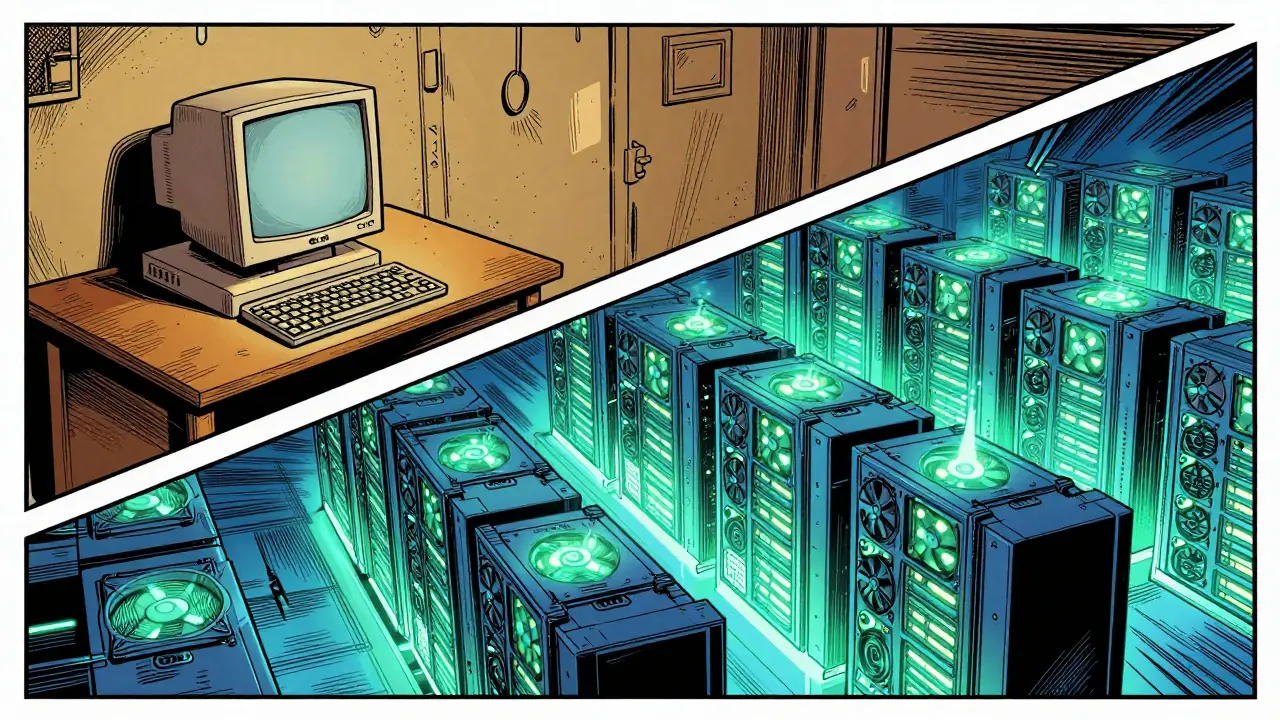
Ever wonder why it took years for Bitcoin to go from a hobby project to a global financial force, yet it still produces a new block roughly every ten minutes? It seems like a contradiction. As more people joined the network and brought in massive amounts of computing power, blocks should have been found in seconds, not minutes. The secret is Mining Difficulty is a self-adjusting mathematical target that ensures blocks are produced at a consistent rate, regardless of how much hardware is fighting for the reward. Without this mechanism, the entire economic model of proof-of-work blockchains would collapse into chaos.
The Core Problem: The Race Against Hardware
In a proof-of-work system, miners are essentially guessing a giant number. It's like a global lottery where the only way to win is to buy as many tickets (computational guesses) as possible. If the lottery is too easy, everyone wins too often, and the supply of coins floods the market. If it's too hard, no one wins, and the network freezes.
When Satoshi Nakamoto launched Bitcoin in 2009, people mined using basic home computers. But then came GPUs, and eventually ASICs (Application-Specific Integrated Circuits)-machines built for the sole purpose of mining. This surge in power, known as the Hash Rate, means the network can now process trillions of guesses per second. To stop the system from printing money too fast, the blockchain automatically makes the "puzzle" harder.
How Difficulty Actually Works (The "Target" Concept)
To understand the technical side, you have to look at the hash. A Hash Function takes any input and turns it into a long string of letters and numbers. For a block to be valid, the resulting hash must be lower than a specific target value.
Think of it like trying to throw a dart at a board. If the target is a giant circle, it's easy to hit (low difficulty). If the target is a tiny dot, it's incredibly hard (high difficulty). When the network sees that miners are hitting the target too quickly, it shrinks the circle. This forces miners to perform more calculations to find a hash that fits the new, smaller target.
| Factor | Change | Effect on Difficulty | Result |
|---|---|---|---|
| Hash Rate | Increases | Goes Up | Consistent block times |
| Coin Price | Rises | Usually Up | More miners join, increasing competition |
| Hardware Efficiency | Improves | Goes Up | More hashes per watt of power |
| Miner Exit | Decreases | Goes Down | Easier for remaining miners to find blocks |
The 2,016 Block Cycle: The Bitcoin Clock
Bitcoin doesn't change its difficulty every second; that would be too volatile. Instead, it uses a window of 2,016 blocks. Since each block should take 10 minutes, this happens roughly every two weeks. At the end of this period, the network looks back and asks: "Did these 2,016 blocks take about 20,160 minutes to mine?"
If the blocks were found in only 15,000 minutes, the network realizes it's too easy and cranks up the difficulty. If it took 25,000 minutes, it lowers the difficulty. To prevent wild swings that could crash the network, there's a safety valve: the difficulty can't change by more than a factor of 4 in a single adjustment. This ensures that even if a huge number of miners suddenly quit, the network remains stable.
Why This Matters for Security and the "51% Attack"
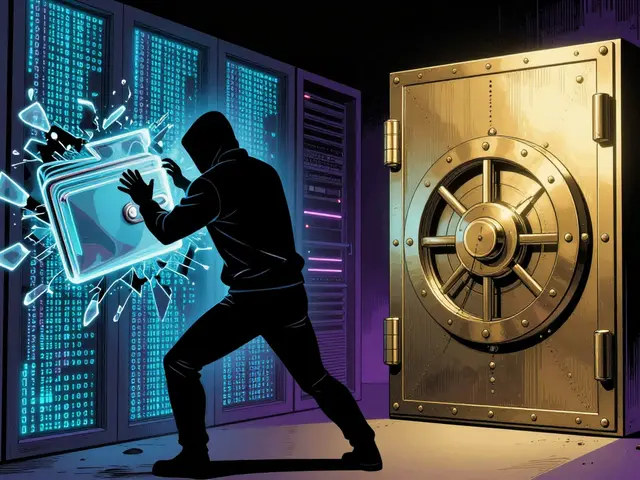
Difficulty isn't just about timing; it's the bedrock of security. When mining difficulty is high, it means the total computational power protecting the network is massive. For a bad actor to rewrite the blockchain's history, they would need to control more than 50% of that power-a 51% Attack.
In the early days, this was a theoretical risk. Today, with the Bitcoin difficulty reaching levels in the tens of trillions, the cost of electricity and hardware required to pull off such an attack is practically impossible for any single entity. The difficulty effectively creates a "computational wall" that protects your transactions from being reversed.
The Downside: Centralization and the "Arms Race"
While the system is elegant, it creates a brutal economic environment. As difficulty rises, the cost of mining increases. A person with a laptop in their bedroom can't compete with a warehouse in Texas filled with 5,000 high-end ASICs. This leads to mining centralization, where only the biggest players can afford the electricity and equipment needed to stay profitable.
This is why Mining Pools exist. Individual miners combine their power to share the rewards. Instead of one person trying to win a nearly impossible lottery, thousands of people pool their tickets and split the prize based on how much work they contributed.
Comparing Different Blockchains
Not every coin handles difficulty the same way. Bitcoin's two-week window is steady but slow. Some other networks use a more responsive approach. For example, before Ethereum switched to Proof-of-Stake (where the "difficulty" is replaced by staking coins), it adjusted difficulty every single block. This allowed it to react instantly to miners joining or leaving, though it could be more erratic.
Coins like Dogecoin or Litecoin have their own variations of these rules, but the goal remains the same: keep the heartbeat of the network steady regardless of who is mining.
What happens if mining difficulty becomes too high?
If difficulty rises too high and the price of the coin doesn't keep up, mining becomes unprofitable for smaller operators. They shut down their machines, the total hash rate drops, and eventually, the network's automatic adjustment period will lower the difficulty to make mining profitable again.
Does higher difficulty mean slower transactions?
Not exactly. Difficulty is designed to keep the 10-minute block time constant. However, if difficulty is very high and many miners leave the network, it might take longer than 10 minutes for a block to be found until the next adjustment happens, which can temporarily slow down confirmations.
Can someone manually change the mining difficulty?
No. In a decentralized blockchain like Bitcoin, the difficulty is governed by the protocol's code. It is calculated automatically by the nodes in the network. No single person or company has a "knob" they can turn to change it.
How is mining difficulty different from hash rate?
Hash rate is the amount of raw computing power being used (the number of guesses per second). Mining difficulty is the setting that determines how hard those guesses need to be. If the hash rate goes up, the difficulty eventually goes up to balance it out.
Why did Ethereum remove mining difficulty?
Ethereum moved to Proof-of-Stake (The Merge), which eliminates the need for computational "guessing" entirely. Instead of miners using electricity to solve puzzles, validators lock up their coins to secure the network. This removed the need for a difficulty adjustment mechanism and cut energy use by over 99%.
Next Steps for Miners and Investors
If you're thinking about mining, don't just look at the coin's price. Use a mining calculator that factors in the current difficulty and your electricity cost per kWh. If the difficulty is trending upward and your hardware is old, you might spend more on power than you earn in coins.
For investors, keep an eye on difficulty trends. A steadily rising difficulty is generally a bullish sign-it means the network is becoming more secure and more participants are trusting the system with their hardware. However, a sudden, massive drop in difficulty could signal a major problem in the mining industry or a regional crackdown on crypto mining.

Gloris Young
April 21 2026This is a really chill way to explain it. Definitely helps make the concept feel less intimidating for newcomers.
Eric Raines
April 22 2026Everyone talks about the target, but nobody mentions how the actual nonce search is just basic brute force. It's not some magical puzzle, it's just trying a billion numbers until one works. Honestly, the whole 'mining' metaphor is just marketing for what is essentially a massive electricity sink that does nothing but secure a ledger.
Matthew Morse
April 23 2026the a-s-i-c part is the real killer here. you can't even try this at home anymore without losing money every second
Candace Sherrard
April 25 2026It is fascinating to consider the philosophical implications of a system that essentially quantifies time and energy into a digital scarcity, creating a synthetic heartbeat for a global network that exists nowhere and everywhere at once. The way the difficulty adjustment acts as a cosmic regulator, ensuring that no matter how much human ingenuity or industrial power is thrown at the problem, the pace of discovery remains glacial and steady, reflects a deep desire for stability in an otherwise volatile digital frontier. One might argue that this mechanism is the only thing preventing the hyper-inflationary collapse of the entire ecosystem by tying the issuance of currency to the physical laws of thermodynamics and computational limits.
Gary Lingrel
April 26 2026who cares about the 10 minute block time lol. it's just a way for the big pools to gatekeep the rewards 🙄 the whole thing is rigged for the whales anyway
Alex Hunter
April 27 2026It's a great starting point. If anyone is struggling with the hash function part, just think of it as a digital fingerprint that can't be reversed. Once you get that, the target value makes way more sense.
Jennifer Taylor
April 27 2026The target is just a way for them to control the flow. They want us to think it's automatic but the people who wrote the code still hold the keys. It's all a game to keep the hash rate high so they can track every single move through the hardware IDs.
debashish sahu
April 28 2026The comparison table provides a clear perspective on how the external factors influence the internal mechanics of the network.
Caiaphas Konkol
April 30 2026The sheer audacity to compare this to a dart board is quaint, though it simplifies the complexity for the masses. In reality, the stochastic nature of the Poisson process governing block discovery is far more elegant than any 'game' analogy. It's simply a matter of probabilistic distribution across a distributed network of nodes.
Jennifer L
May 1 2026Oh my goodness, the thought of a 51% attack is just terrifiyng!! I cannot imagine the sheer horror if someone actually managed to rewrite the history of our transactions... just absolutly wild to think about the risk we take!!
Hannah Rubia
May 2 2026It is imperative to note that mining pools, while providing a necessary buffer for smaller participants, introduce a layer of trust that slightly contradicts the decentralized ethos of the original protocol.
Clair Geary
May 3 2026this is such a sparkly clear explanation! love how it breaks down the spooky math into something we can actually wrap our heads around
Sarah Ingrams
May 4 2026really helps me understand why my old rig is useless now
Mary Tawfall
May 5 2026It's actually encouraging to see how the system protects itself. Even when things get crazy, the adjustment ensures the network keeps ticking along perfectly.
Mike Word
May 6 2026The transition of Ethereum to PoS is a huge point here. It's interesting how the industry is moving away from this 'arms race' entirely to save the planet.