
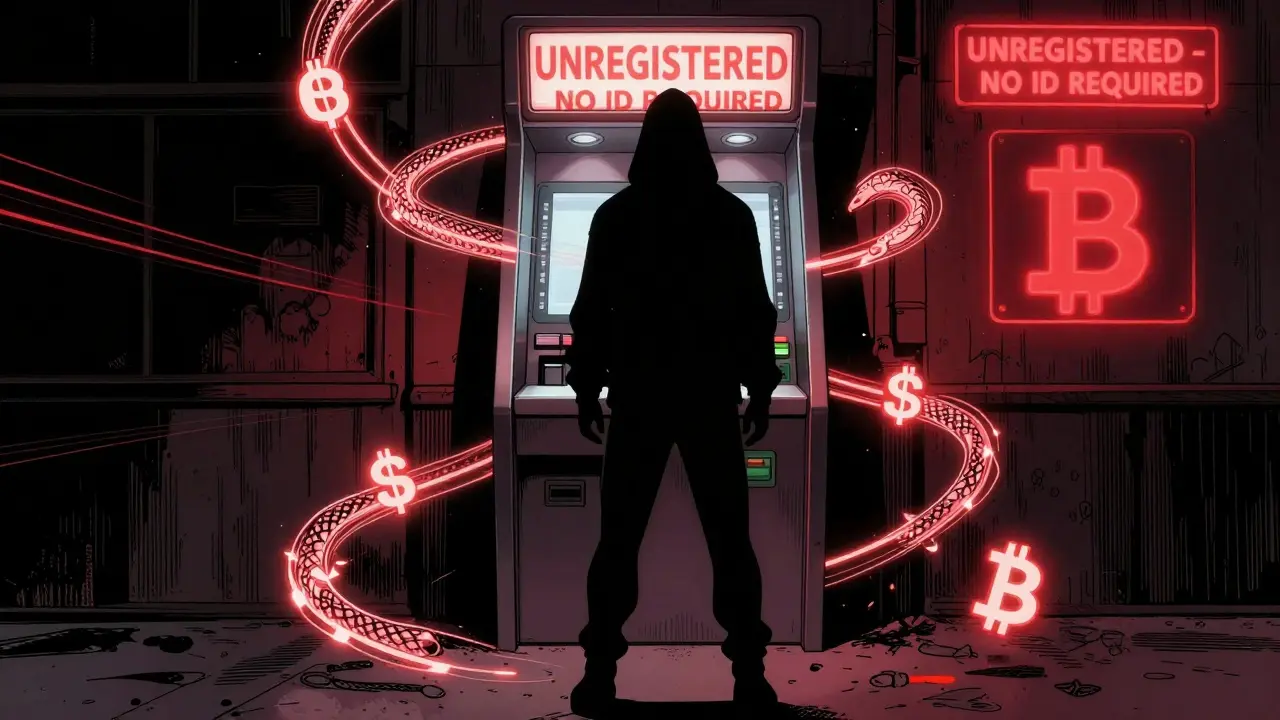
When you hear crypto money laundering and 20 years in prison, it sounds like something out of a crime movie. But this isn’t fiction. In 2025, U.S. federal prosecutors are locking up crypto operators for crimes that move billions in stolen coins. And yes - the maximum penalty under federal law is 20 years per count. Not for holding Bitcoin. Not for trading Ethereum. But for knowingly helping criminals wash dirty crypto through exchanges, mixers, or kiosks.
How Crypto Money Laundering Actually Works
Crypto isn’t anonymous. It’s pseudonymous. Every transaction leaves a trail on the blockchain. That’s why criminals use mixers, privacy coins, and stablecoins to hide where the money came from. In 2025, Tether (USDT) is the go-to tool. Why? Because it’s pegged to the U.S. dollar, moves fast, and crosses borders without triggering the same alerts as Bitcoin. A thief steals $50 million from an exchange. They convert it to USDT. Then they split it into hundreds of tiny transfers - each under $10,000 - to avoid reporting rules. Finally, they cash out through unregulated kiosks in Eastern Europe or Southeast Asia. The Czech government Bitcoin scandal in March 2025 showed how deep this goes. Dormant wallets, linked to a darknet marketplace, suddenly woke up. Over 600 BTC moved in complex patterns - some to Trezor hardware wallets, others through Kraken exchange. The goal? To make the money look clean. But blockchain analysts traced it back. The trail didn’t vanish. It just got harder to follow.What Charges Do You Face?
You don’t get charged with “crypto laundering.” You get hit with multiple federal crimes:- 18 U.S.C. § 1956 - Money laundering: hiding the source of funds from illegal activity
- 18 U.S.C. § 1957 - Spending dirty money over $10,000
- Bank Secrecy Act violations - Failing to report transactions or run AML checks
- Operating an unlicensed money transmitting business - Running a crypto exchange or kiosk without FinCEN registration
Why 20 Years? It’s Not Just One Crime
A single money laundering count can carry up to 20 years. But no one gets charged with just one. Prosecutors stack charges. Take the case of Kais Mohammad, known online as “Superman29.” He ran a network of crypto ATMs across the U.S. between 2014 and 2019. He processed $25 million in cash-for-Bitcoin trades. He charged 25% fees - way above market. He didn’t verify users. He didn’t report anything. He was convicted on three counts: operating an unlicensed money service, money laundering, and failing to maintain an AML program. His sentence? 24 months. That’s two years. Why so low? Because he cooperated. He gave up his network. He helped prosecutors trace the money. Judges reward that. But if he’d fought the case? He could’ve faced 10+ years. And if he’d moved $200 million instead of $25 million? The sentence would’ve jumped. The real 20-year threat comes when:- You launder over $100 million
- You work with drug cartels or ransomware gangs
- You use international exchanges to move money across borders
- You’re part of an organized ring - that’s racketeering under RICO

Who’s Getting Caught - And How
It’s not just the big players. It’s the guy running a crypto kiosk in a strip mall. The developer who built a mixer for darknet vendors. The accountant who helped a client hide crypto profits. FinCEN and the FBI don’t need to catch you red-handed. They track blockchain addresses. They subpoena exchanges. They freeze wallets. They use TRM Labs and Chainalysis to map flows across Bitcoin, Ethereum, and Polygon networks. Tether, the biggest stablecoin, has only a handful of investigators for millions of accounts. That’s a loophole. But it’s also a trap. When enough red flags pile up - multiple small transfers, rapid movement, cash-outs in high-risk countries - the system flags it. And then the FBI shows up. In 2025, the EU’s Anti-Money Laundering Authority called cross-border crypto laundering the “top emerging threat.” Why? Because you can set up shop in one country, move funds through another, and cash out in a third - all before any government acts. But that’s changing. International cooperation is tightening. Joint task forces are forming. The net is closing.Defense Strategies - And Why They Often Fail
People think: “I didn’t know it was stolen money.” Or: “I thought it was a legitimate business.” Those arguments rarely work. If you’re running a crypto service and you don’t ask for ID, don’t report suspicious activity, and charge sky-high fees - the law assumes you knew. The burden of proof is on you to show you acted in good faith. And good faith means having compliance systems. Not just hoping for the best. Defense lawyers now hire blockchain analysts to challenge transaction tracing. They argue: “This address wasn’t definitely linked to my client.” But with wallet tagging, IP logs, and exchange records, that’s harder than ever. One judge in 2024 called it “the new forensic science.” Cooperation is still the best way out. But only if you act fast - before the feds raid your home or freeze your assets.
What’s Changing in 2026?
The scale of crypto crime is exploding. $51 billion in illicit crypto flows are projected for 2025. That’s more than the entire U.S. federal budget for law enforcement. Congress is taking notice. New legislation is coming. Proposals include:- Mandatory KYC for all crypto ATMs, even small ones
- Real-time reporting of transfers over $1,000
- Harsher penalties for using mixers or privacy tools
- Criminal liability for developers who knowingly build tools for laundering
What You Should Do If You’re in Crypto
If you run a business - even a small one - here’s the reality:- Register with FinCEN if you’re transmitting value
- Implement KYC/AML checks - even for small users
- Keep records for at least five years
- Don’t ignore red flags: cash-heavy users, rapid transfers, high fees
- Don’t assume privacy tools make you invisible - they just make you a bigger target
It’s Not About the Tech - It’s About the Intent
Crypto isn’t illegal. Using it to hide crime is. The 20-year sentence isn’t a threat to everyday users. It’s a warning to those who see crypto as a loophole. The system is catching up. The tools are better. The penalties are real. You don’t need to be a kingpin to go to prison. You just need to be careless. Or greedy. In 2026, the message is simple: if you’re helping criminals move crypto, you’re not a tech innovator. You’re a criminal. And the prison door is wide open.Can you go to jail just for owning cryptocurrency?
No. Simply holding Bitcoin, Ethereum, or any other crypto is not a crime. You can own, trade, or invest in crypto legally. The issue arises only when you knowingly help move funds from illegal activities - like hacking, ransomware, or drug sales - through exchanges, mixers, or ATMs without reporting it. Ownership isn’t illegal. Facilitating laundering is.
What’s the minimum sentence for crypto money laundering?
There’s no fixed minimum, but first-time offenders who cooperate and launder small amounts (under $100,000) may get probation, fines, or community service. However, even small-scale operators who ignore AML rules - like running unregistered crypto ATMs - have received 6 to 18 months in prison. The real risk comes when the amount exceeds $500,000 or involves organized crime.
Do crypto exchanges report suspicious activity to the government?
Yes - if they’re registered with FinCEN and follow U.S. law. Major exchanges like Coinbase and Kraken file Suspicious Activity Reports (SARs) when they detect unusual patterns: rapid transfers, cash-outs in high-risk countries, or transactions linked to known darknet addresses. Unregulated platforms don’t report - but that makes them targets for prosecution, not safe havens.
Can you avoid detection by using privacy coins like Monero?
Not anymore. While privacy coins are harder to trace, law enforcement has developed new tools to identify them. Monero transactions are still linked to known illicit addresses through timing analysis, exchange deposits, and wallet tagging. Plus, many exchanges now block Monero entirely. Using it raises red flags - and makes you look more guilty, not less.
What happens if you’re caught laundering crypto outside the U.S.?
U.S. authorities can still prosecute you if your actions affected U.S. financial systems - even if you’re overseas. The DOJ has extradited suspects from over 20 countries for crypto crimes. If you used a U.S.-based exchange, sent money to a U.S. wallet, or targeted American victims, you’re at risk. International cooperation on crypto crime is stronger than ever.
Is using a crypto mixer illegal?
Using a mixer isn’t automatically illegal - but if you use it to hide the source of stolen or illicit funds, it becomes part of a money laundering scheme. The U.S. Treasury has designated several mixers as sanctions targets. Developers who build mixers for criminal use can be charged with aiding and abetting. Even if you think you’re just protecting privacy, prosecutors will argue you enabled crime.
How long does a crypto money laundering investigation take?
Typically 12 to 24 months. Blockchain analysis takes time, especially when funds are moved across multiple chains and jurisdictions. Prosecutors often wait until they have enough evidence to secure a conviction - not just an arrest. Many cases involve months of surveillance, subpoenaing exchange records, and working with international agencies before charges are filed.
Can you be charged if you didn’t know the crypto was stolen?
Yes - if you should have known. Courts use “willful blindness” standards. If you ran a crypto service, charged high fees, ignored red flags like cash deposits from unknown users, or refused to do basic ID checks, the law treats you as if you knew. Ignorance isn’t a defense when your business model depends on avoiding compliance.

Jessica Boling
January 22 2026So let me get this straight... you're telling me if I buy Bitcoin and hold it in my wallet I'm fine but if I sell it to someone who might be sketchy I'm going to prison? That's not law that's guesswork.
And why are they targeting ATMs but not banks that move billions in cash with zero oversight? Hypocrisy much?
Tammy Goodwin
January 22 2026I work at a small crypto kiosk in Arizona. We do ID checks now. We file reports. We lost 70% of our customers but we sleep better. This isn't about freedom. It's about survival.
Andy Simms
January 24 2026Chainalysis doesn't track everything. I've seen cases where funds moved through 12 different wallets and 3 blockchains before cashing out. The tools are good but not perfect. The real issue is that law enforcement is overworked and under-resourced. They go for the low-hanging fruit: the guy with the ATM in the gas station, not the hedge fund that washes millions through DeFi protocols.
Shamari Harrison
January 24 2026The 20-year threat isn't about individuals. It's about scale. If you're moving $100M+ with organized crime ties, yeah, you're looking at serious time. But if you're a small business owner trying to make rent and you didn't know the guy paying in cash was laundering? That's a different story. The system needs nuance, not fearmongering.
Paru Somashekar
January 25 2026In India, we have strict KYC for all crypto transactions. Even small P2P trades require Aadhaar verification. It's inconvenient but necessary. The global financial system is becoming more transparent. Those who resist will be left behind.
Ashok Sharma
January 27 2026I am from India. We have seen many people lose money in fake crypto schemes. Now government is strict. It is good. People must know what they are doing. Crypto is not magic money. It is digital asset. You must follow rules.
Steve Fennell
January 28 2026I've been in crypto since 2017. I've seen the wild west. Now we're entering the regulatory phase. It's messy. It's slow. But it's real. The people who built this space without compliance are now being held accountable. And honestly? It's long overdue.
Heather Crane
January 28 2026I know people who ran crypto ATMs and thought they were just 'helping the community.' Now they're paying fines and doing community service. The system isn't perfect, but it's trying to catch up. Let's not romanticize ignorance as entrepreneurship.
Catherine Hays
January 29 2026This is all a scam. The government wants control. They don't care about crime. They care about tracking every dollar you spend. They're using 'money laundering' as an excuse to destroy privacy. Monero isn't illegal. The Feds just can't spy on it. That's why they're pushing bans.
Mike Stay
January 30 2026The narrative that crypto laundering is a new phenomenon is misleading. Money laundering has existed since the invention of currency. What's new is the scale and speed at which it can occur now, enabled by decentralized infrastructure and cross-border anonymity. The challenge isn't technological-it's institutional. Regulatory frameworks were built for brick-and-mortar banking, not peer-to-peer token flows. Until we modernize those frameworks, we'll keep seeing misaligned enforcement: punishing the small operators while the institutional actors continue to operate in gray zones with impunity.
HARSHA NAVALKAR
January 30 2026I don't understand why people are shocked. If you're moving money for criminals, you're a criminal. Simple. No need for 20-year sentences. Just lock them up and throw away the key.
Ryan Depew
January 31 2026The real story? The DOJ is using crypto as a scapegoat to justify more surveillance. They’ve been pushing for mass financial monitoring for years. Crypto just gave them the perfect excuse. They don’t want to catch criminals-they want to control you.
tim ang
February 1 2026i think people forget that most crypto users are just trying to send money to family or avoid inflation. but now every guy with a bitcoin atm is treated like a cartel boss. its unfair. i run a small shop and i get flagged for sending 500 bucks in usdt to my cousin in mexico. no one asks why. just lock em up.
Julene Soria Marqués
February 3 2026So you're telling me a guy who runs a crypto kiosk without ID checks is worse than a bank that lets a Russian oligarch move $500M through shell companies? That's not justice. That's class warfare.
Bonnie Sands
February 3 2026This is all a psyop. The government is scared of decentralized money. They know if people start using crypto to escape inflation and taxes, their power crumbles. So they invent scary stories about 20-year sentences to scare everyone back into the banking system. It’s psychological warfare.
MOHAN KUMAR
February 5 2026In India, we have seen scams. People lose everything. Now government is strict. It is good. People must learn. Crypto is not lottery. It is technology. Use it right.
Jennifer Duke
February 6 2026I’m Canadian. We don’t have 20-year sentences for this. We have fines and education. Why does the US always have to be the most extreme? You turn every minor violation into a felony. It’s not justice. It’s performance.
Andy Marsland
February 8 2026The real danger isn't the law-it's the precedent. Once you criminalize tools because they *can* be misused, you open the door to banning encryption, anonymous browsing, cash, anything that can't be perfectly monitored. The moment you equate privacy with criminality, you've already lost the war for liberty.
Anna Topping
February 9 2026We're not talking about crime. We're talking about control. The blockchain was supposed to be free. Now every transaction is a potential indictment. The dream of financial sovereignty is dead. They didn't ban crypto. They made it so dangerous to use that only the state-approved can survive.
Jonny Lindva
February 9 2026Hey, I get it. You're scared. I used to run a small crypto service too. We got slammed by regulators. But here's the thing-we adapted. We got licensed. We hired a compliance officer. It cost us money. It cost us time. But we're still here. And our customers trust us. You can fight the system... or you can join it. One path leads to prison. The other leads to sustainability.
Arnaud Landry
February 10 2026I find it deeply troubling that the state is weaponizing blockchain analytics to criminalize ordinary financial behavior. The fact that Tether is being targeted while Wall Street moves trillions in untraceable derivatives is not a coincidence-it is systemic bias. The government is not protecting the public. It is protecting the banking cartel. And the 20-year threat? That's a deterrent against financial independence.
Barbara Rousseau-Osborn
February 11 2026OMG YOU GUYS. I KNEW IT. This is EXACTLY why I told everyone last year that crypto is a SCAM. You think you're being smart by using Bitcoin? NO. You're just helping criminals. And now you're going to PRISON. I told you. I TOLD YOU. 😭😭😭
Nadia Silva
February 11 2026The notion that crypto laundering is a novel threat is a gross misrepresentation. The mechanisms are new, but the behavior is as old as trade. What’s alarming is the disproportionate focus on retail operators while institutional actors-banks, hedge funds, private equity-move far larger sums with zero scrutiny. The real crime isn't the ATM operator. It's the regulatory capture that allows systemic laundering to thrive under the guise of legality.
Sara Delgado Rivero
February 12 2026People think they're safe if they don't know the money is dirty but that's just wishful thinking. If you're charging 25% fees and not asking for ID you're not naive you're greedy and you deserve what you get
Shamari Harrison
February 12 2026I've worked with law enforcement on crypto tracing cases. The real breakthrough isn't the tech-it's the cooperation. When a small operator flips and gives up their network, that's how they take down the big players. The 20-year threat isn't about punishment. It's about leverage.