
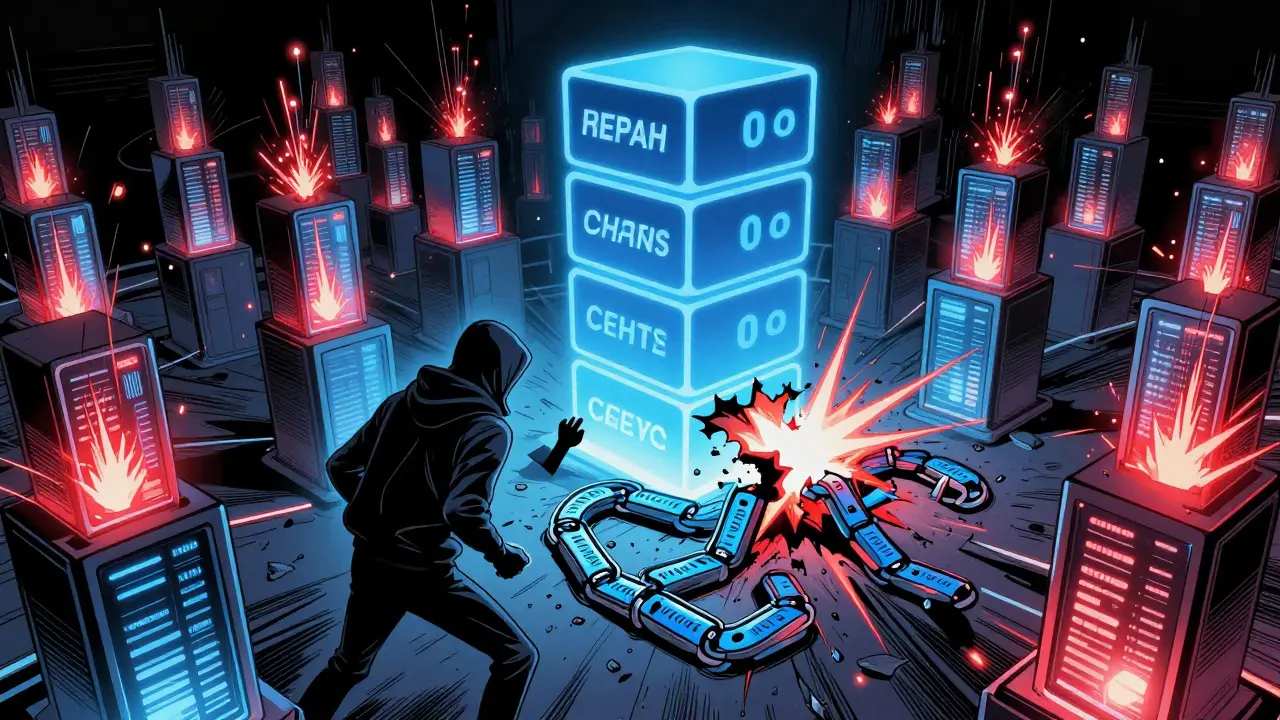
Imagine sending $100 in digital cash to a friend, only to realize later that the same $100 was also sent to someone else. That’s double-spending - and it’s the reason blockchain was invented in the first place. Before Bitcoin, digital money had no built-in way to stop you from copying and spending the same token twice. Banks and payment processors handled this by acting as middlemen. But blockchain removed the need for them entirely - not by magic, but by clever rules built into its consensus systems.
Why Double-Spending Is a Real Problem
Digital files can be copied. That’s how you share a PDF or a song. But money isn’t supposed to be copyable. If you could duplicate a dollar bill, the whole system collapses. Digital currencies faced the same problem until blockchain came along. Without a central authority to track who owns what, the network has to agree - on its own - that a transaction is real and hasn’t been spent before. This is where consensus mechanisms come in. They’re the rules that tell the network: which version of history is true? If two people try to spend the same coin at the same time, the network picks one and rejects the other. The way it makes that choice depends entirely on the consensus algorithm being used.Proof of Work: Security Through Cost
Bitcoin uses Proof of Work (PoW). Here’s how it stops double-spending: miners compete to solve a math puzzle. The first one to solve it gets to add the next block of transactions and earns new Bitcoin as a reward. But solving that puzzle takes massive computing power - and electricity. As of mid-2024, Bitcoin’s network is doing about 300 exahashes per second. That’s like every person on Earth running a supercomputer for a year, just to keep the network secure. The cost to attack it? Around $14.5 billion in hardware and $4.2 million per hour in electricity. That’s not just expensive - it’s practically impossible for any single entity to afford. When someone tries a double-spend, they have to create a fake chain faster than the real one. But because the real chain is being extended by thousands of miners every minute, the fake chain falls behind. The network always follows the longest (most work-heavy) chain. So unless you control more than half the network’s power - a 51% attack - you lose. Bitcoin’s rule of thumb? Wait for six confirmations. That’s about an hour. Each confirmation means another block has been added on top of your transaction, making it harder to reverse. Merchants handling large payments - say, over $10,000 - often wait longer. One BitcoinTalk user lost $32,000 in 2024 after accepting a payment with just one confirmation. It got reversed during a rare chain reorg. That’s why waiting matters.Proof of Stake: Security Through Economics
Ethereum switched from PoW to Proof of Stake (PoS) in 2022. Instead of miners, PoS uses validators. To become one, you lock up 32 ETH - about $102,400 as of late 2024. That stake is your bond. If you try to cheat - like validating two conflicting transactions - you lose it all. Slashing penalties remove 100% of your stake. That’s a huge deterrent. PoS doesn’t need energy-hungry computers. It uses a random selection process to choose who proposes and votes on blocks. The more ETH you stake, the higher your chances. But here’s the twist: to successfully double-spend, you’d need to control two-thirds of all staked ETH. That’s over $270 billion worth. No one has that much. Even if they did, buying that much ETH would spike the price, making the attack self-defeating. Finality in Ethereum is different too. Instead of waiting for six blocks, the network reaches cryptographic finality after 64 epochs - roughly 15 minutes. That’s faster than Bitcoin. But many DeFi apps still get it wrong. Some assume 15 blocks are enough. They’re not. True finality takes 64. Developers who skip this step risk their users losing funds.
Delegated Proof of Stake: Speed Over Decentralization
Some blockchains, like EOS and TRON, use Delegated Proof of Stake (DPoS). Here, token holders vote for a small group of validators - 21 to 27 - who run the network. These elected nodes produce blocks quickly, allowing up to 2,000 transactions per second. That’s great for payments and apps that need speed. But speed comes with a trade-off. If those 27 validators collude, they can reverse transactions or double-spend. There’s no global mining power to stop them. The only defense is that voters can kick them out and elect new ones. But in practice, voting turnout is low. A few big holders control most votes. That’s why experts warn DPoS is vulnerable to centralization. A 2024 report from StartupDefense.io called it a “theoretical risk” - meaning it hasn’t happened yet, but the design makes it possible.Other Systems: PBFT and Hybrid Approaches
Enterprise blockchains - the kind banks and governments use - rarely use PoW or PoS. Instead, they rely on Practical Byzantine Fault Tolerance (PBFT). In PBFT, nodes talk directly to each other. Once 67% agree on a transaction, it’s final. That’s why Ripple settles payments in 3-5 seconds. But PBFT only works with a known, trusted group of validators. It’s not open like Bitcoin. You can’t just join. You’re invited. The future? Hybrid systems. Decred, for example, mixes PoW and PoS. Miners create blocks, but stakeholders vote to approve them. MIT’s 2024 study found hybrid models were 47% more resistant to double-spending simulations than single-mechanism chains. That’s promising. By 2027, Forrester predicts 65% of major blockchains will use hybrids. They’re trying to get the best of both worlds: Bitcoin’s security and Ethereum’s efficiency.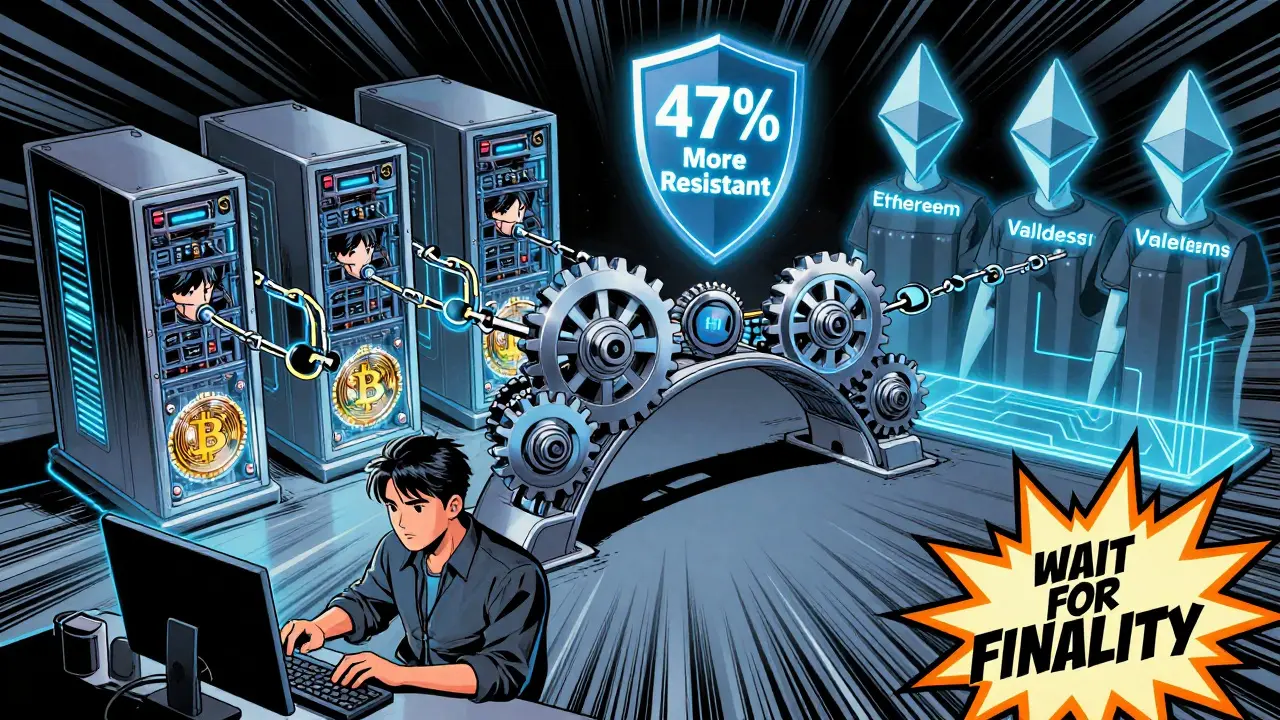
What You Need to Know as a User or Developer
If you’re sending or receiving crypto, confirmation time matters. Don’t assume one confirmation is safe. Bitcoin: wait for six. Ethereum: wait for 15 minutes. Ripple: 5 seconds is fine - but only if you’re on their network. Developers, don’t cut corners. A 2023 Chainalysis report found 12 exchange hacks between 2020 and 2023 happened because systems accepted transactions too early. Total losses? $28.7 million. Use trusted libraries like BitcoinJS or Web3.js. Set minimum confirmations in your code. And test for chain reorganizations - they happen more often than you think.Regulations and the Future
The EU’s MiCA regulation, effective December 30, 2024, requires all crypto service providers to prove their networks can prevent double-spending. They specifically mention “robust consensus mechanisms.” That means exchanges and wallets can’t just pick any blockchain. They have to choose ones with proven security. Quantum computing could one day break current cryptography. That’s why NIST is funding $8.2 million in research to build quantum-resistant consensus algorithms. The goal isn’t just to stop double-spending - it’s to make sure it stays stopped, even when computers get a thousand times faster.Final Takeaway
Double-spending isn’t a bug - it’s the problem blockchain was built to solve. Every consensus mechanism has its own way of stopping it. PoW uses brute-force cost. PoS uses economic risk. DPoS uses voting. PBFT uses trust among known parties. Hybrids use both. The best system isn’t the fastest or the cheapest. It’s the one that matches your risk tolerance. If you’re storing value like Bitcoin, you want the highest security, even if it’s slow. If you’re paying for coffee, speed matters more. And if you’re building a financial app, you need to know exactly how your blockchain reaches finality - or you’ll end up losing money.Can double-spending happen on Bitcoin?
No verified double-spending attack has succeeded on Bitcoin’s main chain since it launched in 2009. The network’s massive computational power makes it economically unfeasible. While rare chain reorganizations can temporarily reverse transactions, the system always converges on the longest valid chain, making successful double-spends practically impossible without controlling over half the network’s mining power.
How many confirmations are safe for Ethereum transactions?
For most users, 15 minutes (64 epochs) is the standard for full finality on Ethereum’s PoS chain. While many apps show a transaction as "confirmed" after just 15 blocks (about 3-4 minutes), true cryptographic finality - where the transaction can’t be reverted even in a network fork - requires 64 epochs. DeFi protocols and exchanges that treat 15 blocks as final are at risk of losing funds during rare reorgs.
Is Proof of Stake more secure than Proof of Work?
Both PoW and PoS prevent double-spending effectively, but they do it differently. PoW relies on physical cost - attacking it requires expensive hardware and electricity. PoS relies on economic cost - attacking it means risking your staked assets. PoS is more energy-efficient and achieves finality faster, but it’s vulnerable to centralization if a few large stakers control too much of the network. PoW has a longer track record and is more decentralized in practice, but uses far more energy. Neither is "more secure" - they’re just different trade-offs.
Why do some blockchains settle transactions in seconds?
Blockchains like Ripple and Stellar use consensus protocols like PBFT, which rely on trusted validators rather than open mining or staking. These networks know who the participants are, so they can reach agreement quickly - often in under five seconds. But this speed comes at the cost of decentralization. You can’t join freely. The network is permissioned, making it suitable for banks or enterprises, but not for public, censorship-resistant money like Bitcoin.
Can a 51% attack still happen on modern blockchains?
Yes - but only on smaller networks. Bitcoin and Ethereum are too expensive to attack. But smaller PoW chains like Vertcoin or Bitcoin Gold have been hit by 51% attacks because they have less hashing power. Attackers rent mining power for a few hours, double-spend coins, then disappear. These attacks cost tens of thousands of dollars, not billions. That’s why you should avoid using small, low-hash-rate blockchains for large transactions.
What’s the biggest mistake people make with double-spending prevention?
Assuming one confirmation is enough. Many users think once a transaction shows up in their wallet, it’s final. It’s not. On Bitcoin, one confirmation means the transaction is in a block - but that block could still be replaced. On Ethereum, one block means nothing. Waiting for the right number of confirmations or full finality is critical. Most losses from double-spending happen because someone accepted a payment too early.

Rishav Ranjan
December 24 2025One confirmation? Bad idea.
Dusty Rogers
December 25 2025I've seen too many people get burned by assuming a transaction is final after one block. Wait for six on Bitcoin. It's not that hard.
Tyler Porter
December 27 2025Wait, wait, wait-don’t just trust the first block! Seriously, people. Six confirmations. That’s the rule. Don’t be lazy.
Melissa Black
December 28 2025The fundamental insight is that consensus mechanisms are not about verification but about incentivizing truthfulness. PoW externalizes cost into energy; PoS internalizes risk into capital. The network doesn’t care about your intent-it cares about your collateral.
Mmathapelo Ndlovu
December 29 2025This is why I love blockchain 😊 It’s not magic, it’s math + incentives. And honestly? The fact that we can build systems that don’t need banks? Mind blown. 🤯
Brian Martitsch
December 29 2025DPoS is just corporate blockchain cosplay. If you’re using EOS for anything serious, you’re already compromised.
Lloyd Yang
December 29 2025Hybrid models are the future. PoW + PoS gives you the best of both. MIT study says so. End of discussion.
Sybille Wernheim
December 30 2025I used to think one confirmation was fine until I lost $500 on a crypto coffee. Never again. Now I wait. Always.
Jordan Renaud
December 30 2025It’s funny how we treat blockchain like it’s some new invention, but really it’s just a new way of solving the same old trust problem. The real breakthrough isn’t the tech-it’s the shift in how we think about trust.
Janet Combs
January 1 2026i read this whole thing and now i just wanna know… what if someone just buys a bunch of miners? like, for real? is that even possible?
Steve B
January 1 2026One must consider the philosophical implications of economic deterrence as a substitute for moral accountability. The system does not judge; it merely penalizes. Is this justice, or merely efficiency dressed in algorithmic robes?
Zavier McGuire
January 3 2026If you're using PoS and think 15 blocks is enough you're either naive or lying to yourself
Sarah Glaser
January 5 2026The MiCA regulation is long overdue. Financial infrastructure shouldn't be a Wild West. If you can't prove your consensus mechanism prevents double-spending, you shouldn't be allowed to operate.
roxanne nott
January 5 2026PBFT is centralized garbage. If you need permission to join your blockchain, it’s not blockchain. It’s a database with extra steps.
Ellen Sales
January 7 2026so like… if quantum computers break sha256… are we all just gonna be like… oops? 😅
Cathy Bounchareune
January 9 2026In my village back home, we used to settle disputes by having the whole community agree on what happened. Blockchain is just that, but with code and stakes instead of elders and goats. Kinda beautiful, really.
Radha Reddy
January 10 2026The real issue is not the mechanism but the human assumption that technology can replace vigilance. No system is foolproof if users ignore basic rules.
Sheila Ayu
January 11 2026Wait, so you’re saying that if I have 51% of the hash power, I can just rewrite history? That’s not security-that’s a backdoor. And you’re calling this decentralized? LOL.
Jordan Renaud
January 13 2026Actually, that’s exactly why the six confirmation rule exists. Even if you had 51%, you’d need to outpace the entire network’s ongoing work. It’s not just about power-it’s about speed, coordination, and timing. The system is designed so that the longer you wait, the more impossible the reversal becomes. It’s not perfect, but it’s probabilistic-and that’s the point.