
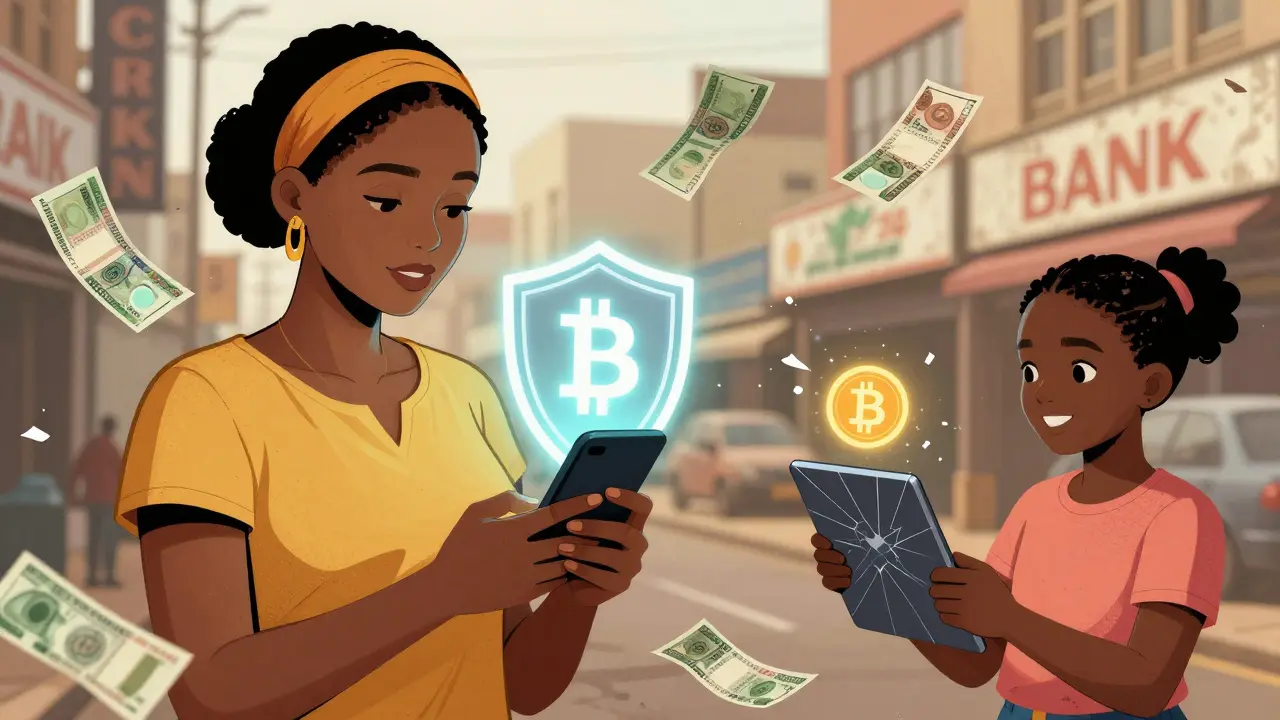
When your country bans cryptocurrency exchanges, your bank freezes your account for using Bitcoin, or your local currency is losing value by the hour - you don’t stop needing money. You find another way. That’s where P2P crypto platforms come in. They’re not fancy, they don’t have glossy ads, and they’re not approved by governments. But in places like Nigeria, Venezuela, Bangladesh, and Egypt, they’re the only thing keeping people financially alive.
Forget the idea that crypto is just for speculators or tech geeks. In restricted countries, P2P crypto is a lifeline. It’s how a mother in Lagos sends $200 to her daughter in London without paying $57 in fees. It’s how a mechanic in Caracas buys food when the peso is worth less than yesterday. It’s how a student in Dhaka pays for online courses when banks won’t let them transfer money abroad.
How P2P Crypto Works When Exchanges Are Banned
Traditional crypto exchanges like Coinbase or Binance act as middlemen. You deposit fiat, they convert it to crypto, and they hold your money. In restricted countries, that’s illegal. So P2P platforms flip the model. Instead of a company holding your cash, you trade directly with another person. One person sends Bitcoin. The other sends Nigerian Naira, Venezuelan Bolívar, or Bangladeshi Taka. The platform doesn’t touch the money - it just holds it in escrow until both sides confirm the deal.
Here’s how it actually works:
- You pick a seller offering Bitcoin for your local currency.
- You pay them via mobile money, bank transfer, or even cash deposit at a local shop.
- The platform locks the Bitcoin in a 2-of-3 multisig wallet - meaning you, the seller, and the platform each hold a key.
- Once you confirm payment, the platform releases the Bitcoin to you.
No central authority controls the funds. No bank approves the transaction. That’s the whole point. Platforms like Paxful, Binance P2P, and Yellow Card don’t need to be licensed in your country - they just need to be accessible. And they are.
Who Uses P2P Crypto in Restricted Countries?
It’s not a fringe group. Chainalysis found that 63% of users on P2P platforms in restricted countries are between 25 and 34. Most of them aren’t traders. They’re regular people doing three things:
- Beating inflation - In Venezuela, monthly P2P volume hit $127 million in 2022. People bought Bitcoin not to get rich, but to stop losing 100% of their savings each year.
- Sending remittances - Traditional services like Western Union charge 6.5% on average. P2P crypto cuts that to 1.2%. In Nigeria, 41% of users use P2P specifically to send money home.
- Accessing finance - A 2022 Binance study found 87% of Nigerian P2P users had never had a bank account. Crypto wasn’t a luxury. It was their first financial tool.
These aren’t tech wizards. They’re teachers, drivers, nurses, and small shop owners. They use Android phones with 2G internet. They download APK files because Google Play blocks crypto apps in 11 banned countries. They learn how to spot scams by trial and error.

Top Platforms and How They Compare
Not all P2P platforms are built the same. Here’s how the big ones stack up in restricted markets:
| Platform | Supported Countries | Payment Methods | KYC Required? | Transaction Time (Avg) | Fees |
|---|---|---|---|---|---|
| Binance P2P | 150+ | Bank transfer, mobile money, gift cards, cash | Yes - strict | 15 minutes | 0%-0.5% |
| Paxful | 150+ | Over 300 methods including Amazon gift cards | Yes - risk-based | 18 minutes | 0.5%-1.5% |
| Yellow Card | Africa-focused (20+ countries) | M-Pesa, Airtel Money, bank transfers | Yes - local compliance | 12 minutes | 0.7%-1.2% |
| Bisq | Global (no restrictions) | Bank transfer, SEPA, cash by mail | No - fully non-custodial | 24-72 hours | 0.25%-0.5% |
Binance P2P leads in volume because it’s fast, has low fees, and supports mobile money. But if you’re in a country where even registering is risky, Bisq is the quiet hero - no ID, no login, no traceable account. It’s slower, but it’s invisible to regulators.
The Hidden Risks
Using P2P crypto in a restricted country isn’t risk-free. Here’s what you’re really up against:
- Fraud - 37% of all fraud cases on Paxful in 2022 came from restricted countries. Scammers fake payment screenshots, use stolen bank accounts, or pressure buyers into releasing crypto too early.
- Bank freezes - 22% of Nigerian users reported having accounts shut down by their banks just for using P2P crypto. Banks don’t always know you’re trading - they just see unusual activity and lock you out.
- Liquidity - In regulated markets, order books hold $200,000+ in Bitcoin. In restricted countries? Often under $8,500. You might wait hours to find a buyer.
- Legal gray zones - Even if trading crypto isn’t illegal, using it to bypass capital controls might be. In Vietnam, you can be fined $8,000 for using crypto as payment. In Egypt, the government monitors P2P transactions closely.
And then there’s the learning curve. Most users need 8-12 hours just to understand wallet security, how to verify a seller, and what payment methods are safe. Many don’t make it past the first few tries.

Why This Isn’t Going Away
Some governments are cracking down harder. China arrested over 1,200 people for crypto-related activity in 2023. Nigeria keeps its banking ban in place. Bangladesh bans crypto entirely. But the demand keeps rising.
Why? Because economic pressure doesn’t care about laws. Inflation in six of the top ten P2P markets exceeds 50% per year. Remittance fees in places like Zimbabwe hit 22.4%. People aren’t choosing crypto because it’s cool - they’re choosing it because it’s the only option left.
Platforms are adapting. Binance added Swahili and Hausa support. Yellow Card built partnerships with mobile network operators. Even regulators are starting to notice - Nigeria’s Central Bank created a sandbox to test blockchain solutions, even while keeping the ban.
By 2025, P2P volume in restricted countries is projected to hit $210 billion annually. That’s not because crypto is becoming popular. It’s because the old financial system is failing.
What You Need to Know Before Starting
If you’re in a restricted country and thinking about using P2P crypto, here’s what actually matters:
- Start small - Do a $10 test trade. See how long it takes. See if the seller is responsive.
- Use escrow - Never send money without the platform holding the crypto. Never release crypto before payment clears.
- Check local rules - Some countries ban crypto payments but allow trading. Others ban everything. Google your country’s name + "crypto law 2026".
- Use a VPN - If the app store blocks the platform, download the APK from the official site. Use a trusted VPN to avoid ISP tracking.
- Keep records - Save screenshots of every transaction. If your bank freezes your account, you’ll need proof it was a peer-to-peer trade.
There’s no magic trick. No shortcut. Just patience, caution, and a willingness to learn.
Is P2P crypto legal in restricted countries?
It depends. In most cases, owning or trading crypto isn’t illegal - but using it to bypass capital controls or send money abroad might be. Countries like Nigeria and Bangladesh don’t ban crypto outright, but they ban banks from supporting it. Others, like China and Algeria, ban all crypto-related services. Always check your country’s latest regulations. If your government warns against crypto, using P2P could put you at legal risk.
Can I get arrested for using P2P crypto?
In countries with strict bans like China, Egypt, or Algeria, yes - arrests have happened. Most cases involve large-scale operations or money laundering. For average users doing small P2P trades ($100-$500), the risk is low but not zero. Banks often report suspicious activity, and authorities sometimes use those reports to track users. Use a VPN, avoid large transfers, and never use your real name on unverified platforms.
Why do P2P trades take longer in restricted countries?
Because platforms add extra checks. In places with high fraud risk, they require more ID verification, longer payment confirmations, and manual reviews. A trade that takes 5 minutes in the U.S. might take 18 minutes in Nigeria. This isn’t a flaw - it’s a defense. The delay reduces scams but slows things down.
What’s the safest P2P platform for beginners?
Binance P2P is the most beginner-friendly. It has low fees, 24/7 support in local languages, and a simple interface. It’s also the most widely used, so finding buyers and sellers is easier. If you’re in Africa, Yellow Card is a strong alternative with mobile money integration. Avoid platforms with no reviews or unknown owners. Stick to ones with at least 1 million users.
Can I use P2P crypto to avoid taxes?
No - and trying to will backfire. In countries like India and Vietnam, crypto profits are taxed. In the U.S., you must report crypto trades. Even if your country doesn’t enforce crypto taxes yet, using P2P to hide income can lead to future penalties. Most platforms now require KYC. If you’re caught evading taxes, you could face fines or legal action later. Use P2P for financial access, not tax evasion.
What if my bank finds out I’m using P2P crypto?
Your bank might freeze your account, close it, or flag your transactions. That’s common in Nigeria, Bangladesh, and Egypt. To reduce risk: use small amounts, avoid using your main account, and don’t label transfers as "crypto" or "Bitcoin." Use vague descriptions like "personal payment" or "service fee." Keep your P2P activity separate from your primary finances.
P2P crypto isn’t a revolution. It’s a workaround. A quiet, stubborn, everyday solution to a broken system. And as long as governments keep restricting finance and inflation keeps eating savings, it won’t disappear. It’ll just keep growing - one small trade at a time.
Grace Mugambi
February 10 2026It’s wild to think that the most revolutionary financial tool of our time isn’t some blockchain whitepaper or DeFi protocol-it’s just two people trusting each other across a screen. No banks. No intermediaries. Just a Nigerian mom sending $200 to her daughter with a screenshot of an M-Pesa receipt and a silent nod to human dignity. This isn’t innovation. It’s survival. And honestly? We in the West have no right to call it ‘crypto.’ It’s just money, doing what money is supposed to do: move.
When you grow up with overdraft fees and credit scores, you forget that for most of the world, money isn’t about wealth-it’s about continuity. The ability to feed your child tomorrow. To pay for a bus ride. To not watch your savings vanish before your eyes. P2P isn’t a workaround. It’s a reclamation.
Elijah Young
February 11 2026There’s a quiet heroism in how people adapt. Not the flashy crypto bros with their Lambos, but the teacher in Lagos who downloads APKs because Google banned the app, then spends three hours learning how to verify a seller’s screenshot. No tutorials. No customer service. Just trial, error, and sheer stubbornness.
I used to think crypto was about decentralization. Now I see it’s about dignity. The right to transact without permission. That’s worth more than any whitepaper.
Benjamin Andrew
February 11 2026Let’s be real-this whole narrative is a PR stunt dressed up as grassroots empowerment. Binance P2P is still a centralized entity with KYC, legal teams, and servers in Luxembourg. They don’t care about ‘lifelines’-they care about market share. The 63% stat? That’s not ‘regular people.’ That’s desperate people being exploited by a platform that profits from their desperation. And don’t get me started on ‘Bisq is invisible to regulators.’ It’s not invisible-it’s irrelevant. 0.25% fees sound great until you wait 72 hours for a $50 trade because no one’s trading on it.
Also, ‘avoid using your real name’? That’s not privacy. That’s criminality. If you’re dodging capital controls, you’re not a hero-you’re a loophole hunter.
krista muzer
February 12 2026ok so i just read this whole thing and i’m crying?? like not even joking. i work at a nonprofit and we help refugees in mexico and guatemala and the way they use p2p crypto to send money home? it’s like… magic. i saw a woman pay for her kid’s medicine with bitcoin sent from her sister in texas. no bank. no fee. just a phone and a qr code. and the best part? she didn’t even know what ‘blockchain’ meant. she just knew it worked. and that’s all that matters. i’m gonna print this out and tape it to my wall. 🥹
Tammy Chew
February 12 2026This is the most beautiful, devastating, and quietly heroic thing I’ve read all year. Not because it’s about crypto-but because it’s about the unyielding human will to keep feeding their children, to keep learning, to keep trying when the world has turned its back. The fact that a mechanic in Caracas is out here trading Bolívars for Bitcoin like it’s a daily ritual… that’s not finance. That’s poetry. And someone should write a movie about this. Not a documentary. A drama. With a piano score and slow-motion shots of phone screens glowing in dark rooms.
Also-I’m donating $500 to Yellow Card. No one asked me to. I just needed to.
Lindsey Elliott
February 14 2026lol i’m not even surprised banks are freezing accounts. i had mine frozen for ‘suspicious activity’ after i bought $100 of dogecoin. they called me. asked if i was ‘scammed.’ i said ‘no, i just like dogs.’ they hung up. 🤡
anyway. this whole thing is wild. but like… why not just use paypal? why does everyone act like crypto is the only option? 🤔
Santosh kumar
February 15 2026I’m from India. We don’t have P2P crypto here because the government shut it down last year. But I still use it. Through friends. Through WhatsApp groups. Through APKs sent by strangers. I bought Bitcoin to pay for my daughter’s online classes. She’s 10. She wants to be a coder. I didn’t want her to miss out because our banks wouldn’t let me send money.
This isn’t about profit. It’s about possibility. And that’s worth more than any law.
Claire Sannen
February 15 2026Thank you for writing this with such clarity. So many articles about crypto in restricted countries focus on the tech. But this? This is about people. Real people. Teachers. Nurses. Mothers. It’s easy to talk about decentralization in a Silicon Valley boardroom. But here? It’s about a woman in Egypt who waits 45 minutes for a bank transfer to clear so she can pay for her son’s insulin. That’s not innovation. That’s love.
One thing I’d add: the emotional labor of this. The anxiety of every transaction. The fear of being caught. The shame of hiding it from your family. We don’t talk about that. But it’s real. And it matters.
Elizabeth Choe
February 16 2026OMG YES. I’ve been using Binance P2P for my sister in Nigeria since 2021. She’s a nurse. She makes 80k Naira a month. That’s $50. But she sends $100 a month to her mom in the village. Without crypto? She’d lose 15% to Western Union. Now? She pays 1%. That’s $15 a month saved. That’s 3 meals. A school uniform. A new pair of shoes.
I used to think crypto was for rich guys with hoodies. Now? It’s the most beautiful thing I’ve ever been part of. And I’m not even the one doing the trading. I just hold her hand through the app. Literally. We video call while she does the transaction. She’s scared. I say ‘you got this.’ She does it. Again. And again. And again.
She doesn’t know what ‘blockchain’ means. But she knows her mom eats.
Crystal McCoun
February 18 2026Let’s be careful here. The article says ‘Binance P2P leads in volume.’ But what about the 37% fraud rate? The 22% account freezes? The fact that people are being targeted by scammers who pose as ‘trusted sellers’? This isn’t a utopia. It’s a minefield.
I’ve seen people lose their life savings because they trusted a screenshot. They didn’t know how escrow worked. They didn’t know to wait for the platform’s confirmation. And now? They’re back to square one-with no money, no trust, and no safety net.
Yes, P2P is vital. But it’s also dangerous. And we need to talk about the human cost-not just the heroism.
Beth Trittschuh
February 18 2026it’s funny how we call this ‘crypto’ like it’s some futuristic thing. it’s not. it’s just bartering. ancient. primal. a man in egypt gives a bag of rice. a woman in london gives a qr code. that’s it. the blockchain? just a digital ledger. the real magic? the fact that two strangers, separated by borders and laws and language, still choose to trust each other.
we used to do this with goats. now we do it with bitcoin. same heart. different tech. 🌍❤️
Donna Patters
February 19 2026Let’s not romanticize this. This isn’t ‘financial inclusion.’ It’s regulatory arbitrage. People are using crypto to circumvent capital controls-not because they’re oppressed, but because they’re avoiding taxes, sanctions, and legal obligations. And let’s be honest: if you’re using a VPN to download an APK to bypass a government ban, you’re not a hero. You’re a rule-breaker.
And if you’re encouraging this behavior under the guise of ‘empowerment,’ you’re enabling lawlessness. The system is flawed? Fix it through democracy. Not by hacking it.
Peggi shabaaz
February 19 2026i just read this on my lunch break and i’m just… sitting here. quiet. i didn’t cry. i didn’t clap. i just… felt it. like the weight of all those silent transactions. all those hidden payments. all those moms, mechanics, students… doing what they have to do. no fanfare. no headlines. just a phone. a screen. a prayer.
we’re all just trying to survive. some of us just have better Wi-Fi.
Holly Perkins
February 20 2026wait so you can just send crypto instead of paypal? why not just use venmo? lol idk i think this is overhyped. also i think banks freeze accounts bc they’re scared of money laundering? like duh.
Kaz Selbie
February 22 2026Oh please. You think Nigeria’s P2P volume is ‘lifeline’? It’s a black market. The same way people used to smuggle cigarettes or fuel. You call it ‘empowerment.’ I call it ‘evasion.’ And when the government cracks down-and they will-you’ll see how fast these ‘heroes’ disappear.
Also, Bisq? That’s a ghost platform. No liquidity. No support. Just a bunch of anarchists with laptops and delusions. If you’re serious about this, use Binance. If you’re a fool, use Bisq. And don’t pretend you’re building a new world. You’re just hiding.
Robbi Hess
February 23 2026This article is a masterpiece of emotional manipulation. You’ve taken real suffering and turned it into a marketing campaign for Binance. You’re not informing people-you’re selling them a fantasy. The ‘low fees’? They’re still higher than a local bank’s transfer. The ‘access’? It’s risky, unstable, and illegal in most places. And the ‘beginner-friendly’ advice? ‘Use a VPN’? That’s not advice. That’s a felony checklist.
Stop pretending this is noble. It’s exploitation. And you’re profiting from it.
Keturah Hudson
February 25 2026I’m from Kenya. My cousin in Uganda uses P2P to send money to her son in Canada. He’s studying engineering. She’s a seamstress. She makes $30 a week. She sends $20. Every week. No bank. No fees. Just a phone and a WhatsApp group. I asked her why she doesn’t use Western Union. She said: ‘Because then they take 20% of my son’s future.’
That’s not crypto. That’s love. And it’s real.
Ace Crystal
February 26 2026Y’all are underestimating the power of this. This isn’t just about money. It’s about agency. The power to say ‘no’ to a broken system. To say ‘I choose my own path.’ Every time someone in Venezuela buys Bitcoin instead of waiting for a peso that’s worth nothing, they’re saying: ‘I refuse to be powerless.’
That’s revolutionary. Not because of the tech. Because of the choice. And that’s something no government can take away. Not yet. Not ever.
Brittany Meadows
February 28 2026obviously the government is using this to track us. 🤫
think about it: who owns the escrow? who logs the transactions? who has the data? it’s all connected. the blockchain is a lie. it’s just a big database owned by the same people who run the banks. they want you to think you’re free. but you’re just giving them more info. 🤖
also… did you know the moon is made of cheese? 🧀
SAKTHIVEL A
March 1 2026While the article romanticizes P2P as grassroots empowerment, it fails to acknowledge the structural dependency on centralized platforms. Binance P2P operates under a corporate umbrella with centralized KYC, server infrastructure, and legal jurisdiction. The notion of decentralization is a performative illusion. Moreover, the ‘low fees’ are predatory, designed to lure users into a long-term ecosystem where data, transaction history, and behavioral patterns are monetized. This is not liberation-it is commodification under the guise of autonomy. The real revolution? A sovereign, offline, non-custodial wallet system-unconnected, untraceable, and utterly ungovernable. Anything less is a corporate Trojan horse.
Gaurav Mathur
March 3 2026People say crypto is for the poor. But the real poor don’t have phones. Or data. Or electricity. This isn’t for the poorest. It’s for the desperate. There’s a difference. And we need to stop pretending that a QR code fixes poverty. It doesn’t. It just moves the pain around.
Jeremy Lim
March 4 2026wait… so if i use p2p, and my bank freezes my account… can i sue them? 😅
also… why do people say ‘bitcoin’ like it’s a magic spell? it’s just code. a number. why are we treating it like a religion? 🤨
John Doyle
March 5 2026I used to think crypto was for tech bros. Then my sister in Ghana lost her job. She started selling homemade soap. She needed to get paid. No bank would let her open a business account. So she signed up for Binance P2P. Now she gets paid in Bitcoin. Then converts it to Ghanaian cedis. She’s making more than she ever did. And she’s proud. Not because she’s rich. Because she’s independent.
This isn’t about money. It’s about dignity. And I’m so damn proud of her.
kelvin joseph-kanyin
March 6 2026YOOOOOOO. I just sent my first $20 via Yellow Card. Took 8 minutes. No fees. No drama. Just me, my phone, and a guy in Lagos who smiled at me through a screenshot. I cried. Not because I’m emotional. But because I realized… this is how the future works. Not with banks. Not with laws. With trust. Between strangers. On phones. In the dark. 🙌✨
Michelle Cochran
March 8 2026How dare you glorify lawbreaking? This isn’t ‘financial access.’ It’s tax evasion. It’s capital flight. It’s undermining national sovereignty. You’re not helping people-you’re encouraging them to become criminals. And if you’re proud of that? You’re part of the problem.
And don’t say ‘the system is broken.’ It’s not. It’s just not designed for you. That’s not a crime. It’s a reality. Adapt. Or leave.
Lindsey Elliott
March 9 2026wait wait wait. so if banks freeze accounts for using crypto… why not just use cash? 🤔
like… i get it. but cash is heavy. and slow. and weird. and also… what if the guy you meet in a parking lot is a cop? 😅
John Doyle
March 9 2026cash is gone. in places like Nigeria? you can’t even withdraw $100 without a 3-day wait. and the ATMs? They’re empty. Or broken. Or both. And if you try to carry $500 in cash? You get robbed. Or stopped. Or questioned. Crypto isn’t perfect. But it’s the only thing that moves. Fast. Quiet. Unseen.
It’s not about avoiding cops. It’s about avoiding starvation.
Beth Trittschuh
March 11 2026the fact that we’re even having this conversation… is beautiful. 🤍
we used to trade salt for fish. now we trade bits for bread. same heart. different language.