
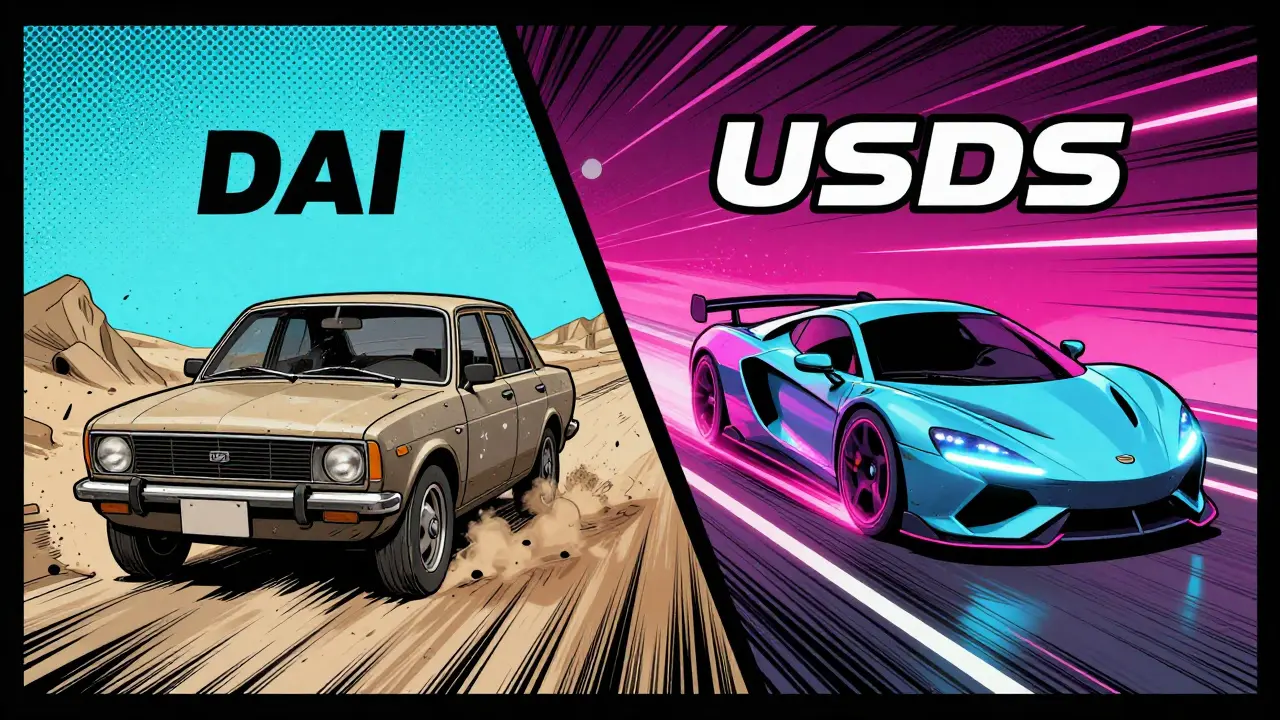
Remember when DAI was the go-to decentralized stablecoin for privacy-focused traders? That era has shifted. Enter USDS, a U.S. dollar-pegged stablecoin that serves as the native currency of the decentralized Sky Protocol. If you’ve been tracking the evolution of DeFi, you might recognize Sky Protocol by its previous name: MakerDAO. USDS isn’t just a new ticker; it’s the upgraded, rebranded successor to DAI, designed to offer better yields and deeper integration within an open financial ecosystem.
For many users, the switch from DAI to USDS feels like upgrading from a reliable sedan to a high-performance electric vehicle-same core engine, but with new features, better efficiency, and a fresh design. But what exactly does this mean for your portfolio? How does USDS maintain its peg compared to centralized giants like USDC? And why should you care about the "Endgame" evolution of the Maker system? Let’s break down the mechanics, the risks, and the real-world utility of holding USDS in 2026.
From MakerDAO to Sky Protocol: The Origin Story
To understand USDS, you first need to understand where it came from. The original MakerDAO was a decentralized autonomous organization (DAO) responsible for issuing the DAI stablecoin through over-collateralized loans on the Ethereum blockchain. For years, MakerDAO operated as the backbone of decentralized lending. However, as the crypto landscape matured, the protocol needed to scale, improve capital efficiency, and compete with centralized stablecoins. This led to the "Endgame" plan-a massive restructuring that transformed MakerDAO into the Sky Protocol is the evolved version of the Maker protocol designed to enhance decentralization, yield generation, and user experience within the DeFi ecosystem.
As part of this transition, DAI was retired and replaced by USDS. Think of USDS as DAI 2.0. It inherits the battle-tested smart contract architecture of its predecessor but operates under a more modern governance model. The goal? To provide users with "more rewarding crypto experiences," according to CoinGecko. This means USDS isn’t just a store of value; it’s integrated into yield-bearing mechanisms and incentive structures that make holding it more attractive than parking funds in a non-interest-bearing bank account.
How USDS Maintains Its Peg
The most critical question for any stablecoin holder is: "Is my money safe?" Unlike USDC is a fiat-backed stablecoin issued by Circle Internet Group, backed by off-chain reserves including cash and short-term U.S. treasuries. or Tether (USDT), which rely on centralized companies holding bank accounts, USDS is collateral-backed. This means every single USDS token in circulation is backed by assets locked in transparent smart contracts on the Ethereum blockchain.
Here’s how it works in practice:
- Over-Collateralization: Users lock up crypto assets (like ETH or WBTC) in Sky Protocol vaults. They can then mint USDS against these assets. Because the value of the collateral must always exceed the value of the minted USDS, there’s a buffer against market crashes.
- Soft Peg Mechanism: USDS maintains a "soft peg" to the U.S. dollar. This doesn’t mean you can walk into a bank and redeem 1 USDS for $1 cash. Instead, the peg is maintained through market forces. If USDS trades below $1.00, arbitrageurs buy it cheaply and redeem it for collateral at a profit, driving the price back up. If it trades above $1.00, users mint new USDS to sell, increasing supply and lowering the price.
- Transparency: All collateral holdings are visible on-chain. You don’t have to trust a company’s audit report; you can verify the health of the system yourself using block explorers.
This decentralized approach offers censorship resistance. No government or corporation can freeze your USDS holdings because they aren’t held in a central ledger. However, it also introduces smart contract risk-if the code fails, the funds could be at risk. That’s why the Sky Protocol relies on extensive audits and a robust community of developers.
USDS vs. DAI vs. USDC: Which Should You Choose?
If you’re deciding between stablecoins, it helps to compare their underlying models. Here’s a quick breakdown:
| Feature | USDS (Sky Protocol) | DAI (Legacy) | USDC (Circle) |
|---|---|---|---|
| Backing Type | Crypto Collateral (On-Chain) | Crypto Collateral (On-Chain) | Fiat Reserves (Off-Chain) |
| Governance | Decentralized DAO | Decentralized DAO | Centralized Corporation |
| Peg Stability | Soft Peg (Market-Driven) | Soft Peg (Market-Driven) | Hard Peg (Redeemable) |
| Yield Potential | High (Integrated into DeFi) | Medium | Low (Unless lent out) |
| Regulatory Risk | Low (Censorship Resistant) | Low (Censorship Resistant) | High (Subject to Compliance) |
USDS effectively replaces DAI. There’s no functional reason to hold legacy DAI anymore unless you’re interacting with older protocols that haven’t updated their integrations. Compared to USDC, USDS offers greater privacy and freedom from regulatory freezes, but it requires more technical understanding. USDC is easier for beginners because you know exactly who backs it, but that same centralization means your funds can be frozen if you violate terms of service.
Technical Specs and Market Data
As of mid-2026, USDS has established itself as a major player in the stablecoin market. Here are the key metrics you need to know:
- Token Standard: ERC-20. This means USDS works seamlessly with Ethereum wallets like MetaMask, Ledger, and Trezor, as well as thousands of DeFi applications.
- Total Supply: Approximately 7.69 billion USDS. This large circulating supply indicates deep liquidity and widespread adoption.
- Market Cap: Around $7.69 billion. While smaller than USDT or USDC, this places USDS firmly in the top tier of decentralized stablecoins.
- Price Volatility: Extremely low. In recent weeks, USDS has traded between $0.9993 and $1.0000. Deviations are rare and usually corrected within minutes by arbitrage bots.
- All-Time High: $1.58 (September 24, 2024). This spike occurred during a period of extreme market stress, highlighting how demand for safe-haven assets can temporarily distort stablecoin pricing.
The tight trading range around $1.00 demonstrates the effectiveness of the Sky Protocol’s stability mechanisms. Even during volatile crypto markets, USDS remains a reliable unit of account for traders and investors.
Real-World Use Cases for USDS
Why would you hold USDS instead of just keeping your money in USD? Here are three practical scenarios:
- Earning Yield in DeFi: By supplying USDS to lending protocols or liquidity pools on the Sky ecosystem, you can earn interest. Unlike traditional savings accounts, these yields are often higher because they come from borrower fees rather than corporate profits.
- Trading Without Fiat Conversion: If you trade frequently, converting crypto to USD and back incurs taxes and fees. Using USDS as a base pair allows you to step out of volatile assets without triggering taxable events (depending on your local jurisdiction).
- Cross-Border Payments: Sending USDS across borders is faster and cheaper than traditional wire transfers. Since it’s an ERC-20 token, transactions settle on the Ethereum network in minutes, regardless of time zones or banking hours.
Additionally, major exchanges like Coinbase and Kraken now support USDS trading pairs. On Kraken Pro, you can even set up automated stop-loss and take-profit orders for USDS positions, treating it with the same seriousness as Bitcoin or Ethereum.
Risks and Considerations
No investment is without risk, and USDS is no exception. Before diving in, consider these factors:
- Smart Contract Risk: Although the Sky Protocol code is audited, bugs can still exist. A successful hack could compromise the collateral backing USDS.
- Collateral Correlation: If all collateral assets (e.g., ETH, BTC) crash simultaneously, the protocol may struggle to maintain the peg. This is known as a "death spiral" scenario, though Sky’s diversified collateral mix mitigates this risk.
- Regulatory Uncertainty: Governments worldwide are scrutinizing decentralized finance. While USDS is censorship-resistant, future regulations could impact its usability on centralized exchanges.
Always do your own research (DYOR) and never invest more than you can afford to lose. Start with small amounts to familiarize yourself with the Sky Protocol interface before committing significant capital.
How to Buy and Store USDS
Getting started with USDS is straightforward. Here’s a step-by-step guide:
- Create a Wallet: Download a trusted Ethereum-compatible wallet like MetaMask or install a hardware wallet app like Ledger Live.
- Fund Your Account: Buy ETH or USDT on a centralized exchange like Coinbase or Kraken. Transfer these funds to your personal wallet address.
- Swap for USDS: Use a decentralized exchange (DEX) like Uniswap or SushiSwap. Connect your wallet, select USDS as the output token, and execute the swap. Alternatively, buy USDS directly on Coinbase if available in your region.
- Secure Your Holdings: Enable two-factor authentication (2FA) on your exchange accounts and back up your wallet seed phrase offline. Never share your private keys.
Once you have USDS, you can leave it in your wallet for storage or deploy it into DeFi protocols to earn yield. Just remember to monitor gas fees on Ethereum, as high network congestion can make small transactions expensive.
Is USDS the same as DAI?
No, USDS is the upgraded successor to DAI. While they share similar underlying technology and were both issued by the Maker/Sky ecosystem, USDS represents a new phase with improved tokenomics, yield opportunities, and governance structures. Legacy DAI is being phased out in favor of USDS.
Can I redeem USDS for real dollars?
Not directly. USDS is a decentralized, collateral-backed stablecoin. You cannot redeem it 1:1 with a bank. To get fiat currency, you must sell USDS on a centralized exchange like Coinbase or Kraken for USD, then withdraw to your bank account.
Is USDS safer than USDC?
Safety depends on your definition. USDC is backed by regulated fiat reserves, making it predictable but susceptible to freezing by authorities. USDS is backed by transparent on-chain crypto collateral, offering censorship resistance but exposing you to smart contract and market volatility risks. Neither is inherently "safer"; they serve different needs.
What happens if USDS de-pegs?
If USDS trades significantly below $1.00, arbitrageurs will buy the discounted tokens and redeem them for underlying collateral, profiting from the difference. This mechanism naturally pushes the price back toward parity. However, in extreme market crashes, temporary deviations can occur.
Where can I trade USDS?
USDS is available on major centralized exchanges like Coinbase and Kraken. It is also widely supported on decentralized exchanges (DEXs) such as Uniswap and Curve, as well as various DeFi lending platforms within the Sky Protocol ecosystem.