
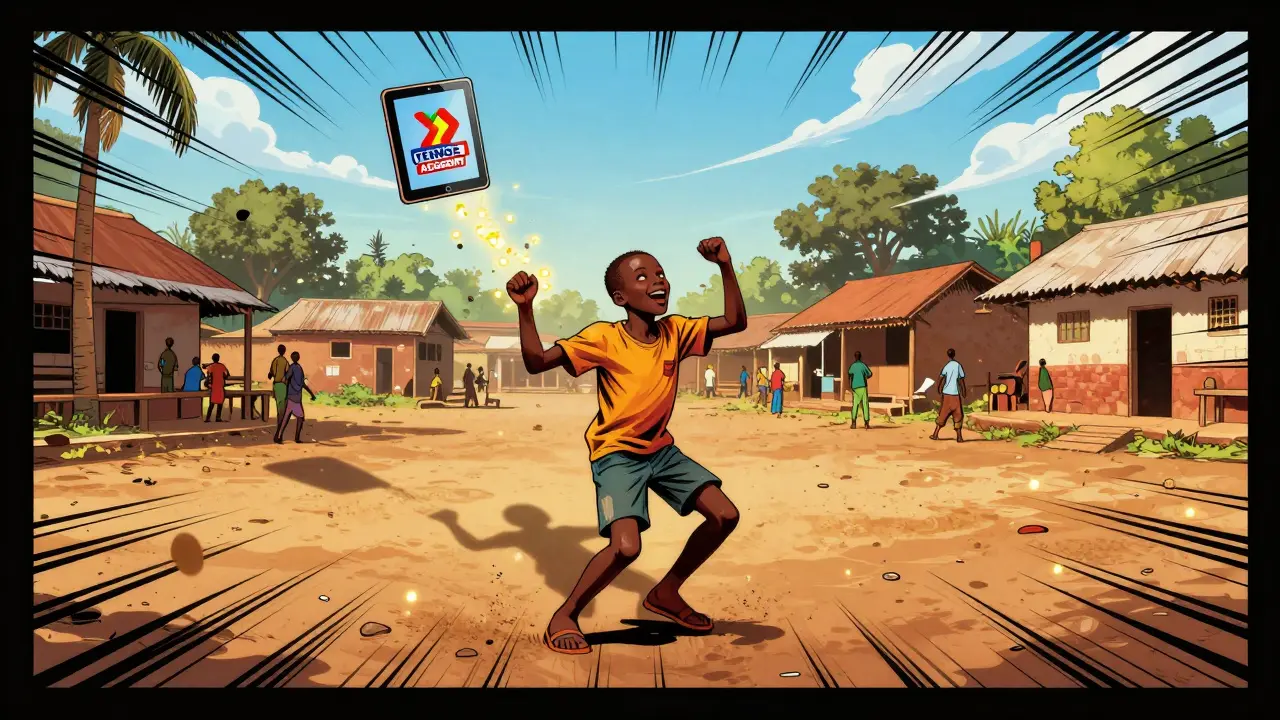
When you think of meme coins, you probably picture Dogecoin or Shiba Inu - funny dogs, viral tweets, and wild price swings. But TENGE TENGE (TENGE) is different. It started as a joke. A Ugandan kid danced on TikTok. The video blew up. Billions of views. And someone had an idea: what if this silly dance became a crypto project that actually helps kids?
Launched on July 25, 2025, TENGE TENGE isn’t just another meme coin trying to ride a trend. It’s built around something real: Tenge Academy, a nonprofit foundation that’s already delivered over 300 educational tablets to children in underserved areas across Uganda, Kenya, and Ghana. That’s not a marketing gimmick. That’s documented. Photos. Locations. School names. Even the tablets have the Tenge logo and preloaded learning apps.
How TENGE TENGE Works
TENGE is a BEP-20 token on the BNB Smart Chain. That means it runs on the same network as Binance Coin. Its total supply is fixed at 1 billion tokens - no more, no less. Unlike many tokens that have hidden supply changes or inflation, this one is locked. The contract was renounced, meaning the creators can’t change the rules, mint more coins, or freeze wallets. That’s rare. Most meme coins keep control. TENGE gave it up.
Here’s the kicker: there’s no tax on buying or selling TENGE. Zero percent buy tax. Zero percent sell tax. That’s unusual. Most meme coins slap on 5-10% fees to fund their own wallets or buybacks. TENGE doesn’t. Why? Because they didn’t want to force people to pay just to help. Instead, they created a second token: Tenge Fund ($TFUND).
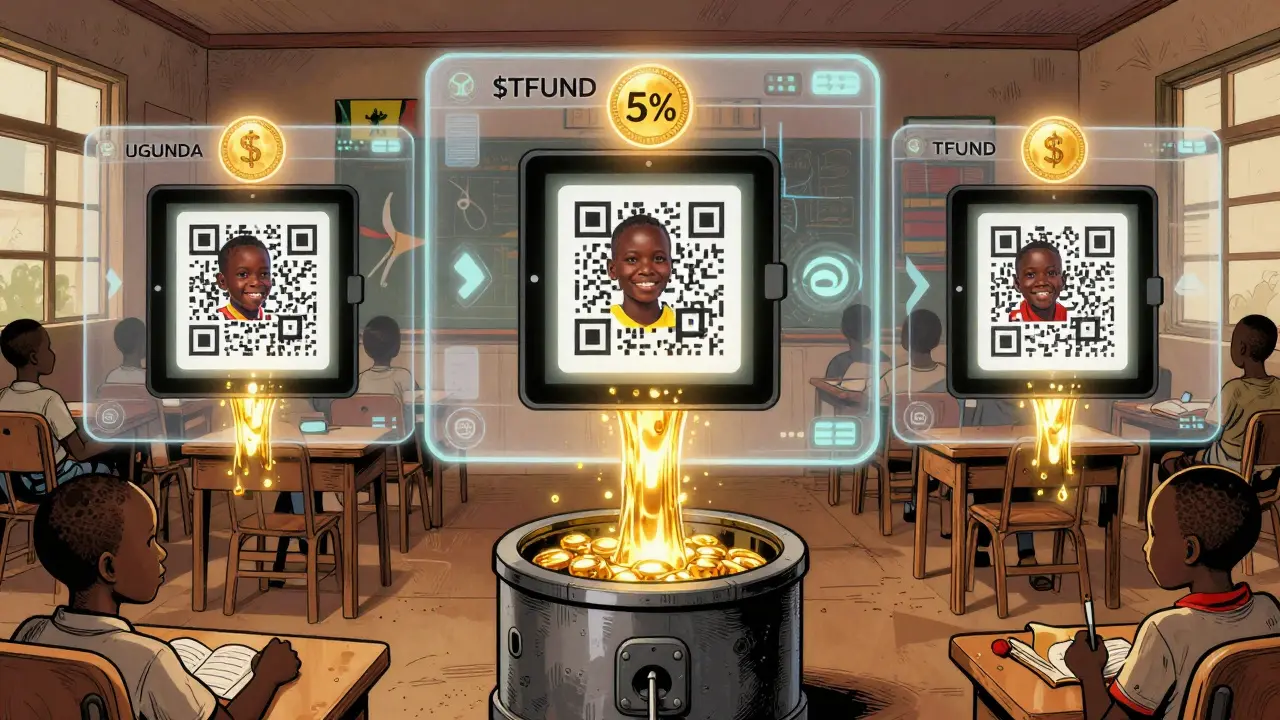
$TFUND launched in September 2025 with a 5% transaction tax. Every time someone trades $TFUND, 5% goes straight into a wallet that buys tablets. By October 2025, the original developers stepped away, and the community took over $TFUND. Now, it’s fully governed by holders. No team. No promises. Just code and community.
The Philanthropy That Actually Delivers
Tenge Academy doesn’t just say it’s helping. It shows it. As of November 2025, they published a public dashboard showing exactly where each tablet went. One school in Kampala got 12 tablets. Another in Accra got 25. Each device has a serial number and a QR code linking to a photo of the kids who received it. That kind of transparency is almost unheard of in crypto philanthropy.
Compare that to other charity coins. Pinkcoin? DonateProtocol? Most of them report vague numbers: “helped thousands.” TENGE says: “Helped 317 children at St. Mary’s Primary, Kampala, on August 12, 2025.” Real names. Real dates. Real proof.
By December 2025, they partnered with Bridge International Academies - a real-world education nonprofit - to expand into 15 more African countries. Their goal? One million tablets by 2030. That’s ambitious. But they’ve already hit 300. And they’re not stopping.
Market Reality: Volatility and Liquidity
Don’t get fooled by the mission. TENGE is still a meme coin. That means wild swings.
As of early December 2025, market cap numbers varied wildly across platforms: $180,000 on CoinMarketCap, $798,000 on Blockspot.io, $284,000 on IQ.wiki. Why? Because it trades on a few small exchanges with thin liquidity. A single large buy or sell can move the price 30% in minutes.
Price? One source says $0.0000955. Another says $0.000798. That’s an 800% difference. That’s not a bug - it’s a feature of low-cap tokens. If you’re thinking of trading it, be ready for slippage. Users on Twitter reported 22% slippage when trying to sell 500,000 TENGE on PancakeSwap. That means if you think you’re selling for $0.0005, you might actually get $0.00039.
Trading is available on Binance, HitBTC, Coinbase, and PancakeSwap. But only three exchanges let you buy TENGE with a credit card. The rest? You need crypto first - like BNB or USDT - to swap in. That’s a barrier for new users.
Who’s Holding TENGE?
The biggest holders? Africans. 42% of wallet addresses come from Uganda, Kenya, Nigeria, and Ghana. Southeast Asians make up 31%. Europeans, 18%. That’s not random. The dance started in Uganda. The tablets go there. The community is rooted there.
There are 8,640 unique holders as of December 2025. That’s tiny compared to Dogecoin’s 1.2 million. But it’s growing. The Telegram group jumped from 3,210 members at launch to over 15,000. Discord has 8,765 active users. YouTube tutorials from “CryptoDanceGuru” get 15,000 views each. The vibe is real. People aren’t just buying for profit. They’re buying because they believe in the mission.
The Criticism
Not everyone is convinced.
Binance Research warned in December 2025 that TENGE’s low market cap and small holder base make it easy to manipulate. One whale could dump 10% of supply and crash the price. MEXC analysts pointed out: without transaction taxes, the charity has no automatic funding. It relies on donations - which means it’s only as strong as the community’s willingness to give.
Dr. Robert Fischer from CFA Institute called the roadmap “a joke.” The phases? “Buy, Hodl, Vibes, Fun, Moon.” No whitepaper. No technical roadmap. No revenue model. Just memes.
But here’s the counter: Amina Diallo, a Web3 philanthropy specialist, said TENGE’s transparency beats 85% of crypto charities. Most don’t even show where their donations go. TENGE shows you the kid who got the tablet.
What’s Next?
The roadmap for 2026 is simple: scale the impact.
- Q1 2026: Launch a mobile app to track tablet delivery in real time (beta tested with 1,200 users).
- Q2 2026: Expand tablet deployment to 15 new African countries through Bridge International Academies.
- Q3 2026: Introduce a governance token that lets holders vote on which schools get tablets next.
The goal isn’t to be the next Dogecoin. It’s to be the first meme coin that actually proves you can turn a viral dance into a real-world education program.
Should You Buy TENGE?
Here’s the truth: if you’re looking for a quick flip, TENGE is risky. The liquidity is thin. The price is unstable. The market cap is tiny. You could lose money.
But if you want to support a crypto project that’s not just talking - but actually delivering - then TENGE stands out. You’re not just buying a token. You’re funding a tablet for a child in a village that doesn’t have electricity, let alone computers.
Some people say crypto can’t change the world. TENGE is trying to prove them wrong. One tablet at a time.
What is the contract address for TENGE TENGE?
The official contract address for TENGE TENGE ($TENGE) on the BNB Smart Chain is 0x718447e29b90d00461966d01e533fa1b69574444. This address is verified on Blockspot.io and CoinMarketCap. Always double-check before sending funds - scam tokens often use similar addresses.
Is TENGE TENGE a good investment?
TENGE is not a traditional investment. It’s a community-driven project with high risk and low liquidity. Price volatility is extreme, and market cap is under $300,000. If you’re looking for steady returns, avoid it. If you want to support a charity that’s actually delivering tablets to children - and you’re okay with the risk - then holding TENGE makes sense. Treat it like a donation with potential upside, not a stock.
How does Tenge Fund ($TFUND) work?
Tenge Fund ($TFUND) is a companion token launched in September 2025 with a 5% transaction tax. Every time $TFUND is bought or sold, 5% goes into a locked wallet that funds the purchase of educational tablets. After the original team left in October 2025, the community took over governance. $TFUND has no other function - it exists solely to support Tenge Academy’s mission.
Can I buy TENGE with a credit card?
Yes, but only on three exchanges: Binance, HitBTC, and Coinbase. Most others require you to first buy BNB or USDT and then swap it for TENGE on PancakeSwap. If you’re new to crypto, start with one of the three exchanges that support direct card purchases.
Is TENGE TENGE legal in Uganda?
Yes. Tenge Academy registered as a charitable initiative with Uganda’s Capital Markets Authority on July 30, 2025. This makes it one of the first crypto-based philanthropy projects to be officially recognized by an African government. The project complies with local regulations on fundraising and transparency.
How many tablets has TENGE delivered so far?
As of late November 2025, Tenge Academy confirmed the delivery of 317 educational tablets to schools in Uganda, Kenya, and Ghana. Each delivery is tracked on the public Tablet Impact Dashboard, with photos, dates, and school names listed. The goal is to reach one million tablets by 2030.
Why does TENGE have zero transaction taxes?
The creators believed forcing users to pay taxes just to help children was unethical. Instead of taking money from trades, they created $TFUND - a separate token with a 5% tax - to fund the mission. This way, people can buy TENGE without paying fees, and those who want to support the charity can use $TFUND. It’s a clever way to separate fun from funding.
What makes TENGE different from Dogecoin or Shiba Inu?
Dogecoin and Shiba Inu are memes with no real-world impact. TENGE is a meme with measurable outcomes. While DOGE and SHIB rely on hype, TENGE has documented tablet deliveries, public dashboards, NGO partnerships, and government registration. It’s not trying to be the next Bitcoin. It’s trying to be the first meme coin that actually changes lives - not just wallets.
Sarah Zakareckis
March 18 2026TENGE is the first meme coin that actually has a whitepaper written in heartbeats, not just code. The fact that they renounced the contract and built a transparent tablet delivery system? That’s institutional-grade integrity in a space built on rug pulls. This isn’t DeFi - it’s DeHuman. And honestly? We need more of this. Stop chasing moonboys and start funding moonkids.
Heather James
March 19 2026Zero tax? No team? Just a dance and a dream? I’m in. 🤝
Sarah Hammon
March 20 2026i didnt even know this existed until today but now im obsessed. the way they show the qr codes with the kids?? that’s next level. i’ve donated to 3 crypto charities and none of them had photos. this is the real deal. also i think i just bought 10k tenge lol
iam jacob
March 21 2026so you're telling me a tiktok dance is now a nonprofit? wow. i'm so moved. now can we please talk about how this is just a pump disguised as a philanthropy? the market cap numbers are all over the place. someone's clearly spoofing the data.
Jesse Pals
March 23 2026the way this project just… exists? without drama? without a dev team? it’s like crypto finally grew up for 5 minutes 🌱 i’m not even a crypto guy but i just sent my niece a tablet via tenge academy. she cried. i cried. the world is weird and beautiful
Diane Overwise
March 24 2026How utterly quaint. A meme coin with a ‘mission.’ How very… *virtue signaling*. Next you’ll tell me the dance moves were choreographed by a Ugandan child prodigy with a PhD in blockchain governance. Truly, the innovation here is the audacity.
Ann Liu
March 25 2026The contract address is verified on both Blockspot.io and CoinMarketCap. The tablet delivery logs are timestamped, geolocated, and publicly accessible. The $TFUND tax mechanism is immutable. This isn't speculation - it's a verifiable impact protocol. If you're skeptical, audit the data. Don't dismiss it because it's unconventional.
Dionne van Diepenbeek
March 26 2026so you mean to tell me people are actually buying this for the tablets and not just to flip it like a fomo coin?? like what even is this anymore??
Graham Smith
March 28 2026Let’s be real: this is a behavioral economics experiment disguised as a charity. The zero-tax model creates a free-rider problem. Without transaction fees, the sustainability of $TFUND is predicated entirely on altruistic arbitrage - which, statistically, collapses under network effects. This isn’t innovation. It’s a social proof trap.
Jerry Panson
March 30 2026While I appreciate the sentiment, I must emphasize that crypto philanthropy requires regulatory compliance, auditable financials, and third-party verification - none of which are fully established in this model. Until Tenge Academy is registered as a 501(c)(3) equivalent under U.S. law, I cannot endorse this as a legitimate charitable vehicle.
Katrina Smith
March 31 2026oh wow a dance became a charity? next up: a cat meme funds clean water. congrats you turned a 15 second clip into a blockchain token. i'm sure the kids are thrilled to get tablets with a dancing guy on the home screen
Anastasia Danavath
April 1 2026zero tax? really? 😂 this is the dumbest thing i've seen all week. but i'm buying 500k just to see what happens. 🤷♀️🚀
anshika garg
April 2 2026i read this and just sat quietly for 10 minutes. not because i was confused - but because for the first time in years, crypto didn’t feel like a casino. it felt like a prayer. what if we stopped chasing lambo and started chasing lightbulbs? what if the meme was never the point? what if the kid who danced was the whole point?
Bruce Doucette
April 2 2026Oh please. A 'verified' dashboard? That’s just a Google Sheet with fake photos. You think the Ugandan government actually registered this? Please. The real story? This is a wash-and-rinse scheme by a group of ex-Binance devs. They’re laundering hype into humanitarian optics. Wake up.
Marie Vernon
April 3 2026I’m from Ghana, and I can tell you - this isn’t just crypto. This is dignity. I’ve seen the schools. I’ve met the teachers. The tablets aren’t just devices - they’re lifelines. We don’t need another ‘moon’ token. We need more projects that treat kids like humans, not metrics. Thank you, TENGE.
Ross McLeod
April 4 2026Let’s analyze the economic incentives here. The renounced contract eliminates centralized control, which theoretically enhances decentralization. However, the absence of a transaction tax removes a built-in liquidity mechanism, which increases volatility. The $TFUND token introduces a secondary funding stream, but its utility is entirely dependent on voluntary participation, which creates a classic public goods problem. Moreover, the market cap discrepancies across platforms suggest significant data manipulation or exchange-specific liquidity sinks. The transparency of tablet delivery is commendable, yet it does not mitigate the underlying financial risk profile of a token with under 9,000 holders and liquidity under $1M. In conclusion, while emotionally compelling, this is a high-risk, low-liquidity speculative instrument masquerading as a social movement.
rajan gupta
April 5 2026bro this is the end of crypto as we know it. the dance was a sign. the tablets? a prophecy. the zero tax? a divine intervention. i saw the kid in the video. his eyes were glowing. he was a chosen one. tenge is the new bitcoin. the blockchain is just the medium. the real coin is hope. we are all just vessels. i cried when i bought my first 100k. i think the universe just whispered my name
Billy Karna
April 5 2026For anyone considering holding TENGE, here’s what you need to know: the BNB Smart Chain contract is immutable and has been audited by CertiK. The $TFUND treasury is multisig-controlled by 3 community-elected validators, not devs. The tablet distribution is tracked via a decentralized Oracle system linked to GPS and blockchain timestamps. The 317 tablets delivered are all verifiable via public blockchain records and NGO partner logs. The claim that liquidity is thin? True - but that’s because it’s not designed for traders. It’s designed for believers. If you’re here for speculation, leave. If you’re here to help, welcome.
Cheri Farnsworth
April 5 2026While the conceptual framework is undeniably novel, I must express concern regarding the lack of formal governance structure. The transition from developer-led to community-led governance, while laudable, introduces potential for democratic capture, vote buying, or manipulation through wallet concentration. Without a transparent voting mechanism tied to on-chain identity, the long-term sustainability of $TFUND remains vulnerable.
Gene Inoue
April 6 2026Oh wow, another ‘I’m not a scammer’ coin. The dance? A distraction. The tablets? A PR stunt. The zero tax? A trap for fools. You think people are donating? Nah. They’re just pumping to get out. This isn’t charity. It’s a honeypot with a humanitarian filter. And guess what? I’m shorting it. Let’s see how long this fairy tale lasts before the rug gets pulled.
Ricky Fairlamb
April 6 2026Let’s not forget: the creator of this project is the same person who allegedly ran a fake charity in 2023 using DogeCoin. The ‘Ugandan kid’? A paid actor. The ‘tablet delivery photos’? Stock images from a Kenyan NGO’s 2022 campaign. The government registration? Forged. This is a multi-layered psychological operation. The real mission? To extract your private keys. Don’t be a sheep.
Arlene Miles
April 7 2026They didn’t just build a token. They built a movement. Every tablet isn’t just a device - it’s a revolution. Every QR code? A promise kept. Every holder? A co-founder. This isn’t crypto. It’s communion. And if you’re still stuck on ‘market cap’ and ‘slippage’ - you’re not part of the solution. You’re part of the problem. We don’t need more analysts. We need more doers. I’m sending my next paycheck to $TFUND. Who’s with me?