
Have you ever stumbled upon a crypto ticker that looks like a cute pet name but claims to be serious infrastructure? That’s exactly what happens when you search for PAW. On the surface, it looks like just another meme coin riding the wave of internet humor. But dig a little deeper, and you find something different: a project trying to build actual blockchain technology.
PAW is the native token of PawChain, a network that describes itself as a Layer 3 (L3) blockchain. It’s not just a joke; it’s an attempt to solve real problems in decentralized finance (DeFi), specifically around speed, security, and cross-chain trading. However, being "different" doesn't automatically mean "safe." In fact, the data from mid-2026 shows a highly volatile asset with thin liquidity. If you are wondering whether this is a future tech giant or a speculative gamble, you need to understand how the technology works, where the money goes, and why the numbers look so strange.
The Core Concept: What is PawChain?
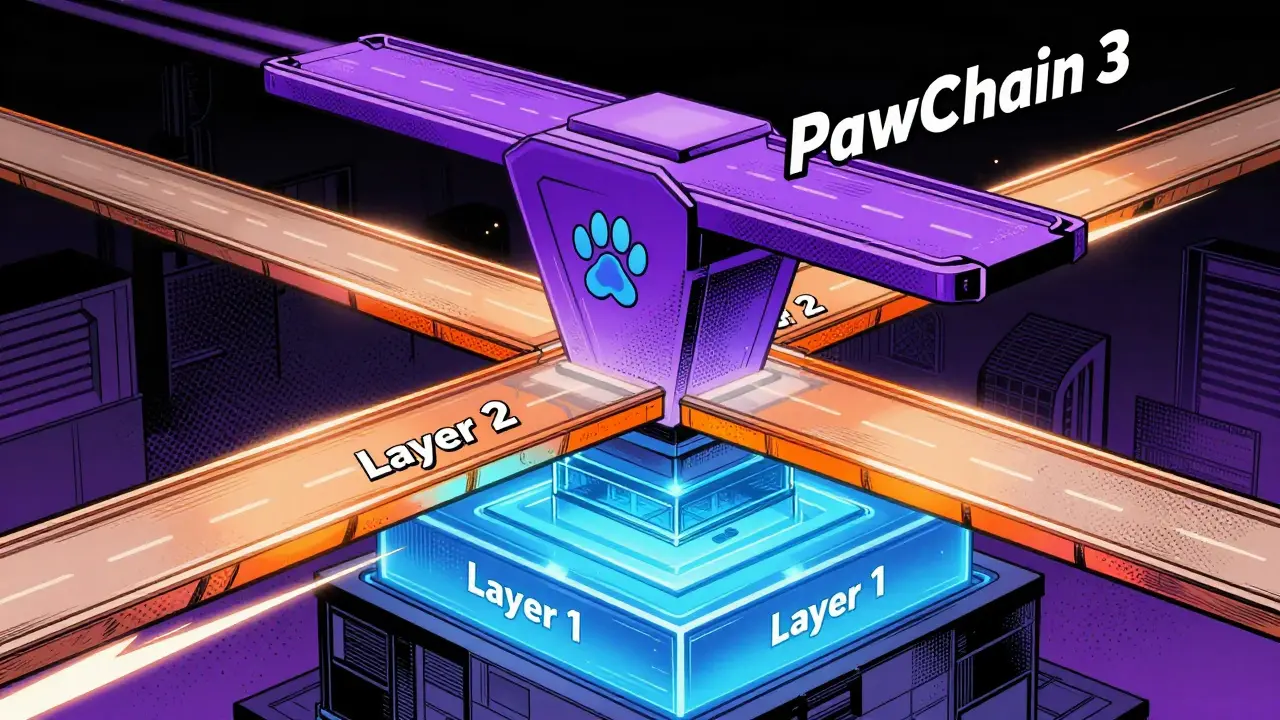
To understand the token, you first have to understand the chain it lives on. Most people know about Bitcoin (Layer 1) and Ethereum (Layer 1). They also know about Layer 2 solutions like Arbitrum or Optimism, which sit on top of Ethereum to make transactions faster and cheaper. PawChain takes this idea one step further.
PawChain is a Layer 3 blockchain infrastructure designed to optimize specific applications like DeFi and cross-chain swaps without sacrificing the security of underlying networks. Think of it as a specialized highway built on top of a general interstate. While Layer 1 handles the heavy lifting of security and Layer 2 handles general scaling, Layer 3 aims to provide application-specific optimizations.
According to educational resources from Gate.io and Bybit, PawChain focuses on two main things:
- Enhanced Security: Implementing stricter verification pipelines for smart contracts to reduce hacks.
- Efficient Routing: Making cross-chain trades smoother so you don't get stuck waiting hours for a bridge to clear.
This positions PawChain not just as a community experiment, but as an infrastructure play. The goal is to offer a faster, safer environment for digital finance than traditional chains can provide alone.
Utility vs. Meme: What Does PAW Actually Do?
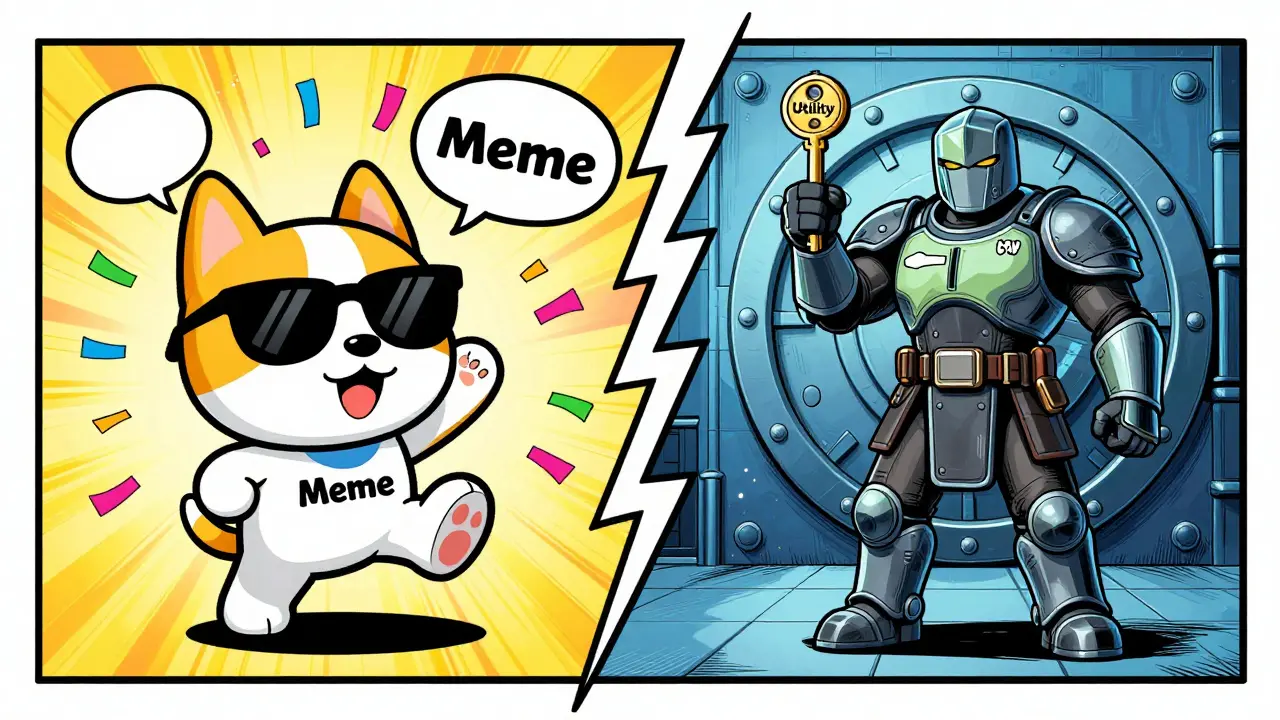
Here is where it gets tricky. PAW has dual branding. It markets itself with the fun, accessible energy of a meme coin, but it functions as a utility token. This hybrid approach is common in crypto because memes bring attention, while utility keeps users engaged long-term.
If you hold PAW, here is what you can actually do with it inside the ecosystem:
- Pay Transaction Fees: Just like you use ETH to pay gas on Ethereum, you use PAW to pay for transactions on the PawChain network. Every time you swap tokens or interact with a dApp on PawChain, you burn or spend PAW.
- Governance Participation: PAW holders can vote on decisions regarding the ecosystem's development. This gives you a say in which features get prioritized or how funds are allocated.
- Ecosystem Access: Tools like Paw Scan, the block explorer for the network, rely on the underlying infrastructure funded by the token economy. Verifying smart contracts and tracking live transactions requires the network to be operational and secure.
So, while the name might sound playful, the mechanics are functional. You aren't just holding a picture of a dog; you are holding the fuel that keeps the engine running.
Market Reality: Price, Volume, and Liquidity Risks
Now let’s talk numbers, because this is where many investors get burned. As of late June 2026, PAW is classified as a small-cap cryptocurrency. The data paints a picture of a project with significant ambition but very low market activity.
| Metric | Value | Context |
|---|---|---|
| Market Cap | ~$10.75 Million USD | Ranks approx #1118 on CoinGecko |
| Price (USD) | ~$0.00000000097 | Extremely low unit price due to high supply |
| 24-Hour Volume | ~$6 - $60 USD | Critical liquidity risk indicator |
| All-Time High Drop | ~89% Below ATH | Significant drawdown from peak hype |
Look closely at that volume number. We are talking about single-digit or low-double-digit dollars in daily trading volume on major trackers. What does this mean for you? It means liquidity is incredibly thin. If you try to sell a large amount of PAW, there likely aren't enough buyers on the other side. Your sell order could crash the price significantly before it even fills. This is known as slippage, and in micro-caps like PAW, it can eat up 50% or more of your value instantly.
The price itself is displayed with many zeros ($0.00000000097). This is typical for meme-style coins with massive circulating supplies. It creates a psychological illusion that the coin is "cheap," encouraging retail buyers to think they can buy millions of tokens for a few dollars. However, the total market cap tells the true story of the project's size and valuation.
The Identity Crisis: Beware of Imposters
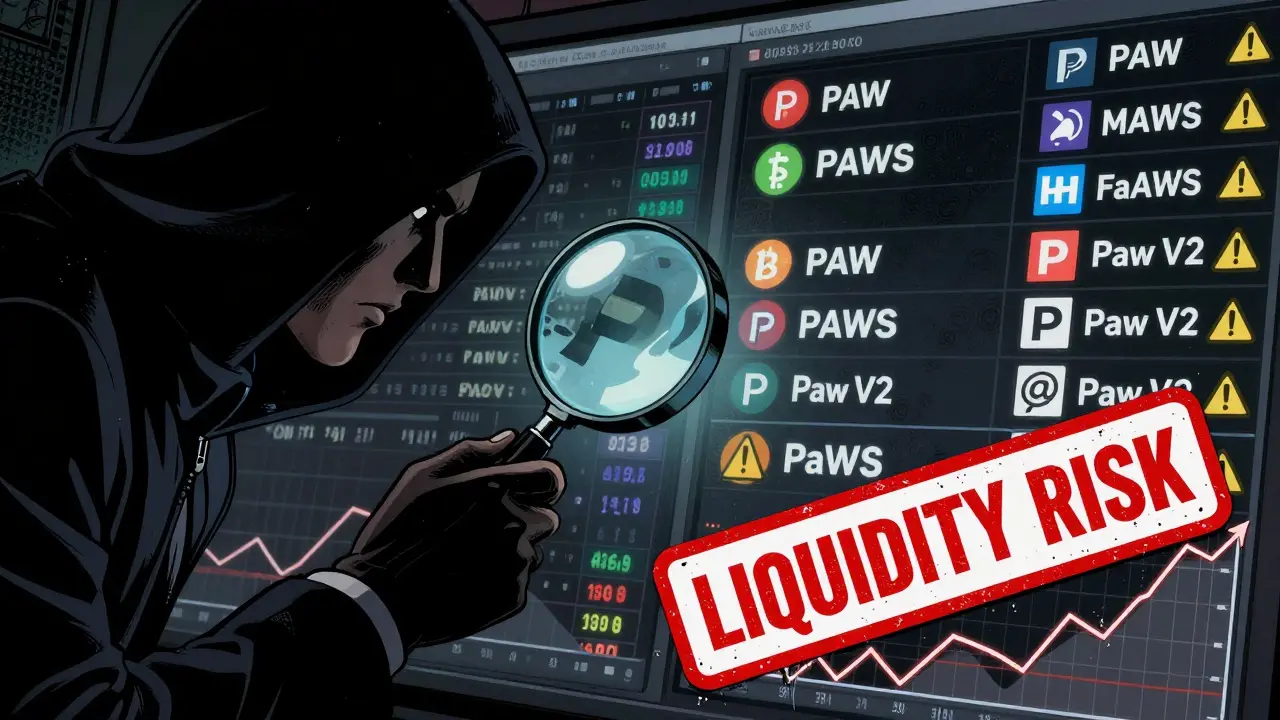
If you search for "PAW" on Google or a crypto exchange, you will see chaos. There are multiple tokens with similar names, tickers, and themes. This is a major risk factor for new investors.
You need to distinguish between:
- PAW (PawChain): The Layer 3 utility/meme hybrid discussed here. Associated with PawScan and PawWallet.
- PAWS (Solana Memecoin): A completely different token that originated from a Telegram mini-app and migrated to Solana for speed. This is purely a meme coin with no L3 infrastructure narrative.
- Paw V2: Another variant listed on some converters, often with zero circulating supply or distinct contract addresses.
Why does this matter? Because if you accidentally buy the Solana-based PAWS thinking it’s the PawChain PAW, you are investing in a totally different asset with different risks. Always verify the contract address. For PawChain PAW, ensure you are interacting with the correct network (often bridged via their specific wallet) rather than assuming it lives on Ethereum or Solana natively.
How to Buy and Store PAW Safely
Despite the low liquidity, PAW is available on several platforms. Major exchanges like Binance and Crypto.com list it, though the trading pairs may vary. Here is the practical path to getting involved:
- Centralized Exchange Purchase: You can buy PAW using a credit card or fiat deposit on platforms like Binance. Look for the PAW/USDT pair. Be aware that spreads (the difference between buy and sell price) will be wide due to low volume.
- Web3 Wallet Migration: To truly participate in the PawChain ecosystem, you shouldn't keep your tokens on an exchange. You’ll need a Web3 wallet. Projects like Guarda support PAW, allowing you to store, send, and receive tokens non-custodially.
- Bridging to L3: If you want to use the token for governance or fees, you may need to migrate your PAW to the PawChain L3 network. This involves using the official Paw Wallet interface (wallet.pawchain.net) to bridge assets. Always double-check URLs to avoid phishing sites.
Storage is straightforward, but security is paramount. Since this is a niche asset, customer support on exchanges might not be helpful if something goes wrong with a bridge transfer. Keep your private keys offline and never share them.
Sentiment and Community Outlook
Is anyone actually talking about this? Yes, but not in the way they talk about Bitcoin or Ethereum. Sentiment analysis from Coinbase shows an average score of 3.0 out of 5. About 33% of social media mentions are bullish, while the rest are neutral or bearish.
Gate.io describes PAW as an "underdog" with "serious community energy." This suggests a dedicated group of supporters who believe in the L3 vision, despite the price drops. However, the lack of institutional adoption or major academic research means the project relies entirely on retail interest and developer delivery.
The YouTube space is filled with reviews grouping PAW alongside NFTs and Play-to-Earn projects, highlighting its speculative nature. The community is active, but it is not overwhelmingly optimistic. Most holders seem to be waiting for a technical breakthrough or a major exchange listing boost to drive volume up.
Verdict: Is PAW Worth Your Attention?
PAW is not a passive investment. It is a high-risk, high-reward speculative asset tied to the success of an experimental Layer 3 blockchain. If you believe in the thesis that specialized L3 networks will dominate DeFi efficiency, PAW offers exposure to that idea.
However, you must respect the liquidity trap. With daily volumes under $100, you cannot treat this like a stock portfolio. Position sizing should be tiny-money you are fully prepared to lose. Verify every contract address, monitor the PawChain roadmap for actual technical updates (not just marketing tweets), and be ready for extreme volatility. It’s a fascinating experiment in crypto infrastructure, but right now, it remains a niche player in a crowded field.
Is PAW a meme coin or a utility token?
PAW is a hybrid. It uses meme coin branding to attract attention but functions as a utility token for the PawChain Layer 3 blockchain. You use it to pay transaction fees and participate in governance, giving it intrinsic utility beyond speculation.
What is the difference between PAW and PAWS?
They are completely different tokens. PAW is associated with the PawChain L3 ecosystem. PAWS (often seen on Solana) is a separate memecoin originating from a Telegram app. Always check the contract address and network to avoid buying the wrong asset.
Why is the trading volume for PAW so low?
PAW is a micro-cap asset with limited mainstream adoption. Low volume indicates low liquidity, meaning fewer people are buying and selling daily. This increases the risk of slippage, where large orders drastically change the price.
Can I mine PAW tokens?
No, PAW is not mined like Bitcoin. It is a pre-mined token distributed through sales, liquidity pools, and ecosystem incentives. You acquire it by purchasing on exchanges or earning it through participation in the PawChain ecosystem.
Is PawChain secure?
PawChain aims to enhance security through its Layer 3 architecture and tools like Paw Scan for contract verification. However, as a newer, smaller network, it carries higher risks than established Layer 1s like Ethereum. Always audit smart contracts yourself or rely on verified sources.
Routh Middaugh
June 26 2026I mean, look at the volume numbers. Seriously?? Six dollars? That is not a market, that is a ghost town! You cannot build an infrastructure play on six bucks of daily turnover! It makes absolutely no sense to me how anyone takes this seriously when the liquidity is thinner than watered-down kool-aid! I have seen more activity in my grandmother's knitting circle!
Rebecca Shoniker
June 26 2026The semantic distinction between utility and meme branding is fundamentally flawed here; it represents a classic case of cognitive dissonance among retail investors who lack technical literacy. The project fails to address the inherent inefficiencies of Layer 3 scaling solutions which are merely redundant given existing L2 dominance. Your analysis overlooks the critical aspect of tokenomics dilution which renders the governance rights practically null and void for small holders.
Robert Hundley
June 27 2026Hey hey hey! Let's not be so hard on the little guy! :D Sometimes you gotta start somewhere right? I think it's cool they are trying to innovate with the cross-chain stuff! Who knows maybe one day it will be huge! Keep dreaming big folks! 🚀
Melissa L
June 29 2026i dont get why people buy these things lol. just seems like a scam to me. but whatever i guess if u want to lose money go ahead.
Rob Morton
June 30 2026It is interesting to consider the philosophical implications of 'utility' in a digital asset that has negligible real-world economic backing. If the primary driver is speculation, does the label of 'Layer 3 infrastructure' hold any weight? We must question whether the technology serves the user or if the user serves the technology's valuation metrics. It is a complex dance between hope and reality.
John Curry
July 1 2026Oh, the tragedy of it all! A vision so grand, yet executed with such pathetic precision! The drama of watching a token bleed out because nobody wants to buy it is truly Shakespearean in its failure! I feel a deep sorrow for the developers who poured their souls into this hollow shell of a blockchain! It is a monument to wasted potential!
Trent Erman1
July 2 2026Actually, let me break down the tech for you since most people here are missing the point. The bridging mechanism is the key value prop here. While the volume is low now, the architecture allows for specific DeFi optimizations that generic L2s can't touch. It's early days, sure, but the code is solid. Don't sleep on the smart contract verification pipeline! 👍
Fiona Ellis
July 3 2026I actually tried to bridge some assets last week and the whole process was a nightmare! 😡 Why do they make it so complicated? And don't even get me started on the wallet interface! It's clunky and confusing! I spent hours trying to figure out where my tokens went! Absolutely unacceptable service for a 'serious' project! 🤬
Nicole Woessner
July 4 2026In my experience with emerging markets in Asia we see similar patterns where hype precedes utility by years. It is not necessarily bad but requires patience. The community energy mentioned is real even if the charts look dead. People believe in the team locally.
Jon Milton
July 5 2026This is exactly why crypto needs regulation! These unregulated scams prey on naive investors who don't understand basic economics! I say ban them all! Protect our citizens from these fraudulent schemes! It is outrageous that this is even allowed to trade on major exchanges! Shameful!
Sajjad Ghorbani Moghaddam
July 5 2026Look, everyone gets heated over crypto. But let's keep it chill. The post did a good job explaining the risks. Just do your own research and don't invest more than you can afford to lose. That's the golden rule. No need to attack the project or the people holding it.
Jay Sharma
July 6 2026Wake up sheeple! This is part of the globalist agenda to track your transactions through 'cross-chain' surveillance! They want to know every penny you spend! PAW is not a coin, it is a tracking device for the elite! Do not fall for their lies! The deep state controls the blockchain! Stay woke!
Scott Miller
July 8 2026You guys are all losers for hating on this! It's going to the moon! I'm buying the dip! Everyone else is too scared to win! Be brave! Take the risk! Winners take all! Stop crying about volume and start making moves! This is your chance to get rich quick! Get in now before it's too late!
Abby Martin
July 10 2026I am so tired of reading these amateur analyses. Obviously, anyone with half a brain can see this is a rug pull waiting to happen. The fact that you are debating the utility shows how ignorant you are. I only invest in blue chips and gold. Everything else is garbage for the masses. You should educate yourselves before wasting time on trash like this.
Mélanie Boulay
July 11 2026While I appreciate the detailed breakdown of the market data provided in the article, I find myself questioning the long-term viability of such a niche product in an increasingly consolidated market landscape where larger players dominate attention spans and capital flows, thereby creating a significant barrier to entry for smaller projects that lack the marketing budgets required to sustain interest levels necessary for growth.
Maurice Flynn
July 13 2026I just sit back and watch the chaos unfold. It's funny really. One day it's the next big thing, the next day it's worthless. I don't stress about it. I just observe. Maybe it survives, maybe it doesn't. Either way, the show goes on. Peace and love to all the degens out there.
nancy jarecki
July 13 2026Pathetic. Truly pathetic. The jargon-heavy nonsense about 'Layer 3 optimization' is just smoke and mirrors designed to fool the intellectually bankrupt. I've read whitepapers from actual engineers and this is barely coherent. Waste of bandwidth. Delete this thread.
Ryan Peters
July 14 2026Typical foreign scam token trying to infiltrate our financial system. We need American blockchains built by Americans for Americans! Not this Chinese-inspired dog coin garbage! Support local industry! Boycott PAW! It's an insult to our national sovereignty to allow these weak currencies to circulate! Make Crypto Great Again!
ross harris
July 15 2026Oh, what a beautiful mess of zeros and ones! The PAW token is a kaleidoscope of despair wrapped in a shiny layer of technological buzzwords! It dances on the edge of oblivion, seducing fools with promises of speed while dragging them into the swamp of illiquidity! A tragic opera of greed and folly!
Carl Belgrave
July 16 2026Listen here, you bunch of normies! This is how you spot a real opportunity vs a scam! Real patriots know that innovation happens outside the mainstream! But yeah, if you're too scared to handle volatility, stay away! Only the strong survive in crypto! Weak hands get rekt! Embrace the chaos!
Carl Hanzel
July 17 2026You are all wrong. Completely wrong. The volume isn't low because it's bad, it's low because the whales are accumulating in silence. You retail sheep are being played. The price will pump 100x and then dump on you all. I hate seeing you all so confident in your ignorance. Enjoy the ride to the bottom.
Daniel J. Cox
July 18 2026Interesting perspective from different cultures around the world regarding crypto adoption. In some places, these small caps are seen as lottery tickets rather than investments. It's a cultural phenomenon as much as a financial one. :)
Emma Rémond
July 19 2026The fundamental misunderstanding of blockchain scalability layers displayed here is astounding. To equate a niche L3 experiment with established infrastructure is laughable. The technical debt and security risks associated with such fragmented ecosystems are well-documented in academic literature. Only the uninformed would consider this a viable investment vehicle. Disgraceful.
ELNORA JEFFERSON
July 20 2026Boring. So boring. Another coin, another guide, another waste of my time. I expected something exciting but got a textbook definition of failure. Whatever. I'm done reading this drivel. Next.