
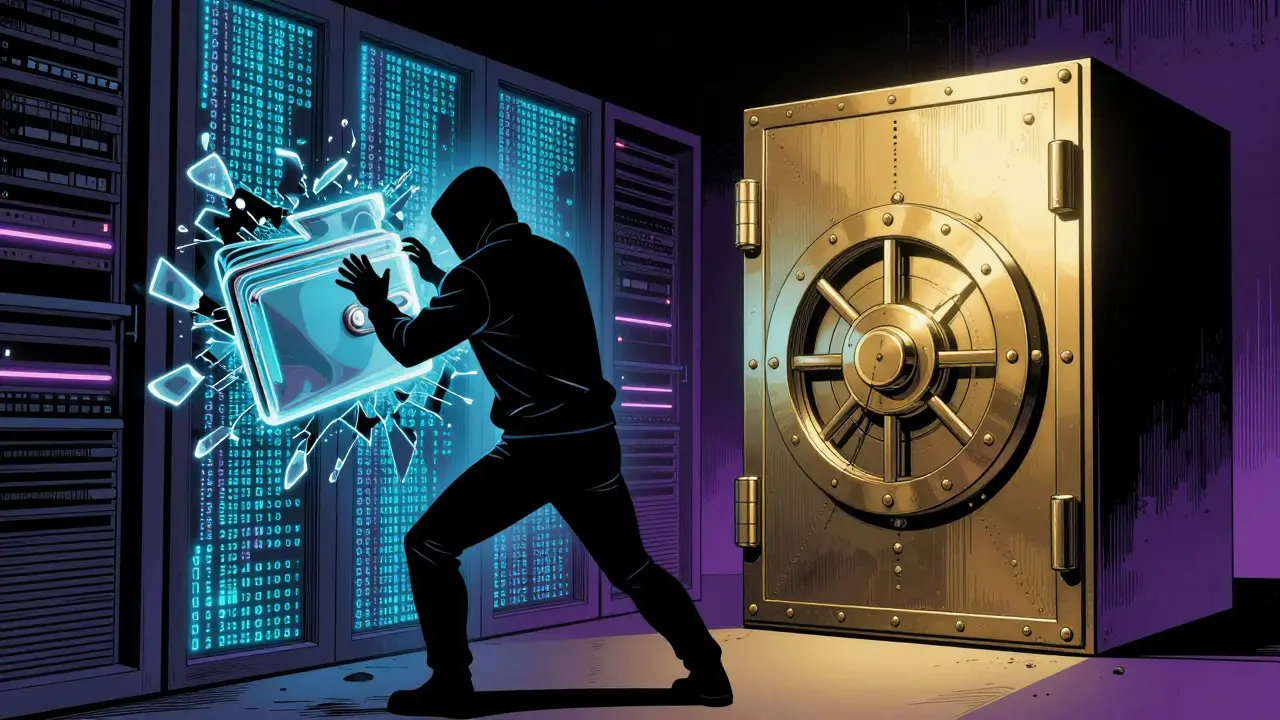
The biggest nightmare for any institutional digital asset holder is a single point of failure. In the world of blockchain, that failure usually looks like a compromised private key. If you're using a traditional software wallet, your keys are essentially files on a server-vulnerable to malware, rogue employees, or a simple infrastructure breach. This is why enterprises are moving toward HSM Integration is the process of using Hardware Security Modules to generate, store, and manage cryptographic keys in a physical, tamper-resistant environment. By ensuring that private keys never leave the hardware, you remove the risk of them being copied or stolen via the network.
The Core Problem: Why Software Wallets Fail at Scale
In an environment like Ethereum , your identity is tied to a public-private key pair. If a hacker gets a hold of that private key, they don't just have your password; they have total ownership of your assets. Software-based management is simply too risky for high-value portfolios because it relies on the security of the general-purpose operating system. An HSM solves this by moving the cryptographic operations-the actual "signing" of a transaction-inside a hardened piece of hardware. The key stays put; only the signed transaction comes out.
How the Technical Bridge Works: The Role of PKCS#11
You might wonder how a piece of specialized hardware talks to a distributed ledger. The secret is the PKCS#11 , which is a standard API specification for cryptographic tokens that allows different software applications to communicate with various HSM vendors. This creates a vendor-agnostic bridge. Instead of writing a unique piece of code for every single hardware brand, developers use this standard interface to request a signature or generate a key.
In a real-world setup, a single HSM device can be split into multiple partitions. Think of these as virtual isolated vaults. For example, if you're running multiple Ethereum nodes, you can assign node one to partition TPA01 and node two to TPA02. This ensures that even if one node is compromised, the keys for the other remain isolated and safe.
Implementation Paths: From On-Premise to Cloud
Depending on your risk appetite and operational budget, there are three main ways to deploy this architecture. On-premise solutions offer the highest level of physical control but require a dedicated team to manage the hardware. Cloud-based HSMs reduce the overhead and allow for rapid scaling, though you are technically trusting a third-party provider with the hardware's availability.
| Model | Control Level | Operational Effort | Primary Use Case |
|---|---|---|---|
| On-Premise (e.g., Thales Luna) | Maximum | High | Institutional Custodians, Banks |
| Cloud HSM (e.g., Luna Cloud) | Medium | Low | SaaS Platforms, Agile FinTechs |
| Managed Custody (e.g., Dfns) | Low | Minimal | Small to Mid-sized Enterprises |
Setting Up Ethereum with Luna HSM
Integrating Thales Luna HSM with an Ethereum network requires a few specific technical hurdles. First, you must ensure the Go executable is correctly set in your system PATH. Once the hardware is initialized and provisioned, you'll create your partitions for the blockchain nodes. One critical detail: if you are using BIP32 (Hierarchical Deterministic keys), the HSM must operate in Non-FIPS mode. There is a known incompatibility between the BIP32 mechanism and FIPS-compliant modes, so choosing the right configuration is the difference between a working system and a broken one.
Advanced Key Generation: ECDSA and BIP32
When you're signing transactions, you usually choose between two paths. You can use ECDSA (Elliptic Curve Digital Signature Algorithm) for standard signatures, or BIP32 for creating a tree of keys from a single seed. The HSM manages these keys so that the wallet only "opens" when a transaction needs to be signed. Once the operation is complete, the wallet closes, and the keys become unavailable again, significantly narrowing the window of opportunity for an attacker.
Enterprise Governance and Policy Engines
Security isn't just about locking keys away; it's about controlling who can use them. This is where Securosys and their Primus Blockchain HSM come in. They utilize Secure Key Access (SKA) to enforce specific rules. Imagine a scenario where a transaction over $1 million requires approval from three different executives before the HSM will actually sign the transaction. This policy-driven approach transforms the HSM from a simple "vault" into a governance tool that prevents a single rogue employee from draining a corporate treasury.
Cold Storage and Root of Trust
For assets that aren't traded daily, cold storage is the gold standard. Solutions like Thales ProtectServer integrated with Ledger hardware wallets provide an institutional-grade air-gap. By combining HSMs with a "root of trust" architecture, organizations can segment their networks into cold, warm, and hot tiers. The hot tier handles daily liquidity, while the cold tier-backed by the HSM-holds the bulk of the assets in a state that is physically disconnected from the internet.
Broadening the Scope: Multi-Chain Support
Modern HSM integrations aren't just for Ethereum. A robust setup now covers a wide range of ecosystems. Whether you're dealing with Bitcoin , Solana, Cosmos, or Polkadot, the goal remains the same: unified key management. Using a single HSM infrastructure to manage diverse portfolios reduces the complexity of your security stack and prevents "key sprawl," where keys are scattered across different software tools and forgotten spreadsheets.
Practical Pitfalls to Avoid
- Ignoring the FIPS Conflict: Attempting to use BIP32 keys in FIPS mode will lead to integration failure.
- Underestimating Partitioning: Using a single partition for all nodes creates a bottleneck and a larger blast radius if a compromise occurs.
- Neglecting Backup Procedures: Hardware fails. If you don't have a secure, HSM-to-HSM backup strategy, a hardware malfunction could mean the permanent loss of your private keys.
- Over-reliance on Cloud: While convenient, cloud HSMs introduce a dependency on the provider's API uptime.
What is the main difference between a software wallet and an HSM?
A software wallet stores private keys as data on a hard drive or server, making them susceptible to theft via hacking or malware. An HSM is a physical device that generates and stores keys in a tamper-resistant chip; the keys never leave the hardware, and all signing happens internally.
Does HSM integration slow down blockchain transactions?
There is a slight latency increase because the transaction must be sent to the hardware for signing rather than being signed in local memory. However, for institutional use, this millisecond delay is a negligible trade-off for the massive increase in security.
Can I use one HSM for multiple different blockchains?
Yes, thanks to the PKCS#11 standard. Most enterprise HSMs can support keys for Bitcoin, Ethereum, and other chains simultaneously by using different partitions or key slots for each network.
What happens if the HSM hardware is physically stolen?
HSMs are designed with tamper-responsive circuitry. If the device detects a physical breach or an attempt to open the casing, it can trigger a "zeroization" process that instantly deletes all stored keys, making the stolen hardware useless to the attacker.
Is PKCS#11 the only way to integrate HSMs?
While there are proprietary APIs from specific vendors, PKCS#11 is the industry standard that ensures interoperability. Using it prevents vendor lock-in and allows you to switch hardware providers without rewriting your entire blockchain integration layer.


Gabrielle Danis
April 27 2026The distinction between FIPS mode and Non-FIPS mode for BIP32 is a critical technical detail that often catches developers off guard during implementation. It is imperative to verify the HSM firmware version before attempting to deploy these configurations to avoid catastrophic integration failures.
Jimmy vasquez
April 28 2026Just wanted to add that for those looking at Cloud HSMs, the latency is usually quite manageable for most enterprise needs, so don't let that scare you off from the cloud route!
Carli Bates
April 28 2026imagine thinking a piece of metal makes you safer while the admin probably left the api key in a public github repo lol
Noel Mandotah
April 29 2026PKCS#11 is ancient. Groundbreaking. Truly.
Brendan Thraxton
April 30 2026this is a great breakdown of the tech side of custody man keep it up if anyone is struggling with the go executable paths just check your environment variables first
Gabby Puche
May 1 2026So helpful! 🌟 Love seeing how the hardware side works ✨
Abhishek Verma
May 2 2026I bet the people writing this think they're geniuses for using a glorified USB stick to hold their money
Sri Astuti
May 4 2026It is honestly laughable that we are still discussing the 'pitfalls' of cloud HSMs in this day and age when any competent analyst can see that the dependency on API uptime is a systemic risk that outweighs the marginal benefit of operational ease, and frankly, the way this post glosses over the actual cost of Thales hardware is just insulting to anyone who actually manages a corporate budget :(
Janis Naglis
May 5 2026The multi-signature governance logic mentioned regarding Securosys is absolutely paramount!!! It effectively mitigates the single-point-of-failure risk via an institutionalized M-of-N authorization matrix!!!
Michael Repak
May 7 2026I totally agree with the point about partitioning!!! It's such a smart way to keep the blast radius small!!!
Nitin Gupta
May 8 2026I would suggest that adding a detailed recovery procedure for the HSM-to-HSM backup could be beneficial for readers, as losing the seed is an irreversible event.
Ryan Nakielny
May 9 2026Right, because nothing says "decentralized" like trusting a massive hardware vendor from France with your entire treasury. Pure poetry.
Elle Kharitou
May 10 2026There is something deeply poetic about the physical manifestation of trust in a digital age, where we build these high-tech vaults to protect strings of numbers that represent our labor and hope. It reminds me of how ancient civilizations guarded their gold in stone temples, and yet here we are, doing the exact same thing with silicon and electricity to find peace of mind in an unstable market 🌸✨
edie rosa
May 11 2026The lack of emphasis on the moral hazard of creating such powerful centralized custody tools is disappointing. We are just building bigger cages for the assets.
April D Thompson
May 11 2026Imagine the drama of a CEO losing the physical key to a million-dollar vault! It's like a modern tragedy written in binary!
Kara Spadone
May 12 2026Most people just don't get the energy of true security <3
Arun Prabhu
May 12 2026A pedestrian overview. The prose is as bland as the security standards it praises, lacking any real intellectual rigor regarding the actual cryptographic primitives involved.
Jehan ZA
May 13 2026The provided comparison of deployment models is most helpful for establishing a baseline of operational expectations.
Amanda Macy
May 14 2026The balance between accessibility and security is the eternal struggle of the industry.
Wayne Gillis
May 14 2026I tried one of these once! 🚀 Total game changer for the peace of mind! Who else is using Luna? 😂