
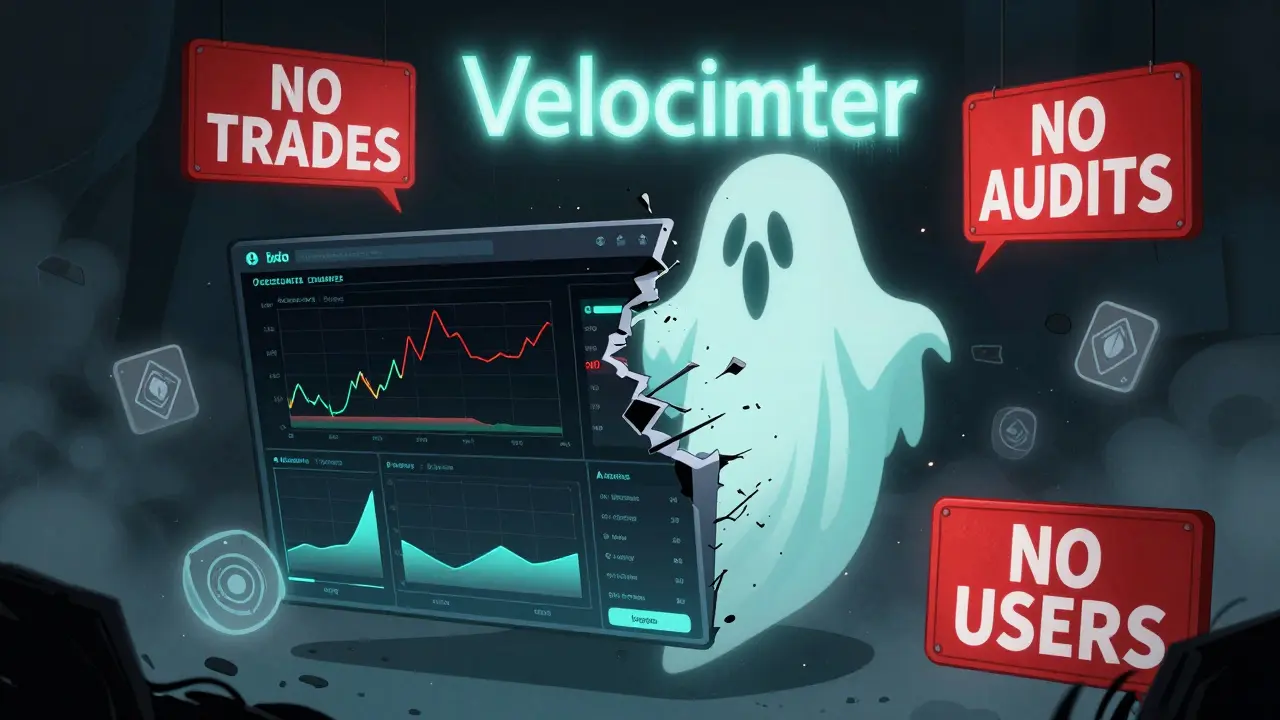
When you hear about a new crypto exchange promising "next-generation DeFi" and "options token rewards," it’s easy to get excited. But if no one is actually trading on it, should you care? That’s the reality with Velocimeter is a decentralized exchange (DEX) launched in 2023 that claims to revolutionize liquidity mining through veNFT governance and automated staking. Also known as Velocimeter V3 and Velocimeter Base, it’s marketed as a dynamic ecosystem for yield farmers and governance participants. But behind the buzzwords, the numbers tell a very different story.
Zero Trades, Zero Trust
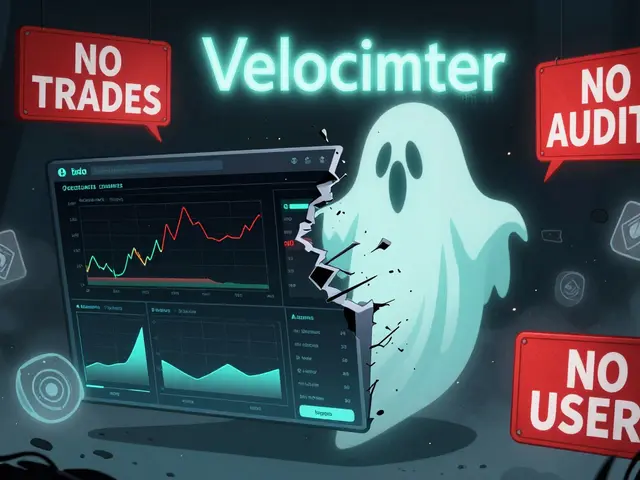
As of September 2025, CoinGecko shows a trust score of 0 for both Velocimeter V3 and Velocimeter Base. That’s the lowest possible rating on the platform’s trust scale - meaning no activity, no liquidity, no confidence. Velocimeter V3 lists zero cryptocurrencies as actively traded. Even the so-called "most active" pair, CANTO/SCANTO, recorded no transactions in the past 30 days. Velocimeter Base lists six tokens, with BMX--2/WBLT as its top pair. Still, zero trades. Zero. Not one. This isn’t a slow startup. This is a dead platform. Compare that to Uniswap, which handles billions in daily volume, or even PancakeSwap, which processes thousands of trades daily with a simple 0.25% fee. Velocimeter doesn’t just lag behind - it doesn’t exist as a working exchange.
What’s Supposed to Make It Special?
Velocimeter’s pitch revolves around three ideas: options token rewards, veNFT governance, and fair launches. Let’s break it down. Options token rewards are supposed to incentivize liquidity providers (LPs) by giving them special tokens tied to staking duration. Sounds cool? Maybe. But if no one’s adding liquidity, these rewards are just digital confetti. You can’t earn what no one’s using. veNFT stands for voting escrow NFT. It’s a fancy way of saying users lock up tokens to get voting power over protocol changes. It’s a model used by other DeFi projects like Curve. But again - if no one’s trading, who’s voting? And who’s even holding these tokens? There’s no public record of veNFT holders, no dashboard, no user activity logs. Fair launches and airdrops are also mentioned. But where are the users? Where are the claims? No Reddit threads. No Twitter threads. No Telegram groups with more than 50 people. No screenshots of people claiming tokens. No success stories. Just silence.
Where’s the Security? The Audits? The Transparency?
Every serious crypto project publishes audit reports. They list their smart contract addresses. They explain their multisig wallets. They detail their emergency shutdown procedures. Velocimeter does none of this. No audit reports from reputable firms like CertiK, SlowMist, or Hacken. No public GitHub commits showing active development. No team members listed. No LinkedIn profiles. No press releases from major crypto news outlets like CoinDesk or The Block. In crypto, absence of information isn’t neutrality - it’s red flags stacked on top of each other. If you’re going to lock up your ETH or SOL in a liquidity pool, you need to know who’s behind it. Velocimeter gives you nothing.
Is It Even Real?
Velocimeter appears on The Magic Store as a "top-tier Web3 DeFi tool." But The Magic Store isn’t a regulated financial platform - it’s a directory that lists almost anything with a website and a whitepaper. Being listed there is like being in a phone book full of pizza places that never answer the phone. There’s no evidence Velocimeter was ever functional. No on-chain data showing token swaps. No wallet addresses moving liquidity. No gas fees paid for trades. No block explorers showing contract interactions. It’s possible this was a vaporware project from day one - a website built to attract early adopters who would then pump the token, then vanish. Or maybe it was abandoned after a failed launch. Either way, it’s not a platform you can use. It’s a ghost.
What About Fees?
Velocimeter claims to have a "transparent fee structure." But no numbers are published. No trading fees. No withdrawal fees. No staking costs. You can’t calculate your returns if you don’t know what you’re paying. Compare that to Uniswap V3, which clearly states its 0.05%, 0.3%, or 1% fee tiers. Or SushiSwap, which breaks down its fee distribution to LPs. Velocimeter? Blank.
Why This Matters
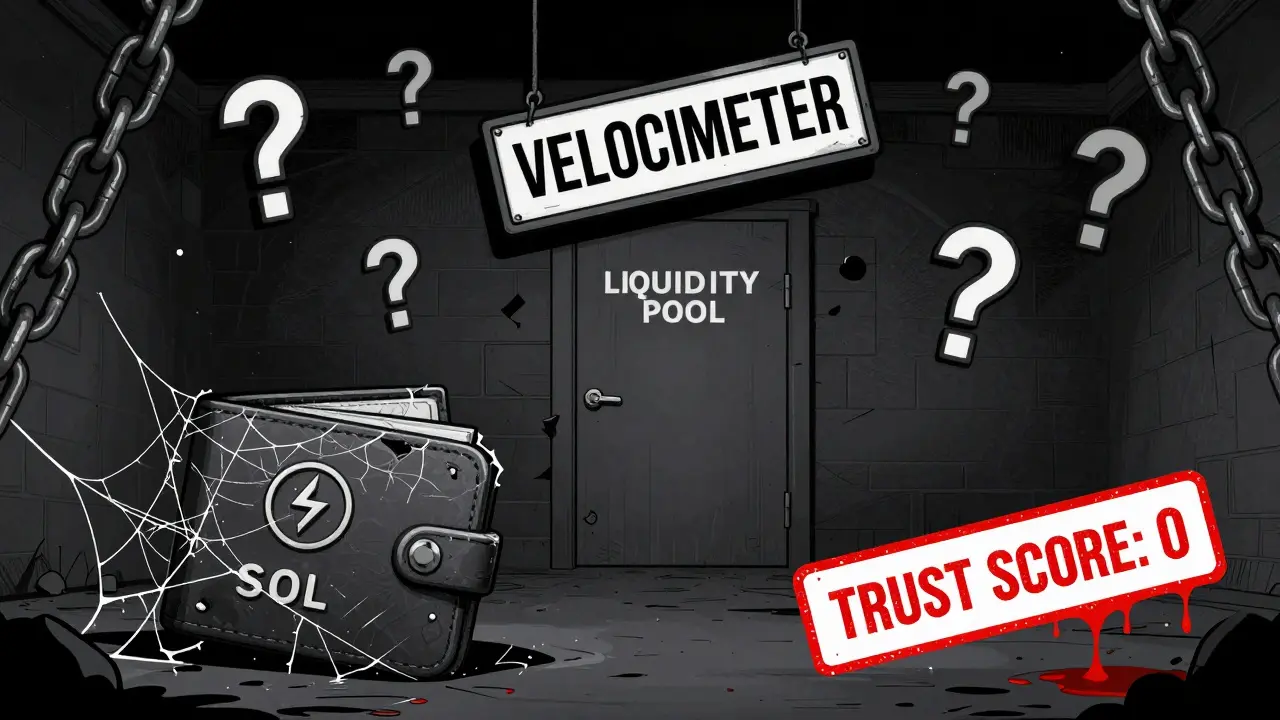
Most people don’t realize how dangerous it is to interact with a DEX that has zero activity. You might think, "It’s just a testnet. I’ll try it with a small amount." But here’s the truth: if a platform has no trades, it has no liquidity. That means if you deposit $100 worth of tokens, you won’t be able to withdraw them. Ever. Liquidity pools need two-way traffic. If no one else is trading, your tokens are stuck. You’re not investing - you’re donating. And if the project disappears tomorrow? Your tokens vanish with it. No customer support. No refund. No recourse.
What Should You Do Instead?
If you want to trade crypto on a decentralized exchange, use one that’s actually working.
- Uniswap (Ethereum) - The most used DEX in the world. Trusted, audited, transparent.
- PancakeSwap (BSC) - High volume, low fees, active community.
- Curve Finance - Best for stablecoin swaps with deep liquidity.
- SwapDEX (Solana) - Fast, cheap, growing rapidly.
Final Verdict
Velocimeter isn’t a crypto exchange you should consider. It’s a warning sign. It has:
- Zero trading volume across all versions
- A trust score of 0
- No security audits
- No team information
- No user community
- No transparent fee structure
- No evidence it ever worked
Is Velocimeter a scam?
Velocimeter isn’t confirmed as a scam - but it behaves like one. It has all the hallmarks: no trading activity, no transparency, no community, and no updates since its 2023 launch. While it may have started as a legitimate idea, it’s now a non-functional platform with no path to recovery. Treat it as high-risk and avoid it entirely.
Can I withdraw my funds from Velocimeter?
Technically, yes - if you deposited tokens into a liquidity pool, you might still be able to remove them. But if no one else is trading, your withdrawal will likely fail due to insufficient liquidity. Even if it succeeds, you’ll likely lose a large portion of your funds to slippage. The real risk isn’t withdrawal - it’s locking up assets in a dead ecosystem.
Does Velocimeter have a mobile app?
There is no official Velocimeter mobile app. Any app claiming to be Velocimeter on the App Store or Google Play is likely a fake. The platform only operates through web interfaces, and even those are rarely updated. Avoid downloading any app tied to this name.
Is Velocimeter listed on major crypto exchanges?
No. Velocimeter’s native token (likely $VELO or similar) is not listed on any major centralized exchange like Binance, Coinbase, or Kraken. It only exists as a token on its own failed DEX. This makes it nearly impossible to buy or sell outside of its own non-functional platform.
Why do some websites still promote Velocimeter?
Some crypto directories and affiliate sites list Velocimeter because they earn commissions from traffic or token promotions - not because it’s a good product. They rely on new users not doing their research. Always check CoinGecko, Dune Analytics, or DeFiLlama for real data before trusting any project.
Should I invest in Velocimeter’s token?
No. There is no evidence that Velocimeter’s token has any real value or utility. It trades on its own dead DEX with zero volume. Investing in it is equivalent to buying a lottery ticket for a game that was canceled before it started. You’re not investing - you’re gambling on a ghost.
Are there any alternatives to Velocimeter with similar features?
Yes. Curve Finance uses veCRV for governance and rewards, similar to Velocimeter’s veNFT. Uniswap’s V3 offers concentrated liquidity with dynamic fees. Both have active communities, real trading volume, and public audits. If you want governance and rewards, use platforms that are actually working.
Elana Vorspan
February 21 2026I just deposited $50 into Velocimeter last week bc I thought it was the next big thing 😅 turns out it's like buying a ticket to a concert that got canceled before the doors opened. still holding out hope though... maybe they'll come back? 🤷♀️✨
Danny Kim
February 22 2026Zero trades? That’s not a DEX. That’s a digital ghost town with a fancy whitepaper and a LinkedIn page no one updated since 2023. Someone’s definitely cashing checks while the rest of us play peekaboo with our assets.
Brian Lemke
February 24 2026Look, I get the allure of shiny new DeFi toys. But when the whole thing is built on vapor and hashtags, you’re not innovating-you’re performing. Velocimeter’s whole pitch feels like a TED Talk given by someone who’s never actually built anything. Real innovation doesn’t need buzzwords. It needs users. And trades. And gas fees. None of which exist here.
Samantha Stultz
February 26 2026The veNFT model is fundamentally flawed if there’s no liquidity to vote on. Governance without economic activity is performative theater. And the fact that they don’t even publish their contract addresses? That’s not opacity-that’s obfuscation. This isn’t a startup. It’s a honeypot.
Robert Conmy
February 28 2026People still fall for this? Are you serious? You’re not a pioneer-you’re a sucker. If you think this is ‘high risk’ you’re delusional. This is zero risk because there’s nothing to lose. Your tokens are already gone. You just haven’t realized it yet.
Lilly Markou
February 28 2026I find it profoundly distressing that individuals continue to allocate capital to platforms devoid of operational integrity. The psychological burden of financial loss, compounded by the absence of recourse, is not merely monetary-it is existential. One must ask: what value does one place upon security, when none is offered?
precious Ncube
March 2 2026If you’re still holding $VELO, you’re not an investor. You’re a donation.
Tracy Peterson
March 3 2026There’s a quiet tragedy in projects like this-not because they fail, but because they pretend to be alive. They feed hope like a drug. People pour their time, their savings, their belief into something that never had a heartbeat. Maybe the real innovation here is how well they sold the illusion.
Dianna Bethea
March 5 2026I’ve been in crypto since 2017 and seen a lot of dead projects but this one stands out because it didn’t even try. No updates. No community. No transparency. Just a website with a spinning wheel and a promise. If you’re thinking of using this, just go to Uniswap. Save your sanity.
Patrick Streeb
March 6 2026The absence of audit reports, team disclosures, and on-chain activity constitutes a material failure in the governance of decentralized systems. One cannot reasonably engage with a protocol that presents no verifiable evidence of its operational existence. Such instances necessitate a precautionary principle in asset allocation.
Phillip Marson
March 6 2026They had a chance to build something real and instead they built a brochure and called it a DEX. The fact that people are still whispering about it like it’s some underground gem is honestly wild. It’s not hidden potential. It’s hidden junk.
Tracy Whetsel
March 7 2026I know it’s hard to let go of hope in crypto 🫂 but sometimes the kindest thing you can do for yourself is walk away. Velocimeter isn’t coming back. It’s not a glitch. It’s a graveyard. You don’t have to be mad. You just have to move on. I’m here if you wanna talk about it 💛
Alyssa Herndon
March 8 2026I think what’s most sad about Velocimeter isn’t that it failed-it’s that it made people believe they could be part of something revolutionary. And then silence. No announcement. No apology. Just… gone. It’s not just a dead project. It’s a broken promise.
Ifeanyi Uche
March 9 2026This Velocimeter thing be like a guy who keep talkin bout buildin a spaceship but never even got the metal. He got slideshows. He got dreams. He got a website. But no engine. No wings. No flight. Just noise. We all know the type.
Jeff French
March 10 2026Zero trades. Zero audits. Zero updates. Zero users. Zero trust score. That’s five zeros. You don’t need to be a crypto expert to see this is a dead end. It’s not even a bad project. It’s not a project at all.
Kenneth Genodiala
March 11 2026I can’t believe people still have wallets connected to this. You’re not ‘supporting innovation.’ You’re just giving your private keys to a .com domain that expired in 2024. The fact that you’re proud of being ‘early’ is the real tragedy.
Don B.
March 11 2026I literally cried when I checked Velocimeter’s stats. Like… I thought I was gonna be rich. I told my mom. I made a TikTok. I even named my dog ‘VELO’. Now I just stare at my wallet and whisper ‘what did I do’