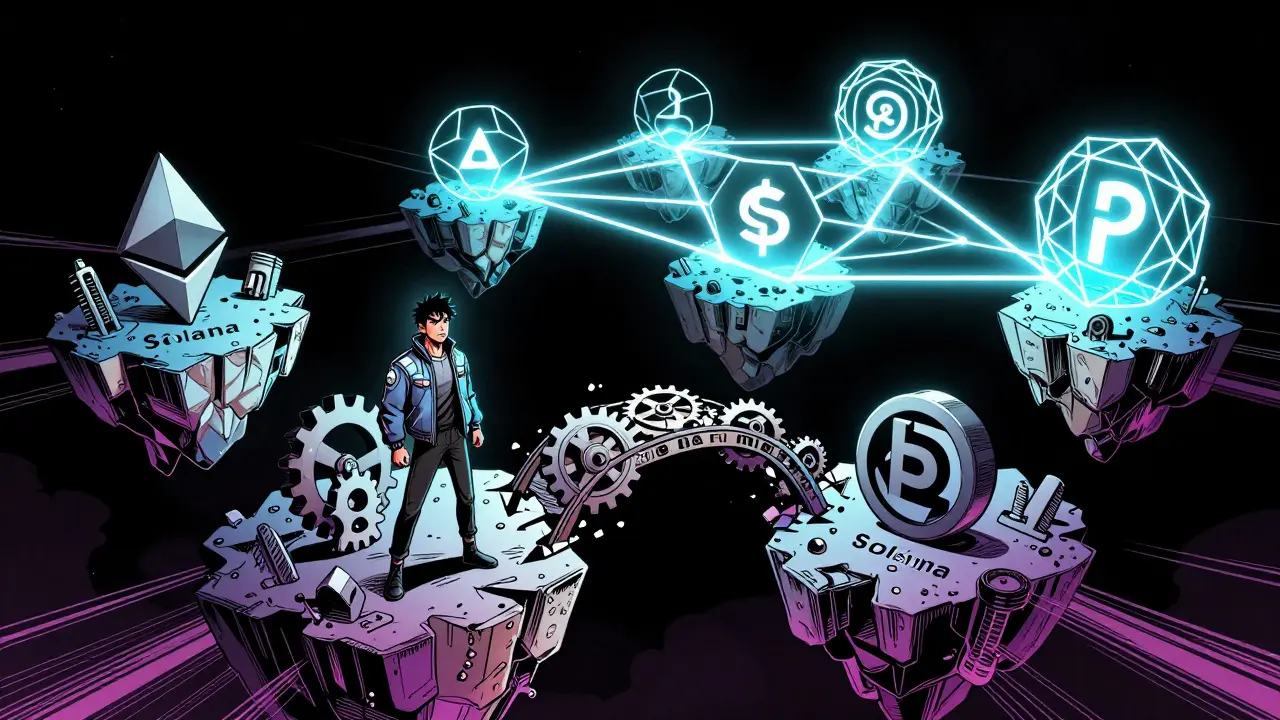
Remember when moving crypto from one chain to another felt like sending a letter via carrier pigeon? You’d lock your assets in a smart contract, wait for confirmations, and hope the other side actually minted the tokens. In 2026, that friction is gone. We are living in the multi-chain era, where blockchain interoperability bridges are the essential infrastructure connecting isolated networks like Ethereum, Solana, and Polygon into a single, fluid ecosystem. These bridges are no longer just technical afterthoughts; they are the connective tissue of the entire digital asset economy.
The landscape has shifted dramatically. What started as risky, centralized custodial services has evolved into a sophisticated network of trustless protocols, aggregators, and native chain abstractions. By 2032, projections suggest this market will hit $911 million, growing at a compound annual rate of 22.5%. But numbers only tell half the story. The real change is how we interact with these tools. Users no longer think about "bridging"; they just expect their assets to be available wherever they need them.
From Lock-and-Mint to Native Omnichain Assets
To understand where we are going, you have to look at how bridge architecture has changed. Early bridges used a "lock-and-mint" model. You locked Bitcoin on its native chain, and a wrapped version appeared on Ethereum. This worked, but it created security risks and liquidity fragmentation. If the bridge got hacked, your funds were gone. If the liquidity pool dried up, you couldn’t swap.
In 2026, the industry is moving toward mint-and-burn solutions and native omnichain token standards. Instead of wrapping assets, new chains like Monad and Plasma are embedding interoperability providers directly into their core design. When you launch an asset today, it isn’t just on one chain; it’s issued across multiple chains simultaneously using standards like ERC-7683. This means the asset exists natively everywhere. There is no wrapper to hack. There is no delay. It’s a structural shift from connecting silos to building a unified mesh from the start.
This evolution reduces constraints significantly. Previously, developers had to build separate versions of their app for every chain. Now, with generalized execution layers, a single interface can trigger actions across ten different networks. The complexity is hidden from the user, which is exactly how technology should work.
The Rise of Bridge Aggregators
If native standards solve the issuance problem, aggregators solve the routing problem. Trying to find the best bridge manually is inefficient. You might check three different sites to see which offers the lowest fee or fastest time. That’s why platforms like LI.FI and Symbiosis Finance have become dominant forces.
LI.FI integrates over 20 bridges and decentralized exchanges (DEXs) across 60+ chains. It doesn’t just move money; it optimizes the path. Want to swap ETH on Ethereum for USDC on Arbitrum? LI.FI checks direct bridges, DEX swaps, and even complex routes involving intermediate chains to find the cheapest and fastest option. It wins most comparisons because it treats liquidity as a global resource rather than a local one.
Symbiosis takes a similar approach but focuses heavily on non-custodial security using Multi-Party Computation (MPC) node networks. It supports over 30 networks, including Bitcoin and non-EVM environments. For users who want to move stablecoins without surrendering control of their keys, these aggregators provide a critical layer of safety and efficiency. They eliminate the guesswork and reduce the risk of human error.
| Platform | Type | Key Feature | Best For |
|---|---|---|---|
| LI.FI | Aggregator | Integrates 20+ bridges & DEXs | Optimized routing & cost savings |
| Wormhole | Generalized Messaging | Cross-chain communication protocol | Developers building cross-chain apps |
| Avalanche Bridge | Native/Trusted | Sub-second finality | High-speed transfers to Avalanche |
| Allbridge Core | Specialized | EVM to Non-EVM stablecoin transfers | Stablecoin arbitrage & yield strategies |

Security: Trustless vs. Trusted Models
Security remains the biggest concern in bridging. Historically, trusted bridges relied on centralized intermediaries or small validator sets. If those validators colluded or were hacked, users lost everything. We’ve seen this happen repeatedly since 2021.
The industry is now pivoting hard toward trustless architectures. Protocols like LayerZero and Wormhole use decentralized oracle networks and relayers to verify transactions. No single entity holds the keys. This decentralization makes attacks exponentially harder and more expensive.
However, trustlessness isn’t free. It often comes with higher gas fees or slightly longer confirmation times compared to centralized options. The trade-off is clear: do you want speed and low cost with higher counterparty risk, or do you want maximum security with slightly higher friction? For most institutional players and large holders, security wins. For casual users making small bets, speed might matter more. Aggregators help here by letting you choose the level of trust based on your specific transaction size.
Intent-Based Bridging and Chain Abstraction
The next frontier is intent-based bridging. Currently, you still have to think about chains. You decide which bridge to use, which network to target, and how to pay the fees. Intent-based systems remove this mental load. You simply state what you want: “I want to buy NFT X.” The system figures out the rest. It might bridge ETH from Polygon to Optimism, swap it for USDC, and execute the purchase, all in one click.
This is powered by chain abstraction, a concept that hides the underlying blockchain complexity from the end user. Wallets are already integrating these features. Imagine logging into a wallet and seeing all your assets from Ethereum, Solana, and Cosmos in one balance sheet, without needing to switch networks manually. This is becoming the standard in 2026.
As these technologies mature, the distinction between chains blurs. Developers can focus on building great applications rather than worrying about compatibility. Users can focus on their goals rather than managing technical logistics. This abstraction is crucial for mass adoption. Regular people don’t care about EVM compatibility; they care about whether their payment went through.

Regulatory Compliance and Institutional Adoption
As bridges scale, regulators are paying attention. The World Economic Forum projects that multi-chain ecosystems will allow public, private, and permissioned blockchains to work together seamlessly by 2026. But seamless doesn’t mean unregulated. Institutions need compliance.
Bridge protocols are increasingly incorporating identity verification and transaction monitoring to meet jurisdictional requirements. This doesn’t necessarily mean sacrificing anonymity for everyone, but it does mean that high-value institutional flows will have built-in compliance rails. Think of it like SWIFT for crypto: fast, global, but with audit trails.
This regulatory clarity is driving enterprise adoption. Companies are using bridges to move tokenized cash equivalents across execution environments for treasury operations. Real-world assets (RWAs) like bonds and real estate are being tokenized and made accessible across multiple chains. For this to work, the bridges must be reliable, secure, and compliant. The future isn’t just about tech; it’s about trust within legal frameworks.
What to Expect by 2032
Looking ahead, the trend lines are clear. The bridge market will continue to grow, driven by DeFi expansion and the need for liquid markets. We’ll see fewer standalone bridges and more integrated infrastructure. Chains will launch with interoperability baked in, not bolted on.
Vaults will unify credit across chains, allowing you to borrow against assets on one network while spending on another. Stablecoin mobility will become instantaneous and nearly free. And security models will evolve further, potentially incorporating zero-knowledge proofs to verify transactions without revealing sensitive data.
The goal is simple: make the blockchain invisible. When the technology works perfectly, you don’t notice it. You just experience a faster, cheaper, and more connected financial world. That’s the promise of interoperability bridges, and it’s finally starting to deliver.
What is the difference between a trusted and a trustless bridge?
A trusted bridge relies on centralized intermediaries or a small group of validators to approve transactions, which carries higher counterparty risk. A trustless bridge uses decentralized smart contracts and oracle networks to validate transfers, offering greater security but potentially higher costs or slower speeds.
Why are bridge aggregators like LI.FI important?
Aggregators simplify the user experience by scanning multiple bridges and DEXs to find the best route for a transaction. They optimize for cost, speed, and slippage, saving users time and money compared to manually checking individual bridge platforms.
How does mint-and-burn differ from lock-and-mint?
Lock-and-mint locks original assets on one chain and mints wrapped versions on another, creating dependency on the bridge's custody. Mint-and-burn allows assets to be issued natively across chains via shared standards, reducing reliance on wrappers and improving security and liquidity.
What is chain abstraction?
Chain abstraction hides the complexity of different blockchain networks from the user. It allows interactions like swapping or buying NFTs to happen seamlessly across chains without the user needing to manually switch networks or manage gas tokens for each specific chain.
Are cross-chain bridges safe to use in 2026?
Safety varies by protocol. Trustless bridges and reputable aggregators with audited smart contracts are generally considered safer. Users should always verify the security model of the bridge, prefer decentralized validation, and consider using insurance or limit exposure when using newer or less established protocols.