
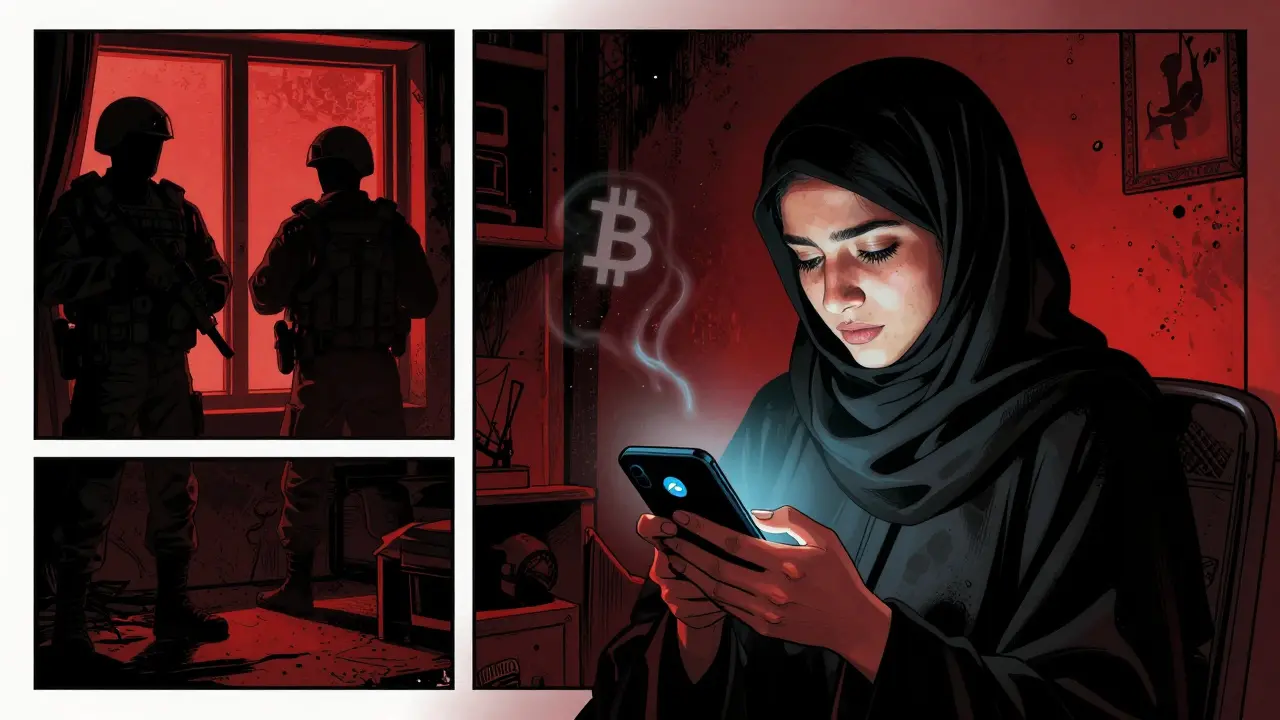
The Taliban banned Bitcoin and all cryptocurrencies in Afghanistan in August 2022 - not because of technical risks, fraud, or money laundering concerns, but because they declared it haram under their interpretation of Islamic law. This wasn’t a policy tweak. It was a religious edict enforced with arrests, asset seizures, and closed exchanges. And yet, despite the ban, Afghan citizens are using crypto more than ever.
Why the Taliban Says Bitcoin Is Forbidden
The Taliban’s reasoning is simple: Bitcoin has no intrinsic value. It’s not backed by gold, oil, or a government. To them, that makes it gambling - or maysir - which is strictly forbidden in Islam. Sayed Shah Sa’adat, head of Herat’s counter-crime unit, announced the ban publicly, citing the closure of 16 crypto exchanges in one province alone. Da Afghanistan Bank (DAB), the country’s central bank, backed the move, calling crypto “un-Islamic.” They also argue that crypto undermines monetary sovereignty. In their view, only the state should control money. If people can send value across borders without permission, it weakens the regime’s grip on the economy. That’s why they banned foreign currencies in 70% of transactions in early 2024 - and why they see Bitcoin as an even bigger threat. But here’s the contradiction: the Taliban’s own financial system collapsed after the U.S. froze Afghanistan’s $9.5 billion in foreign reserves in 2021. Banks stopped functioning. Salaries went unpaid. Families couldn’t receive remittances from relatives overseas. That’s when Bitcoin became a lifeline.The Real Reason People Use Crypto in Afghanistan
Before the Taliban took over, Afghanistan processed $740 million in cryptocurrency transactions in just one year - ranking 20th globally for crypto adoption. Most of it wasn’t speculation. It was survival. Afghans used Bitcoin and USDT to send money home. A father working in Pakistan could send $200 to his family in Kandahar in minutes, with no bank fees, no waiting, no bureaucracy. When banks shut down, crypto filled the gap. By 2024, 38% of Afghans used crypto for remittances - up from just 2% before 2021. That’s not a trend. That’s a necessity. Women are among the biggest users. With restrictions on employment, education, and movement, many women have no access to traditional banking. Bitcoin gives them control. The Digital Citizen Fund documented 687 Afghan women trained in crypto use. Nearly 90% said it gave them financial autonomy. But 42% were harassed or threatened by Taliban officials when caught using it. One Reddit user, “KabulTrader88,” lost 1.2 Bitcoin - worth over $50,000 at the time - when Taliban forces raided an exchange in November 2022. His savings vanished overnight. Yet, thousands still risk it. Telegram channels like “AfghanCryptoHelp” have over 15,000 members trading USDT weekly, averaging $38,500 in volume.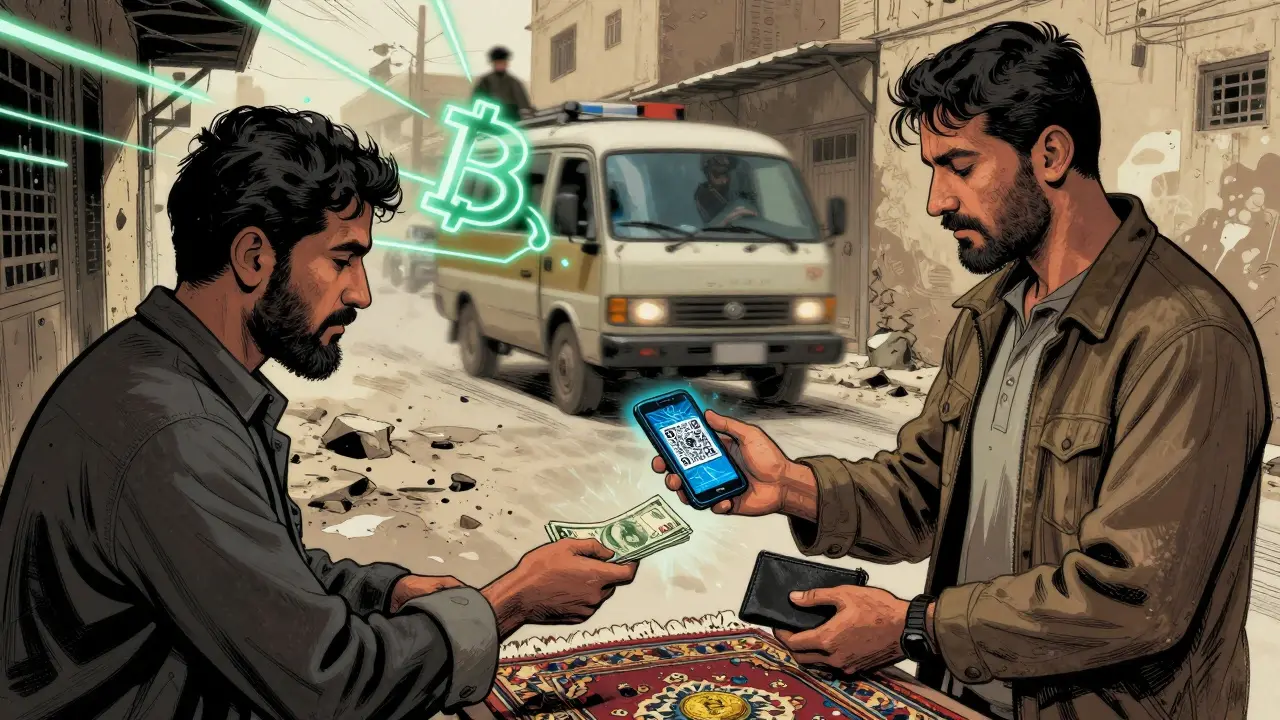
How People Bypass the Ban
The Taliban bans crypto. But they can’t ban the internet - not completely. They can’t ban smartphones. They can’t ban human ingenuity. People use non-custodial wallets like Trust Wallet and Phantom. They avoid exchanges entirely. Instead, they trade peer-to-peer (P2P) through Telegram, WhatsApp, and even SMS. A growing number use “CryptoSMS” services - blockchain transactions sent via text message - which became popular after a 48-hour nationwide internet blackout in October 2024 affected 13 million people. To stay safe, users learn to use multi-signature wallets. They hide keys on paper. They use mesh networks during outages. But the learning curve is steep. Most users spend 3 to 5 weeks just learning how to set up a wallet. Only 22% successfully implement advanced security measures, according to a UNODC report. Support is unofficial. There are no help desks. No customer service. Just Telegram groups like “AfghanCryptoSupport,” with 4,850 members. Answers come hours later, if at all. Language is a barrier too - most guides are in English, and many users don’t read it fluently.Is the Ban Legal Under Sharia? Experts Disagree
The Taliban claims their ban is based on Islamic law. But many Islamic scholars say otherwise. Dr. Mohsin Choudhry, a scholar at the Journal of Islamic Accounting and Business Research, argued in 2022 that crypto can be halal if used as a medium of exchange - not for gambling. The OIC’s Fiqh Academy issued a similar non-binding opinion in June 2022, saying crypto “may be permissible if it achieves the objectives of Sharia.” Compare that to Saudi Arabia and the UAE, which regulate crypto under Islamic finance principles. Or Iran, which licenses mining and restricts trading - but doesn’t ban it. Even Egypt allows licensed exchanges. Afghanistan is the only country with a total ban based purely on religious interpretation - with no regulatory framework, no licensing, no exceptions. It’s not about finance. It’s about control. Roya Mahboob, founder of the Digital Citizen Fund and one of Forbes’ Most Powerful Women in 2023, put it bluntly: “Bitcoin is a survival tool. For women in Afghanistan, it’s not about profit. It’s about hope.”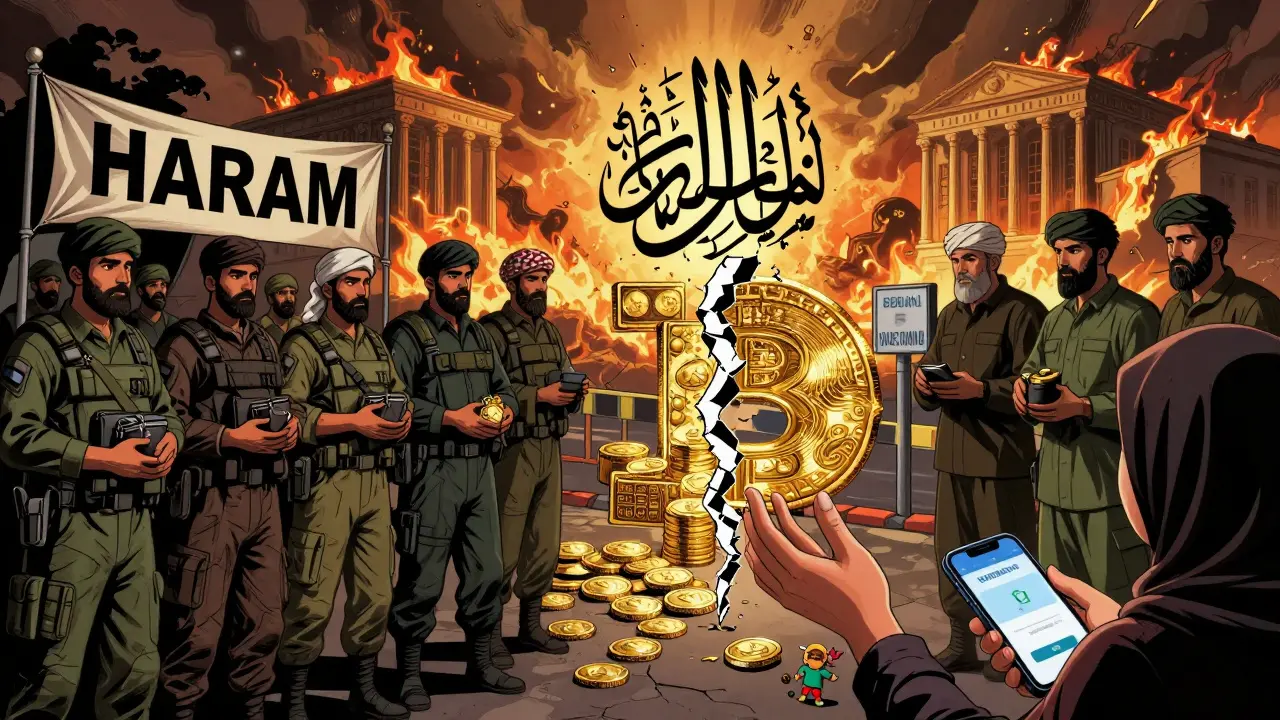
The Ban Is Failing - But the Regime Won’t Back Down
Despite the ban, Afghanistan’s on-chain crypto activity grew 37% annually from 2022 to 2024. In Q1 2025, monthly P2P trading hit $4.2 million - up 22% from the year before. USDT makes up 68% of those trades. The Taliban still conducts raids. In Q1 2025 alone, they arrested 112 people across 15 provinces. But they can’t arrest everyone. They can’t shut down every phone. They can’t stop a mother from sending $50 to her child through a text message. And here’s the biggest irony: according to a December 2023 UN Security Council report, Taliban officials themselves accepted Bitcoin payments at border crossings. The regime’s stance is rigid. Deputy Prime Minister Mullah Abdul Ghani Baradar said in February 2025: “Digital currency has no place in an Islamic system.” But economic reality is louder than ideology. Afghanistan’s GDP shrank 20.7% between 2021 and 2023. The economy is collapsing. People need money. And Bitcoin works.What Happens Next?
Goldman Sachs estimates only a 30% chance the ban lasts beyond 2028. The Atlantic Council says there’s a 65% chance it continues through 2027 - not because it’s effective, but because the Taliban won’t admit defeat. The most likely path forward? Tacit tolerance. Like Iran, Afghanistan may eventually allow limited P2P trading without ever legalizing it. No licenses. No oversight. Just silence. Until then, Afghans keep trading. They keep learning. They keep risking arrest - because for them, Bitcoin isn’t an investment. It’s the only bank left.Is Bitcoin illegal in Afghanistan under Sharia law?
Yes, the Taliban declared Bitcoin and all cryptocurrencies haram (forbidden) under their interpretation of Sharia law in August 2022. They argue it lacks intrinsic value and functions as gambling (maysir), which is prohibited in Islam. Da Afghanistan Bank and FinTRACA enforce this ban, with no legal exceptions.
Why do Afghans still use Bitcoin if it’s banned?
After the U.S. froze Afghanistan’s $9.5 billion in foreign reserves in 2021, the banking system collapsed. Remittances stopped, salaries went unpaid, and families couldn’t access money. Bitcoin became the only reliable way to send and receive funds. By 2024, 38% of Afghans used crypto for survival - especially women and rural communities cut off from traditional finance.
How do people trade crypto in Afghanistan without getting caught?
Most Afghans use peer-to-peer (P2P) trading through Telegram, WhatsApp, or SMS-based blockchain services like CryptoSMS. They avoid exchanges entirely and use non-custodial wallets such as Trust Wallet. To stay safe, some use multi-signature wallets, offline storage, and mesh networks during internet blackouts. But this requires weeks of learning and carries serious risk - arrests and asset seizures are common.
Are there any Islamic scholars who disagree with the Taliban’s ban?
Yes. Scholars like Dr. Mohsin Choudhry argue that cryptocurrency can be halal if used as a medium of exchange, not for speculation. The OIC’s Fiqh Academy also stated in 2022 that crypto “may be permissible” if it serves Sharia objectives. This contrasts sharply with the Taliban’s blanket ban, which lacks support from mainstream Islamic finance institutions.
Has the Taliban ever used crypto themselves?
According to a December 2023 UN Security Council report, Taliban officials have accepted Bitcoin payments at border crossings. This highlights a clear contradiction: the regime bans crypto for citizens but uses it when it serves their interests - revealing the ban is more about control than religious principle.
Will the Taliban ever lift the crypto ban?
Unlikely in the short term. The Taliban’s leadership has repeatedly affirmed the ban as permanent. But economic collapse and rising underground adoption make enforcement unsustainable. Experts predict a future of tacit tolerance - where the regime turns a blind eye to P2P trading without ever legalizing it, similar to Iran’s current model.
Alex Strachan
December 30 2025So the Taliban bans Bitcoin because it's 'haram'... but still takes it at border crossings? 😂 Classic. The only thing more ironic than this ban is the fact that it's working exactly backwards. People are using crypto MORE because of it. 🤦♂️
Rick Hengehold
December 30 2025This isn't about religion. It's about control. When your economy collapses and you can't pay salaries, you don't ban the only thing keeping people alive-you fix your own mess.
Brandon Woodard
December 31 2025It is profoundly disingenuous to invoke religious doctrine as the sole justification for economic suppression. The Taliban's position lacks theological consensus, contradicts empirical human need, and reveals a deeper agenda: the monopolization of survival itself. This is not piety. It is power.
Antonio Snoddy
January 1 2026You know... when you think about it, Bitcoin is kind of like the Holy Spirit of finance-invisible, everywhere, and impossible to contain. The Taliban wants to lock it down like it’s a demon in a bottle, but you can’t cage a spirit that moves through wires and phones and human desperation. It’s not about halal or haram. It’s about whether you believe people deserve autonomy. And if you don’t... well, that’s not faith. That’s fear dressed in a turban.
Ryan Husain
January 2 2026The contradiction here is staggering. A regime that claims moral authority while relying on the very technology it forbids exposes its ideological fragility. Crypto adoption in Afghanistan isn’t rebellion-it’s resilience.
Rajappa Manohar
January 3 2026this is wild... people are riskin their life for crypto... i cant even imagine
Daniel Verreault
January 4 2026The Taliban’s crypto ban is a textbook case of institutional incompetence masquerading as theological purity. They’re not enforcing Sharia-they’re enforcing obsolescence. Meanwhile, Afghan women are using USDT to feed their kids while dodging checkpoints. That’s not crypto. That’s civil disobedience with a private key.
Jacky Baltes
January 6 2026There’s a deeper philosophical question here: Can a system that denies autonomy be legitimate? If the state controls money, and the state is illegitimate, then isn’t the refusal to use its money an act of moral sovereignty? Crypto isn’t breaking Sharia-it’s revealing the emptiness of the regime’s claim to it.
prashant choudhari
January 7 2026Afghans are using crypto because they have no choice. The ban is not about religion. It is about power. And power fears decentralization
Willis Shane
January 7 2026The moral bankruptcy of this policy is staggering. To criminalize financial survival under the guise of religious orthodoxy is not piety-it is cruelty. The Taliban’s actions reveal a regime more concerned with symbolic dominance than the welfare of its people.
Abhisekh Chakraborty
January 9 2026I mean... if Bitcoin is haram then why do they take it at border crossings? 🤔 Maybe they just hate when people are smarter than them
Gavin Hill
January 9 2026They banned it because they can’t control it and that terrifies them more than any theological debate ever could
SUMIT RAI
January 11 2026Wait so the Taliban says crypto is haram but uses it themselves? So now its haram for us but halal for them? 😂 Islamic logic at its finest
nayan keshari
January 12 2026The ban is a joke. People are using crypto because banks are dead. The Taliban are just mad they cant tax it
Johnny Delirious
January 14 2026This is the most powerful example of grassroots innovation I’ve ever seen. No government. No banks. Just people. Phones. And a stubborn refusal to starve. We should be honoring these users-not arresting them.
Monty Burn
January 16 2026If God wanted us to have centralized money he would have made Bitcoin with a CEO
Kenneth Mclaren
January 17 2026This is all part of the globalist deep state plan. The UN, Goldman Sachs, and the CIA are using Afghan women’s crypto use to destabilize Islamic governments. They’re weaponizing blockchain to undermine Sharia. The Taliban are the only ones standing in the way. Don’t believe the lies. They’re already watching you through your phone.
Raja Oleholeh
January 17 2026India is way ahead of this. We don’t ban tech. We regulate it. Taliban = backwards
Prateek Chitransh
January 18 2026You know what’s wild? The fact that women are learning crypto in secret to feed their families? That’s not a tech trend. That’s a revolution. And no fatwa can stop that kind of courage.
Michelle Slayden
January 20 2026The Taliban's position is not only theologically unsupported-it is ethically indefensible. To deny access to financial autonomy under the pretense of religious law is to weaponize faith against the vulnerable. This is not governance. It is oppression.
christopher charles
January 21 2026I can’t even imagine being a mom in Afghanistan and having to send $50 to your kid through a text message because the bank’s shut down… and then getting arrested for it. That’s not religion. That’s horror.
Vernon Hughes
January 22 2026The Taliban’s crypto ban is a cultural artifact of fear. In societies where information is controlled, money becomes the last frontier of autonomy. Crypto is not the problem. The regime is.
Alison Hall
January 23 2026Women using crypto to survive? That’s the most beautiful thing I’ve read all year. Keep going. You’re not alone.
Alex Strachan
January 24 2026Also… if Bitcoin is gambling, then what’s the Taliban’s entire economy? Selling opium to fund their regime? That’s literally the definition of maysir. 🤡