
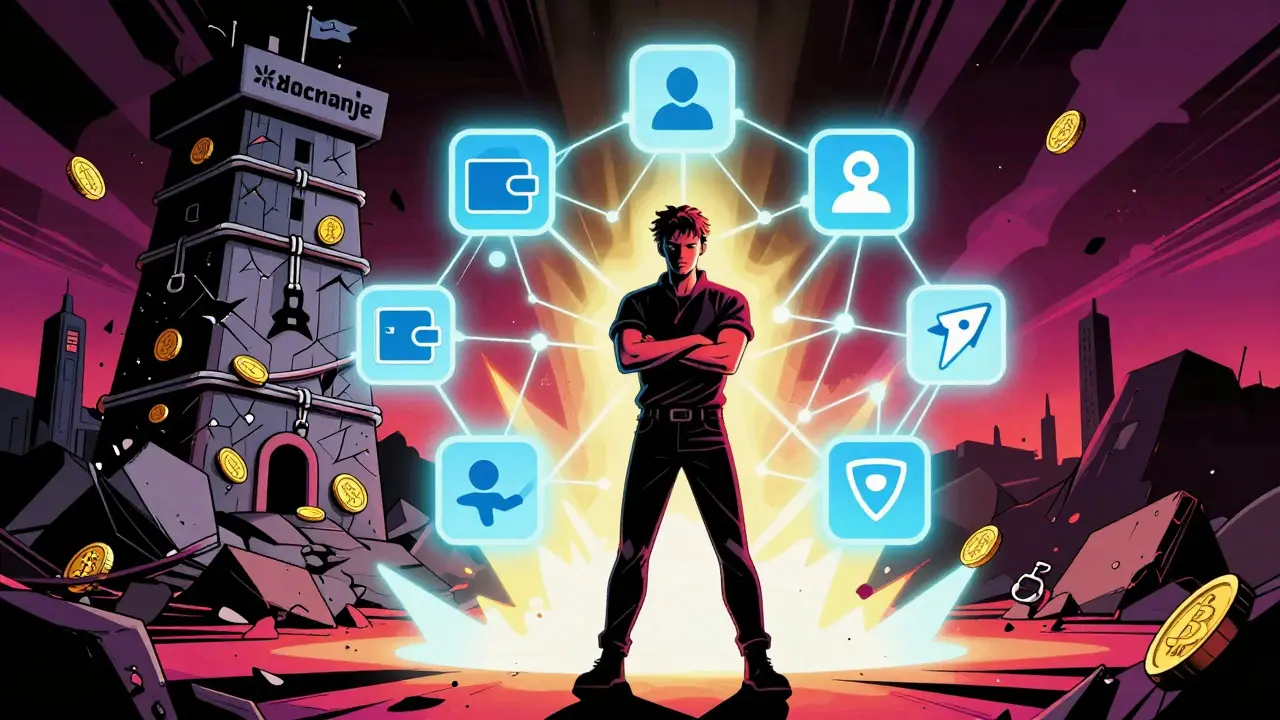
When you trade crypto on a centralized exchange, you're handing over your keys to someone else. That means your coins aren't really yours-they're locked in an exchange wallet. If that exchange gets hacked, goes bankrupt, or freezes your account, you lose access. Decentralized exchanges (DEXs) change all that. They let you trade directly from your own wallet, with no middleman. No deposit. No withdrawal. No waiting. Just you, your private keys, and the blockchain.
Full Control Over Your Assets
On a centralized exchange like Binance or Coinbase, you have to send your Bitcoin or Ethereum to their servers before you can trade. That gives them control. DEXs don’t work that way. You keep your coins in your own wallet-MetaMask, Phantom, or whatever you use. When you swap tokens on a DEX, the smart contract handles the trade directly between your wallet and the liquidity pool. No one else touches your funds. Not the platform. Not a hacker. Not a regulator.
This is called self-custody. And it’s the biggest advantage most people overlook. If you lose your phone or forget your password, you’re out of luck. But if a centralized exchange gets hacked? Millions of dollars vanish overnight. DEXs remove that single point of failure. Your money stays safe because it never leaves your control.
No KYC, No Tracking
Have you ever filled out a form on a crypto exchange asking for your ID, passport, or proof of address? That’s KYC-Know Your Customer. Centralized exchanges use it to comply with laws. But it also means they collect and store your personal data. And that data gets hacked. In 2023, OKX had a breach exposing 600,000 users’ personal details. In 2022, KuCoin lost $280 million, and user data was leaked too.
DEXs don’t require KYC. You don’t need to give your name, email, or government ID. You just connect your wallet and start trading. That means no tracking. No profiling. No government reporting. If you value privacy, this isn’t a bonus-it’s a necessity. It’s how people in countries with capital controls or unstable banking systems access global markets without asking permission.
Access to Every Token, Even the Ones No One Else Lists
Centralized exchanges are picky. They only list coins that pass their legal reviews, marketing budgets, and compliance checks. That means thousands of new tokens-especially from small DeFi projects-are never available on Binance or Coinbase.
On a DEX like Uniswap or SushiSwap, anyone can create a trading pair. If a developer builds a new token and adds liquidity, it’s live on the DEX within minutes. That’s how you find the next big thing before it hits the headlines. In 2024, over 70% of new DeFi tokens launched first on DEXs. Many never made it to centralized platforms. If you’re looking for early-stage projects, DEXs are your only real option.

Lower Fees and No Hidden Costs
Centralized exchanges charge trading fees, withdrawal fees, deposit fees, and sometimes even inactivity fees. DEXs? They only charge the blockchain’s network fee-called gas. And that’s it.
On Coinbase, a $1,000 trade might cost you $5 in fees. On Uniswap, the same trade costs around $2-$4 in Ethereum gas. On Solana-based DEXs like Raydium, it’s less than $0.01. Plus, there are no hidden charges. No currency conversion fees. No overnight holding fees. Just transparent, on-chain costs you can see before you click confirm.
And because DEXs don’t need to hire compliance teams, customer support centers, or security squads to protect centralized wallets, they pass those savings straight to users.
Resistant to Censorship and Shutdowns
Remember when the U.S. government pressured Binance to freeze accounts linked to certain wallets? Or when Russia banned centralized exchanges and users lost access overnight? Centralized platforms answer to regulators. They comply. They freeze. They shut down.
DEXs don’t have a CEO. They don’t have a headquarters. They’re code running on a blockchain. You can’t shut down Ethereum. You can’t arrest a smart contract. That’s why DEXs are the only trading platforms that remain accessible during political crises, sanctions, or banking collapses. In 2025, when Argentina’s currency crashed, DEX usage spiked by 300%-people used them to move value out of pesos and into stablecoins, with zero interference.
Integration with DeFi Tools
DEXs aren’t just for trading. They’re the gateway to the whole DeFi world. Want to lend your ETH and earn interest? Use Aave. Want to stake your tokens to earn rewards? Use Curve. Want to borrow against your crypto without selling? Use Compound. All of these tools connect directly to DEXs.
On centralized exchanges, you’re stuck with whatever they offer-maybe a simple staking program. But on DEXs, you can participate in yield farming, liquidity mining, and automated strategies that earn you 5%, 10%, even 50% APY in some cases. You’re not just trading-you’re building wealth through open finance.

Less Market Manipulation
Centralized exchanges are vulnerable to wash trading, spoofing, and fake volume. Some platforms inflate trading numbers to attract users. In 2023, Chainalysis found that over 40% of reported volume on major CEXs was fabricated.
DEXs don’t have that problem. All trades happen on-chain. Every swap is public, permanent, and verifiable. You can check the transaction history yourself on Etherscan or Solana Explorer. No one can fake the numbers. Liquidity pools are transparent. Price changes are algorithm-driven, not controlled by a trading desk.
This doesn’t mean DEXs are immune to manipulation-rug pulls still happen. But at least you know the trades you’re seeing are real.
Challenges? Yes. But They’re Not Dealbreakers
Let’s be honest: DEXs aren’t perfect. They’re not for everyone.
- You need to understand wallet security. Lose your seed phrase? Your coins are gone forever.
- Slippage can be a problem on low-liquidity pairs. A $1,000 trade might execute at $980 if the pool is thin.
- No fiat on-ramps. You can’t buy Bitcoin with a credit card on a DEX. You need crypto already in your wallet.
- The interface isn’t as polished as Coinbase. Beginners might feel lost.
But these aren’t flaws in the model-they’re growing pains. Wallets are getting smarter. Interfaces are improving. On-ramps are being built. In 2025, platforms like MoonPay and Wyre started integrating directly into DEX interfaces, letting users buy crypto with a card and send it straight to their wallet in one click.
Who Should Use a DEX?
If you’re:
- Someone who values privacy and hates KYC
- Trading small to medium amounts of crypto
- Interested in DeFi, yield farming, or new tokens
- Living in a country with financial restrictions
- Comfortable managing your own keys
Then DEXs are the right choice. You get more control, more privacy, more access, and lower fees. You trade like a peer-not a customer.
If you’re new to crypto and just want to buy Bitcoin with a credit card? Start with a centralized exchange. But once you have some crypto, move it to your wallet. Then use a DEX. That’s the smart path.
Are decentralized exchanges safer than centralized ones?
Yes, in terms of asset security. DEXs don’t hold your funds, so there’s no central target for hackers. If a centralized exchange gets breached, millions can disappear. On a DEX, your coins stay in your wallet. The only risk is losing your private key-which means you need to back it up properly. But that’s your responsibility, not someone else’s.
Can I trade any cryptocurrency on a DEX?
Almost any token that exists on a blockchain can be traded on a DEX. Unlike centralized exchanges, which pick which coins to list, DEXs allow anyone to create a trading pair. That means you can trade new tokens, obscure altcoins, or tokens banned on CEXs. Just check if there’s enough liquidity in the pool-otherwise, you might get a bad price.
Do I need to do KYC to use a DEX?
No. DEXs don’t require KYC. You connect your wallet-like MetaMask or Phantom-and start trading. Your identity isn’t collected, stored, or shared. That’s why they’re popular in countries with strict financial controls or high surveillance.
Can I use fiat currency on a DEX?
Not directly. DEXs only accept crypto. You can’t deposit USD or EUR. But newer integrations now let you buy crypto with a credit card and send it straight to your wallet, which you can then use on a DEX. So while the DEX itself doesn’t take fiat, tools around it make it easier than ever to get started.
What happens if I lose my private key on a DEX?
Your coins are gone permanently. Unlike centralized exchanges, DEXs have no customer support team to recover your account. There’s no reset button. That’s why backing up your seed phrase on paper or a hardware wallet is non-negotiable. Treat it like a house key-if you lose it, you can’t get back in.

Gaurav Mathur
February 11 2026Dexs are the only way to trade. Cexs are just banks with crypto branding. They freeze your money. They report you. They lie. Your keys your coins. No keys no coins. Simple.
Jeremy Lim
February 12 2026I just... ugh. I don't have the energy to learn this. Why can't it just be like PayPal? :(
John Doyle
February 14 2026This is actually life-changing if you think about it. You're not a customer-you're a participant. The freedom to move money without asking permission? That's power. And it's real. Start small. Learn your wallet. You'll thank yourself later. 🙌
kelvin joseph-kanyin
February 15 2026DEXs = freedom 🚀 no KYC = no stress 💪 no middleman = no BS 🤝 this is the future and it's here. stop waiting. start swapping. 🌐✨
Grace Mugambi
February 17 2026There's something deeply human about owning your own wealth. It's not just about security or fees-it's about autonomy. When you hold your keys, you're no longer a subject of systems you didn't consent to. You're simply... you. That shift in identity changes everything.
Crystal McCoun
February 18 2026I used to think DEXs were too complicated... until I tried it. Now I can't go back. But please-please-back up your seed phrase. Twice. On paper. In a safe. I've seen people lose everything because they trusted a note on their phone. Don't be that person.
Beth Trittschuh
February 19 2026I love how DEXs just... exist. Like trees or rivers. They don't ask for ID. They don't judge. They just work. And that’s beautiful. 🌱💧
Benjamin Andrew
February 20 2026The premise of this article is fundamentally flawed. DEXs are not safer. They are merely different. The absence of centralized vulnerability is offset by the proliferation of rug pulls, honeypots, and unverified liquidity pools. You are not 'in control'-you are exposed. And statistically, more users lose funds to poor wallet management than to exchange hacks.
Donna Patters
February 21 2026If you're using a DEX, you're either a degenerate or a genius. There's no middle ground. And most people? They're just gambling with their life savings. You think you're 'free'? You're just broke and proud.
Michelle Cochran
February 23 2026I used to believe in decentralization. Then I watched a guy lose $80k because he copied his seed phrase wrong. No one helped him. No one cared. That's not freedom. That's cruelty dressed up as ideology.
Peggi shabaaz
February 24 2026I just keep my stuff on a DEX now. It's chill. I don't stress. I don't check my balance every hour. I just let it be. If it grows, cool. If it doesn't, also cool. Peaceful.
Holly Perkins
February 25 2026i used dex once and i think i sent my eth to the wrong adress? i dont even know anymore. i just wanna buy btc with my card and go to bed.
Sanchita Nahar
February 25 2026Dex is for rich people who don't care about losing money. Normal people need CEX. At least then someone answers the phone.
Ben Pintilie
February 26 2026I tried DEX... it's too much work. I just want to trade and go. Why do I need to understand gas fees? 😩
Sakshi Arora
February 27 2026i like dex because i can trade new coins no one else has. last week i bought a token called doge2.0 and it went 500x. no cex would ever list it. its magic
Desiree Foo
February 28 2026You're glorifying chaos. DEXs enable fraud. They enable scams. They enable people to steal from the naive. This isn't freedom-it's anarchy. And anarchy doesn't build wealth. It just redistributes it to the cleverest predators.
Kaz Selbie
March 1 2026Let me break this down for you. DEXs don't have customer service. That's not a feature. That's a bug. If you get hacked, you're SOL. If you send to the wrong address? Too bad. You're not a 'degen'-you're a sucker. And you're paying for someone else's 'innovation'.
Robbi Hess
March 1 2026The romanticization of DEXs is dangerous. You're ignoring the reality: 90% of users don't know what a smart contract is. They click 'approve' without understanding. They lose everything. This isn't empowerment. It's exploitation disguised as progress.
Keturah Hudson
March 2 2026In my country, DEXs are how people survive. When the banks freeze, when the currency collapses, when the government shuts down access-DEXs are still running. It's not about crypto. It's about dignity. And that matters more than any fee structure.
SAKTHIVEL A
March 4 2026The notion that DEXs are 'decentralized' is a fallacy. The liquidity is concentrated in a handful of AMMs. The governance is dominated by whale wallets. The front-running bots are institutional. The entire ecosystem is a facade of decentralization. It's a centralized oligarchy with a blockchain aesthetic.
krista muzer
March 5 2026i think dexc are great but sometimes i get confused with slippage and like... i dont know if i should approve the transaction or wait? i just wanna trade without thinking too hard. maybe one day itll be easier
Ace Crystal
March 6 2026If you're not using a DEX, you're leaving money on the table. Yield farming, new tokens, no fees, full control. This isn't a 'next step'-it's the only step that matters. Stop waiting for permission. Start building your own financial future. The tools are here. Use them.
bala murali
March 7 2026I appreciate the depth of this post. The technical clarity around self-custody and liquidity pools is rare. Many overlook that DEXs enable sovereign finance-not just trading. It’s a paradigm shift in economic agency. Thank you for articulating this so thoughtfully.