You think you’re just swapping tokens on a decentralized exchange, but if you touch the U.S. financial system or involve a U.S. person, OFAC is watching. The Office of Foreign Assets Control doesn’t care if your transaction is anonymous; it cares if you violated strict liability rules that apply with full force to digital assets. In 2025 alone, OFAC settled cases like ShapeShift AG’s $750,000 penalty and re-designated Garantex Europe OU for processing over $100 million in illicit transactions. If you run a crypto business or hold significant assets, understanding these restrictions isn't optional-it's survival.
Key Takeaways
- Strict Liability Applies: You don’t need intent to break OFAC rules. If you transact with a sanctioned entity, you are liable, even if you didn't know they were sanctioned.
- Screening is Mandatory: Automated blockchain analytics tools are no longer 'nice to have.' They are required to screen wallets against the Specially Designated Nationals (SDN) List in real-time.
- Costs Vary Wildly: Implementing a robust compliance program can cost anywhere from $150,000 to $2 million annually, depending on your transaction volume.
- Privacy Coins Are Tricky: Screening Monero or Zcash remains a major pain point, with 68% of firms citing difficulties here. OFAC now requires 'reasonable measures' even when identification is hard.
- Enforcement Is Aggressive: OFAC has issued 17 crypto-related enforcement actions since 2018, totaling $48.7 million in penalties, far outpacing competitors like the UK’s OFSI.
Understanding the OFAC Framework for Crypto
At its core, OFAC is a division of the U.S. Department of the Treasury established in 1950 to enforce economic and trade sanctions based on national security goals. While its jurisdiction over traditional finance has been clear for decades, the application to cryptocurrency became explicit with the October 2021 publication of the 'Sanctions Compliance Guidance for the Virtual Currency Industry.' This guidance confirmed that OFAC regulations apply to all activities involving digital assets, including those conducted by U.S. persons, entities organized under U.S. laws, and anyone physically located in the United States.
The biggest hurdle for many businesses is the concept of strict liability. Unlike other areas of law where you might argue you 'didn't know better,' OFAC violations can occur without intent. As noted in the 2025 Global Legal Insights chapter, regulators and courts have clarified that the technology exists to implement effective screening, and willful blindness will be met with maximum penalties. This means if a wallet address on your platform belongs to a sanctioned individual, and you processed their transaction, you are in trouble-regardless of whether your customer told you who they were.
To manage this risk, OFAC maintains the Specially Designated Nationals (SDN) List. As of October 2025, this list includes 27,538 total SDNs, with 1,247 specifically identified as cryptocurrency-related addresses. These addresses act as identifiers for blocked persons. Your compliance infrastructure must constantly cross-reference every transaction against this dynamic list. It’s not a one-time check; it’s a continuous process because OFAC updates the list frequently. In Q2 2025 alone, they added 37 new crypto addresses, which created false positive rates of 12-15% for some exchanges using standard tools.
Technical Implementation: How to Screen Wallets
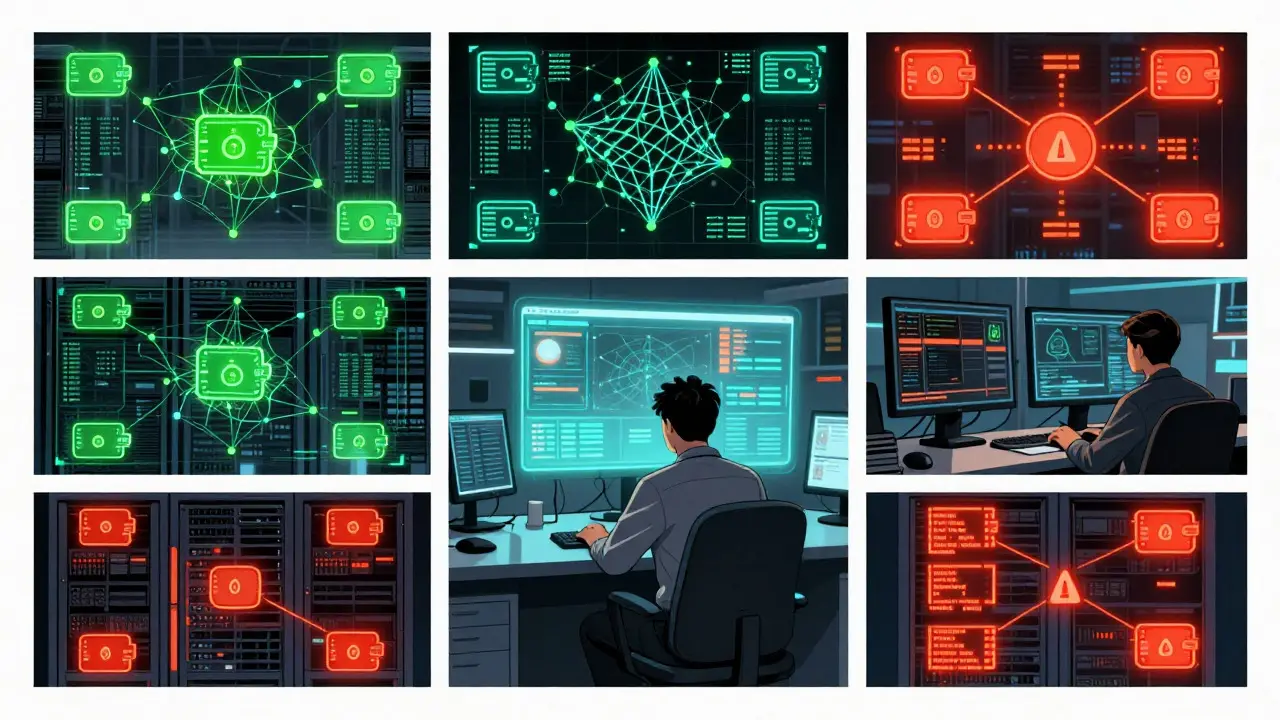
So, how do you actually stop a sanctioned transaction before it settles? You need automated transaction monitoring. According to Crystal Intelligence’s 2025 analysis, crypto businesses are required to have an automated tool in place and conduct proper wallet screening using blockchain analytic tools such as Crystal Explorer, Chainalysis Reactor, or TRM Labs. These platforms enable customized risk rules and real-time screening against sanction lists.
When you identify a blocked asset, OFAC FAQ 646 gives you two main options for handling it:
- Individual Blocking: Block each digital currency wallet individually where a blocked person has an interest.
- Consolidated Blocking: Consolidate blocked digital currency into a single designated wallet titled 'Blocked SDN Digital Currency.'
A crucial detail here: OFAC explicitly states that holders of blocked digital currency are not obligated to convert these assets into traditional fiat currency. You can keep them in digital form, provided your compliance controls ensure they remain blocked until legal prohibitions cease. However, you must submit specific reports to OFAC regarding these blocked assets, with requirements varying based on asset type and value.
Implementing this tech stack isn't cheap or fast. A 2025 Steptoe & Johnson implementation study found that getting a full compliance system up and running typically takes 22 to 36 weeks. Here is what that timeline looks like in practice:
- Risk Assessment (4-8 weeks): Conduct a cryptocurrency-specific sanctions risk assessment.
- Tool Selection (8-12 weeks): Select and implement blockchain analytics tools.
- Integration (6-10 weeks): Integrate with existing transaction monitoring systems.
- Training & Testing (4-6 weeks): Train staff and test the program.
One Coinbase compliance officer noted that the constant SDN list updates require daily monitoring. If you rely on manual checks, you’re already behind. You need API connections to services that maintain updated sanction address databases to ensure real-time accuracy.
Comparing Compliance Approaches: OFAC vs. Other Jurisdictions
If you operate globally, you might wonder how OFAC compares to other regulators. The short answer? OFAC is stricter and more aggressive. Let’s look at a comparison between OFAC, the EU, and the UK to see where the differences lie.
| Jurisdiction | Liability Standard | Crypto Enforcement Actions (Since 2018) | Total Penalties | Key Characteristic |
|---|---|---|---|---|
| U.S. (OFAC) | Strict Liability | 17 | $48.7 Million | Aggressive network sanctions; applies to all transactions involving U.S. nexus. |
| UK (OFSI) | Reasonable Measures | 3 | £2.1 Million | Less active enforcement; focuses on high-profile cases. |
| Singapore (MAS) | Risk-Based | 5 | SGD$3.8 Million | Balanced approach; emphasizes local market stability. |
| EU (6AMLD) | Principles-Based | Varies by Member State | Varies | Focuses on Travel Rule ($1,000+ threshold) rather than blanket blocking. |
The difference in liability standards is critical. The Financial Action Task Force (FATF) Travel Rule requires virtual asset service providers to share beneficiary and originator information for transactions above $1,000. OFAC’s framework, however, applies to all transactions regardless of amount when involving sanctioned entities. There is no 'de minimis' exception for small swaps if the counterparty is on the SDN List.
This strictness was highlighted in the September 2025 settlement with ShapeShift AG. The company paid $750,000 for allowing users in Cuba, Iran, Sudan, and Syria to exchange approximately $12.5 million in cryptocurrency over nearly two years. The issue wasn't intentional evasion; it was a lack of geolocation controls. OFAC noted the exchange processed transactions from 527 unique IP addresses in sanctioned jurisdictions without blocking them. Under OFAC’s strict liability regime, that negligence was enough to trigger a penalty.
In contrast, the UK’s Office of Financial Sanctions Implementation (OFSI) has issued only three cryptocurrency-related enforcement actions since 2018. This suggests that while global standards are converging, the U.S. remains the primary enforcer of crypto sanctions. For businesses with any U.S. exposure, aligning with OFAC standards is often the safest bet, even if you primarily serve European or Asian clients.
Real-World Costs and Implementation Challenges
Let’s talk numbers. How much does it actually cost to stay compliant? A 2025 Deloitte survey of 78 cryptocurrency firms found that implementation costs range from $150,000 to $2 million annually, depending on transaction volume. That’s a massive budget line for smaller exchanges. For context, Kraken implemented Chainalysis Reactor with custom risk rules, which dropped their sanction screening false positives from 18% to 4.3% within six months. But that implementation cost them $450,000.
Smaller players struggle more. A 2025 Cambridge Centre for Alternative Finance survey showed that 98% of cryptocurrency exchanges processing over $1 billion monthly implement dedicated sanction screening tools. Compare that to only 42% of smaller exchanges processing under $100 million monthly. This gap creates a two-tiered market where large players are heavily regulated and screened, while smaller ones take higher risks or exit the market.
One of the biggest technical headaches is privacy coins. Sixty-eight percent of respondents in a recent industry review cited difficulties screening privacy-enhanced coins like Monero and Zcash. Because these coins obscure transaction details, traditional blockchain analytics struggle to trace the source or destination. OFAC’s October 2025 update to FAQ 646 addressed this by requiring 'reasonable measures to prevent transactions involving blocked persons' even when counterparty identification is technically challenging. What counts as 'reasonable' is still being defined, but experts suggest it involves multi-layered verification and heightened due diligence for any interaction with privacy coin protocols.
Another challenge is Decentralized Finance (DeFi). Seventy-three percent of surveyed firms reported difficulties applying traditional sanctions screening to liquidity pools and automated market makers. In DeFi, you often don't know who the counterparty is. You’re swapping tokens in a pool, not dealing with a registered user. Professor Sarah Bloom Raskin, former Deputy Treasury Secretary, critiqued this in her February 2025 Harvard Law Review article, arguing that OFAC’s strict liability approach creates impossible compliance burdens for entities with no control over transaction routing. Yet, former OFAC Director John E. Smith countered that the technology exists to handle this, and ignoring it is risky.

Building a Robust Sanctions Compliance Program
According to the October 2021 VC Compliance Guidance, all companies-even those not primarily engaged in financial services-should implement risk-based sanctions compliance programs. OFAC Director Andrew E. Hallman reinforced this in May 2025, stating there is no such thing as a cryptocurrency business that falls outside OFAC's jurisdiction if it involves U.S. persons or the U.S. financial system.
Your program needs five essential components:
- Management Commitment: Documented board-level oversight. The CEO and Board must sign off on the compliance strategy.
- Risk Assessment: Updated quarterly with documented methodology. Don't do this once and forget it.
- Internal Controls: Including automated screening tools integrated into your workflow.
- Testing and Auditing: Conducted by independent third parties annually to verify effectiveness.
- Training: Mandatory for all relevant staff. Aim for 92% completion rates.
Staff training is often underestimated. A 2025 Association of Certified Anti-Money Laundering Specialists (ACAMS) survey showed that compliance officers require an average of 147 hours of specialized training to effectively implement cryptocurrency sanction controls. That’s roughly four weeks of full-time work just to get up to speed. Hiring certified Blockchain Intelligence Analysts (BIA) can help, though they command 35% higher salaries according to 2025 Payscale data.
Documentation quality varies significantly among vendors. Chainalysis received 4.7/5 stars for documentation in 2025 G2 reviews, compared to TRM Labs’ 3.2/5 rating. If you’re choosing a vendor, prioritize clarity and ease of integration. Also, leverage community resources like the OFAC Sanctions List API GitHub repository, maintained by Treasury, which provides essential technical implementation guidance.
Future Outlook: Where Is Crypto Sanctions Going?
The landscape is shifting rapidly. In September 2025, OFAC Director Hallman announced a new 'Digital Asset Sanctions Task Force' comprising 35 specialists dedicated solely to cryptocurrency enforcement. This signals that regulatory focus is intensifying, not relaxing. The August 2025 action against Garantex also marked a new pattern: targeting not just the exchange, but its entire ecosystem, including successors, executives, and supporting companies. This 'network sanctions' approach suggests future actions will be even broader.
Technologically, we’re seeing moves toward protocol-level compliance. The Ethereum Foundation announced EIP-7594 in September 2025, proposing on-chain sanction compliance mechanisms. However, this faces significant community resistance, with 1,247 comments on Ethereum’s AllCoreDevs call condemning the proposal. The debate between privacy and compliance is far from over.
Market projections indicate that spending on crypto sanction compliance will reach $1.8 billion by 2026, growing at 34% annually. Forrester predicts that by 2027, 65% of cryptocurrency transactions will undergo real-time sanction screening, up from 38% in 2025. Former Treasury Secretary Janet Yellen predicted in July 2025 that sanction evasion through cryptocurrency will decline by 60% over the next five years due to improved compliance frameworks. Whether that happens depends on how well the industry adapts to these rigorous standards.
Frequently Asked Questions
Does OFAC apply to all cryptocurrency transactions?
Yes, but with a caveat. OFAC regulations apply to all activities involving digital assets if there is a U.S. nexus. This means if you are a U.S. person, an entity organized under U.S. laws, or physically located in the United States, you are subject to OFAC jurisdiction. Even if you are foreign, if you use the U.S. financial system or involve a U.S. person in the transaction, OFAC rules apply. There is no minimum transaction amount for OFAC applicability.
What is the penalty for violating OFAC crypto sanctions?
Penalties vary based on the severity and willfulness of the violation. Recent examples include the $750,000 settlement with ShapeShift AG in 2025. Since 2018, OFAC has issued 17 cryptocurrency-related enforcement actions totaling $48.7 million in penalties. Beyond fines, violations can lead to reputational damage, loss of banking partners, and potential criminal liability in extreme cases. Strict liability means you can be fined even if you didn't intend to violate the rules.
How do I screen wallets for OFAC compliance?
You need automated blockchain analytics tools like Chainalysis Reactor, Elliptic, or TRM Labs. These tools connect via API to your transaction monitoring system and screen wallet addresses in real-time against the OFAC SDN List. You should also implement geolocation controls to block users from sanctioned countries. Manual screening is insufficient due to the frequency of SDN List updates and the volume of transactions.
Do I need to convert blocked crypto assets to fiat?
No. OFAC FAQ 646 explicitly states that holders of blocked digital currency are not obligated to convert these assets into traditional fiat currency. You can keep them in digital form, provided you consolidate them into a designated 'Blocked SDN Digital Currency' wallet or block individual wallets, ensuring they remain inaccessible until legal prohibitions cease. You must report these blocked assets to OFAC as required.
How does OFAC compare to the FATF Travel Rule?
The FATF Travel Rule requires sharing originator and beneficiary information for transactions over $1,000. OFAC’s framework is broader; it applies to all transactions involving sanctioned entities, regardless of amount. While the Travel Rule focuses on transparency for anti-money laundering, OFAC focuses on preventing dealings with specific bad actors. Most compliant businesses implement both, as they serve different regulatory purposes.
What are the main challenges in complying with OFAC crypto sanctions?
The top challenges include screening privacy coins like Monero and Zcash, where transaction details are obscured; handling DeFi protocols where counterparties are unknown; managing high false positive rates (often 12-15%) from standard tools; and the high cost of implementation, which can range from $150,000 to $2 million annually. Additionally, keeping up with frequent SDN List updates requires continuous monitoring and automated systems.