
Is Kujira actually a place where you can buy Bitcoin with your credit card? If that’s what you’re looking for, you might be disappointed. Kujira is not a centralized cryptocurrency exchange like Binance or Coinbase. Instead, it operates as a decentralized finance (DeFi) ecosystem built on the Cosmos blockchain. When people search for a "Kujira exchange review," they are usually trying to figure out if this platform is safe, how to trade its native token, KUJI, and whether its promise of "real yield" is worth the risk. The short answer is that Kujira is a powerful tool for advanced users who understand smart contracts and want exposure to the Cosmos network. It is not a beginner-friendly spot for swapping fiat currency. This guide breaks down exactly what Kujira is, how the trading infrastructure works, the current state of the KUJI token in mid-2026, and the risks you need to watch out for before connecting your wallet.
What Is Kujira? Understanding the Ecosystem
To get a handle on Kujira, you have to look past the word "exchange." In the traditional sense, an exchange is a company that holds your money and matches buyers with sellers. Kujira does none of that. It is a protocol-a set of rules and code-that lives on the blockchain. Specifically, Kujira positions itself as a "Real Yield Focused DeFi Ecosystem." What does that mean in plain English? Most DeFi projects pay rewards using their own newly printed tokens. This often leads to inflation and crashing prices. Kujira tries to solve this by routing actual revenue from trading fees and other sources back to liquidity providers and stakers. The goal is sustainable returns rather than speculative hype. The backbone of this system is the KUJI token. Think of KUJI as the fuel for the engine. You use it to pay for transaction fees, vote on governance proposals (deciding how the protocol evolves), and stake it to secure the network. As of June 2026, the ecosystem has grown significantly since its inception, aiming to become the primary financial hub for the broader Cosmos network.
How Trading Works on Kujira
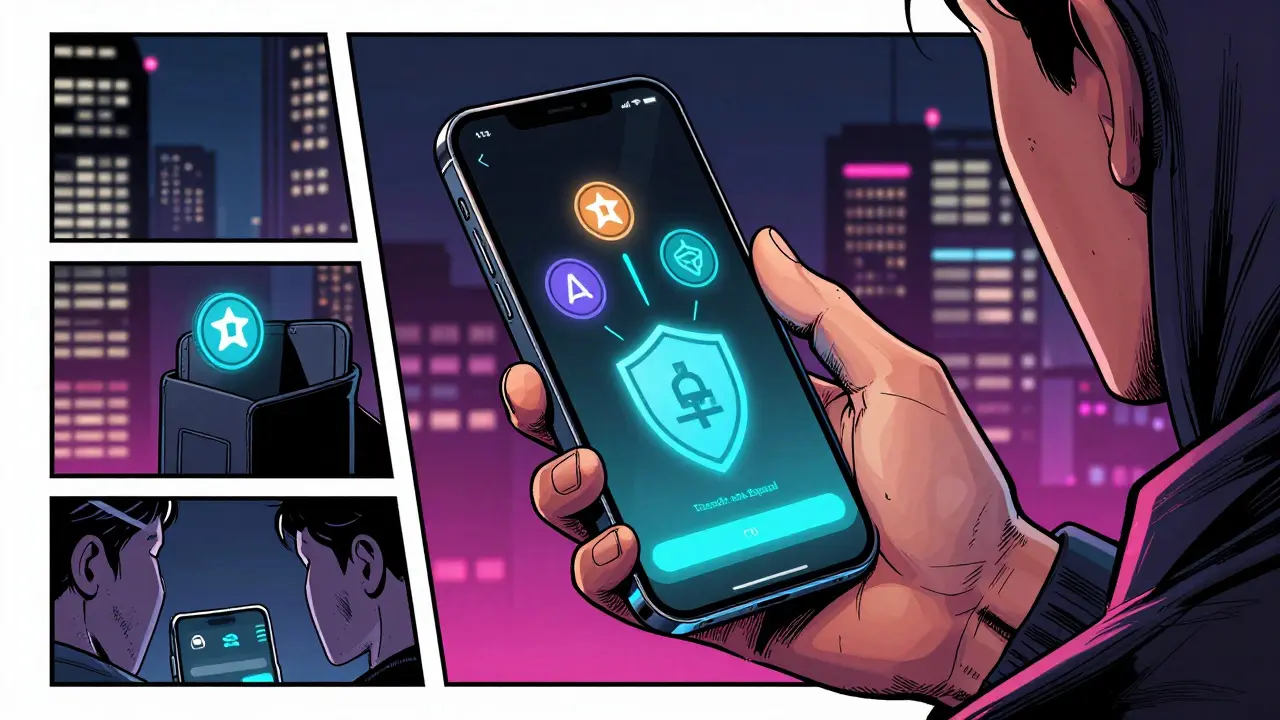
Since there is no central customer support team or login page, how do you actually trade? You interact directly with the blockchain through a web interface or mobile app. Here is the step-by-step process:
- Get a Wallet: You need a non-custodial wallet compatible with the Cosmos ecosystem. Popular choices include Keplr or Leap. These wallets hold your private keys, meaning you are solely responsible for security.
- Fund Your Wallet: You can’t deposit USD directly. You must acquire ATOM (the native token of Cosmos Hub) or USDC (a stablecoin) on a centralized exchange like Kraken or Coinbase, then withdraw it to your Kujira-compatible wallet address.
- Connect to Kujira: Visit the Kujira dashboard and connect your wallet. You will see a prompt asking for permission to interact with the site.
- Swap Tokens: Use the integrated swap feature to exchange assets. For example, you might swap ATOM for KUJI. This happens instantly via automated market makers (AMMs) within the Kujira network.
- Provide Liquidity or Stake: To earn yields, you can add your tokens to liquidity pools or stake KUJI to validators.
KUJI Token Analysis: Price and Market Data (June 2026)
If you are considering investing in the KUJI token, you need to look at the hard numbers. The crypto market is volatile, and KUJI is no exception. Here is the current snapshot based on data from June 2026:
| Metric | Value |
|---|---|
| Current Price | ~$0.20 |
| Market Cap Rank | #858 |
| Circulating Supply | 122,350,000 KUJI |
| All-Time High (ATH) | $5.22 |
| 24-Hour Change | -12.59% |
| 1-Month Change | -46.49% |
Risks and Challenges You Must Know
Decentralized finance offers freedom, but it comes with significant responsibilities and risks. Before you put money into Kujira, consider these factors:
- Smart Contract Risk: Like all DeFi protocols, Kujira relies on code. If there is a bug or a vulnerability in the smart contracts, hackers could exploit it. While audits are conducted, no system is 100% immune.
- Liquidity Constraints: Because KUJI isn't listed on top-tier centralized exchanges, moving large amounts of capital in or out can be difficult. You might face higher slippage (getting a worse price than expected) when swapping large volumes.
- Cosmos Dependency: Kujira’s success is tied to the health of the Cosmos network. If interest in Cosmos wanes, Kujira likely follows. Conversely, if Cosmos grows, Kujira benefits.
- Regulatory Uncertainty: DeFi operates in a gray area legally. Governments worldwide are still figuring out how to regulate non-custodial platforms. Future regulations could impact how easily you can access these services.
- User Error: There is no "forgot password" button. If you lose your seed phrase (the 12-24 words generated when you create your wallet), your funds are gone forever. Scammers also target new DeFi users with phishing links. Always double-check URLs.
Who Is Kujira For?
Kujira is not a one-size-fits-all solution. Let’s break down who should use it and who should stay away. Best For:
- Experienced Crypto Users: People who already use wallets like MetaMask or Keplr and understand gas fees and slippage.
- Cosmos Believers: Investors who think the Inter-Blockchain Communication (IBC) protocol will dominate the future of crypto connectivity.
- Yield Seekers: Traders looking for passive income through liquidity provision, provided they understand the risks of Impermanent Loss.
- Absolute Beginners: If you’ve never bought crypto before, start with a regulated centralized exchange. Kujira’s interface assumes you know what a private key is.
- Low-Risk Investors: If you cannot afford to lose your principal investment, avoid high-volatility altcoins and complex DeFi mechanisms.
- Fiat On-Ramp Seekers: If you want to buy crypto directly with a bank transfer or credit card, Kujira doesn’t offer this service.
Final Verdict: Is Kujira Worth It?
In the landscape of 2026, Kujira stands out as a serious player in the Cosmos DeFi sector. Its focus on real yield distinguishes it from meme-driven projects that offer nothing but empty promises. The infrastructure is robust, the community is active, and the integration with the wider Cosmos ecosystem provides a strong foundation for growth. However, the current market conditions are challenging. With the token trading well below its all-time high and facing bearish technical signals, now is not necessarily the time to chase momentum. It may be a good time for long-term believers to accumulate slowly, but only if you are comfortable with the inherent risks of DeFi. If you decide to proceed, start small. Learn how to use the wallet, make a tiny test transaction, and familiarize yourself with the interface. Never invest more than you can afford to lose, and always prioritize security-enable two-factor authentication wherever possible and store your recovery phrases offline.
Can I buy KUJI with a credit card on Kujira?
No. Kujira is a decentralized platform and does not accept fiat currency or credit cards. You must first buy a supported asset like ATOM or USDC on a centralized exchange (e.g., Binance, Coinbase) and transfer it to your Kujira-compatible wallet.
Is Kujira safe to use?
Kujira uses audited smart contracts, but no DeFi platform is 100% risk-free. Security largely depends on you: keeping your private keys secret, avoiding phishing sites, and understanding the risks of smart contract vulnerabilities.
What is the minimum amount to stake KUJI?
There is generally no strict minimum, but you need enough KUJI to cover transaction fees (gas). Staking very small amounts may result in negligible rewards after fees are deducted.
Why is KUJI price so volatile?
KUJI has lower liquidity compared to major coins like Bitcoin. It is not listed on many large centralized exchanges, meaning fewer buyers and sellers. This thin order book causes larger price swings with smaller trade volumes.
How do I get started with Kujira?
Download a Cosmos-compatible wallet like Keplr. Fund it with ATOM or USDC from a centralized exchange. Connect the wallet to the Kujira website. Start by making a small swap to test the process before providing liquidity or staking.
Brad Ranks
June 23 2026I literally just lost my entire savings because I clicked a phishing link that looked exactly like the Kujira dashboard. The drama of it all is insane. You think you are safe with your private keys but one wrong click and poof. Gone. It is not even funny anymore.
Caralee Robertson
June 25 2026oh no brad i am so sorry to hear that happened to you :( it really is scary how easy it is to get tricked these days especially when you are trying to be careful
Greg Lewis
June 25 2026you see this is why the system is broken they want you to feel helpless so you go back to the banks where they can steal your money legally instead of illegally on the blockchain it is all about control man
Sonya O'Brien
June 25 2026While I completely agree that security is paramount, we cannot ignore the fact that the real yield model proposed by Kujira actually addresses a fundamental flaw in previous DeFi iterations which relied heavily on inflationary tokenomics rather than sustainable revenue streams generated from actual trading fees and protocol usage, thereby creating a more robust economic foundation for long-term stakeholders who are willing to navigate the initial learning curve associated with non-custodial wallet management and smart contract interaction protocols.
Filbert Reeves
June 26 2026real yield my ass its all rigged the insiders know what is coming next and they dump on us little guys before the news breaks out to the public i have seen this pattern a thousand times in different coins and now here we are with kujira doing the same thing dont believe the hype
Akeem Whittaker
June 27 2026You need to understand the mechanics before you dismiss the technology. The issue isn't the protocol itself but the user's lack of due diligence. If you are going to participate in decentralized finance you must take responsibility for your own security measures including hardware wallets and verifying contract addresses manually every single time.
Kwon Bill
June 29 2026The integration with the Cosmos ecosystem via IBC is actually quite sophisticated from a technical standpoint allowing for cross-chain liquidity aggregation without the need for wrapped assets which reduces counterparty risk significantly compared to Ethereum bridging solutions that have been plagued by exploits in the past making Kujira a potentially safer haven for multi-chain asset management strategies.
Fede Faith
June 30 2026Look at the RSI levels right now. We are approaching oversold territory which historically has been a good entry point for swing traders if you have the stomach for the volatility. Just make sure you set strict stop losses because this market can move against you fast.
Josh Dodson
July 1 2026hey guys dont forget to check your gas fees before swapping sometimes they spike during high traffic periods and eat into your profits big time also always double check the url its super important for safety
Suman Patil
July 3 2026This is an excellent opportunity for those who understand the potential of the Cosmos network. The interoperability features are game-changing for the future of web3 infrastructure. Let's keep the community positive and focused on the long-term vision of decentralized financial sovereignty and innovation across chains.
Kumaran sowkarpet
July 3 2026namaste friends i have been staking KUJI for two years now and the yields have been consistent compared to other platforms i recommend starting small and learning the interface first it is very user friendly once you get the hang of keplr wallet :)
sreeja boora
July 3 2026The regulatory environment remains highly uncertain and poses significant risks to any decentralized platform operating outside traditional financial frameworks. Users should be aware that legal precedents are still being established and could result in severe restrictions or prohibitions on access to such services in various jurisdictions.
Grace Newman
July 5 2026One must consider the possibility that these decentralized exchanges are merely fronts for money laundering operations that evade detection by traditional banking systems. The anonymity provided by non-custodial wallets is a feature to some but a critical vulnerability to law enforcement agencies who are increasingly capable of tracing blockchain transactions through advanced heuristic analysis techniques.
Annemarie Fitzgerald
July 6 2026i mean honestly who cares about the price action when the whole concept of value is subjective anyway we are just playing a game with digital numbers while the world burns around us but sure let us talk about rsi indicators like they matter in the grand scheme of existence lol
Abby Sivertsen
July 8 2026Stop overcomplicating things. If you cant handle the risk then stay away. Its that simple. But for those of us who want true ownership of our assets this is the only way forward. Centralized exchanges are ticking time bombs waiting to happen.
Benjamin Eisen
July 8 2026i was wondering if anyone else noticed the slight increase in volume today maybe its a sign of accumulation? i might try putting in a small amount just to test the waters again after my last bad experience
Kenneth Riley
July 9 2026the price chart looks absolutely pathetic right now everyone talking about mooning is delusional the fundamentals are weak and the competition is fierce why would anyone put money here when there are better options available it is basically a death spiral waiting to happen
ravi mahla
July 11 2026haha nice try kenny but you forgot to mention that your portfolio is probably down 90% too sarcasm aside the tech is solid whether you like it or not people are using it and that matters more than your pessimistic rant
Mark Brunschwiler
July 11 2026I feel like we are all just screaming into the void here. Does anyone really care about the technical details or are we just looking for validation for our biases? It is exhausting trying to find genuine insight amidst all the noise and fear mongering.
Terry Hyland
July 12 2026this whole crypto thing is immoral it encourages gambling addiction and destroys families who lose their life savings chasing dreams of getting rich quick we should ban it entirely to protect society from these predatory schemes designed by evil corporations
Tim Lefebvre
July 13 2026look i know its risky but if you use a hardware ledger device you are pretty much safe from remote hacks the main risk is physical theft or losing the device so buy two and store them in different places trust me i learned this the hard way
Monica Pathammavong
July 14 2026obviously the article missed the point that liquidity providers are essentially subsidizing traders who have superior information and tools this creates an uneven playing field where retail investors are guaranteed to lose in the long run unless they have insider knowledge which most do not
JEVON HALL
July 16 2026Just swapped some ATOM for KUJI yesterday and the slippage was minimal 😊 The UI is getting better every update. Good luck everyone! 🚀
Dr Lynea LaVoy
July 17 2026It is crucial to remember that diversification is key in any investment strategy. While Kujira offers unique opportunities within the Cosmos ecosystem, allocating only a small percentage of your total portfolio to high-volatility altcoins can help mitigate potential losses while still allowing you to benefit from upside growth if the project succeeds.