
You hold twelve words in your hand. On paper, they look like random gibberish-maybe "witch," "collapse," "practice," and "feed." But to the blockchain, those words are the master switch for your entire digital fortune. They aren't just a password; they are the mathematical blueprint that generates every single private key you will ever use. If you lose them, your crypto is gone forever. If someone else gets them, your crypto is gone too.
So how does a list of common English words turn into complex cryptographic keys? It’s not magic, and it’s not simple encryption. It’s a precise, standardized process defined by Bitcoin Improvement Proposal 39 (BIP-39). Let’s break down exactly how this works, why it’s designed this way, and where the real dangers lie.
The Problem with Raw Private Keys
Before seed phrases existed, managing cryptocurrency was a nightmare. A private key is a 256-bit number used to sign transactions and prove ownership of funds on a blockchain. In its raw form, it looks like this:
B0183D69E6D87DC0FB6A5778633389F4453213303DA61F20BD67FC233AA33262
Imagine trying to write that down by hand. One mistake-one swapped character-and the key is useless. You can’t recover it. You can’t guess it. It’s binary: right or wrong. For early adopters, losing a device meant losing access to their assets permanently. There was no backup plan that humans could reliably execute.
This problem led to the creation of mnemonic seeds, also known as seed phrases or recovery phrases. These are human-readable representations of cryptographic entropy. Instead of memorizing a string of hex characters, you memorize (or write down) a list of words from a predefined dictionary. This standardization happened through BIP-39, proposed in 2013 by Marek Palatinus and Pavol Rusnak of SatoshiLabs.
From Randomness to Words: The Generation Process
When you create a new wallet, the software doesn’t pick words randomly from a dictionary. It follows a strict mathematical sequence to ensure the phrase is secure and verifiable. Here is the step-by-step breakdown of how a seed phrase is generated:
- Generate Entropy: The wallet application generates a stream of random bits, called entropy is random data used as the foundation for cryptographic keys. For a standard 12-word phrase, the system generates 128 bits of entropy. For a more secure 24-word phrase, it generates 256 bits.
- Create a Checksum: To prevent errors when writing down the phrase, the system hashes the entropy using SHA-256. It takes the first few bits of this hash (4 bits for 12 words, 8 bits for 24 words) and appends them to the end of the original entropy. This acts as a built-in error correction code.
- Split into Segments: The combined string of entropy + checksum is divided into chunks of 11 bits each. Since $2^{11} = 2048$, each chunk corresponds to a specific index number between 0 and 2047.
- Map to Words: Each index number is matched to a word in the official BIP-39 wordlist, which contains exactly 2,048 words. For example, index 0 might be "abandon," and index 1234 might be "witch."
The result is a sequence of words that mathematically represents the original random data plus a verification check. If you mistype one word, the checksum won’t match, and the wallet will reject the input immediately. This prevents you from accidentally locking yourself out due to a handwriting error.
Turning Words Back Into Keys: PBKDF2 and HMAC-SHA512
Having the words is only half the battle. The wallet needs to convert those words back into a usable cryptographic seed. This is where the heavy lifting happens. The wallet uses a key derivation function called PBKDF2 is Password-Based Key Derivation Function 2, a standard algorithm for strengthening passwords against brute-force attacks.
Here is what occurs behind the scenes:
- Input: Your mnemonic sentence (the 12 or 24 words).
- Salt: The string "mnemonic" concatenated with an optional passphrase (if you set one). If you don’t set a custom passphrase, the salt is just "mnemonic".
- Algorithm: HMAC-SHA512.
- Iterations: 2,048 times.
Why 2,048 iterations? Because PBKDF2 is intentionally slow. By running the hashing algorithm over two thousand times, the system makes it computationally expensive for attackers to try billions of guesses per second. This protects your seed phrase if it is ever stolen but remains unreadable to the thief without significant processing power.
The output of this process is a 512-bit master seed. This is the true root of your wallet. From this single seed, all your private keys are derived.

HD Wallets and Deterministic Derivation
You might wonder: "If I have one seed, how do I get multiple addresses?" This is thanks to Hierarchical Deterministic (HD) wallets, standardized in BIP-32. An HD wallet allows you to generate an infinite tree of private keys from a single master seed.
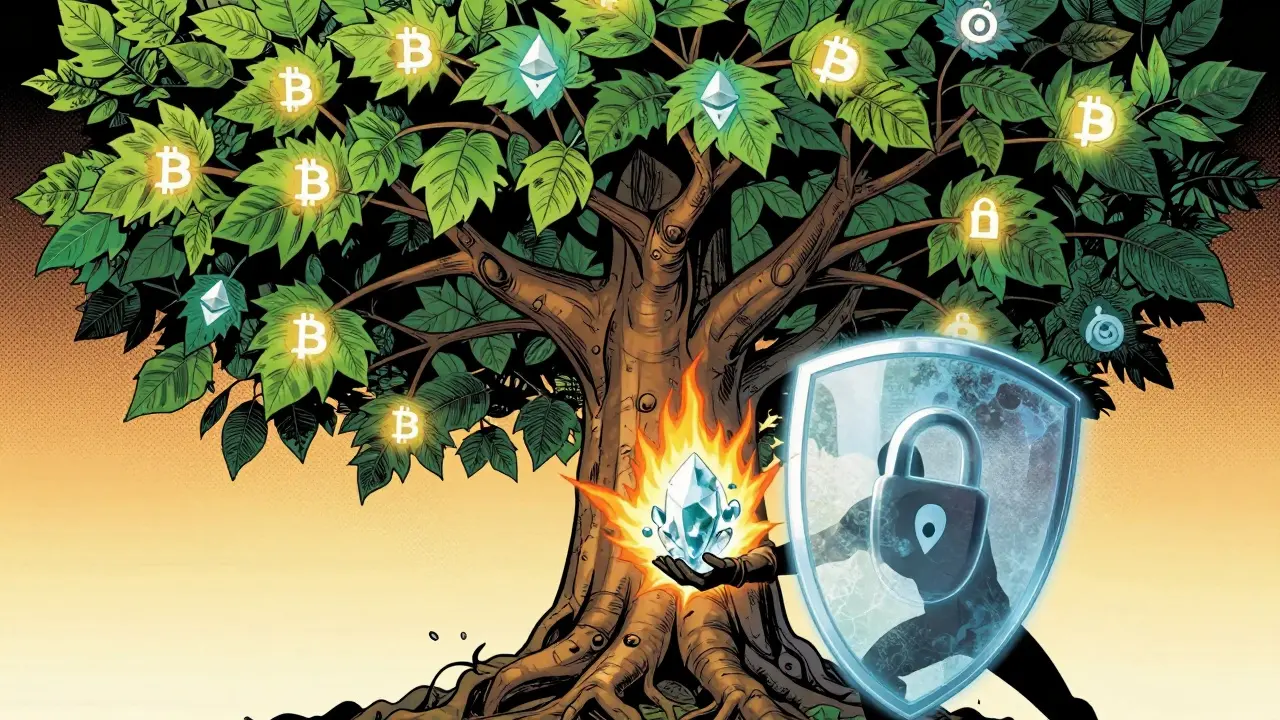
Think of the master seed as the trunk of a tree. From the trunk grow branches (accounts), and from those branches grow leaves (individual addresses). Every single key is mathematically linked to the parent seed. This means:
- You never need to back up a new address separately. Recovering the seed recovers everything.
- You can generate thousands of addresses for privacy, ensuring each transaction goes to a fresh address.
- The process is deterministic. Input the same seed into any BIP-39 compliant wallet, and you will get the exact same private keys in the exact same order.
To organize these keys across different cryptocurrencies, standards like BIP-44 define a path structure for deriving keys for different coins and accounts. For example, an Ethereum address might follow the path `m/44'/60'/0'/0/0`, while a Bitcoin address might follow `m/44'/0'/0'/0/0`. The numbers tell the wallet which coin, which account, and which address index to generate.
| Phrase Length | Entropy Bits | Checksum Bits | Total Security Strength | Use Case |
|---|---|---|---|---|
| 12 Words | 128 | 4 | 128-bit | Standard personal wallets |
| 24 Words | 256 | 8 | 256-bit | High-value holdings, institutional custody |
Note that a 12-word phrase provides 128 bits of security, which matches the strength of Bitcoin’s native private keys. A 24-word phrase offers 256 bits, matching the maximum security of SHA-256. For most users, 12 words are sufficient, but 24 words provide a larger margin of safety against future quantum computing threats or implementation flaws.
Common Mistakes and Security Risks
Understanding the tech is great, but human behavior is the weak link. According to a MetaMask security report from late 2023, 78% of account compromises resulted from seed phrase exposure. Here are the critical pitfalls to avoid:
- Digital Storage: Never save your seed phrase in a text file, email, cloud note, or screenshot. If your computer or phone is hacked, the attacker has instant access to your funds. Keep it offline.
- Human-Generated Phrases: Do not make up your own 12 words. Humans are terrible at generating randomness. A predictable phrase like "apple banana cherry..." can be guessed easily. Always let the wallet generate the entropy.
- Physical Damage: Paper burns. Ink fades. Water damages. Consider metal backup solutions like CryptoSteel, which can withstand temperatures up to 1,500°C. Fireproof safes alone may not be enough if the heat exceeds their rating.
- Phishing Scams: No legitimate service will ever ask you to enter your seed phrase online. If a website or support agent asks for it, it is a scam. Close the tab immediately.
Security researcher Dan Guido from Trail of Bits notes that 90% of seed phrase compromises happen through physical exposure or social engineering, not cryptographic breaks. The math is solid; the handling is where people fail.
Advanced Features: Passphrases and BIP-85
If you want an extra layer of security, you can add a passphrase (also called a 25th word). This is an optional string you append to your seed phrase during entry. It changes the salt in the PBKDF2 function, resulting in a completely different master seed. This creates a hidden wallet. If someone steals your written seed phrase but doesn’t know the passphrase, they cannot access your main funds. However, if you forget the passphrase, there is no recovery option. Use this feature with extreme caution.
Another recent development is BIP-85, introduced in 2024. This proposal allows a single master seed to deterministically derive multiple separate seed phrases. This means you can create distinct wallets for different purposes (e.g., daily spending vs. long-term savings) that can be recovered independently, without needing to carry the full master seed everywhere. It enhances both privacy and convenience.
Conclusion: Treat Your Seed Like Cash
Your seed phrase is not a password. It is the ultimate authority over your assets. It generates your private keys, which control your public addresses, which hold your cryptocurrency. The system is designed to be robust, error-resistant, and user-friendly, but it places the burden of security squarely on you. Write it down correctly. Store it physically. Keep it secret. And remember: if you lose the words, you lose the money. There is no customer support to reset it.
Can I change my seed phrase after creating a wallet?
No. A seed phrase is tied to the specific entropy generated at creation. You cannot edit or change it. If you suspect it is compromised, you must create a brand new wallet with a new seed phrase and transfer your funds to the new addresses.
Is a 12-word seed phrase less secure than a 24-word one?
Mathematically, yes, but practically, both are extremely secure. A 12-word phrase offers 128 bits of security, which is equivalent to Bitcoin’s private key strength. A 24-word phrase offers 256 bits. For most individuals, 12 words are sufficient. Choose 24 words if you are storing very large amounts of value or want protection against potential future advances in computing power.
What happens if I lose one word from my seed phrase?
You cannot recover the wallet if you are missing even one word. The checksum validation will fail, and the remaining words do not contain enough information to reconstruct the missing piece. Some advanced tools can attempt to brute-force the missing word if you know the position, but this is not guaranteed and requires technical expertise.
Can I use the same seed phrase for Bitcoin and Ethereum?
Yes. Because HD wallets use derivation paths (like BIP-44), a single BIP-39 seed phrase can generate addresses for Bitcoin, Ethereum, Litecoin, and many other cryptocurrencies. Just ensure your wallet software supports multi-chain functionality.
Are seed phrases vulnerable to quantum computers?
Currently, no practical quantum computer exists that can break BIP-39 or SHA-256. However, 256-bit security (24-word phrases) is considered more resistant to future quantum threats than 128-bit security. As quantum technology evolves, the industry may shift toward post-quantum cryptographic standards.
KEITH WONG
July 10 2026finally someone explains this properly 🧠 most people just copy paste words without understanding the math behind it
Brad Semp
July 11 2026The article is adequate, though it simplifies the cryptographic nuances for a lay audience. It is imperative to note that while BIP-39 is robust, the implementation flaws in various wallet software often negate these theoretical security guarantees. One must exercise extreme diligence in selecting audited, open-source clients rather than proprietary black boxes.
Natalie Lucas
July 12 2026honestly i was so confused about why my wallet generated different addresses but same seed now it makes sense lol thanks for breaking it down
Tracy Marshall
July 14 2026they want you to think its safe but its all part of the plan :/ once they crack sha256 your metal plate wont save you from the new world order controlling your assets via backdoors in the hardware itself stay vigilant people
Korn Arrieta
July 15 2026This is dangerously oversimplified. The checksum mechanism described here is merely a basic error-detection code, not a fail-safe against sophisticated attacks. Furthermore, relying on PBKDF2 with only 2048 iterations is laughably weak by modern computational standards; anyone with a decent GPU cluster can brute-force a weak passphrase in hours. You are giving false confidence to users who believe writing words on paper makes them unhackable. It does not. Human error is the only variable that matters, and you are ignoring the social engineering vectors entirely.
Guy Davis
July 16 2026u need to write it down on paper dont use digital storage ever
Sophie Nakasako
July 18 2026I find it fascinating how this standardizes chaos into order. It’s almost poetic that twelve random words can hold such power. I’ve started using a passphrase as a 25th word, which feels like adding a secret layer to the puzzle. It gives me peace of mind knowing that even if someone finds my physical backup, they still won’t have the key to the kingdom. What do others think about the extra step? Is it worth the risk of forgetting?
John Harman
July 20 2026look i've been in crypto since 2013 and let me tell you something most of you don't know the derivation paths are where the real magic happens bip44 is just the start there's bip84 for segwit and bip86 for taproot if you're using an old path you're leaving money on the table or worse exposing yourself to analysis
Curtis Johnson
July 21 2026Wow! That is truly incredible how much technology has evolved to protect our digital assets. It really warms my heart to see such detailed explanations helping everyone stay safe out there. Let us all support each other in learning these important skills together because knowledge is power after all!
Hamza k
July 22 2026Oh my god! I literally screamed when I read about the checksum saving people from typos! That is absolutely brilliant design! It’s like having a guardian angel watching over your private keys! I’m going to go buy some steel plates right now because fireproof safes sound totally inadequate compared to surviving a volcano eruption!
Steven Briggs
July 24 2026i just keep mine in a safe at home seems fine to me
Jackie D
July 25 2026what if i lose one word is there any way to recover it or am i totally screwed
Kristy Morrow
July 26 2026actually the whole concept of entropy is flawed because true randomness doesn't exist in computers so we're all just playing russian roulette with pseudo-random number generators that are predictable if you know the seed of the operating system clock
Ruth Williams
July 26 2026It is quite amusing to observe the sheer lack of technical literacy displayed in this thread. While the author attempts to elucidate the mechanics of BIP-39, the commenters seem more interested in expressing emotional reactions rather than engaging with the cryptographic principles. One would assume that individuals handling significant financial assets would possess a rudimentary understanding of information theory and hash functions. Alas, the masses continue to rely on faith rather than fact.
Kim Kay
July 26 2026i always double check my words three times before storing them away just to be sure hope everyone else does the same
Antony Lopez
July 27 2026Foreign governments are trying to break these algorithms. We need American-made encryption standards that aren't compromised by globalist agendas. Trust no one but US-based hardware vendors.