

Imagine opening a business bank account in Cyprus, only to have your funds frozen because you sent €1,500 worth of Bitcoin to a friend. It sounds like a nightmare scenario, but for many crypto users and businesses in Cyprus, this is the reality of 2026. The island nation has long been marketed as a "crypto-friendly" hub within the European Union, boasting zero capital gains tax on digital assets. Yet, behind the welcoming regulatory rhetoric lies a complex web of banking restrictions that can trip up even the most compliant operators.
If you are trying to move money between fiat and crypto in Cyprus today, you are navigating a landscape defined by strict Anti-Money Laundering (AML) laws, the newly enforced Markets in Crypto-Assets (MiCA) regulation, and cautious traditional banks. This article breaks down exactly what these restrictions are, why they exist, and how you can operate legally without getting shut out of the banking system.
The Core Problem: Banks vs. Crypto Reality
To understand the restrictions, you first need to understand the mindset of Cypriot banks. Despite the government’s push for innovation, traditional financial institutions view cryptocurrency with deep suspicion. The Central Bank of Cyprus (CBC) has repeatedly issued warnings stating that cryptocurrencies are not legal tender and are not backed by any government or central bank. This official stance creates a fundamental conflict: regulators want crypto adoption, but banks fear the reputational and compliance risks associated with it.
In practice, this means that while nothing explicitly bans a bank from serving a crypto user, most banks impose severe internal limits. Many will block transactions to known exchanges entirely. Others allow small amounts but trigger immediate Enhanced Due Diligence (EDD) checks if you cross certain thresholds. For individual retail users, this often results in accounts being closed after just one suspicious-looking transfer. For businesses, it means months of negotiation to find a single willing partner.
MiCA and the Rise of CASPs
The game changed significantly with the full implementation of the EU’s Markets in Crypto-Assets (MiCA) regulation. MiCA created a unified set of rules for crypto across Europe, and Cyprus moved quickly to align its national laws. The key outcome? The formal recognition of Crypto-Asset Service Providers (CASPs).
As of mid-2025, the Cyprus Securities and Exchange Commission (CySEC) had registered over 87 CASPs. If you are running a crypto exchange, wallet provider, or trading platform in Cyprus, you must register with CySEC. This isn't optional. Operating without a CASP license means you are illegal, and no reputable bank will touch you. Even with a license, however, banking access is not guaranteed. You still have to prove to banks that your AML controls are bulletproof.
| Entity | Primary Responsibility | Impact on Banking |
|---|---|---|
| CySEC | Licensing and supervising CASPs | Banks check CySEC registry to verify legitimacy |
| Central Bank of Cyprus (CBC) | Oversight of Electronic Money Tokens (EMTs) and payment systems | Sets strict guidelines for banks handling crypto flows |
| MOKAS | Unit for Combating Money Laundering | Receives suspicious transaction reports; triggers freezes |

The Travel Rule and Transaction Limits
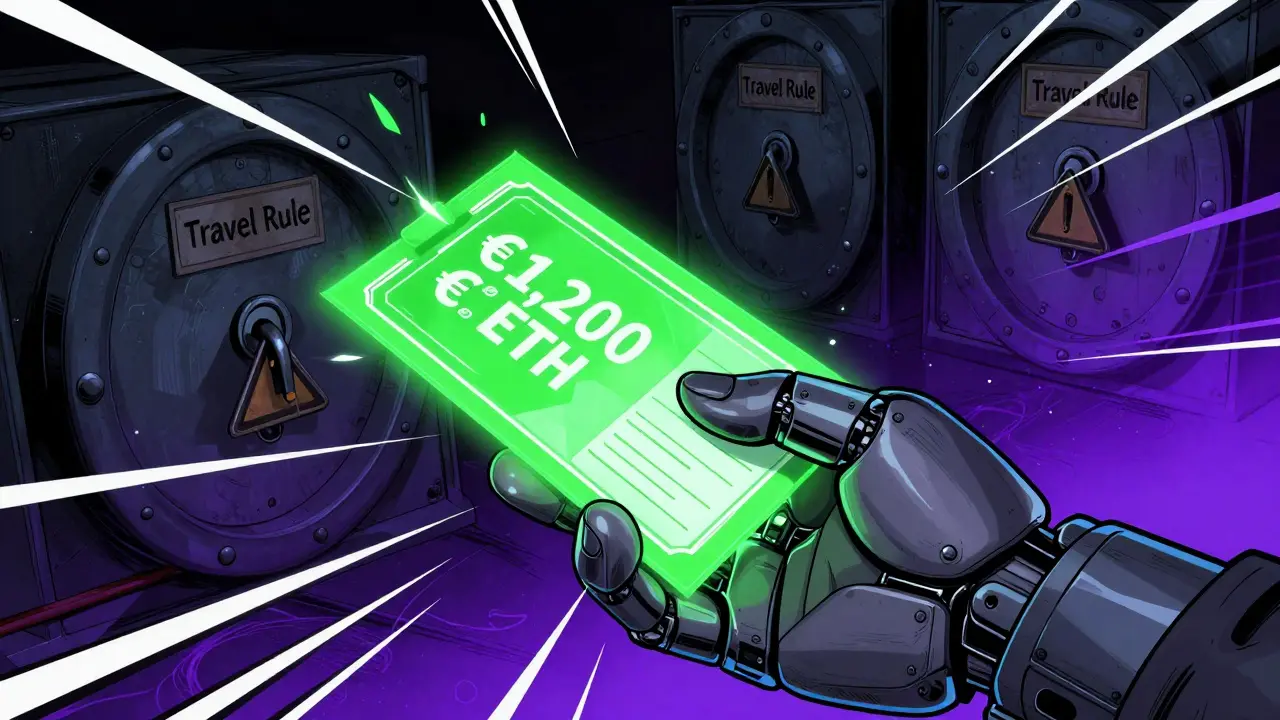
One of the most impactful restrictions for everyday users is the enforcement of the Travel Rule. Implemented through amendments to the Prevention and Suppression of Money Laundering Law in 2025, this rule requires that identity information "travel" with every crypto transaction above €1,000.
Here is how it works in real life: If you send €1,200 in Ethereum from one exchange to another, both platforms must share sender and receiver details. If you send funds to a self-hosted wallet (like a Ledger or Trezor), the sending exchange must verify the recipient's identity thoroughly before releasing the funds. This has led to massive delays. Eurofast reported in 2025 that real-time beneficiary verification increased processing times by 15-20 seconds per transaction. While that sounds minor, scale it up to high-volume traders, and it becomes a bottleneck.
For banks, this means they must ensure their customers are complying. If a bank sees a large transfer to an unverified entity, they may block it to avoid penalties. Non-compliance with these rules can result in fines up to 10% of annual turnover or €5 million. That is why banks are so conservative-they would rather lose your business than risk a multi-million euro fine.
Self-Hosted Wallets: The Biggest Hurdle
If you prefer privacy and use self-hosted wallets, you will face the steepest banking restrictions in Cyprus. The amended AML laws specifically target transfers to and from self-hosted addresses. Banks are required to apply Enhanced Due Diligence (EDD) to any customer who frequently interacts with non-custodial wallets.
In practical terms, this often means:
- Your bank asks for proof of where the crypto came from.
- You must declare the purpose of the transaction.
- Repeated transfers to private wallets may lead to account closure.
This is not anti-crypto bias; it is risk management. Without an intermediary like an exchange, banks cannot easily verify the other side of the transaction. Until blockchain analytics become seamless and integrated into banking software, this friction will remain.
How to Navigate the Restrictions
So, what can you do? Whether you are an individual investor or a startup founder, here are actionable steps to stay compliant and keep your banking relationships intact.
- Use Licensed CASPs Only: Never transact with unregistered platforms. Banks can instantly check the CySEC registry. Using a licensed provider signals low risk.
- Keep Transactions Below Thresholds: If possible, structure transactions to stay under the €1,000 Travel Rule limit when moving between exchanges. Note: This does not apply to self-hosted wallets, where scrutiny is higher regardless of amount.
- Maintain Clear Audit Trails: Keep records of all crypto purchases, sales, and transfers. Be prepared to show your bank the source of funds. Transparency builds trust.
- Engage Early with Your Bank: Before making large moves, talk to your relationship manager. Explain your activity. Some banks offer dedicated desks for high-net-worth individuals involved in crypto.
- Consider Instant Payments: Cyprus is rolling out instant euro payments by 2027. Use these channels for fiat movements to reduce settlement risk and improve visibility for banks.
The Future Outlook: Tighter Controls?
Despite Cyprus’s reputation as a crypto haven, the trend is toward tighter control. The establishment of a National Sanctions Unit in 2025 marks a shift toward centralized oversight. Additionally, MOKAS received over 1,200 suspicious transaction reports from CASPs in the first few months after the new Travel Rule enforcement began. This data suggests regulators are actively monitoring and cracking down on non-compliant behavior.
By 2027, analysts predict that 95% of crypto transactions in Cyprus will flow through registered CASPs. The era of wild west crypto banking is over. Success now depends on transparency, licensing, and patience. If you can adapt to these rules, Cyprus remains one of the best places in the EU for crypto business-just don’t expect your local bank to make it easy.
Can I use crypto at regular banks in Cyprus?
Yes, but with significant limitations. Most Cypriot banks allow small transactions to licensed exchanges but may block or delay larger transfers. They often require you to disclose your crypto activities upfront. Frequent transfers to self-hosted wallets can lead to account closure due to enhanced due diligence requirements.
What is the Travel Rule in Cyprus?
The Travel Rule requires that identity information for both sender and receiver be shared for crypto transactions exceeding €1,000. This applies to transfers between exchanges and to self-hosted wallets. It aims to prevent money laundering by ensuring transparency in digital asset movements.
Do I need a license to run a crypto business in Cyprus?
Yes. If you provide services like exchange, custody, or trading, you must register as a Crypto-Asset Service Provider (CASP) with CySEC. Operating without a license is illegal and will prevent you from accessing traditional banking services.
Is there capital gains tax on crypto in Cyprus?
No. Cyprus does not charge capital gains tax on the sale or exchange of cryptocurrencies. However, income generated from professional trading or mining may be subject to corporate or personal income tax depending on your status.
Why are Cypriot banks so strict about crypto?
Banks face heavy fines for non-compliance with Anti-Money Laundering (AML) laws. Since cryptocurrencies are anonymous and borderless, they pose higher risks for illicit finance. Banks restrict crypto transactions to protect themselves from regulatory penalties and reputational damage.

Hamza k
July 3 2026Oh, the sheer audacity of these banks! 🎭 They sit on their golden thrones, trembling at the mere whisper of a blockchain transaction, while we try to build the future. It is a tragicomedy of errors, really. One sends a modest sum to a friend, and suddenly, poof! Your financial life is vaporized into thin air like a bad magic trick. The irony is palpable; they claim to support innovation yet strangle it with red tape tighter than a python in a phone booth. I have seen friends lose their minds over this bureaucratic nonsense. It is not just inconvenient; it is an affront to common sense. We are living in 2026, for heaven's sake! Yet here we are, begging permission to move our own digital assets. The drama is real, and it is exhausting.
Kim Kay
July 3 2026i totally get where u r coming from its so frustrating when the banks dont understand crypto but hey we gotta be patient right? i made some typos earlier sorry abt that
Brad Semp
July 4 2026It is rather quaint how the uninitiated believe that 'patience' is a viable strategy when dealing with institutional inertia. The reality is far more stark: traditional banking entities are fundamentally incompatible with the decentralized ethos of cryptocurrency. To suggest otherwise is to ignore the structural antagonism between legacy finance and digital sovereignty. One must either adapt to their archaic compliance frameworks or seek alternative avenues entirely. There is no middle ground for those who value efficiency.
Jessie Smith
July 5 2026look man, the whole system is rigged anyway. its all about control. they want you to feel helpless so you stay in the matrix. i mean, come on, who do they think they are? freezing accounts over bitcoin? thats just fear mongering 101. you gotta think outside the box, bro. its all mental. the banks are scared because they know theyre obsolete. its funny really. they pretend to care about security but theyre just protecting their own turf. its a big game and most people dont even realize theyre playing. wake up sheeple. its not about the money, its about the power dynamic. and frankly, its boring as hell watching them squirm. but hey, if you wanna play by their rules, go ahead. just dont complain when you get crushed. its the way of the world. or at least the way of the west. eastern philosophies would tell you to detach, but lets face it, detachment doesnt pay the bills in cyprus. so yeah, keep your head down and maybe use a mixer if you really wanna be safe. but honestly, its all pointless in the grand scheme of things. entropy wins eventually.
Drew M
July 6 2026My dear fellow enthusiasts, let us not descend into such melodramatic despair! 😇 While the regulatory landscape may seem daunting, it is merely the growing pains of a new era. Think of it as shedding one’s skin-painful, yes, but necessary for growth. The introduction of MiCA is actually a triumph of order over chaos. It provides a framework that, once understood, can be navigated with grace and precision. Do not let the fear of the unknown paralyze you. Instead, embrace the clarity that regulation brings. After all, structure allows for true freedom within boundaries. Let us remain optimistic and polite in our dealings, shall we? 🌟
Deep Rahman
July 7 2026I have been thinking about this situation for a long time and I believe that the core issue is not really about money but about trust and how we define value in society today which has changed so much since the days of gold and silver coins which were tangible and could be held in one's hand whereas now we deal with abstract concepts that exist only in digital form and this shift has caused a great deal of anxiety among the older generation of bankers who do not understand the technology and therefore fear it and this fear leads to restrictive policies that ultimately harm the very people they are supposed to protect because when you restrict access to financial tools you are restricting freedom and freedom is essential for human flourishing and economic progress so perhaps the solution is not to fight the banks but to educate them and show them that crypto is not a threat but an opportunity for inclusion and innovation and that by embracing it they can become part of the solution rather than the problem and this requires patience and dialogue and understanding and a willingness to change which is difficult but necessary for the advancement of civilization as a whole.
Ella Collinson
July 8 2026The systemic inefficiencies inherent in Cypriot banking infrastructure regarding CASP integration represent a critical failure point in the broader EU financial architecture. The latency introduced by EDD protocols is not merely an inconvenience but a structural impediment to liquidity velocity. Furthermore, the reliance on manual verification processes for self-hosted wallet interactions demonstrates a profound lack of technological sophistication among traditional FIIs. This misalignment between regulatory intent and operational capability creates significant friction costs for compliant market participants. It is imperative that stakeholders recognize the deleterious impact of these antiquated procedures on overall market efficiency and capital allocation.
Ray Arney
July 9 2026I see what you mean about the inefficiencies. It does seem like a tough spot for everyone involved. Maybe there is room for improvement in how banks handle these verifications. Collaboration could help smooth out some of these rough edges.
Andrew Schneider
July 10 2026Oh, please! Spare me the corporate speak about 'collaboration' and 'smooth edges.' 🙄 You are all asleep at the wheel. The banks aren't trying to improve; they are trying to extort. Every delay is a feature, not a bug. They love the friction because it gives them leverage. And don't get me started on MiCA-it's just a shiny new leash for the dogs of finance. We should be burning it down, not polishing it! 🔥 But sure, keep talking about 'room for improvement' while they freeze your assets. What a joke!
Eric Braddock
July 11 2026You naive fools think this is about banking? It is about surveillance capitalism and the total erosion of privacy. The Travel Rule is not a safety measure; it is a tracking mechanism designed to map every single transaction you make. MOKAS isn't fighting money laundering; they are building a database of dissent. When they say 'Enhanced Due Diligence,' they mean 'we want to know who you are and what you believe.' The entire crypto narrative was sold to you as liberation, but it is actually a honeypot. They want you on-chain so they can watch you. Wake up before they lock the doors completely.
Nick G
July 13 2026While I appreciate the passion in your perspective, I believe it is important to consider the cultural context of Cyprus and the European Union as a whole. Privacy is indeed a cherished value, but so is security and social cohesion. Perhaps there is a middle path where we can advocate for privacy-preserving technologies while acknowledging the need for some level of oversight to prevent illicit activities. Dialogue and mutual respect are key to finding solutions that honor both individual freedoms and collective well-being. Let us strive for understanding rather than confrontation.
Nick Wengel
July 14 2026I agree with Nick G. It is important to find a balance. In my experience, open communication helps. We should try to understand different viewpoints.
Alicia Hull
July 15 2026This article is dangerously misleading. It suggests that compliance is the only path forward, ignoring the fundamental rights violations embedded in these regulations. How many of you have read the actual text of the amended AML laws? No? Then stop parroting the official line. The definition of 'suspicious activity' is so broad it encompasses almost any non-standard behavior. This is a slippery slope towards authoritarian control. Demand transparency or demand nothing. I will not apologize for questioning the legitimacy of these measures.
Johan Otto
July 16 2026Wow, Alicia, you are intense! 😂 But seriously, sometimes you just gotta roll with the punches. Life is too short to fight every battle. Just do what works for you and move on. Don't let the haters get you down. Stay chill.
Anuj Kashyap
July 17 2026Ah, the eternal struggle between order and chaos. 🧘♂️ It is fascinating how humans crave structure yet rebel against it. Perhaps the answer lies not in choosing one side but in accepting the duality. Embrace the bank, embrace the blockchain. Be water, my friends. Or better yet, be Bitcoin. 🚀
Tracy Marshall
July 17 2026they are watching us :o its not just about money its about control of thought and behavior through financial means. the elites want to starve us out if we dont comply. its a moral issue really. we should boycott these banks entirely. why support systems that oppress us? its simple really. stand up for your rights. dont let them win. they rely on our silence. break the silence. #resist
Guy Davis
July 18 2026people need to take responsibility for their actions. if you do something shady dont expect the bank to save you. its not fair to honest people who follow the rules. stop whining and start complying. its that simple.
KEITH WONG
July 18 2026Listen up folks 👂 The gurus here are telling you to comply, but I am telling you to evolve. Most of you are stuck in the past. Use the workarounds mentioned in the post. Instant payments are your friend. Stop being lazy and learn the system. If you cant handle the heat, get out of the kitchen. 🍳
Natalie Lucas
July 19 2026you got this guys! dont let the banks get you down. stay positive and keep moving forward. there is always a way around. just keep smiling and doing your thing. 💪✨