Remember the summer of 2021? That was the peak of the decentralized finance (DeFi) boom. Every week brought a new protocol promising to revolutionize how we earn interest. Unreal Finance (UGT) was one of those projects. It launched with buzz, raised millions, and promised to let you trade future yields like stocks. Today, it sits in the graveyard of abandoned crypto projects.
If you stumbled upon the ticker symbol UGT on an old watchlist or saw a lingering reference in a forum thread, you’re probably wondering what happened. Did it pivot? Did it get hacked? Or did it just fade away? The short answer is that Unreal Finance failed to deliver on its core promises, lost all liquidity, and effectively ceased operations shortly after its launch. This article breaks down what the project was supposed to do, why it collapsed, and what this means for anyone holding the token today.
The Promise: Tokenizing Future Yields
To understand why Unreal Finance existed, you have to look at the problem it tried to solve. In DeFi, interest rates are volatile. One day your staking rewards might be 10%, and the next they could drop to 2% due to market shifts. Unreal Finance aimed to create a marketplace for yield futures.
In simple terms, the platform allowed users to tokenize their expected future earnings from lending protocols. Imagine you lend money on Aave and expect to earn $100 next month. Unreal Finance would let you turn that future $100 into a tradable asset right now. You could sell it for $95 cash immediately, locking in your profit and hedging against rate drops. Meanwhile, buyers could speculate that rates would stay high, hoping to collect the full $100 later.
This concept isn’t new; it’s similar to interest rate swaps in traditional finance. But applying it to blockchain required complex smart contracts and deep liquidity pools to function. Unreal Finance positioned itself as a multichain layer, meaning it intended to work across different blockchains like Ethereum and Binance Smart Chain, rather than being limited to just one network.
The Launch and Tokenomics
The project moved fast. Founded in 2021, Unreal Finance held its Token Generation Event (TGE) on August 25, 2021. At that moment, the hype was real. They raised approximately $3.15 million across several funding rounds, including seed, private, and public sales.
Here is how the token distribution looked at launch:
- Total Supply: 200,000,000 UGT tokens.
- Seed Round: Raised $500,000 at $0.05 per token. Tokens were locked with a 3-month cliff before monthly unlocks began.
- Private Round: Raised $1.5 million at $0.095 per token. 20% unlocked at TGE, followed by a vesting schedule.
- Public Round: Raised $300,000 at $0.12 per token. All tokens were unlocked immediately at TGE.
The initial price action was explosive. The UGT token hit an all-time high of $0.3771 on the very day of its launch. For early investors, paper gains looked massive. However, this immediate spike followed by a rapid decline is often a red flag in the crypto world, suggesting speculative trading rather than fundamental value adoption.
| Round | Price Per Token | Funds Raised | Vesting Schedule |
|---|---|---|---|
| Seed | $0.05 | $500,000 | 10% unlock Day 30, then monthly |
| Private | $0.095 | $1,500,000 | 20% at TGE, 3-month cliff |
| Strategic | $0.075 | $700,000 | 15% at TGE, 3-month cliff |
| Public | $0.12 | $300,000 | 100% unlocked at TGE |
Why Unreal Finance Failed
So, what went wrong? The collapse of Unreal Finance wasn't caused by a single hack or scandal. Instead, it was a slow bleed of functionality and interest that led to total abandonment. Several critical factors contributed to its downfall.
Lack of Liquidity: For a yield futures platform to work, you need buyers and sellers. If you want to sell your future yield, someone needs to buy it. Within weeks of launch, users reported that the liquidity pools were dry. There was simply no one on the other side of the trades. Without liquidity, the core product becomes useless. You can’t hedge risk if you can’t execute the trade.
Technical Issues: Early user reports from late 2021 highlighted broken user interfaces and non-functional testnets. Users complained about wasting gas fees on failed transactions because the smart contracts weren’t interacting correctly with underlying protocols like Aave or Compound. When a financial tool doesn’t work reliably, trust evaporates quickly.
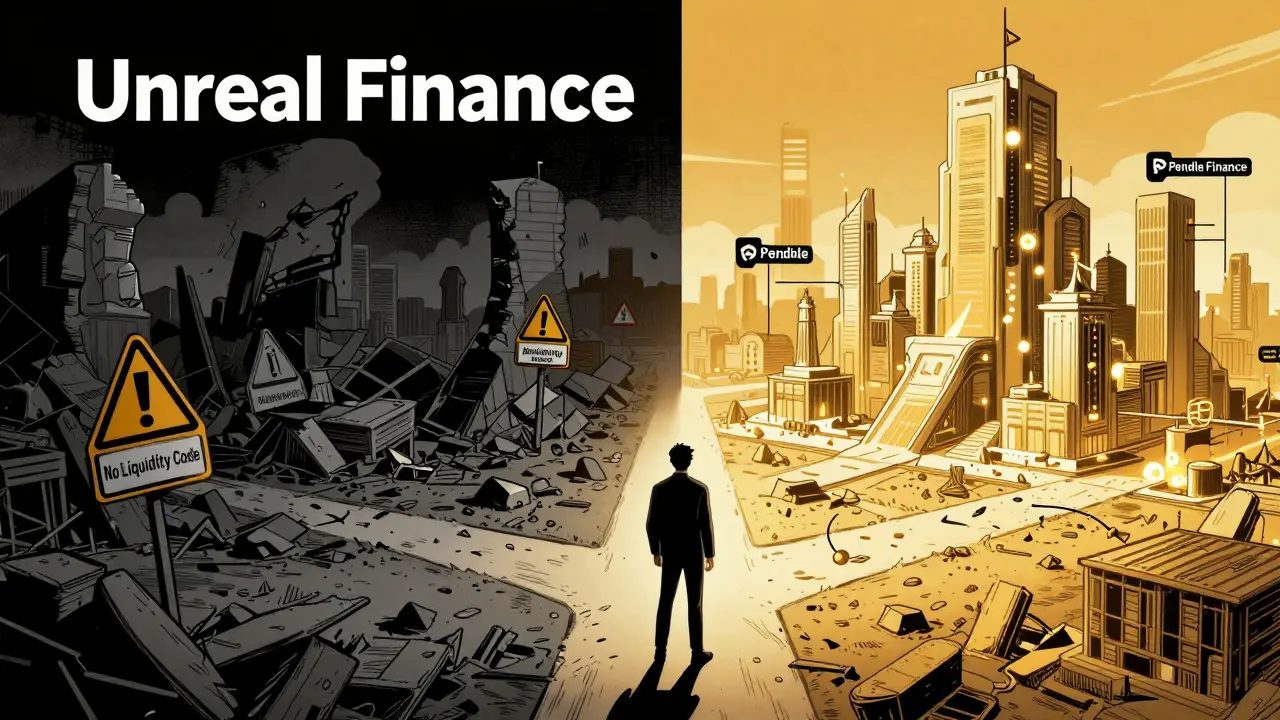
Competitive Pressure: The DeFi derivatives space is crowded. While Unreal Finance was struggling with basic functionality, competitors like Pendle Finance and Hegic were building robust platforms. Pendle, for example, successfully captured the yield tokenization niche by offering better security audits, deeper liquidity, and a more intuitive interface. By Q4 2021, most serious DeFi users had migrated to these more stable alternatives.
Development Abandonment: Perhaps the biggest sign of trouble was the silence from the team. The Unreal Finance Medium blog stopped updating after 2021. Their Discord and Telegram channels, once active with developer announcements, went dark. GitHub repositories showed no significant commits after October 2021. In the crypto world, code is law, but silence is death.
Current Status: Is UGT Still Alive?
As of May 2026, Unreal Finance is effectively defunct. Let’s look at the hard numbers.
The UGT token currently trades at approximately $0.0003446 USD. This represents a decline of over 99.9% from its all-time high. More importantly, the 24-hour trading volume is listed as $0 on major trackers like CoinMarketCap. Zero volume means there is no active market. You cannot buy or sell UGT on any legitimate exchange without incurring prohibitive slippage or facing complete rejection.
The project’s market capitalization hovers around $68,000, placing it among the least valuable assets in the entire cryptocurrency ecosystem. It has no Total Value Locked (TVL) on DeFi tracking platforms like DefiLlama. There are no active developers, no community managers, and no roadmap updates.
If you hold UGT tokens in a wallet, they are essentially digital collectibles with no economic utility. They cannot be used to hedge yields, earn interest, or govern a protocol. The smart contracts may still exist on the blockchain, but the application layer that made them useful is gone.
Lessons for DeFi Investors
The story of Unreal Finance serves as a cautionary tale for anyone navigating the decentralized finance landscape. Here are key takeaways to protect your capital.
Verify Liquidity: Before investing in a DeFi protocol, check if there is actual trading activity. High token prices mean nothing if you can’t exit your position. Look for deep liquidity pools on DEXs like Uniswap or PancakeSwap.
Monitor Development Activity: Regularly check the project’s GitHub repository. Are developers pushing code? Are issues being resolved? A silent GitHub is a major red flag, regardless of how active the marketing team appears on social media.
Assess Competitive Moats: Ask yourself: Why should users choose this protocol over established competitors? If a new project offers only a marginal improvement over giants like Aave or Pendle, it will struggle to gain traction. Unique value propositions must be backed by working technology.
Beware of Launch Hype: Tokens that spike immediately after listing and then crash often suffer from pump-and-dump dynamics. Sustainable growth comes from gradual adoption and utility, not speculative frenzy.
Alternatives to Unreal Finance
If you are interested in yield tokenization or interest rate hedging, there are viable, active alternatives in the market today. These platforms have proven their models and maintain active communities.
Pendle Finance: Currently the leader in yield tokenization, Pendle allows users to separate the principal and yield components of an asset. It supports multiple chains and has hundreds of millions in TVL. It is the direct successor to the concept Unreal Finance attempted.
Hegic: Focused on options trading, Hegic provides automated market making for put and call options. It is a great tool for hedging downside risk in your DeFi positions.
Opyn: Another pioneer in DeFi options, Opyn offers permissionless options markets and insurance products. It is widely used by sophisticated traders looking to manage complex risk profiles.
These platforms offer the same theoretical benefits Unreal Finance promised-hedging, speculation, and arbitrage-but with the critical difference of actual usage, security audits, and ongoing development.
Is Unreal Finance (UGT) a scam?
While there is no definitive proof of malicious intent or theft by the founders, the project exhibits many characteristics of a failed venture. The lack of development, zero liquidity, and abandonment of communication channels suggest the team lost interest or failed to execute. Whether intentional or not, the result for investors is the same: total loss of value. Treat it as a dead project.
Can I still use Unreal Finance to hedge my DeFi yields?
No. The platform is non-functional. There are no active liquidity pools, and the smart contracts are not being maintained. Attempting to interact with the dApp will likely result in failed transactions and wasted gas fees. Use active platforms like Pendle Finance instead.
Where can I buy UGT tokens?
You technically cannot buy UGT on any major centralized exchange. It may appear on some obscure decentralized exchanges (DEXs), but with zero trading volume, any purchase would be highly risky and likely impossible to sell later. It is strongly advised to avoid acquiring UGT tokens.
What happened to the Unreal Finance team?
The team disappeared from public view after 2021. Their social media channels, blog, and community forums have been inactive for years. There is no current information on their whereabouts or whether they have started new projects. In the crypto industry, this is known as "rug pulling" via abandonment, even if funds were not directly stolen.
How does Pendle Finance compare to Unreal Finance?
Pendle Finance is the successful evolution of the yield tokenization concept. Unlike Unreal Finance, Pendle has active development, significant total value locked (TVL), and a functional marketplace for trading yields. Pendle operates on multiple chains and has undergone rigorous security audits, making it a safe alternative for yield strategies.