
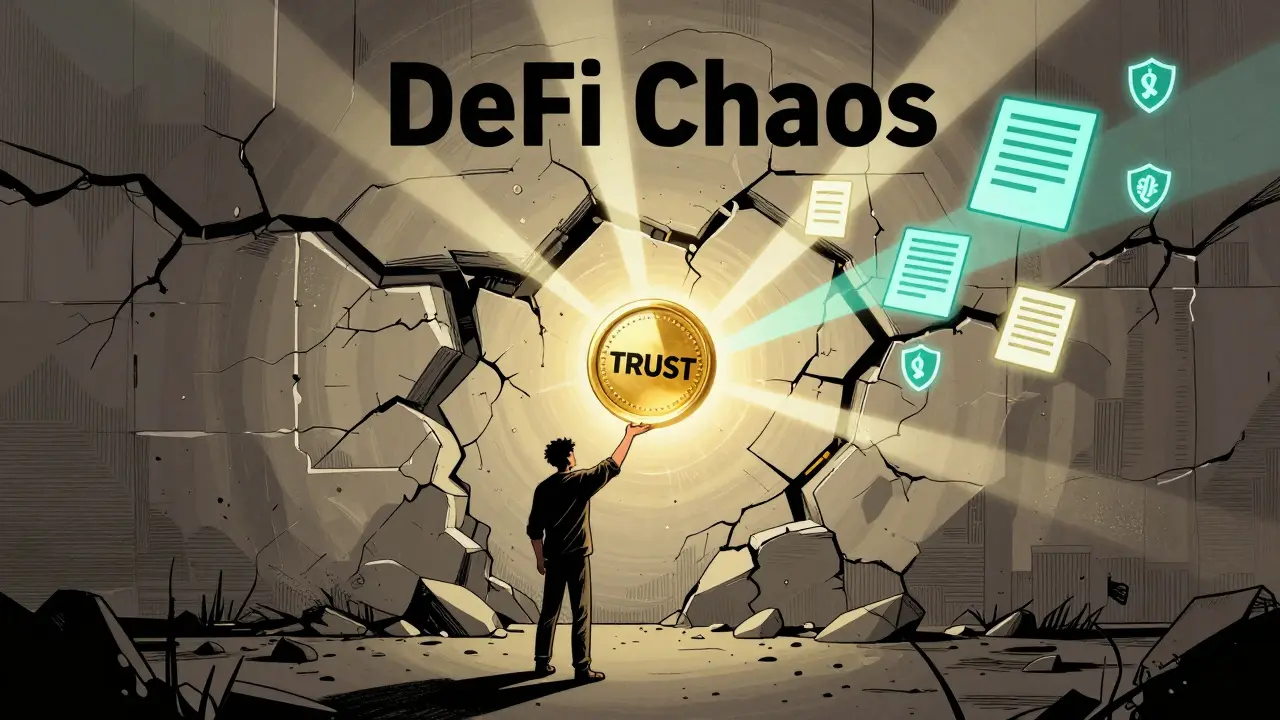
Ever heard of Trust The Process (TRUST) and wondered if it’s just another crypto meme or something real? It’s not a household name like Bitcoin or Ethereum, but it’s got a clear mission - and that’s what makes it worth understanding.
Unlike coins built to get rich quick, TRUST was created to fix a real problem: how broken and confusing the DeFi world feels. If you’ve ever tried to track down reliable info on a DeFi project, only to find conflicting reports, hidden fees, or silent devs, you know what this coin is trying to change.
What TRUST Actually Does
Trust The Process isn’t just a token. It’s a tool built for transparency and community control. Its main job? To help users make smarter decisions in decentralized finance by giving them access to clear, trustworthy data and a say in how the ecosystem evolves.
Here’s how it works in practice:
- It powers governance - if you hold TRUST, you can vote on upgrades, fee structures, and new features.
- It rewards participation - users who contribute to community discussions, audits, or educational content get rewarded in TRUST.
- It links to tools that verify smart contract safety and data accuracy, cutting through the noise.
It’s not about hype. It’s about building systems that don’t collapse when the market turns.
The Numbers: Supply, Price, and Trading
As of February 26, 2026, here’s what the data says:
- Total supply: 1 billion TRUST tokens (with 999,640,964 already in circulation).
- Current price: Around $0.000140 to $0.0001557 USD.
- 24-hour volume: Roughly $195,000 USD - low, but steady.
- 7-day change: Up 11.1%, outpacing the broader market’s 2.6% gain.
- Market cap: About $140 million USD (based on circulating supply).
- Ranking: #4512 on CoinGecko - yes, it’s tiny compared to top coins.
These numbers might seem underwhelming, but they tell a story. TRUST isn’t chasing pumps. It’s slowly building a base of users who care more about long-term reliability than short-term gains.
Why “Trust The Process” as a Name?
The name isn’t random. It’s a philosophy.
The team behind TRUST came from backgrounds in blockchain engineering and finance. They saw how many crypto projects promised big returns but delivered broken contracts, hidden agendas, or abandoned roadmaps. So they built TRUST around four core principles:
- Patience: Real value takes time. Don’t chase quick flips.
- Resilience: Markets crash. Teams vanish. TRUST is built to keep going.
- Community & Collaboration: No lone geniuses. Decisions are made by holders, not just founders.
- Sustainability: It’s not about the next moonshot. It’s about lasting infrastructure.
This is rare. Most tokens are designed to be traded. TRUST is designed to be used - and relied on.

Where Can You Trade TRUST?
Right now, the main place to buy or sell TRUST is MEXC. It’s a well-established exchange with strong security and clear guides for new users. There’s no major listing on Binance, Coinbase, or Kraken yet - and that’s intentional.
The team chose MEXC because they wanted to avoid the noise of mainstream hype. They’d rather have serious users than casual traders. If you’re looking to trade TRUST, make sure you’re using MEXC’s official site. Don’t trust random links or Telegram groups.
Price Predictions: Realistic or Just Wishful Thinking?
Some sites are throwing out wild numbers. CoinCodex says TRUST might drop to $0.0001158 by late February 2026. DigitalCoinPrice, on the other hand, predicts it could hit $0.00650 by 2031.
Here’s the truth: no one can accurately predict a low-cap token like this. The models they use rely on Bitcoin cycles and past volatility - but TRUST has no history of massive price swings. It’s not a pump-and-dump coin. It’s a utility token with a slow, steady growth path.
If you’re thinking about investing, don’t look at price forecasts. Look at adoption. Are more people using it for governance? Are more projects integrating it as a verification layer? That’s the real signal.

The Road Ahead
The TRUST team has a clear roadmap:
- Expanding the ecosystem with partner DeFi protocols that use TRUST for transparency checks.
- Adding on-chain voting with improved UI so even beginners can participate.
- Integrating with blockchain analytics tools to automatically flag risky contracts.
- Launching a grant program for developers building tools around TRUST.
They’re not chasing a billion-dollar market cap. They’re aiming to become the go-to token for anyone who wants to know if a DeFi project is legit - not just because they say so, but because the system proves it.
Who Is TRUST For?
TRUST isn’t for everyone. If you’re here for fast returns, look elsewhere. But if you’re tired of:
- Getting scammed by fake audits,
- Watching projects vanish after a moonshot,
- Not knowing who’s really in charge of a DeFi protocol,
then TRUST might be worth your attention.
It’s for the quiet builders. The long-term holders. The people who care more about how a system works than how fast it climbs.
Final Thought: It’s Not a Coin. It’s a Standard.
TRUST isn’t trying to beat Bitcoin. It’s trying to fix a hole in DeFi’s foundation.
Imagine if every DeFi app had to pass a simple transparency check - verified by TRUST holders - before being listed anywhere. That’s the end goal. It’s not flashy. It’s not viral. But if it works, it could change how we trust crypto forever.
Right now, it’s small. But small things often grow quietly - and last the longest.
Kristi Emens
February 28 2026I appreciate how TRUST focuses on transparency instead of hype. Most crypto projects feel like shell games, but this one actually gives users tools to verify what’s real. It’s quiet, but that’s the point.
Deborah Robinson
February 28 2026This is the kind of project I wish more people paid attention to. Not every coin needs to moon. Some just need to build something that lasts. TRUST is quietly doing the work that others ignore. 👍
Michelle Mitchell
February 28 2026i mean like… trust the process? sounds like a self help book for crypto bros. why not just call it ‘dont get rickrolled’? lol
Kaitlyn Clark
March 2 2026OMG YES. Finally someone gets it. This isn’t about flipping coins - it’s about building infrastructure. I’ve been in DeFi since 2021 and I’m SO tired of rug pulls. TRUST is the antidote. Let’s get this token on more DEXs!! 🚀
christopher luke
March 2 2026I’ve been holding TRUST since last year and I’m not even sure why anymore. But I like the vibe. The team seems real. That’s rare. I’ll stick around.
Mary Scott
March 2 2026They said ‘community governance’ but I bet the dev wallet still controls 40%. This is just another way to centralize power under the guise of decentralization. I’ve seen this movie before.
Shannon Holliday
March 4 2026I love how this isn’t trying to be the next Bitcoin. It’s like… the quiet librarian of crypto. Always there, always reliable. 📚✨
Jeremy buttoncollector
March 5 2026The ontological underpinnings of TRUST as a meta-governance substrate represent a paradigmatic shift from speculative tokenomics toward epistemic sovereignty in DeFi. The emergent consensus layer, when calibrated against verifiable on-chain metadata, creates a novel axiomatic framework for trust attribution.
Michelle Xu
March 6 2026I’ve reviewed several DeFi tools that integrate TRUST for contract verification. The data accuracy is solid. The UI could use work, but the underlying logic is clean. If you’re building something, this is worth testing. Not hype - just good engineering.
Amanda Markwick
March 7 2026I used to think crypto was all about get-rich-quick. Then I met people who actually care about how systems work. TRUST isn’t a coin - it’s a movement. Slow? Yes. Boring? Maybe. But if it works, it’ll outlast every meme coin that ever popped. Keep going.
Sriharsha Majety
March 8 2026this sounds good but i dont understand half of it lol. can someone explain like im 10? thanks
Tabitha Davis
March 9 2026Oh please. Another ‘anti-hype’ coin. I’ll believe it when I see it on Binance. Until then, this is just a vanity project for people who hate making money. Wake up, sheeple.
Vishakha Singh
March 10 2026As someone who works in fintech in India, I see tremendous potential here. The emphasis on community-led governance and verifiable transparency aligns with what emerging markets need most. This could be a model for inclusive finance beyond crypto.
Don B.
March 10 2026I’m not even gonna read this. If it’s not on Coinbase, it’s trash. Why do people waste time on these tiny coins? I’m out.
Arya Dev
March 11 2026Wait… wait… wait… 1 billion supply? At $0.00014? That’s… that’s… 140 million market cap? Are you kidding me? This is a joke. A total joke. Why even bother? Who even uses this? No one. No one.
Leslie Cox
March 12 2026I’m sorry, but if you’re not aggressively maximizing yield, you’re just enabling systemic inefficiency. TRUST might be noble, but nobility doesn’t pay bills. If you’re not staking, farming, or leveraging, you’re part of the problem.
Andrew Hadder
March 13 2026I’ve been using TRUST for governance on a small DeFi protocol. It’s not perfect, but it’s the first time I’ve felt like my vote actually mattered. No one’s yelling. No one’s shilling. Just quiet, thoughtful decisions. That’s rare.