
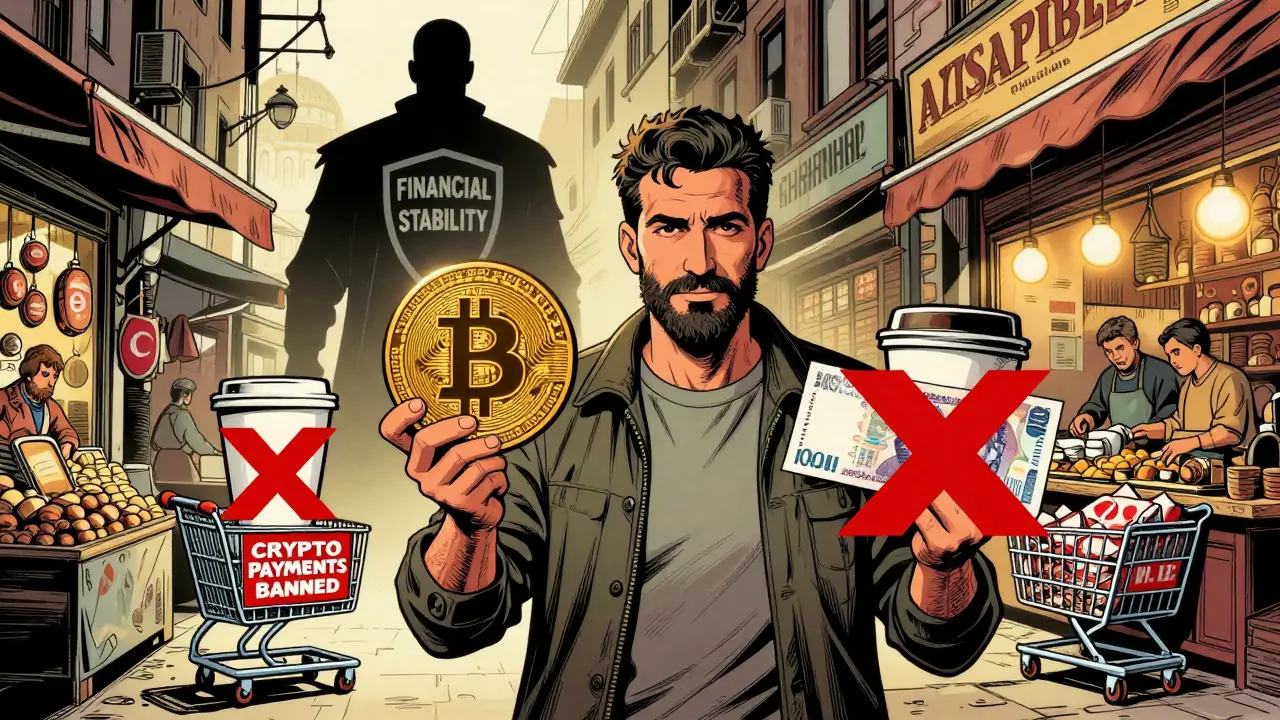
On April 30, 2021, Turkey made a clear move: you could still buy, sell, and hold Bitcoin and other cryptocurrencies-but you couldn’t use them to pay for anything. Not your coffee, not your rent, not your phone bill. The Central Bank of the Republic of Turkey (CBRT) didn’t ban crypto outright. It banned its use as money. That distinction matters. It wasn’t about stopping crypto. It was about stopping crypto from becoming a payment tool.
Why Did Turkey Ban Crypto Payments?
The CBRT didn’t make this decision lightly. They laid out five specific risks in their official announcement:- Cryptoassets have no central regulator-no one’s in charge if things go wrong.
- Prices swing wildly. A coin can lose half its value in a day.
- Transactions are anonymous. That makes it easy to hide illegal activity.
- Wallets can be stolen. If you lose access, there’s no way to get it back.
- Payments are final. No chargebacks. No refunds. If you send crypto to the wrong address, it’s gone for good.
These weren’t theoretical concerns. Turkey had seen a surge in crypto use. By 2021, over 11 million people were trading crypto-up 11 times from just a year earlier. Many used it to protect savings from inflation, but others tried to use it like cash. The bank didn’t want that. They feared chaos in the payment system.
What Exactly Is Banned?
The rule is simple: no crypto as payment. That means:- Stores can’t accept Bitcoin for groceries.
- Online shops can’t let you pay with Ethereum.
- Payment processors like bank apps or digital wallets can’t process crypto transactions.
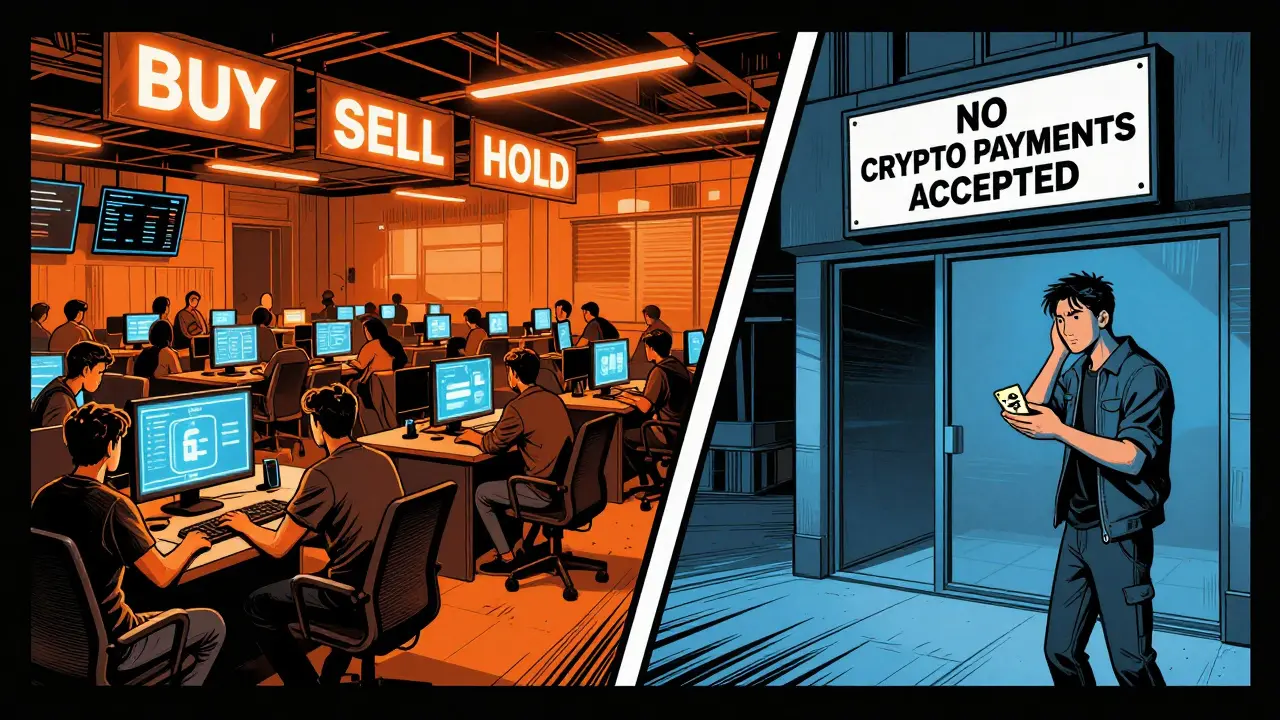
But here’s the twist: you can still buy crypto. You can still sell it. You can still hold it in your wallet. You can even trade it on local exchanges like Binance Turkey or Paribu. The ban only targets using crypto to pay for goods or services. It doesn’t touch trading, investing, or holding.
This made Turkey’s approach unique. Unlike China, which banned all crypto activity in 2021, or El Salvador, which made Bitcoin legal tender, Turkey drew a line. Crypto is an asset-not a currency. You can own it. You just can’t spend it.
What Happened After the Ban?
The ban didn’t kill crypto in Turkey. It reshaped it.By 2023, nearly 19.3% of Turkey’s population was actively using cryptocurrency-according to surveys from MiTrade. That’s one in five people. Most of them use it to hedge against inflation. The Turkish lira lost over 50% of its value against the dollar between 2020 and 2024. Crypto became a refuge.
But people got frustrated. Reddit threads in r/CryptoTurkey are full of complaints. One user, AnkaraTrader88, summed it up in January 2025: “I can trade freely but can’t use my USDT to pay for dinner-that’s the Turkish crypto paradox.”
Businesses noticed too. A 2024 survey by TÜİK (Turkish Statistical Institute) found only 2% of Turkish businesses accepted crypto. Compare that to Georgia, where 14% do. The payment ban made Turkey a trading hub, not a spending hub.
The 2024 Law: Licensing Crypto Providers
In July 2024, Turkey took another big step. The Law on Amendments to the Capital Markets Law came into effect. Now, every crypto exchange, wallet provider, or custodian serving Turkish users must get a license from the Turkish Capital Markets Board (CMB).Here’s what that means in practice:
- Exchanges need at least TRY 150 million ($4.1 million) in capital.
- Custodians must hold TRY 500 million ($13.7 million).
- All platforms must register locally. Foreign platforms can’t operate in Turkey without a local office.
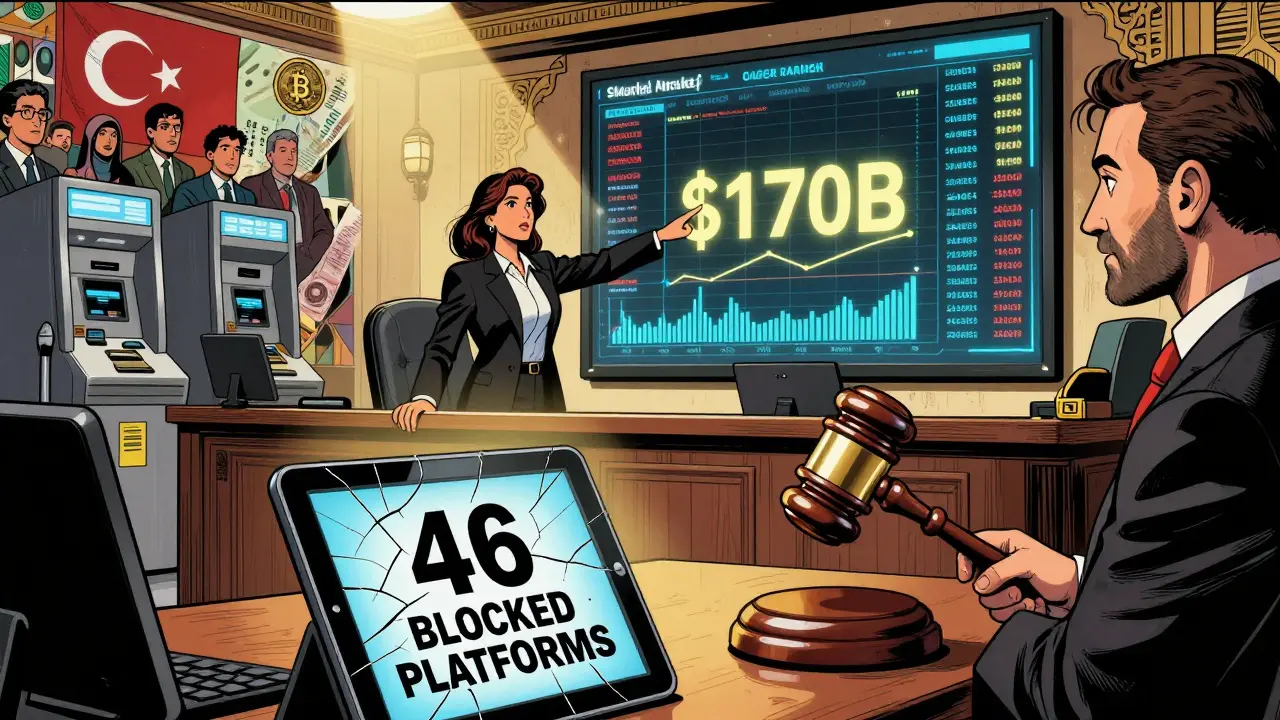
By March 2025, the CMB had blocked 46 platforms-including popular DeFi apps like PancakeSwap-for not complying. The message was clear: if you want to serve Turkish users, you play by our rules.
Strict AML Rules: Identity Checks Everywhere
On December 25, 2024, Turkey published new anti-money laundering (AML) rules. They took effect on February 25, 2025. Now:- Any transaction over TRY 15,000 (about $425) requires full identity verification.
- Wallets without registered owner details are flagged as “risky.”
- Transfers from unverified addresses can be suspended.
Exchanges had to hire more staff. Deloitte Turkey reported a 30-40% increase in compliance teams in early 2025. Every transaction, even canceled ones, must be logged. Systems now auto-flag suspicious patterns-like sudden large transfers to unregistered wallets.
What’s Allowed? What’s Not?
Here’s a quick breakdown of what you can and can’t do under Turkey’s current rules:
| Activity | Allowed? | Notes |
|---|---|---|
| Buying crypto | Yes | On licensed exchanges only |
| Selling crypto | Yes | Must go through licensed platform |
| Holding crypto | Yes | Personal wallets allowed |
| Using crypto to pay for goods | No | Full ban since April 2021 |
| Trading crypto derivatives | No | Options, futures, leveraged tokens banned |
| Initial Coin Offerings (ICOs) | Yes | Must pass CMB smart contract review |
| Stablecoin transfers | Yes, with limits | Large transfers flagged and delayed |
The Legal Challenge: Is the Ban Still Fair?
In May 2025, a major legal case is set to be heard in Ankara. Sima Baktaş, founding partner of Turkish law firm GlobalB, is challenging the payment ban. She argues that blocking crypto payments is hurting innovation and economic growth.Her case points to data: Turkey’s crypto market is now worth over $170 billion. Millions use it daily. Yet, businesses can’t accept it. She says: “Lifting the ban would foster financial sector development, make payments more effective, and increase Turkey’s attractiveness for blockchain businesses.”
If the court sides with her, it could open the door to new licensing frameworks for payment processors. But for now, the ban stands.
What’s Next for Turkey’s Crypto Market?
Turkey is walking a tightrope. On one side: inflation, distrust in the lira, and millions of citizens turning to crypto. On the other: fears of financial instability, money laundering, and unregulated chaos.Right now, the government is choosing control. The CMB is tightening oversight. Exchanges are being forced to comply. DeFi platforms are being blocked. AML rules are getting stricter.
But the market won’t disappear. People still need protection from inflation. They still want to trade. The ban on payments hasn’t stopped adoption-it’s just pushed it underground. People use crypto to store value, then convert it to lira before spending.
For now, Turkey’s crypto scene is split: strong on trading, weak on spending. Whether that changes depends on the May 2025 court ruling. Until then, don’t expect to buy a pizza with Bitcoin in Istanbul.
Can I still buy Bitcoin in Turkey?
Yes. You can buy, sell, and hold Bitcoin and other cryptocurrencies on licensed exchanges like Binance Turkey, Paribu, and Cointr. The ban only stops you from using crypto to pay for goods or services. Trading is fully legal.
Why can’t I use crypto to pay for my rent or groceries?
The Central Bank of Turkey banned crypto payments in 2021 because of risks like extreme price volatility, lack of regulation, anonymous transactions, and irreversible transfers. They didn’t want crypto replacing the lira in everyday commerce, fearing instability in the payment system.
Are crypto exchanges regulated in Turkey?
Yes. Since July 2024, all crypto asset service providers (exchanges, custodians, wallet services) must be licensed by the Turkish Capital Markets Board (CMB). They must meet strict capital requirements-TRY 150 million for exchanges, TRY 500 million for custodians-and operate locally in Turkey.
What happens if I send crypto to an unregistered wallet?
Transactions involving unregistered wallet addresses are flagged as risky. Starting February 25, 2025, any transfer over TRY 15,000 requires identity verification. If the sender or receiver isn’t verified, the transaction may be suspended or delayed. Exchanges are required to block such transfers.
Is the crypto payment ban likely to be lifted soon?
There’s a high-profile legal challenge set for May 28, 2025, arguing that the ban stifles innovation and economic growth. If the court rules in favor of lifting the ban, new payment infrastructure could emerge. But as of now, the ban remains in full effect, and no official changes are planned.
Justin Credible
March 24 2026lol so turkey just made crypto a savings account with no spending power? i get it, inflation's wild there, but now people gotta cash out to buy coffee? that's like banning cash from walmart but letting you keep your dollar bills under the mattress. 🤡
Nicolette Lutzi
March 24 2026this is just the deep state protecting the lira. they know if crypto becomes real money, the whole fiat ponzi collapses. they're terrified. mark my words, this ban is temporary. when the lira hits zero, they'll beg for bitcoin.
Jeannie LaCroix
March 25 2026I can't believe this. People in Turkey are using crypto to survive inflation, and the government is still playing petty power games? This is like telling someone to stop using a life raft because it's not a yacht. The emotional toll on families just trying to eat is heartbreaking. 🥺💔
Domenic Dawson
March 27 2026Actually, this is kind of genius. You let people protect their wealth but keep the payment system stable. It’s not about stopping crypto-it’s about not letting it destabilize the banking system while it’s still volatile. Smart middle ground. Most countries don’t even try to find balance.
Abhishek Thakur
March 28 2026The regulatory framework in Turkey is one of the most structured in emerging markets. Licensing requirements for exchanges ensure accountability. The AML thresholds are reasonable. This is not a ban-it's a controlled integration of crypto into the financial ecosystem.
Jackie Crusenberry
March 30 2026so they banned payments but let people trade? that's like letting you own a car but not drive it. why even bother? just confiscate the wallets and be done with it.
Neil MacLeod
April 1 2026The Central Bank of the Republic of Turkey has demonstrated a commendable degree of prudence. By prohibiting crypto from functioning as a medium of exchange, while permitting its role as a store of value, they have mitigated systemic risk without stifling innovation. A textbook case of regulatory restraint.
Misty Williams
April 1 2026This is pure moral failure. Crypto is a tool for the greedy and the reckless. Allowing people to hold it is like letting kids play with fireworks. The government should have shut it down completely. No exceptions. No loopholes. No moral compromise.
Anand Makawana
April 3 2026The licensing regime introduced in 2024 is a game-changer. Capital adequacy requirements, local operational mandates, and KYC/AML compliance are non-negotiable pillars for sustainable adoption. Turkey has created a regulatory sandbox that prioritizes systemic integrity over speculative frenzy.
Mohammed Tahseen Shaikh
April 4 2026they banned payments but let people trade? classic. people are just converting crypto to lira before buying stuff. so the ban is pointless. it's like banning beer at the bar but letting you drink at home and bring it in. what a joke.
Sarah Terry
April 4 2026This is actually one of the smartest approaches I've seen. People need a hedge against inflation. Trading crypto gives them that. But letting it be used for daily payments? Too risky. This way, they get safety without crushing innovation.
kavya barikar
April 5 2026The Turkish approach is thoughtful. It respects individual autonomy while preserving macroeconomic stability. Crypto as an asset, not a currency, is a clear and necessary distinction.
namrata singh
April 6 2026I wonder how many people are quietly using P2P to pay for things anyway. The ban might be official, but in practice, I bet a lot of shops just accept USDT in cash form. People are creative when they have to be.
Andrea Zaszczynski
April 6 2026so you're telling me i can't use my dogecoin to buy a kebab but i can trade it for lira and then buy the kebab? that's not regulation, that's a mental health crisis. who thought this up?
Cordany Harper
April 7 2026Honestly? I respect the balance. Turkey gets it. You don’t ban something everyone’s using-you channel it. They let crypto thrive as an asset, which makes sense. It’s not about control. It’s about control with purpose.
Zion Banks
April 8 2026this is all a distraction. the real goal is to keep people dependent on the lira so the elite can keep printing money. crypto is the only thing keeping millions from starving. they know it. that’s why they’re scared. this ban is a trap.
manoj kumar
April 9 2026why even have crypto if you can't spend it? this is just bureaucracy pretending to be smart. people are using it anyway. the government is just making life harder for normal folks.
JOHN NGEH
April 10 2026I really admire how Turkey is handling this. They’re not trying to stop crypto-they’re trying to make it safe. That’s leadership. Most governments just panic and ban everything. Turkey’s doing the hard work of building a real system.
Jenni Moss
April 12 2026It’s so inspiring to see people in Turkey finding ways to protect their families through crypto. Even with all the rules, they’re still finding hope. That’s resilience. We should be cheering them on, not over-regulating them.
vu phung
April 13 2026The licensing framework is actually a win for retail users. It means fewer scams, more transparency, and real accountability. This isn’t a ban-it’s a upgrade. The payment restriction is just phase one. Wait till they roll out crypto payroll options.
Lorna Gornik
April 13 2026so they banned crypto payments but let people trade? lmao. i mean, sure, technically you can’t use it to pay, but everyone’s just doing p2p. i’ve seen turkish reddit threads where people say "send me 500 usdt, i’ll give you 15k lira cash at the coffee shop" 😂
Joshua T Berglan
April 14 2026This is the future of finance. You don’t ban innovation-you shape it. Turkey didn’t kill crypto. They gave it rules. And guess what? Rules make markets stronger. This is how you build trust. 🙌
Kevin Da silva
April 15 2026The ban makes sense. Payments need stability. Crypto’s volatility breaks budgets. Holding? Fine. Spending? No. Simple.
Andrew Midwood
April 16 2026The 2024 licensing law is a masterstroke. Forcing foreign platforms to register locally? That’s how you ensure accountability. Turkey’s not anti-crypto-they’re pro-integrity. And honestly? That’s rare.