
Most crypto traders think of decentralized exchanges as platforms like Uniswap or PancakeSwap - places where you swap tokens with a few clicks, no KYC, no middleman. But there’s another kind of DEX that doesn’t try to compete with them. It’s built into a blockchain that doesn’t just handle trades - it handles everything. That’s Ardor DEX.
If you’ve never heard of it, you’re not alone. Ardor DEX doesn’t show up on CoinGecko’s top 10 DEX list. It doesn’t have a flashy YouTube ad campaign. But if you’re already using the Ardor blockchain, or you care about how blockchain security really works, this exchange might be more interesting than you think.
How Ardor DEX Actually Works
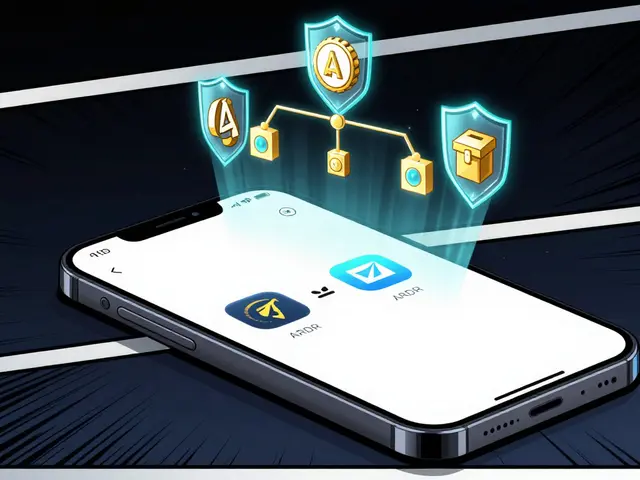
Ardor DEX isn’t a separate app or website. It’s built right into the Ardor blockchain. That means you don’t need to connect a wallet to a DEX interface like you do on Uniswap. Instead, you use the Ardor Wallet - a single app that lets you send, receive, store, and swap crypto all in one place.
The magic behind it is the parent-child chain design. The main Ardor chain handles security. It’s the backbone. Every transaction - whether it’s a token swap, a payment, or a message - gets secured by this chain. Meanwhile, child chains handle the actual work. One child chain might be for trading tokens. Another could be for managing digital assets. They all run on the same security, but they don’t slow each other down.
This is different from Uniswap, where every trade floods the Ethereum network. With Ardor, trading doesn’t clog the system. It’s like having a private highway for trades that’s still protected by the main road’s guardrails.
What You Can Trade
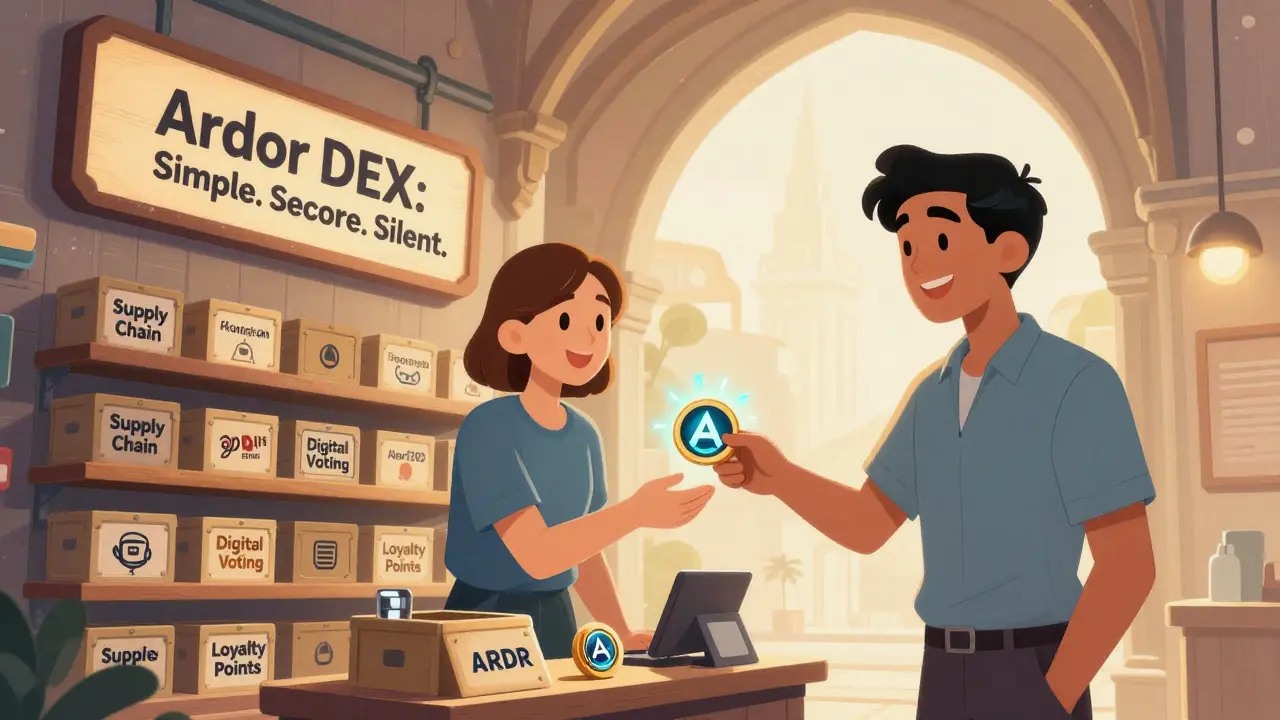
You can swap ARDR - the native token of the Ardor blockchain - for other tokens issued on child chains. These aren’t just random altcoins. Developers build their own tokens on Ardor child chains for real use cases: supply chain tracking, loyalty points, digital voting systems. So when you trade on Ardor DEX, you’re not just gambling on price swings. You’re trading tokens tied to actual projects.
There’s no official list of supported tokens, but based on active child chains, you can expect to find dozens of unique assets. That’s far fewer than Uniswap’s 10,000+ tokens, but it’s also way more focused. You won’t find Dogecoin or Shiba Inu here. You’ll find tokens built for utility, not hype.
Transaction Fees and Speed
Fees on Ardor DEX are dirt cheap. Because the main chain handles security, child chains don’t need to pay high fees to validators. A typical swap costs less than $0.01. Compare that to Ethereum DEXs where fees can hit $5 or more during busy times.
Speed is another win. Transactions on Ardor finalize in about 60 seconds. That’s faster than Bitcoin (10 minutes) and close to Solana’s speed. Not as fast as Solana, sure - but fast enough for everyday swaps. You won’t be waiting 10 minutes for your ETH to BTC trade to go through.
Wallet Integration: The Real Advantage
The biggest reason Ardor DEX stands out? It’s not a separate service. It’s part of the wallet. Download the Ardor Wallet app (available on Android and iOS), and you’re already set up to trade. No need to connect MetaMask. No need to approve hundreds of smart contracts. Just open the app, go to the exchange tab, pick your tokens, and swap.
The Ardor Wallet has a 4.8/5 rating on Google Play with over 10,000 downloads. Users say it’s simple, secure, and doesn’t crash. That’s rare in crypto apps. Most wallets feel like they were built by engineers who forgot regular people exist. Ardor Wallet doesn’t.
You’ll need ARDR tokens to pay for transaction fees. You can buy them on centralized exchanges like Binance or KuCoin, then send them to your Ardor Wallet. Once you have them, you’re ready to trade. No complicated staking. No yield farming. Just swap.
How It Compares to the Big Players
Let’s get real: Ardor DEX won’t beat Uniswap or PancakeSwap in trading volume. Uniswap handles over $1.7 billion in trades every day. Ardor DEX? No one’s publishing exact numbers, but estimates suggest it’s in the low millions - maybe even lower. That’s because it’s not trying to be the biggest. It’s trying to be the most integrated.
Here’s how it stacks up:
| Feature | Ardor DEX | Uniswap (v3) | PancakeSwap |
|---|---|---|---|
| Trading Volume (Daily) | Unknown (low) | $1.72B | $892M |
| Token Support | Dozens (child chain tokens) | 10,000+ | 1,000+ |
| Fee per Trade | ~$0.01 | $2-$10+ | $0.50-$3 |
| Finality Time | 60 seconds | 15-30 seconds | 15-30 seconds |
| Wallet Integration | Native (Ardor Wallet) | Requires MetaMask | Requires WalletConnect |
| Best For | Users in Ardor ecosystem, low-fee swaps, utility tokens | High-volume traders, Ethereum-based DeFi | BNB Chain users, yield farming |
The bottom line? If you want to trade the hottest memecoins or farm APYs, Ardor DEX isn’t for you. But if you want to swap utility tokens without paying $5 in fees or dealing with 10 different wallet connections - it’s a quiet winner.
Who Should Use Ardor DEX?
This isn’t a platform for beginners looking to flip Dogecoin. It’s for three kinds of people:
- Developers using Ardor child chains - If you built a token on an Ardor child chain, this is your native marketplace.
- Security-focused users - If you hate smart contract risks and want a DEX that doesn’t rely on volatile code, Ardor’s parent-chain security is a big deal.
- Long-term ARDR holders - If you believe in the Ardor ecosystem, using the DEX helps grow its utility. More trades = more demand for ARDR.
It’s not for people who want 24/7 liquidity, big trading pairs, or advanced order types. You won’t find limit orders or margin trading here. It’s a simple, clean swap tool - like a vending machine for crypto, not a stock exchange.
The Downsides
Let’s be honest - Ardor DEX has holes.
- Low liquidity - If you want to trade a large amount of a token, you might not find enough buyers or sellers.
- Not beginner-friendly - You need to understand ARDR, child chains, and how the blockchain works. It’s not drag-and-drop like Coinbase.
- Minimal community presence - You won’t find Reddit threads, Twitter trends, or TikTok tutorials. The community is small and quiet.
- No mobile app for iOS yet - The Android app works fine, but the iOS version is limited.
And yes - the ARDR token price has been flat. As of late 2025, it’s trading around $0.068. That’s not a crash, but it’s not a breakout either. If you’re looking for a coin to double in 30 days, this isn’t it.
The Bigger Picture
The crypto world is obsessed with speed and volume. But Ardor DEX asks a different question: What if security and simplicity mattered more than hype?
Most DEXs are like crowded malls - noisy, expensive, full of distractions. Ardor DEX is like a quiet, well-organized store in a small town. You won’t find every brand, but everything works. No glitches. No surprise fees. No drama.
It’s not the future of crypto trading. But it might be the future of responsible crypto trading.
If you’re tired of paying $10 in gas fees just to swap two tokens - or if you’re building something on a blockchain and need a real, secure way to trade your tokens - Ardor DEX is worth a look. Not because it’s popular. But because it’s quietly doing something few others are: making decentralized trading actually usable.
Is Ardor DEX a good exchange for beginners?
Not really. Ardor DEX requires you to understand blockchain basics, own ARDR tokens to pay fees, and navigate a multi-chain system. If you’re new to crypto, start with a simple platform like Coinbase or Kraken. Ardor DEX is better suited for users who already use the Ardor blockchain or want a secure, low-fee way to trade utility tokens.
Can I trade Bitcoin or Ethereum on Ardor DEX?
No. Ardor DEX only supports tokens issued on its own child chains. You can’t directly trade Bitcoin, Ethereum, or other major blockchains. However, some child chains issue tokens that represent wrapped versions of other assets. These are rare and not the same as native tokens. If you want to trade BTC or ETH, use Uniswap, PancakeSwap, or a centralized exchange.
Do I need a hardware wallet to use Ardor DEX?
No. The Ardor Wallet app (available on Android and iOS) is fully functional on smartphones. You can store your ARDR and trade tokens directly from your phone. There is no official hardware wallet for Ardor, though you can use a third-party wallet that supports the Ardor blockchain if you prefer cold storage.
How do I get ARDR tokens to use Ardor DEX?
Buy ARDR on centralized exchanges like Binance, KuCoin, or Gate.io. Once you have it, send it to your Ardor Wallet address. You’ll need ARDR to pay for transaction fees on the network. There’s no way to earn ARDR through staking or farming on the Ardor DEX - it’s only used for fees.
Is Ardor DEX safe?
Yes, it’s one of the safer DEX options. Because trading happens on child chains secured by the main Ardor blockchain, you’re not relying on smart contracts that can be hacked. The parent chain uses proof-of-stake with a fixed supply of ARDR, which has been stable for years. There have been no major security breaches on the Ardor network since its launch in 2013.
Final Thoughts
Ardor DEX doesn’t try to be everything. It doesn’t need to. It’s a quiet, efficient tool built for a specific purpose: letting people trade tokens securely, cheaply, and without the chaos of mainstream DEXs. If you’re already in the Ardor ecosystem, it’s a no-brainer. If you’re not - but you’re tired of paying $5 in fees just to swap two tokens - give it a try. The wallet is free. The swaps are cheap. And the blockchain? It’s been running for over a decade without a single major outage.

Cheryl Fenner Brown
February 27 2026lol at the 'quiet winner' hype. i just swapped my 5 ARDR for some 'utility token' that's basically a digital coupon for a blockchain that doesn't even have a meme coin. i'm richer by 0.0001% and emotionally drained. 🤡
bella gonzales
February 27 2026This is the most boring thing I’ve ever read. Who even uses this? Why? I’m sorry, but if it doesn’t have a 10,000% pump potential, I’m not interested. 😭
Colin Lethem
March 1 2026I actually tried it. The wallet’s smooth, no crashes, no gas fees that make me cry. I traded my child-chain token for another one-no drama, no 30-minute wait. It’s like crypto from 2017, but actually functional. I’m weirdly into it.
Samantha Stultz
March 1 2026You’re all missing the architectural elegance. Ardor’s parent-child model decouples consensus from transactional throughput-this isn’t just a DEX, it’s a modular blockchain architecture that prioritizes composability over speculative liquidity. The fact that you’re comparing it to Uniswap reveals a fundamental misunderstanding of layered consensus design.
Mae Young
March 2 2026Oh, so now we’re romanticizing the blockchain equivalent of a dial-up modem? "Quiet winner"? More like "quietly irrelevant." They didn’t build a DEX-they built a museum exhibit for blockchain archaeologists. And don’t get me started on the "utility tokens"-they’re just corporate loyalty points with a blockchain sticker on them. 🙄
Paul Reinhart
March 4 2026I think there’s something deeply human about this approach. We’ve been conditioned to equate value with volume, with hype, with noise. But Ardor DEX… it’s like a library. No flashing lights. No screaming salespeople. Just clean, reliable, unobtrusive utility. It doesn’t need to be loud to be meaningful. I’ve been using it for two years now. Never once felt ripped off. That’s rare.
kati simpson
March 4 2026I like that it doesn't try to be everything. Most crypto stuff feels like a carnival. This is just a quiet corner where people who actually need to move tokens without paying $10 can do it. I don't need 10000 coins. I need one thing to work. It does.
Carl Gaard
March 5 2026I tried the iOS app… it’s a ghost. Like, I swear I downloaded it but it just… vanished. I had to use Android. Why? Why is iOS always the one that breaks? 😭😭😭
Michael Teague
March 6 2026It’s free. It works. No scams. No rug pulls. No 500 contract approvals. You just open the app, swap, done. If you’re still complaining about low volume, you’re not here for the tech-you’re here for the casino. Go play roulette.
McKenna Becker
March 8 2026The real win isn’t the fee. It’s the absence of anxiety. No contract risks. No MEV bots. No gas wars. Just a clean swap. That’s worth more than any pump.
Cory Derby
March 9 2026I appreciate the thoughtful breakdown. For those unfamiliar with blockchain architecture, I’d like to clarify: the Ardor parent chain’s proof-of-stake model ensures long-term security without the environmental cost of mining. This isn’t just a DEX-it’s a sustainable model for decentralized finance. Well done on highlighting its purpose.
Amanda Markwick
March 11 2026I know people say it’s niche, but honestly? I think this is the future. Not the flashy, loud one. The quiet, reliable one. People are tired of being exploited. This doesn’t exploit you. It just… works. And that’s powerful.
Sean Logue
March 12 2026I used to think crypto was all about getting rich. Now I think it’s about not getting screwed. Ardor DEX is the first time I felt like I wasn’t a pawn. Just a person swapping tokens. No drama. Just peace.
Lilly Markou
March 12 2026The absence of volatility in the ARDR token price is not a flaw. It is a feature. Stability is not the enemy of innovation. It is its foundation. To demand constant price movement is to misunderstand the nature of value. This is not a financial instrument. It is a protocol.
Trenton White
March 14 2026I’m from a country where crypto is still seen as risky. My cousin asked me about this. I showed him Ardor Wallet. He didn’t understand half of it. But he said, "It doesn’t look like it wants to steal my money." That’s the real win.