Imagine finding a brand-new cryptocurrency exchange that promises total privacy and control over your funds. It sounds like the dream for many traders tired of centralized giants holding their assets hostage. That is exactly the pitch behind Splash, a decentralized cryptocurrency exchange launched in 2024. But here is the hard truth you need to hear before you connect your wallet: Splash is extremely limited right now. With only nine supported coins and twelve trading pairs, it isn't ready to be your main trading hub. If you are looking for a place to park serious capital or trade complex strategies, you might want to look elsewhere. Let’s break down what Splash actually offers, where it falls short, and whether it deserves a spot in your portfolio.
What Exactly Is Splash?
To understand Splash, you first need to know how it differs from the big names you probably use daily. Most people trade on Centralized Exchanges (CEXs) like Coinbase, Binance, or Kraken. These platforms act as intermediaries. They hold your money, verify your identity through strict KYC (Know Your Customer) checks, and execute trades on their own books. It is convenient, but it means you don’t truly own your keys.
Splash operates as a Decentralized Exchange (DEX). This means there is no central company holding your funds. Instead, you trade directly from your personal cryptocurrency wallet using smart contracts. You keep custody of your assets at all times. There is no account registration, no email verification, and no ID upload. For privacy-focused users, this is a massive advantage. However, this model comes with significant trade-offs regarding liquidity and ease of use.
| Feature | Splash (DEX) | Major CEXs (e.g., Kraken, Coinbase) |
|---|---|---|
| Custody | User-controlled (Non-custodial) | Platform-controlled (Custodial) |
| KYC Required | No | Yes (Strict Identity Verification) |
| Supported Coins | 9 | 500+ |
| Trading Pairs | 12 | Thousands |
| Security Model | Smart Contract / Self-Custody | Institutional Cold Storage + Insurance |
The Harsh Reality: Limited Selection
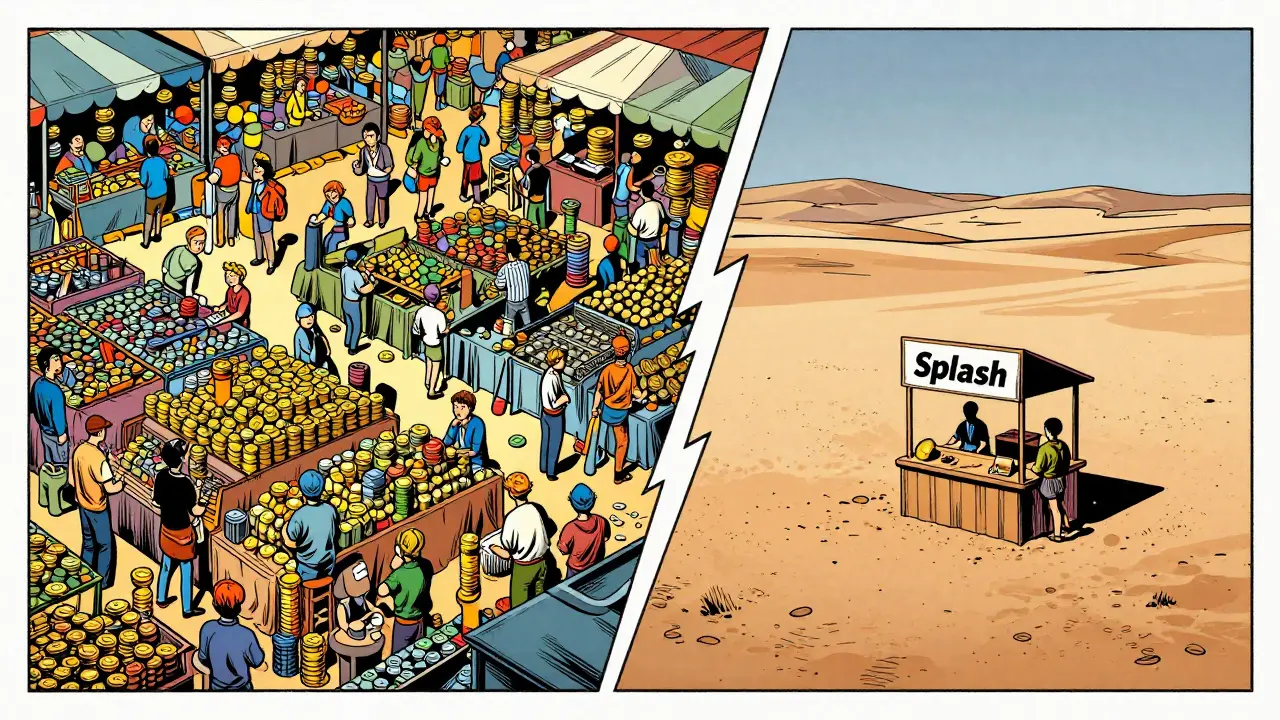
If you are used to scrolling through hundreds of tokens on Binance or KuCoin, Splash will feel empty. As of mid-2026, the platform supports just nine cryptocurrencies. That is it. Whether you are into major caps like Bitcoin or Ethereum, or smaller altcoins, your options are severely restricted. With only twelve trading pairs available, you cannot diversify easily. If the coin you want to trade isn’t on that tiny list, you can’t use Splash.
Compare this to industry leaders. Kraken, for example, supports over 500 cryptocurrencies and has maintained a flawless security record since 2011 without a single large-scale hack. Crypto.com serves approximately 100 million users across more than 90 countries, offering deep liquidity and extensive asset variety. Splash, having launched in 2024, is still in its infancy. It lacks the network effect that drives liquidity. Low liquidity means wider spreads and higher slippage when you try to trade larger amounts. You might end up paying more in hidden costs than you save on fees.
Security: The Double-Edged Sword
Security is the biggest selling point for any DEX, but also the biggest risk if you don’t know what you are doing. Because Splash is non-custodial, they cannot steal your funds in a traditional hack. However, you are responsible for your own security. If you lose your private key or seed phrase, your money is gone forever. There is no customer support hotline to reset your password.
Furthermore, the platform itself relies on smart contracts. If there is a bug in the code, hackers could exploit it. While Splash underwent a review by Traders Union in February 2026, specific details about vulnerabilities or audit results are not publicly detailed in major databases. Compare this to Coinbase, which offers insurance protection up to $250,000 for custodial accounts and employs six types of two-factor authentication. For a beginner, the safety net of a regulated CEX is often preferable to the "do-it-yourself" security of a small DEX like Splash.

Missing Features: What You Can’t Do
Modern crypto trading is about more than just buying and selling spot assets. Traders look for advanced tools to maximize profits. Here is what Splash currently lacks:
- Margin Trading: You cannot borrow funds to leverage your positions. Major platforms offer leverage ranging from 10x to 125x.
- Futures Contracts: No ability to bet on price movements without owning the underlying asset.
- Staking Rewards: You cannot earn passive income by locking up your assets. Competitors offer yields up to 22% APY on certain coins.
- Advanced Order Types: Likely limited to basic market or limit orders, lacking stop-losses or trailing stops found on professional desks.
This makes Splash unsuitable for active traders or those looking to generate yield. It is strictly a simple swap platform for a very narrow selection of assets.
Fees and Costs: The Unknown Variable
One of the most frustrating aspects of reviewing Splash is the lack of transparent fee data. Unlike Kraken, which clearly lists maker/taker fees between 0.25% and 0.40% with volume discounts, Splash does not publish a clear schedule. On decentralized networks, you pay gas fees (network transaction fees). Depending on which blockchain Splash operates on (likely Ethereum or a Layer 2), these fees can fluctuate wildly. During high network congestion, a simple swap could cost significantly more than the spread on a centralized exchange. Without clear documentation, you are guessing what it will cost to move your money.
Who Should Use Splash? (And Who Shouldn’t)
Let’s be realistic. Splash is not for everyone. In fact, it is likely not for most people.
You might consider Splash if:
- You are an extreme privacy advocate who refuses to provide any personal information.
- You specifically want to trade one of the nine supported coins and prefer self-custody.
- You are experimenting with DEX interfaces and have disposable funds you are willing to lose.
You should avoid Splash if:
- You are a beginner who needs customer support and easy fiat on-ramps (buying crypto with dollars/euros).
- You want to trade a wide variety of cryptocurrencies.
- You rely on staking rewards or leveraged trading.
- You are concerned about smart contract risks and prefer insured custodial storage.
Better Alternatives in 2026
If Splash doesn’t meet your needs, what should you use? The market is crowded, but a few stand out for reliability and features.
For security and trust, Kraken remains a gold standard. With AAA CER Security Ratings and a history of never being hacked, it is ideal for long-term holders. For variety and innovation, Bybit and OKX offer robust futures markets and global licensing. If you prefer the DEX experience but with better liquidity and more coins, established protocols like Uniswap are far more mature. Uniswap processes billions in volume and supports thousands of tokens, whereas Splash is still finding its footing.
Final Verdict: Proceed with Caution
Splash represents the promise of decentralized finance: user control and privacy. However, as of mid-2026, it fails to deliver on the practical side of trading. With only nine coins and no advanced features, it is too limited to be a primary exchange. The lack of transparent fee structures and detailed security audits raises red flags for serious investors. While it may grow over time, right now, it is a niche tool for specific, low-volume use cases. For most traders, sticking with established platforms that offer insurance, deep liquidity, and comprehensive support is the smarter financial decision. Do not rush to adopt new technology just because it is new; wait until it proves it is reliable.
Is Splash crypto exchange safe to use?
Safety depends on your definition. Splash is non-custodial, meaning they don't hold your funds, which reduces the risk of platform-wide hacks. However, you are responsible for securing your own wallet. Additionally, as a new platform with limited public audit details beyond a general review by Traders Union, there are inherent smart contract risks. It is safer than unregulated CEXs in terms of custody, but riskier in terms of technical maturity compared to older DEXs like Uniswap.
Does Splash require KYC verification?
No. As a decentralized exchange (DEX), Splash does not require Know Your Customer (KYC) verification. You connect via a wallet address rather than creating an account with personal details. This appeals to privacy-conscious users but means you have no recourse if you make a mistake or get scammed.
How many coins does Splash support?
As of mid-2026, Splash supports only 9 cryptocurrencies with 12 trading pairs. This is significantly lower than major competitors like Kraken or Binance, which support hundreds of assets. This limitation restricts diversification opportunities.
Can I stake my crypto on Splash?
Currently, no. Splash appears to focus solely on spot swapping. It does not offer staking services, margin trading, or futures contracts. If earning passive yield is important to you, you would need to use other platforms that offer staking rewards, often up to 22% APY depending on the asset.
What are the fees on Splash?
Specific fee schedules for Splash are not clearly published in major directories. As a DEX, you will likely pay network gas fees plus a protocol fee. These costs can vary based on blockchain congestion. For comparison, centralized exchanges like Kraken charge transparent fees between 0.25% and 0.40%. Without clear data, Splash's cost efficiency is hard to guarantee.
Is Splash better than Uniswap?
Generally, no. Uniswap is a much more mature DEX with significantly higher liquidity, thousands of supported tokens, and a proven track record. Splash is a newer entrant with only 9 coins. Unless you have a specific reason to use Splash's particular interface or supported pairs, Uniswap offers a safer and more versatile decentralized trading experience.