
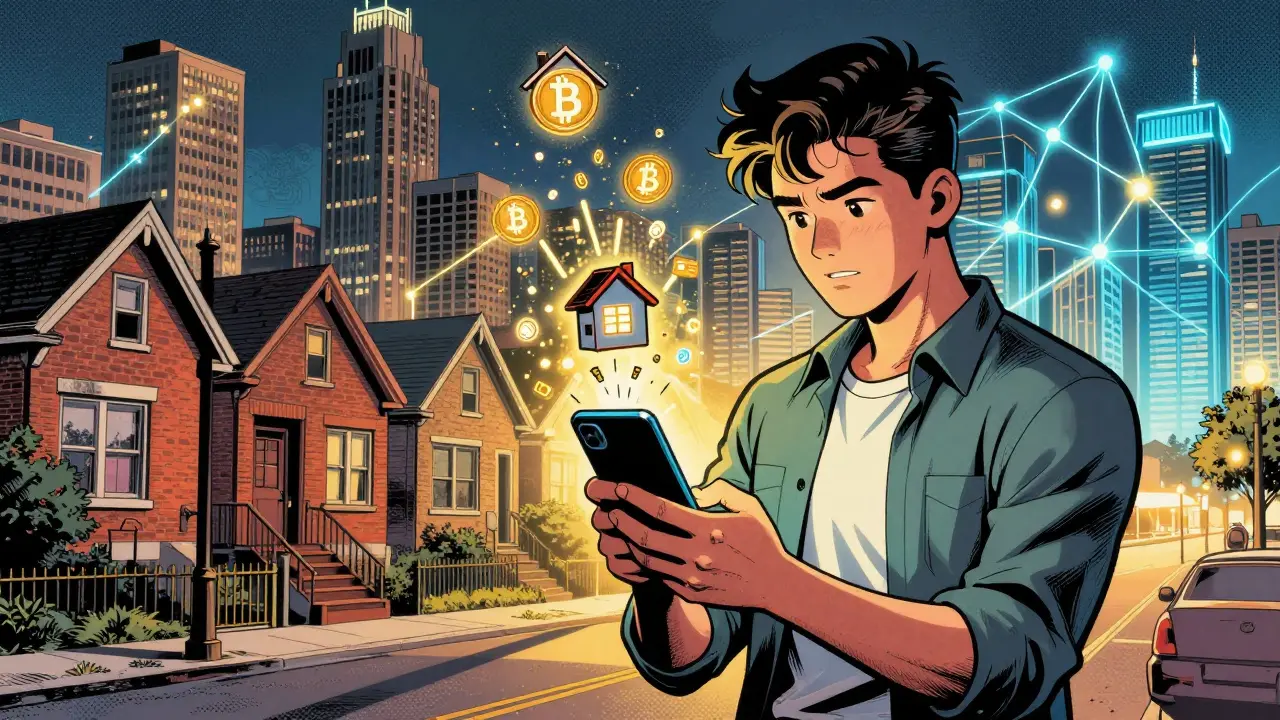
Buying a house used to mean saving for years, getting a mortgage, and signing stacks of paperwork. Now, you can own a piece of a rental property in Miami for $50 - no bank loan, no closing costs, no six-month wait. That’s the promise of real estate token trading. It’s not science fiction. It’s happening right now, on blockchain platforms that turn bricks and mortar into digital shares you can buy, sell, and earn rent from - all from your phone.
How Real Estate Tokenization Actually Works
Tokenization means turning ownership of a physical property into digital tokens on a blockchain. Each token represents a fraction of the property - like a share in a company. Instead of needing $300,000 to buy a house, you buy 100 tokens at $50 each. You’re not buying the whole building. You’re buying 0.03% of it. And that’s the whole point.
When the property collects rent, smart contracts automatically split the money and send your share to your crypto wallet. No property manager needed. No delays. If the rent hits the account on the 5th, your $1.20 shows up by the 6th. It’s programmed. No human error. No missed payments.
Most platforms use Ethereum because it’s reliable and has the most developer tools. But newer ones like Propy and SolidBlock are moving to Polygon and Solana. Why? Lower fees. Faster transactions. Ethereum can cost $10 to $20 just to buy a token. Polygon? Often less than $0.10. That makes small investments practical.
The Big Players in Tokenized Real Estate
Not all platforms are the same. Some are built for regular people. Others are for Wall Street.
- RealT is the go-to for beginners. Over 15,000 users, mostly investing under $5,000. They’ve tokenized over 970 homes across the U.S., mostly in Detroit, Cleveland, and Atlanta. Their monthly trading volume hit $2.3 million in mid-2024. You can buy, sell, and get rent all in one place.
- Propy focuses on international buyers. If you’re in Germany and want to invest in a property in Texas, Propy handles the currency conversion and legal paperwork. Minimums start around $5,000. It’s smoother for cross-border deals than anything traditional.
- Harbor targets accredited investors - people with over $1 million in net worth or $200,000 in income. Their strength? Compliance. They follow SEC rules tightly, which means less risk of legal trouble. But you can’t easily sell your tokens. The market is locked down.
- SolidBlock sticks to commercial real estate: office buildings, warehouses, shopping centers. Minimums are $10,000. They offer liquidity pools - basically, a group of buyers ready to snap up your tokens if you want out.
- Tokeny Solutions doesn’t sell to you. They build the backend for banks and funds. If you’re an investor, you’ll never see their name. But if your REIT uses tokenized assets? They’re behind it.
RealT holds about 34% of the retail market. Harbor controls 28% of the high-net-worth segment. Together, the top five platforms control nearly 70% of all tokenized real estate volume.
Why This Is a Big Deal (and Why It’s Not)
The upside? Access. Liquidity. Efficiency.
Before tokenization, real estate was the ultimate illiquid asset. You couldn’t sell half your house if you needed cash. Now, you can list your tokens on a marketplace and find a buyer in hours. That’s huge. It’s like turning a savings account into a stock you can trade anytime.
Transaction costs drop by up to 30%. No realtor fees. No title insurance. No escrow agent. Smart contracts handle everything: ownership transfer, rent payout, even tax withholding in some cases.
But here’s the catch: liquidity isn’t guaranteed. Only 18% of tokenized properties have consistent trading. Most sit idle. You might own a piece of a house in Cleveland - but if no one wants to buy your tokens, you’re stuck. That’s the biggest risk.
And then there’s regulation. The U.S. treats these tokens as securities. That means you need to pass KYC - identity checks that take 24 to 72 hours. Some platforms reject 13% of applicants. If you’re in the EU, MiCA rules might block you from investing in U.S. properties. 22% of EU investors hit this wall. It’s not just about money. It’s about where you live.

What You Need to Get Started
It’s not as simple as buying Bitcoin. You need three things:
- A crypto wallet - MetaMask is used by 73% of investors. It’s free, easy, and connects to every major platform.
- Verified identity - Upload your ID, proof of address, and sometimes a selfie. Platforms check you against global databases. It’s annoying. But it’s mandatory.
- Understanding of taxes - This is where most people get burned. In the U.S., rental income from tokens is taxable. Selling tokens? Capital gains. If you’re in Canada or Australia, rules change. 67% of investors hired a specialist accountant in 2023. Hourly rates? $200 to $350.
Most platforms offer 40- to 50-page onboarding guides. That’s not a typo. You’re not just learning how to buy. You’re learning how to own a piece of real estate under new legal rules. The learning curve is 14 to 21 days for someone new to crypto.
Real Returns - And Real Risks
RealT investors in Detroit are averaging 8.2% annual returns after fees. That’s higher than most REITs. But here’s the fine print: those properties are in declining neighborhoods. High yield because they’re cheap. If the city doesn’t recover, rents drop. Your tokens lose value.
On the flip side, commercial properties in Austin or Nashville are seeing slower but steadier returns - 5% to 6%. Less risk. Less reward.
And don’t forget: you’re not protected by FDIC. If the platform gets hacked? You lose your tokens. That’s why 92% of platforms use multi-signature wallets - meaning three people must approve a withdrawal. It’s safer. But slower.
Withdrawals are another headache. Only 28% of platforms let you cash out directly to your bank. Most force you to sell tokens for USDC or ETH, then move it to a centralized exchange like Coinbase to get dollars. That’s two steps. Two sets of fees. Two chances for something to go wrong.
What’s Next? The Road Ahead
Real estate tokenization is still early. But it’s accelerating.
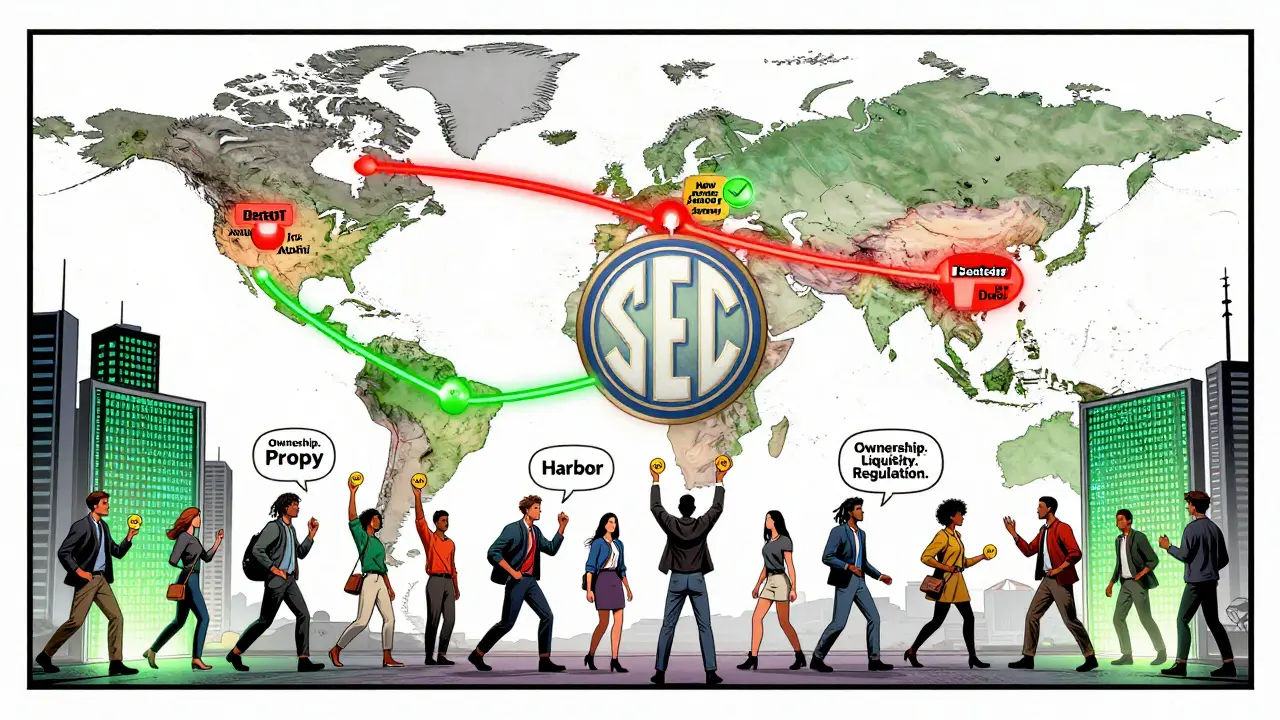
In January 2024, New Jersey passed a law making tokenized real estate legal. Dubai launched its own framework in September 2023. These are signals. Governments are starting to catch up.
The biggest potential catalyst? The SEC approving real estate tokens as Alternative Trading Systems (ATS). Right now, trading happens on private platforms. If the SEC gives the green light, these tokens could trade on regulated exchanges like Nasdaq. That could unlock $3.7 billion in new liquidity by late 2025.
Deloitte predicts 45% of commercial real estate deals under $50 million will use tokenization by 2027. Institutions - REITs, private equity, family offices - are moving fastest. Retail investors? Slower. Because regulation is still a maze.
By 2030, experts say 88% of commercial real estate transactions will include some form of tokenization. But if global rules don’t align, the market could cap out at $12.4 billion instead of the projected $18.2 billion. Fragmentation kills growth.
Is It Right for You?
Ask yourself:
- Do you want exposure to U.S. real estate without buying a whole property?
- Can you handle 2-3 weeks of setup and learning?
- Are you okay with limited resale options?
- Do you have a tax advisor who understands crypto real estate?
If you answered yes to all four, start with RealT. Invest $100. See how rent hits your wallet. Watch how the token price moves. Test the platform.
If you’re unsure? Wait. This isn’t a get-rich-quick scheme. It’s a long-term shift in how we own property. The infrastructure is still being built. The rules are still being written. The market is young. But it’s real. And it’s growing.
Can I really buy a piece of a house for $50?
Yes. Platforms like RealT allow you to buy fractional tokens starting at $50. Each token represents a tiny share of a rental property - like 0.01% of a house in Detroit. You get a proportional share of rent and potential appreciation. It’s not ownership of the whole property, but it’s legal, recorded on blockchain, and backed by real assets.
Are tokenized real estate investments safe?
They’re safer than some crypto bets, but not risk-free. The property itself is real. The smart contracts are audited. But if the platform shuts down, or if the property is poorly managed, you lose value. Security features like multi-sig wallets and quarterly audits reduce risk, but you’re still exposed to market swings, regulatory changes, and platform failures. Never invest more than you can afford to lose.
Do I pay taxes on rental income from tokenized real estate?
Yes. In the U.S., rental income from tokenized properties is taxed as ordinary income. Selling tokens for profit triggers capital gains tax. Tax rules vary by country - Canada, Australia, and the UK treat them differently. Most investors hire a crypto-savvy accountant. Expect to pay $200-$350/hour for specialized help.
Can I sell my tokens anytime?
Only if the platform has an active secondary market. RealT does - with $2.3 million in monthly trades as of mid-2024. Harbor and some others don’t. Even on active markets, finding a buyer isn’t guaranteed. Liquidity is still limited. You might have to wait days or weeks to sell, or accept a lower price than you hoped.
Why can’t I invest if I live in the EU?
The EU’s MiCA regulation classifies real estate tokens as securities, but many U.S. platforms aren’t licensed to operate there. Some platforms block EU IP addresses entirely. Others require additional legal structures you can’t easily access. About 22% of EU investors are locked out of U.S.-based platforms because of this mismatch in rules.
What’s the difference between tokenized real estate and REITs?
REITs are companies that own and manage real estate - you buy shares in the company. Tokenized real estate means you own a direct fractional stake in the actual property. With tokens, you can see exactly which building you own part of. With REITs, you own a slice of a portfolio. Tokens offer more transparency, but less diversification.
Is this just a crypto bubble?
No. The underlying asset - real estate - has real value. The technology is just changing how it’s bought and sold. The market grew from $2.7 billion in 2022 to $4.1 billion in 2023. Institutional investors are pouring in. This isn’t speculation. It’s infrastructure being built. The risk isn’t the concept - it’s the regulation, liquidity, and adoption speed.
How do I know if a platform is legitimate?
Look for third-party audits (published quarterly), multi-signature wallets, clear legal disclaimers, and KYC/AML compliance. Check if they’re registered with U.S. state regulators or have partnerships with law firms like Pillsbury. Avoid platforms that promise guaranteed returns or don’t disclose property details. RealT, Propy, and Harbor have public track records. Others? Do your homework.
Katherine Melgarejo
January 18 2026So I can own 0.03% of a house in Detroit for $50? Cool. Now tell me how many of those tiny shares I need to buy before I can afford a decent coffee in that neighborhood. 😅
Patricia Chakeres
January 20 2026This is just the Fed’s way of laundering Wall Street’s trash assets into your phone. Smart contracts? More like smart scams. They’re not giving you ownership-they’re giving you a digital receipt for a house that’s falling apart. And don’t get me started on the KYC. They’re tracking your every move.
Anna Gringhuis
January 21 2026Let’s be real-this isn’t democratizing real estate. It’s just making it easier for hedge funds to offload depreciating assets to people who don’t know what a title search is. You think you’re getting a piece of a house? You’re getting a piece of a legal gray zone with a 72-hour identity verification process. And yes, I’ve tried it. It’s exhausting.
Jill McCollum
January 21 2026okay so i tried realt and honestly?? the rent hit my wallet and i cried. not because it was a lot, but because it was REAL. like, $1.20 from a house in cleveland?? that’s magic. also, the onboarding took 3 days and i had to upload my passport 4 times. but still. i’m hooked. 🥹
Stephen Gaskell
January 23 2026Foreign investors buying up American homes with crypto? No thanks. This is how our housing market gets hijacked. Keep your tokens. I want my house to stay in American hands.
Pat G
January 24 2026You think this is safe? The SEC is one lawsuit away from wiping out every tokenized property. And when they do, you’ll be begging for your $50 back while some lawyer in Manhattan cashes out. Don’t be a sucker.
Alexandra Heller
January 25 2026We’ve replaced the dignity of owning land with the transactional numbness of blockchain. You don’t own a house anymore-you own a data point in a decentralized ledger. Is this progress? Or just the final stage of capitalism eating its own soul?
Bryan Muñoz
January 26 2026REALT IS A SCAM THEY USE FAKE RENTS TO MAKE IT LOOK LIKE YOU’RE EARNING AND THE PROPERTIES ARE ABANDONED AND THE LANDLORD IS A LLC THAT OWNS 200 OF THEM AND THEY JUST RECYCLE THE MONEY AND NO ONE CAN TRACE IT LOL
Rod Petrik
January 27 2026they said crypto would free us from banks but now we just have new banks with better websites and worse customer service. why do i need to verify my identity 3 times just to own 0.01% of a house in detroit? this is not freedom this is digital serfdom
Sarah Baker
January 29 2026You’re not just investing in property-you’re investing in the future of ownership. This is the beginning of something beautiful. Start small. $50 is your foot in the door. The tech is improving every day. I believe in you. You’ve got this.
Pramod Sharma
January 29 2026Simple truth: if you can’t afford a whole house, this is the only way to get started. No drama. Just code and cash. The system isn’t perfect-but it’s better than waiting 20 years to save.
Liza Tait-Bailey
January 31 2026i know i sound dumb but i just bought my first token and now i check my wallet like 10x a day lol. its kinda sweet? like i own a piece of something real. even if its just a corner of a house in atlanta. 🤗
nathan yeung
February 1 2026bro this is wild. i live in delhi and i just bought a token in texas. no one in my family gets it. but i feel like i’m part of something global now. not just a renter. not just a saver. a co-owner.
Bharat Kunduri
February 2 2026this whole thing is a mess. i spent 3 hours trying to get my wallet to connect and then they said my id was 'unverifiable' because my passport photo had a shadow. now i have to wait 5 days for a manual review. why is this so hard? i just wanted to own a piece of a house not join the space program
Chidimma Okafor
February 4 2026This innovation is nothing short of revolutionary. The democratization of asset ownership through blockchain is a beacon of hope for emerging economies. Imagine a young woman in Lagos owning a fractional stake in a property in Atlanta-this is financial sovereignty in action. The infrastructure is nascent, but the vision? Timeless.
Bill Sloan
February 4 2026I just bought 5 tokens on RealT. Got my first rent payout yesterday. $6.12. I bought a burrito and celebrated. This is the future. Small wins. Real returns. No middlemen. Who else is doing this? Let’s form a group chat.
ASHISH SINGH
February 6 2026they say its decentralized but every platform is just a new gatekeeper with a website and a compliance team. who really owns the blockchain? the devs. who controls the rules? the lawyers. you think you’re free? you’re just in a new cage with better UI
Vinod Dalavai
February 6 2026start with $50. don’t overthink it. if you like the rent coming in, add more. if it feels sketchy, walk away. no pressure. this isn’t gambling-it’s just a new way to own something real. i’ve been doing it for a year. still here.
Tony Loneman
February 7 2026You think Harbor is safe? They’re just a fancy shell for private equity to park their dirty money. The SEC doesn’t care about you. They care about the 1% who fund their campaigns. Tokenization? It’s just a Trojan horse for wealth consolidation. Wake up.
Callan Burdett
February 8 2026I bought a token in Perth because I’m from Australia and wanted to feel connected to home. Turns out it’s a house in Phoenix. But hey-I got rent. And I cried a little. This is weirdly beautiful.
Anthony Ventresque
February 10 2026I’ve been researching this for months. The tax stuff is the real killer. I hired an accountant who charges $300/hour just to explain how to report $12 in rental income. Is it worth it? Maybe. But I’m glad I didn’t jump in blind.
Katherine Melgarejo
February 11 2026I just checked my RealT account. My $50 share earned $1.20 this month. I spent it on a burrito. The house in Detroit? Still standing. I think I’m in love.