
| Holding Period / Activity | Tax Rate | Tax Category (PIT Code) |
|---|---|---|
| Long-term (> 365 days) | 0% (Tax-Free) | Category G |
| Short-term (< 365 days) | 28% Flat | Category G |
| Passive Income (Staking/Lending) | 28% Flat | Category E |
| Professional Trading/Mining | 14.5% to 53% (Progressive) | Category B |
The Magic of the 365-Day Rule
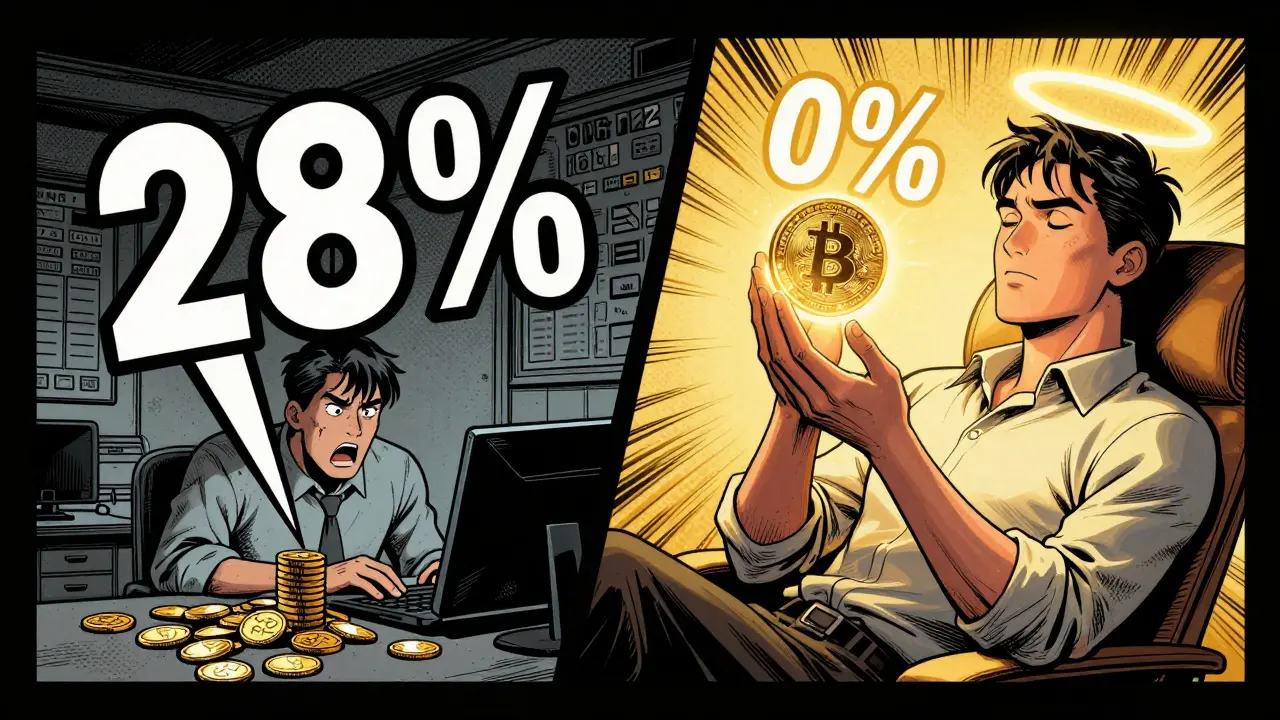
The biggest draw for any investor is the long-term exemption. Under the Personal Income Tax Code (also known as the PIT Code), if you hold your assets for more than a year, you don't owe a dime in capital gains tax when you sell. This is a massive win for those who believe in the "HODL" strategy. For example, if you bought Bitcoin in January 2024 and sold it in February 2025, the entire profit is yours to keep.
However, if you are a swing trader or a scalp trader, the story changes. Any gains realized on assets held for less than 365 days are hit with a flat 28% tax. While that might sound steep, it is actually quite predictable compared to the sliding scales you find in other countries. The best part? Crypto-to-crypto exchanges are generally not treated as taxable events. This means you can swap your Bitcoin for Ethereum or a stablecoin to rebalance your portfolio without triggering a tax bill immediately.
Passive Income: Staking, Lending, and Airdrops
Not all crypto wealth comes from price appreciation. Many investors earn "yield" through Staking, which is the process of participating in a Proof-of-Stake blockchain to secure the network in exchange for rewards. In Portugal, this passive income falls under Category E (Capital Income). Unlike capital gains, there is no "waiting period" here. Whether you've been staking for one day or ten years, the reward is taxed at a flat 28%.
The same rule applies to lending your assets or receiving airdrops. Because there is no withholding tax on these earnings, the responsibility falls on you to declare them during your annual tax filing. It is a straightforward system: you calculate your total passive income for the year and apply the flat rate. No complex brackets, no hidden fees.
Professional Trading vs. Occasional Investing
Here is where things get tricky. The Portuguese tax authorities, known as the Autoridade Tributária e Aduaneira, distinguish between an occasional investor and a professional trader. If your primary source of income is trading, or if you run a Bitcoin Mining operation, you fall into Category B (Self-Employment Income).
Professional traders don't get the flat 28% rate. Instead, they face progressive tax rates that can climb as high as 53% for high earners. This is the one area where Portugal's benefits vanish. If you are treating crypto as a full-time business, you are essentially taxed like any other freelancer or business owner in the country. The key to avoiding this is documenting your activity to show that your trades are an investment strategy rather than a commercial business operation.
How Portugal Compares to Other European Hubs
When you look at the rest of Europe, Portugal looks like a paradise for the long-term holder. Let's look at the competition. In France, you're dealing with a flat tax of 30% on gains, and if you move into mining or staking, you could be taxed up to 45%. Germany is a close competitor because it also offers a one-year exemption, but their short-term gains are taxed at progressive rates that can hit 45%, far higher than Portugal's 28%.
The ability to optimize a portfolio through crypto-to-crypto swaps without immediate tax triggers gives Portuguese residents a huge edge in compounding their wealth. While other countries view every single swap as a "sale" of one asset to buy another, Portugal allows you to pivot your strategy without losing a chunk of your capital to the tax man every time you trade.
Combining Crypto Gains with Residency Programs
Many investors aren't just looking for tax breaks; they want a way into the EU. This is where the Non-Habitual Residence Program (NHR) and the Golden Visa come into play. The NHR program is a game-changer for digital nomads. It can offer a flat 20% rate on certain Portuguese-sourced income and, more importantly, exemptions on most foreign-sourced income. When paired with the 0% long-term crypto tax, it creates an incredibly efficient financial setup.
For those looking for permanent residency, the Golden Visa allows you to obtain residency through specific investments. Some Bitcoin-linked investment funds now qualify for these pathways, meaning you can effectively turn your crypto wealth into a European passport while benefiting from the local tax laws. It's a strategic move that secures both your financial future and your mobility.

Practical Steps for Tax Compliance
You can't just move to Lisbon and ignore the tax man forever. To make the most of these Portugal crypto tax benefits, you need a bulletproof paper trail. The 365-day clock is the most important factor. If you sell an asset at 364 days, you pay 28%. At 366 days, you pay 0%. That one-day difference can cost you thousands of dollars.
- Track Acquisition Dates: Use software like CoinTracking or CoinLedger to log exactly when you bought every single coin.
- Categorize Your Income: Separate your airdrops and staking rewards (Category E) from your trading profits (Category G).
- Distinguish Your Status: Keep records that prove you are an investor, not a professional trader, to avoid the Category B progressive rates.
- Annual Declarations: Ensure you file your annual taxes with the Autoridade Tributária e Aduaneira, even if your long-term gains are 0%, to maintain a clean legal record.
Is all cryptocurrency tax-free in Portugal?
No, not all of it. Only capital gains from assets held for more than 365 days are generally tax-free. Short-term gains (under a year) and passive income like staking are taxed at a flat 28%.
What happens if I swap Bitcoin for another coin?
In Portugal, crypto-to-crypto exchanges are typically not considered taxable events. This means you can switch assets without triggering the 28% short-term tax, as long as you aren't converting to a "fiat" currency like Euros or Dollars.
Do I need to pay tax on staking rewards?
Yes. Staking, lending, and airdrops fall under Category E of the PIT Code and are subject to a flat 28% tax rate, regardless of how long you hold the rewarded tokens.
At what point am I considered a "professional trader"?
The law doesn't set a strict number of trades, but if trading is your primary business activity and source of income, you may be classified under Category B. This leads to progressive tax rates up to 53% instead of the flat 28%.
Does the 0% tax apply to coins held outside the EEA?
Generally, the long-term exemption applies to cryptocurrencies. However, if the asset is classified as a security or held in specific ways outside the European Economic Area (EEA), the rules might differ. It is always best to consult a local tax expert for non-EEA assets.
Next Steps for Investors
If you are a long-term Bitcoin holder, Portugal is likely the most attractive destination in Europe. Your first step should be a residency consultation to see if the NHR program or Golden Visa fits your goals. If you're already a resident, start by auditing your wallet history. Map out your purchase dates to identify which assets have crossed the 365-day threshold.
For those who trade frequently, consider shifting your strategy toward longer holding periods to capitalize on the 0% rate. If you're a high-net-worth individual, look into Bitcoin-linked funds that can facilitate your residency while keeping your assets in a tax-efficient environment. Just remember: the tax man is getting better at tracking blockchain data, so clean records are your best defense.
JERRY ORTEGA
April 6 2026moving to portugal sounds like a vibe but honestly just holding for a year is the way to go regardless of where you live
vijendra pal
April 8 2026Bro the 365 day rule is legit 🚀 just dont get caught being a 'professional' lol 🤣 easy money!!
Arlen Medina
April 8 2026Obviously the US has better infrastructure for this stuff but I guess Portugal is fine if you just want to hide your gains from the IRS
david head
April 10 2026Love this info ✨ definitely looking into that Golden Visa now ✌️
June Coleman
April 11 2026Oh sure, because moving your entire life to another continent just to save 28% is totally a low-stress, reasonable decision 🙄
Robert Coskrey
April 12 2026The distinction between an occasional investor and a professional trader seems quite critical, and one must be very diligent with record-keeping...
Taylor Meadows
April 13 2026Most of you aren't even thinking about the psychological toll of living in a foreign country just for tax evasion, you're just chasing numbers while your souls starve
shubhu patel
April 13 2026It is quite fascinating how different countries approach the definition of digital assets and while the 0% rate is appealing, I wonder if the administrative burden of residency outweighs the benefit for those of us who prefer a more stable, long-term living environment without the constant need to audit every single trade we make
Alexandra Lance
April 13 2026Imagine actually trusting a government to keep a "0% tax" rule for more than a year 🙄 They'll just change the law once enough whales move there to feast on the capital 🤡
Emily 2231
April 15 2026THEY ARE TRACKING THE BLOCKCHAIN DATA AS PART OF A GLOBAL SURVEILLANCE GRID and thinking a Portuguese passport protects you is pure delusion. THE STATE ALWAYS WINS
Sonya Bowen
April 15 2026Focus on the audit trail. Clean records prevent audits.
Lauren Gilbert
April 16 2026There is a certain poetic irony in the way we strive for financial freedom through decentralized currencies only to spend our time researching the most favorable centralized government jurisdictions to call home, as if the geography of our physical bodies still matters in an era where wealth is merely a string of characters on a ledger
Hugo Lopez
April 18 2026This is such a helpful breakdown! Really appreciate the clarity on the categories 🌟
Carol Prates
April 19 2026Omg I can't even believe people actually pay 53% tax like that is literally a crime!! 😭 Imagine the heartbreak of losing half your Bitcoin to some bureaucrat
Manisha Sharma
April 21 2026Why look at Portugal when India has its own potential for wealth creation and the elite here know how to manage assets better than any expat in Lisbon anyway
sekhar reddy
April 21 2026LMAO imagine paying 28% for staking!! total rip off 🤣 just use a different platform
Carmelita Gonzales
April 22 2026it's a nice way to see the world while keeping your savings
Bruce Micciulla Agency
April 23 2026The actual risk here is the misclassification of a retail investor as a professional trader which would lead to a catastrophic tax liability that most people aren't prepared for because they don't keep an hourly log of their activities and they assume the flat rate is a guarantee when it is actually a conditional benefit based on the tax authorities' arbitrary interpretation of their trade frequency and volume
gladys christine
April 24 2026Slay!! 💅 just move and live your best life tax free!!!
Brooke Herold
April 25 2026I've heard the coast is beautiful this time of year and very welcoming to new residents