
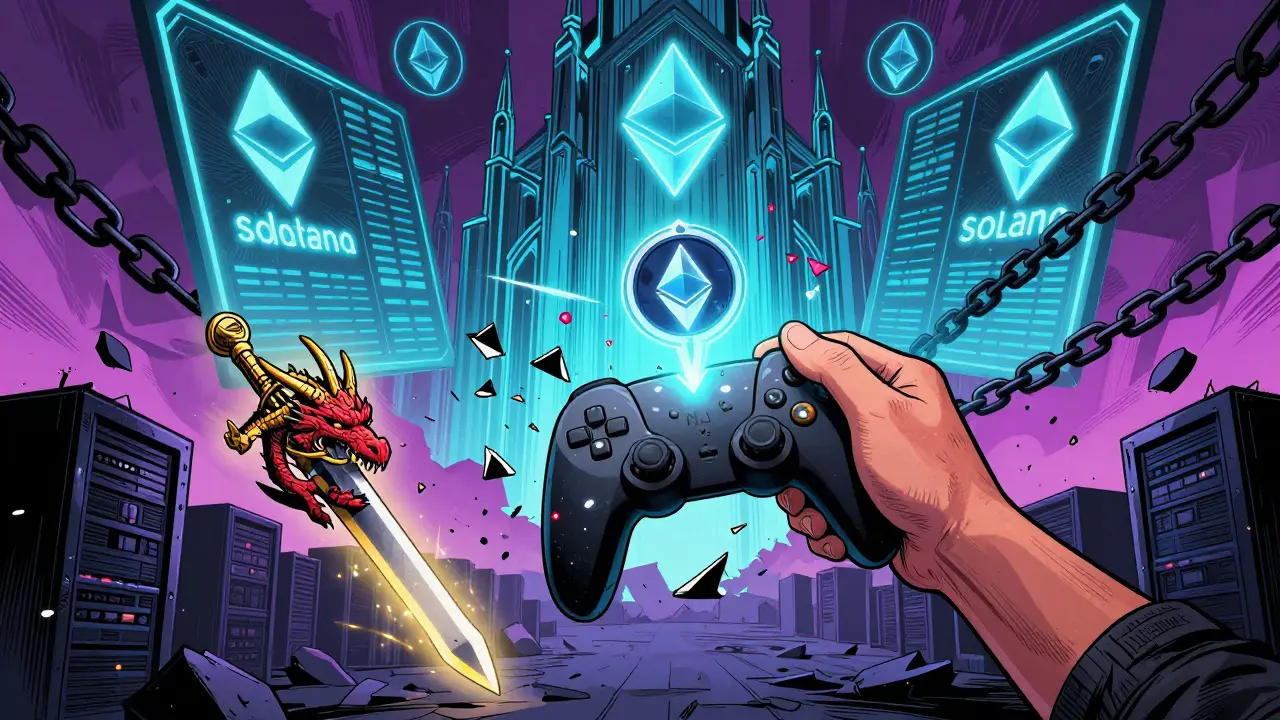
For decades, if you bought a skin, weapon, or mount in a video game, you didn’t really own it. You paid for access - a license that could vanish if the server shut down, the company changed its mind, or you got banned. Your hard-earned loot was locked inside a digital cage, owned by the publisher. That’s changing - slowly, messily, and with a lot of broken promises - thanks to NFTs.
What NFTs Actually Do in Games
NFTs, or non-fungible tokens, are digital certificates stored on a blockchain. They don’t hold the game asset itself - like a dragon skin or a virtual house - but they prove who owns the right to use it. Think of it like a deed to a house. The house is still there, but the deed says, “This property belongs to you.” In games, that deed is recorded on Ethereum, Solana, or other blockchains, making it public, permanent, and transferable.
Before NFTs, your rare sword in World of Warcraft or your limited-edition skin in Fortnite lived only as data inside the game’s database. The company could delete it, nerf it, or sell duplicates. With NFTs, your asset is tied to your wallet. Even if the game crashes, the token still exists. That’s the core promise: ownership that survives beyond the game.
The Big Lie: “You Own It”
Marketers love to say you now have “true ownership.” That’s misleading. Legally, you rarely own the asset itself - you own the token that points to it. The actual image, model, or sound file? That’s usually still hosted on a server controlled by the developer. If they delete the file, your NFT becomes a fancy digital placeholder - like owning the deed to a house that got bulldozed.
Legal experts at Strebeck Law explain it clearly: NFTs in games usually grant a license, not copyright. You can’t resell the skin as a poster. You can’t copy it into another game unless the developer says so. The “basket of rights” - what you can actually do with your NFT - is written in the game’s terms of service. And those terms can change.
There’s a disconnect between hype and reality. Players bought NFTs thinking they could trade freely, build empires, or even cash out. But when the game studio shut down in early 2024, one player lost $8,250 in ETH because their NFTs stopped working. No refund. No recourse. Just a token with no function.
How NFTs Are Different From Steam Items
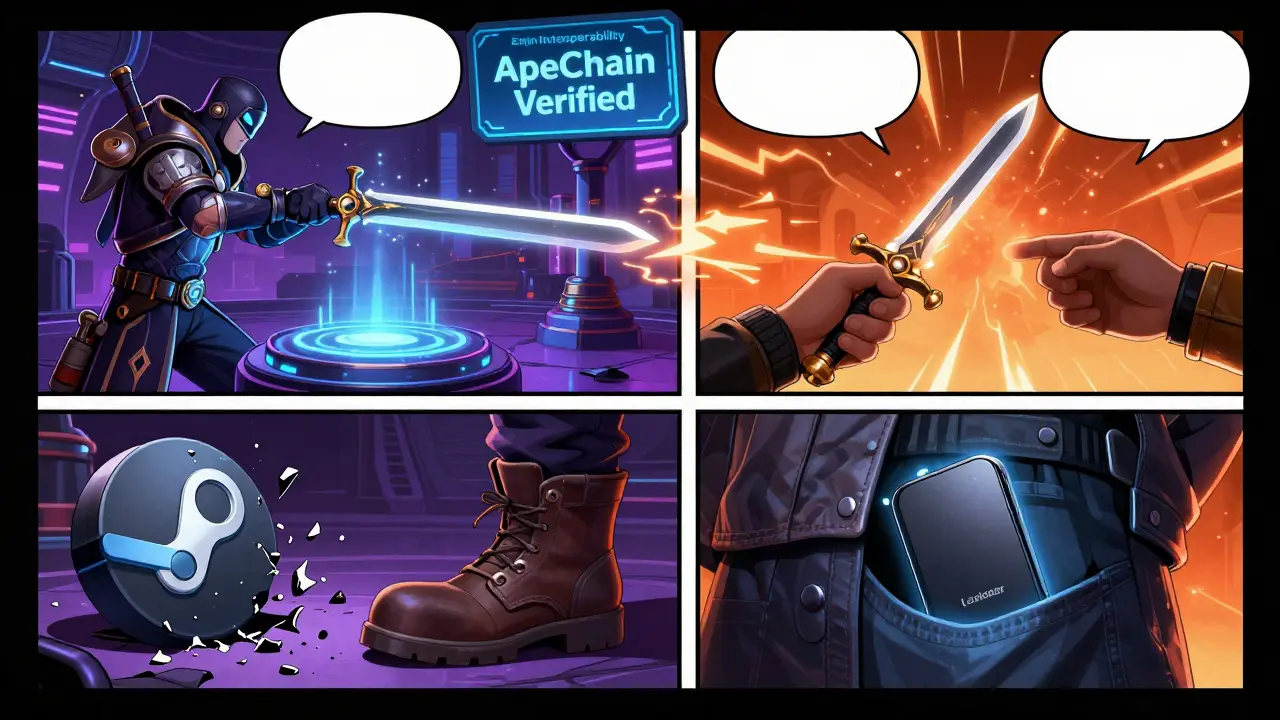
Compare this to Steam’s marketplace. You can buy a knife in Counter-Strike, sell it, and even trade it with friends. Sounds like ownership, right? But it’s not. You can’t take that knife outside of Steam. You can’t list it on OpenSea. You can’t move it to another game. Valve controls everything. It’s a walled garden with fancy fences.
NFTs break those walls. If a game uses an open blockchain standard, your NFT can - in theory - be used in another game. That’s interoperability. Platforms like Enjin and ApeChain are building tools to make this real. Imagine buying a sword in one game, then using it in a different RPG, a virtual world, or even a trading card game. That’s the dream. But right now, it’s rare. Only a handful of games support cross-game NFT use.
The Real World Impact: Play-to-Earn and Financial Risk
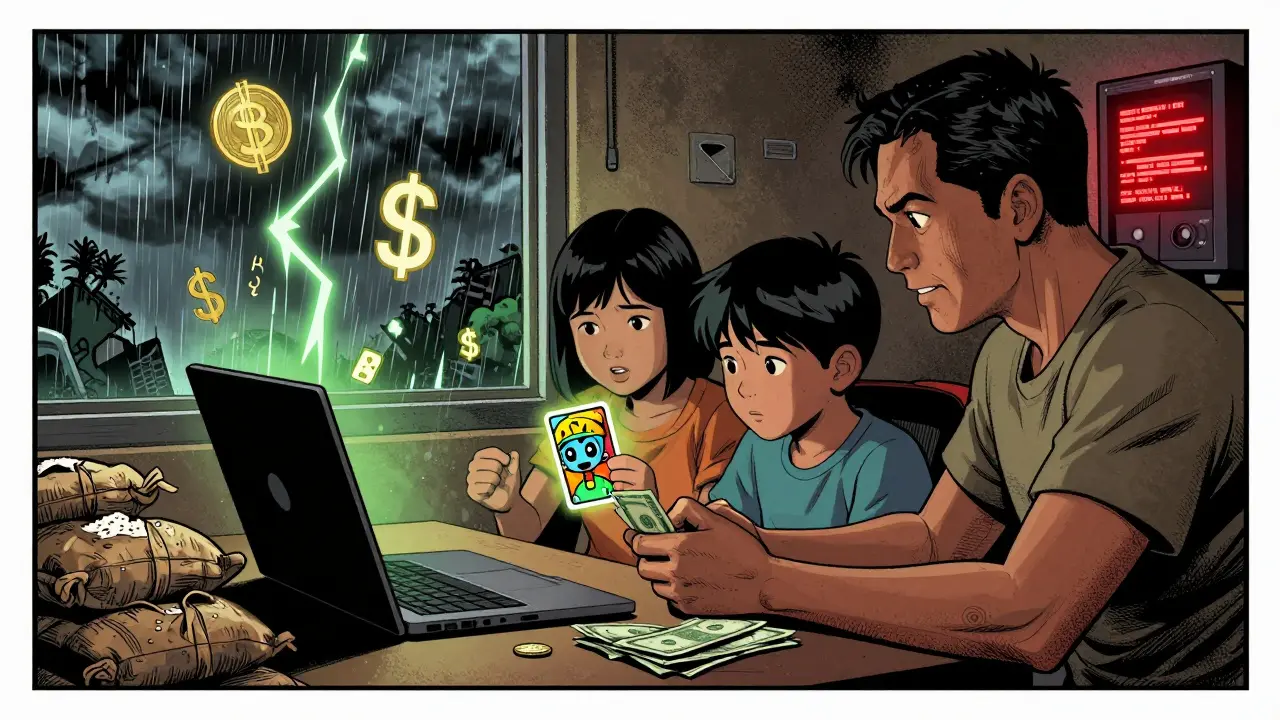
Where NFTs hit hardest is in economies. In the Philippines, during the peak of Axie Infinity in 2021, some players earned up to $1,000 a month just by playing. For families living on minimum wage, this wasn’t a hobby - it was survival. Academic research from the Blockchain Research Institute confirmed it: NFT games became income sources, not just entertainment.
But the flip side is brutal. When Axie’s token price crashed in 2022, those incomes vanished. Players who borrowed money to buy Axies found themselves in debt. The same thing happened in other “play-to-earn” games. The market collapsed by 62.3% between 2022 and 2023, according to DappRadar. What felt like opportunity turned into gamble.
And it’s not just about money. Gas fees on Ethereum can hit $50 during peak hours. Transaction failures are common. OpenSea has a 2.8/5 rating on Trustpilot, with 37% of complaints about failed trades. For someone unfamiliar with crypto, this isn’t gaming - it’s a technical minefield.
Who’s Winning and Who’s Losing
Big studios are shifting tactics. Ubisoft killed its Quartz NFT platform in 2022 after 87% of Steam users gave it negative reviews. Epic Games, once a vocal critic, quietly joined ApeChain in January 2024. Square Enix sold $1.5 million in NFTs for their Sands of Destruction collection in 2021. The industry is divided.
What’s emerging is a new model: limited rights. Instead of claiming “full ownership,” some developers are offering clear, useful perks. For example, owning an NFT might give you early access to content, exclusive cosmetics, or voting rights in game updates. That’s more sustainable. It’s not about owning the asset - it’s about owning a better experience.
And the tech is improving. Solana handles over 1,000 transactions per second. Ethereum? Only 15-30. That’s the difference between smooth gameplay and laggy, expensive frustration. Newer blockchains built for gaming - like Enjin’s Efinity - are designed for speed, low fees, and cross-game compatibility. That’s where the real innovation is happening.
What You Need to Know Before Buying
If you’re thinking about jumping in, here’s what actually matters:
- Check the game’s terms. What rights does the NFT actually give you? Can you trade it? Can you use it elsewhere? Is the asset stored on IPFS or a private server?
- Look at the blockchain. Is it fast and cheap? Solana, Polygon, and Arbitrum are better than Ethereum for gaming.
- Study the community. Are there active Discord servers? Are developers responsive? Projects with no community support die fast.
- Don’t buy for profit. The market is volatile. Treat NFTs like collectibles, not stocks.
- Use a cold wallet. Never leave your NFTs on an exchange or game platform. Store them in a hardware wallet like Ledger or Trezor.
Surveys show 68% of new users need 3-5 hours just to understand the basics. That’s not a game. That’s a job.
The Future: Clear Rules, Real Utility
The future of NFTs in gaming won’t be about “owning everything.” It’ll be about owning something valuable - clearly defined, legally recognized, and actually useful.
The U.S. passed Article 12 of the Uniform Commercial Code in 2022, giving NFTs a legal category as “controllable electronic records.” That’s a step forward. The EU’s MiCA regulations, rolling out in June 2024, will bring more clarity. The U.S. Copyright Office held hearings in March 2024 specifically on NFTs and intellectual property. Change is coming - slowly.
Games that succeed will be the ones that stop selling “ownership” and start selling value. Better gear. Faster progression. Real influence over game design. Community perks. That’s the path forward.
NFTs didn’t fix game asset ownership. They exposed how broken it was. Now, the industry has to build something better - not with hype, but with honesty, utility, and respect for the player.”
Do NFTs give me copyright over in-game items?
No. Owning an NFT doesn’t give you copyright or the right to copy, sell, or modify the digital asset itself. You own the token that proves you have a license to use it - but the underlying artwork, code, or design is still owned by the game developer. This is clearly stated in most game terms of service.
Can I use my NFT in other games?
Only if the game developers agree and use compatible standards. Right now, cross-game NFT use is rare. Platforms like Enjin and ApeChain are building tools to make this possible, but most games still lock NFTs to their own ecosystem. Don’t assume your sword from Game A will work in Game B.
What happens if the game shuts down?
If the game studio shuts down and the digital assets (like skins or maps) are hosted on their private servers, your NFT may become useless - even if the token still exists on the blockchain. The NFT proves ownership, but not access. Always check if assets are stored on decentralized networks like IPFS, which are more permanent.
Are NFT games worth the money?
Only if you’re buying for fun, not profit. The NFT gaming market dropped 62% from 2022 to 2023. Many players lost money when tokens crashed or games shut down. Treat NFTs like collectibles - buy what you like, not what you think will rise in value.
Why are gas fees so high for NFT games?
Gas fees depend on the blockchain. Ethereum can cost $50+ per transaction during busy times. Solana and Polygon are much cheaper, often under $0.10. Choose games on low-fee blockchains if you plan to trade often. High fees make casual play unviable.
Is NFT gaming legal?
Yes, but it’s legally murky. The U.S. and EU are updating laws to classify NFTs as digital property. However, regulators are cracking down on games that act like investment schemes. The SEC sued Impact Theory in 2024 for selling unregistered securities through NFTs. Always check if the game is designed as entertainment or as a financial product.
Should I use a crypto wallet for NFT games?
Yes - but only a secure one. Never store NFTs on exchanges or game platforms. Use a hardware wallet like Ledger or Trezor. If the game platform gets hacked or shuts down, your NFTs could disappear. Your wallet is your key to ownership.
Vernon Hughes
December 31 2025NFTs in games are just digital collectibles with extra steps. You don't own the skin you paid for, you own a string of code that points to a file someone else controls. That's not ownership, that's a fancy receipt.
Brooklyn Servin
December 31 2025Bro. I spent $2k on an NFT sword in that one game that shut down last year. The token still exists on the blockchain 😭 But the actual model? Gone. Like owning a key to a house that got turned into a parking lot. The devs didn't even say sorry. Just vanished. Blockchain doesn't fix bad faith.
Andrea Stewart
January 2 2026People keep saying 'you own it' like it's magic. No. You own a license. Same as buying a movie ticket-you can't resell the theater seat. The asset is still locked in the studio's vault. NFTs just make the lock look fancy.
Rajappa Manohar
January 3 2026in india many play axie for income. when price drop they lose everything. no safety net. this is not gaming this is gambling with worse odds.
prashant choudhari
January 4 2026Gas fees on Ethereum make casual NFT trading impossible. If you're buying skins for $50, but each trade costs $30 in gas, you're losing money before you even start. Use Solana or Polygon. Simple math.
Josh Seeto
January 4 2026So Ubisoft killed Quartz because players hated it. Epic joined ApeChain quietly. Square Enix sold $1.5M in NFTs. Guess who's really in charge here? Not the players. Not the devs. The VCs betting on hype while the rest of us clean up the mess.
Jacky Baltes
January 6 2026Ownership is a social contract, not a blockchain transaction. If the game's rules change, or the server dies, the illusion of ownership collapses. What we're seeing isn't technological progress-it's a redefinition of trust, and the industry is failing that test.
Khaitlynn Ashworth
January 7 2026Oh wow you mean I paid $800 for a virtual sword and now I can't even screenshot it without the devs suing me? That's not ownership, that's digital serfdom with a fancy NFT badge. And you call this innovation? Please. I'd rather play a game where I don't need a crypto degree just to log in.
NIKHIL CHHOKAR
January 7 2026People who buy NFTs thinking they'll get rich are just funding the next pyramid scheme. You think the devs care about your 'ownership'? They care about your wallet. The moment the hype dies, your NFT becomes a digital paperweight. And you'll still be stuck with the gas fees.
Amy Garrett
January 8 2026ok but like… i bought a dragon skin and now i cant even show it off in my other game? and the devs said its 'licensed' not owned? so i paid $150 for a wallpaper i cant even copy? this is so dumb. i just wanna play games not do my taxes in crypto.
christopher charles
January 8 2026Look, I get the dream. Cross-game NFTs? That’s wild. Imagine your rare sword from that indie RPG showing up in a VR world or a card game. But right now? It’s like buying a Ferrari that only runs on one gas station-and that station just closed. The tech is promising, but the execution is still in kindergarten. Don’t buy in hoping for the future. Buy in because you love the thing, not because you think it’ll flip.
And yes, use a hardware wallet. I lost $400 once because I left my NFT on a game platform. They got hacked. Poof. Gone. Your keys, your coins. Not their problem. Don’t be lazy.
Also, if the game’s Discord is dead, walk away. No community = no future. NFTs live and die by their people, not their code.
And stop treating this like a stock market. You wouldn’t buy a collectible baseball card because you think it’ll double next week. Same thing here. Buy what you like. Play what you love. The rest? Noise.
Daniel Verreault
January 10 2026Let me break this down for the crypto newbs: NFTs in gaming aren't about ownership-they're about *utility*. If your NFT gives you early access, exclusive cosmetics, or a vote on lore changes? That's value. If it just sits there looking pretty? Then you're paying for a digital sticker. The real innovation isn't blockchain-it's designing games where owning an NFT actually improves your experience, not just your portfolio.
Also, Solana's throughput is 1000 TPS. Ethereum? 15. If your game makes you wait 10 minutes to trade a skin? It's broken. Not 'blockchain.' Broken.
And yes, I know the EU's MiCA is coming. Good. Finally, some legal clarity so we stop calling this 'ownership' when it's a license with extra steps.
Gavin Hill
January 12 2026Ownership is a myth. Even with NFTs, the asset is still hosted on a server. If the server dies, your deed is just a fancy bookmark. The blockchain doesn't store your dragon skin. It stores a link to it. And links break. Always have. Always will.
SUMIT RAI
January 12 2026everyone saying 'you dont own it' is missing the point. the point is you can sell it on opensea. the dev can't take it back. that's more than steam ever gave you. steam can ban you and delete your stuff. nft? nope. its yours. even if the game dies you can still sell the token. its a collectible. not a game item. get it right.
😎Ryan Husain
January 13 2026The fundamental issue is not technological but philosophical. If we define ownership as the ability to transfer, control, and retain value outside a closed ecosystem, then NFTs represent a meaningful shift. However, if ownership requires legal rights to reproduction, modification, or commercial exploitation, then NFTs fall short. The confusion arises from conflating property rights with access rights. The industry must clarify this distinction before consumers can make informed decisions.
Willis Shane
January 13 2026It is imperative to recognize that the current implementation of NFT-based game assets constitutes a significant departure from established consumer protection frameworks. The absence of recourse in the event of service termination, coupled with the non-transferability of underlying intellectual property, renders the term 'ownership' legally indefensible. Consumers are being misled by marketing semantics that exploit technical ambiguity. Regulatory intervention is not merely advisable-it is ethically mandatory.
Mike Pontillo
January 14 2026So you paid $500 for a sword that only works in one game, can't be copied, can't be resold unless the devs say so, and if they shut down you're out $500? That's not ownership. That's being scammed with a blockchain logo.
Alison Hall
January 14 2026Just buy NFTs because you love the art or the character-not because you think it’ll make you rich. Play for fun. Treat it like a vinyl record. If the game dies, you still have the cool thing you loved. That’s enough.