
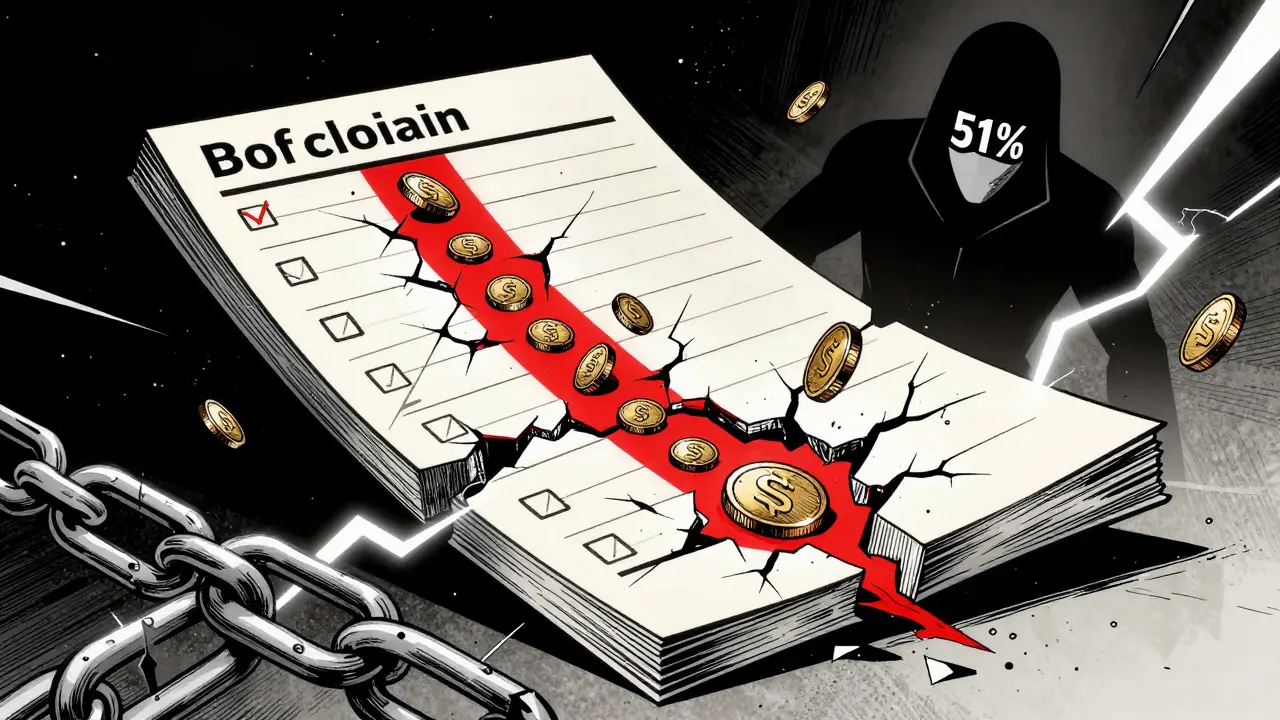
Blockchain is often sold as a perfect, unchangeable ledger - once data is written, it can never be erased. But that’s not the full story. In reality, immutability in blockchain systems creates more problems than it solves in many real-world applications. It sounds like a feature, but for businesses, regulators, and everyday users, it’s often a bottleneck - and sometimes a disaster waiting to happen.
Immutability Isn’t Absolute - It’s Probabilistic
People think Bitcoin’s blockchain is untouchable. But that’s only true if no one has enough power to break it. In January 2019, the Ethereum Classic network got hit by a 51% attack. Attackers controlled more than half the mining power for over 12 hours. They reversed transactions, double-spent 219,500 ETC, and walked away with $1.1 million. This wasn’t a glitch. It was a direct proof that immutability depends on economic security - not magic. The same thing could happen to Bitcoin. If someone poured enough money into mining hardware, they could rewrite recent blocks. It’s expensive, sure - but not impossible. Immutability isn’t a law of physics. It’s a bet that no one will ever spend more than the value of the chain itself to break it. When that bet fails, the ledger breaks.GDPR and the Right to Be Forgotten
The European Union’s GDPR law says you have the right to delete your personal data. That’s simple. But what if that data is stored on a blockchain? You can’t delete it. You can’t edit it. You can’t even hide it. Once your name, email, or ID number is on-chain, it’s there forever. In 2023, a European healthcare provider got fined €500,000 for storing patient records on an immutable blockchain. They thought hashing the data was enough - but GDPR doesn’t care about hashes. If the original data can be linked back to a person, it’s still personal data. And under GDPR, that data must be erased on request. No exceptions. Companies like IBM and R3 Corda solved this by storing data off-chain. Only a cryptographic hash goes on the blockchain. The real data lives in secure, editable databases. That way, when someone asks for deletion, they delete the off-chain copy. The hash stays - but it’s useless without the data it points to.Smart Contract Bugs Can’t Be Fixed
Imagine writing a code that sends money to someone. You type the wrong address. One letter off. You send $4,200 - and it’s gone forever. No customer service. No undo button. No refund. That’s not hypothetical. On Reddit, a developer named u/CryptoEngineer lost 2.3 ETH because of a typo. On GitHub, over 200 users reported similar errors in Ethereum clients. DeFi projects lose millions every year because of bugs that can’t be patched. The code runs. The transaction executes. And that’s it. Some teams try to work around this with upgradeable smart contracts - proxy patterns that let developers swap out the logic. But here’s the catch: if you can change the contract, is it really immutable? And if you can change it, who controls that power? Centralization kills the trust blockchain is supposed to provide.
Scalability Makes Immutability Weaker
Bitcoin processes 7 transactions per second. Visa handles 24,000. That’s not a gap - it’s a canyon. When networks get crowded, transaction fees spike. Miners prioritize high-fee transactions. And when miners are incentivized to reorder or delay transactions, the chain becomes vulnerable. The more congested the network, the longer it takes for a transaction to get confirmed. Bitcoin requires 6 confirmations - about an hour - to feel safe. Ethereum’s PoS needs 64 epochs - roughly 13 minutes. But even that’s not foolproof. If a powerful actor controls enough hashing power or staked ETH, they can still reverse recent blocks. And then there’s storage. The Bitcoin blockchain is over 473 GB. That’s not just a number. It means your laptop can’t run a full node unless you have serious storage and bandwidth. Fewer full nodes = less decentralization = weaker immutability. It’s a feedback loop: as the chain grows, fewer people can verify it - and that makes it easier to attack.Energy Use and Environmental Cost
Bitcoin uses more electricity every year than Norway. That’s 121.49 TWh, according to the Cambridge Bitcoin Electricity Consumption Index. Why? Because Proof-of-Work needs massive computing power to solve cryptographic puzzles. That’s the price of immutability. Ethereum switched to Proof-of-Stake in 2022 and cut its energy use by 99.95%. But even then, the trade-off remains: strong immutability demands resources. And those resources aren’t free. They’re paid in electricity, hardware, and environmental cost. For many industries - healthcare, finance, logistics - that’s a non-starter.Enterprise Blockchains Are Already Changing
Public blockchains like Bitcoin and Ethereum cling to strict immutability. But enterprises? They don’t have that luxury. Hyperledger Fabric, used by 30% of Fortune 500 companies, lets admins delete or edit data. R3 Corda uses notaries to approve or reject transaction changes. Energy Web Chain lets members vote to correct records. These aren’t hacks - they’re design choices. Gartner reported in 2023 that 58.7% of enterprise blockchain implementations now include some form of mutability. Why? Because businesses need to comply with laws, fix mistakes, and adapt. Immutability sounds great on a whitepaper. In real life, it’s a liability.
What’s the Future?
The blockchain world is starting to admit the truth: absolute immutability doesn’t work. The World Economic Forum said it best in 2023: "The future of blockchain lies not in absolute immutability but in context-appropriate verifiability." That means:- Public chains like Bitcoin will keep strict immutability - but only for transactions, not for all data.
- Enterprise chains will build in correction mechanisms - through voting, governance, or off-chain storage.
- Zero-knowledge proofs and off-chain data storage will become standard for privacy-sensitive uses.
- Regulators will force changes. The EU’s 2023 Digital Finance Package already says blockchain solutions must allow data deletion.
Real Solutions Being Used Today
Here’s what actually works:- Off-chain storage: Store data in a secure database. Put only a hash on-chain. If data needs to be deleted, delete the off-chain copy. The hash stays - but it’s meaningless.
- Proxy contracts: Use upgradeable smart contracts with a central admin. Accept the trade-off: you gain flexibility, lose decentralization.
- Permissioned chains: Use consortium blockchains where a group of trusted parties can vote to correct errors.
- Zero-knowledge proofs: Prove data is valid without revealing it. This lets you verify compliance without storing sensitive info on-chain.
What You Should Do
If you’re building on blockchain:- Don’t assume immutability is a feature. Treat it like a constraint.
- Ask: "What happens if we make a mistake? Can we fix it?" If the answer is no, rethink your design.
- Never store personal data on-chain. Use hashes and off-chain storage.
- For enterprise use, pick a platform that allows controlled mutability - don’t force public blockchain into a private-world problem.
- Expect regulators to demand deletion rights. Design for it now.
Immutability was a brilliant idea in 2008. But we’re not living in 2008 anymore. The world has laws, mistakes, and real people who need to be protected - not just secured.
Can blockchain data ever be deleted?
Technically, no - not on public blockchains like Bitcoin or Ethereum. Once a transaction is confirmed, it’s permanently recorded. But in practice, yes - if you store data off-chain and only keep a hash on the blockchain. Deleting the off-chain data renders the on-chain hash useless. Many enterprises use this method to comply with GDPR and other privacy laws.
Why do smart contract bugs cause so much damage?
Because blockchain code runs exactly as written - with no human override. If a bug lets someone drain funds, or a typo sends money to the wrong address, there’s no way to reverse it. Unlike traditional banking, where a customer service rep can intervene, blockchain has no central authority. This makes smart contract development incredibly high-stakes.
Is Ethereum’s immutability stronger than Bitcoin’s?
No - both are vulnerable to 51% attacks. Bitcoin uses Proof-of-Work, Ethereum uses Proof-of-Stake, but both rely on economic security. Ethereum’s switch to PoS made attacks harder because attackers need to buy and lock up ETH, not just spend on mining hardware. But if someone owned enough ETH, they could still manipulate the chain. Immutability is never guaranteed - only probabilistic.
How do enterprises handle GDPR compliance on blockchain?
They avoid storing personal data on-chain. Instead, they store hashes of data on the blockchain and keep the real data in private, editable databases. When a user requests deletion, the off-chain data is erased. The hash remains, but it’s just a random string - no longer linked to personal information. This approach is used by IBM, R3 Corda, and major banks.
Will blockchain ever become fully mutable?
Not in public, permissionless chains like Bitcoin. Those rely on immutability for trust. But enterprise and consortium blockchains are already moving toward controlled mutability. By 2025, 75% of enterprise implementations are expected to include mechanisms for data correction - through governance votes, off-chain storage, or admin overrides. Immutability isn’t disappearing - it’s being tailored to fit real-world needs.


John Doyle
February 14 2026Man, this post hits different. I’ve seen so many startups try to force blockchain into everything just because it’s ‘cool,’ and then they get burned when they can’t fix a single typo in a contract. Immutability sounds badass until you’re the one who lost $50k because of a misplaced decimal. Real talk: we need flexibility, not dogma.
Michelle Cochran
February 14 2026How can anyone defend this? Immutability is the entire point. If you can delete or edit data, you’re just running a glorified Google Doc with a blockchain sticker on it. This isn’t innovation-it’s surrender to bureaucracy. The blockchain isn’t here to babysit GDPR. It’s here to be unbreakable.
monique mannino
February 15 2026Off-chain storage + hash on-chain = genius. 🙌 I work in healthcare and this is literally our solution. The hash stays, the data gets deleted. GDPR happy, blockchain happy. Win-win.
Peggi shabaaz
February 16 2026so true. i’ve been saying this for years. blockchain isn’t magic. it’s just a database with extra steps. and now we’re paying for those steps with energy, compliance headaches, and lost funds. 😅
Tammy Chew
February 18 2026Let me be the first to say this: the idea that blockchain should be immutable like a tombstone is a relic of early crypto bro ideology. We’re in 2024. People have rights. Laws exist. If your tech can’t adapt to human needs, it’s not tech-it’s a cult.
Enterprise chains aren’t betraying the vision. They’re evolving it. The original Bitcoin whitepaper didn’t mention healthcare, banking, or supply chains. It mentioned peer-to-peer cash. That’s it. We’ve outgrown the myth.
Zero-knowledge proofs aren’t a workaround-they’re the next evolution. You prove you’re compliant without exposing the data. That’s not weakness. That’s intelligence.
And yes, I know someone’s gonna say ‘but decentralization!’-decentralization doesn’t mean ‘no accountability.’ It means distributed trust. You can have both.
Stop romanticizing immutability. Start engineering for reality.
Lindsey Elliott
February 18 2026lmao imagine thinking you can fix a blockchain bug. like bro, that’s the whole point. no refunds. no do-overs. if you can’t code, don’t deploy. simple.
Santosh kumar
February 19 2026This is the kind of post that makes me hopeful. India is starting to see blockchain not as a silver bullet, but as a tool. We need smart contracts that can be paused, not just frozen forever. Thank you for writing this.
Claire Sannen
February 21 2026I’ve worked with enterprise blockchains for over five years. The companies that stuck with strict immutability? They’re either dead or being acquired. The ones that built in governance layers? Thriving. It’s not about choosing between decentralization and control-it’s about designing for resilience.
Also, the energy argument is real. Bitcoin’s footprint is unsustainable. PoS isn’t perfect, but it’s a step toward sanity.
Christopher Wardle
February 22 2026Immutability as a feature is a philosophical stance, not a technical one. The real question isn’t whether data can be changed-it’s whether the *authority* to change it is distributed or concentrated. That’s the core tension in every blockchain design.
Bitcoin’s answer: no one can change it. Enterprise’s answer: a group can, under rules. Neither is perfect. But one is more practical.
Jeremy Lim
February 22 2026Ugh. Another ‘blockchain isn’t perfect’ post. Newsflash: NOTHING is perfect. But that doesn’t mean we should abandon the best system we’ve ever had for trustless transactions. You want flexibility? Use a SQL database. Don’t ruin blockchain trying to make it something it’s not.
And don’t even get me started on GDPR. If you’re storing personal data on a public ledger, you deserve to get fined.
kelvin joseph-kanyin
February 22 2026THIS. 👏👏👏 We need to stop treating blockchain like a religion. It’s a tool. A really cool, expensive, energy-guzzling tool. Use it right. Off-chain storage? Yes. Upgradeable contracts? Fine, if governed. But don’t pretend you’re building the future if you’re just copying Bitcoin from 2012.
Elizabeth Choe
February 23 2026Y’all acting like immutability is a virtue. Honey, if your system can’t handle a mistake, it’s not secure-it’s fragile. Imagine if your bank said ‘oops, we sent your rent to a stranger, but hey, blockchain says we can’t fix it!’ You’d riot. So why do we accept this from crypto?
Real security isn’t about permanence. It’s about *reliability*. And reliability means having a way to fix things when they break.
Crystal McCoun
February 23 2026Thank you for this. As someone who works in fintech, I’ve seen so many teams ignore the GDPR issue until they get slapped with a fine. The off-chain hash model isn’t a loophole-it’s the industry standard for a reason. And yes, proxy contracts are messy, but they’re the only way most companies can move fast without risking millions.
Also-yes, Bitcoin’s energy use is insane. PoS isn’t perfect, but it’s a start. We need to stop pretending we can scale a 2009 tech for 2024 needs.
Elijah Young
February 23 2026Immutability was never meant to be absolute. It was meant to be *trustless*. If you can verify the history without trusting a single entity, that’s the win. Whether you can edit data later doesn’t change that.
Enterprise chains aren’t ‘cheating.’ They’re just using blockchain for what it’s good at: tamper-proof logs. The rest? Leave it off-chain.
Donna Patters
February 23 2026The notion that blockchain should accommodate human error is not just naive-it’s a betrayal of cryptographic principles. We do not lower the standards of mathematics because people can’t type correctly. If you can’t write code, you shouldn’t be deploying smart contracts. Period.
GDPR is a bureaucratic overreach. Blockchain is not subject to EU law. If you want compliance, use a centralized system. Don’t corrupt decentralization with regulation.
Keturah Hudson
February 25 2026As someone from a country where data privacy laws are still being written, I see this differently. Immutability isn’t universal. It’s cultural. In some places, permanence is sacred. In others, flexibility is survival. This post bridges that gap beautifully.
Joe Osowski
February 27 2026Let’s be real-this whole ‘immutability is flawed’ thing is just woke crypto nonsense. America doesn’t need to bend to EU regulations. Bitcoin was built to resist control. Now you want to turn it into a corporate compliance tool? Pathetic.
Gaurav Mathur
March 1 202651% attack proof immutability is probabilistic. Yes. But probability is not impossibility. The system works because cost > reward. If someone spends $100M to reverse $10M, they lose. Math still holds. Stop overthinking.
Robbi Hess
March 2 2026Immutability is the foundation. Everything else is a hack. The fact that we need workarounds like off-chain storage and proxy contracts proves the original model is broken. We should be building better systems-not patching failures.
SAKTHIVEL A
March 3 2026The paradigm shift is inevitable. Blockchain’s core value proposition is not immutability-it is verifiable consensus. Immutability is merely a byproduct. Once we decouple the two, we unlock scalability, compliance, and adaptability. The future is not ‘immutable or mutable’-it is ‘contextually verifiable.’
krista muzer
March 4 2026i just want to say… i’ve been reading all this and i think we’re all kinda right? like, immutability is cool, but also… what if we just… made it so you can delete stuff if you really need to? 🤔 maybe like a vote? or something? idk i’m just a lil confused but i like the hash idea
blake blackner
March 4 2026Y’all are overcomplicating this. Blockchain = permanent record. Period. If you need to delete stuff, you’re using the wrong tool. Stop trying to turn Bitcoin into a CRM. 🤡
Also, energy use? So what? We burn oil for cars. This is just the price of freedom.