

You’ve probably seen APX popping up on your crypto charts or mentioned in DeFi circles. But what exactly is it? Is it just another meme coin hoping for a quick pump, or does it have real utility under the hood? The short answer is that APX is the native fuel for APX Finance, a major player in the world of decentralized derivatives.
If you are tired of centralized exchanges freezing your funds or charging hidden fees, APX might be worth your attention. It isn’t just a token you hold; it’s a tool used for trading, earning yield, and voting on how the platform runs. Let’s break down what makes this project tick, how the technology works, and whether it fits into your portfolio strategy.
The Core Concept: What is APX Finance?
To understand the coin, you first need to understand the engine it powers. APX Finance, also widely known as ApolloX, is a decentralized exchange (DEX) focused specifically on derivatives. Unlike standard DEXs where you simply swap one token for another (like Uniswap), APX Finance allows you to trade perpetual contracts. This means you can bet on the price going up (long) or down (short) without actually owning the underlying asset.
Launched in December 2021, the platform was built to solve a specific pain point in DeFi: the lack of professional-grade trading tools without giving up custody of your assets. Traditionally, if you wanted high leverage or advanced order books, you had to use centralized exchanges like Binance or Bybit. That requires trusting a company with your money. APX Finance removes that middleman by running entirely on blockchain smart contracts.
The platform operates across multiple blockchains, including BNB Chain, Ethereum, Arbitrum, zkSync Era, Base, and Manta Network. This multi-chain approach ensures that liquidity isn't trapped in one ecosystem. If gas fees spike on Ethereum, traders can move to Arbitrum or Base. For users, this means accessibility regardless of which chain they prefer to use for their daily transactions.
How the Trading Engine Works: V1 vs. V2
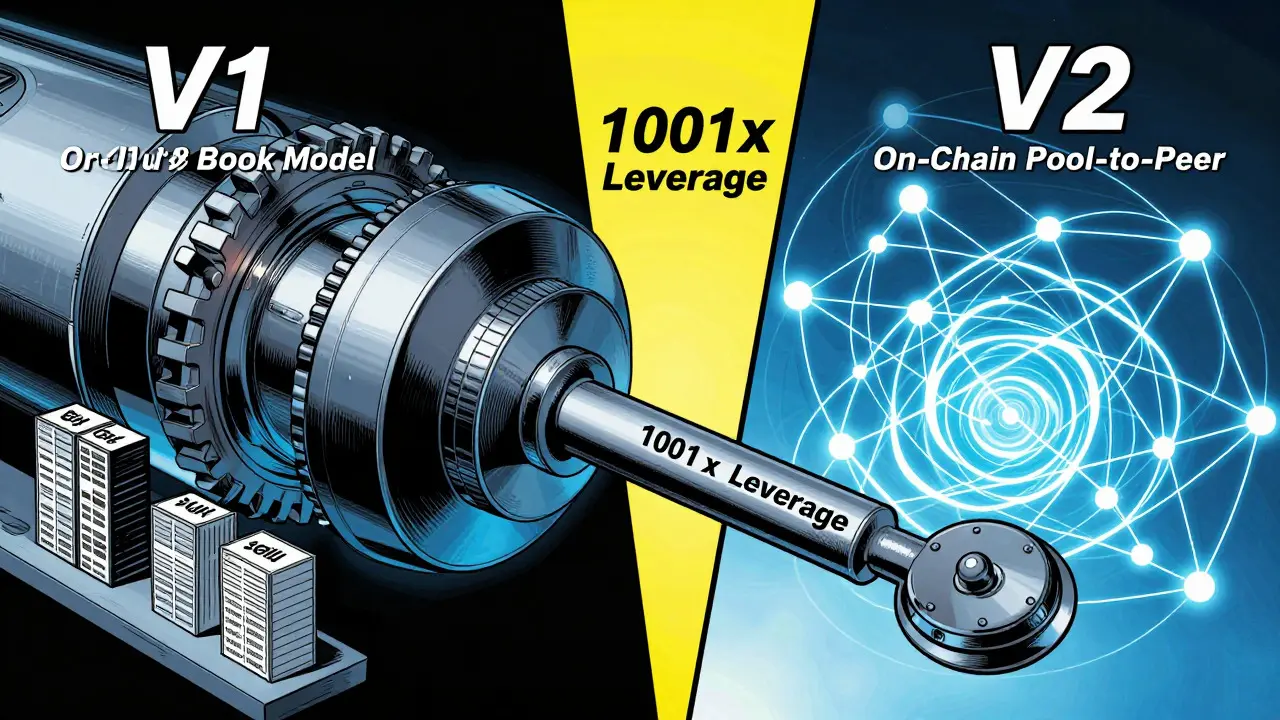
One of the reasons APX stands out is its dual-product architecture. Most decentralized platforms force you to choose between speed and decentralization. APX offers both through two different versions: V1 and V2.
V1 Order Book Perpetuals uses a hybrid model. It matches trades off-chain for speed but settles funds on-chain for security. Think of it like a traditional stock exchange interface but backed by blockchain custody. This model supports visible order books, allowing traders to see exactly where buy and sell orders sit before they commit capital.
V2 On-Chain Perpetuals takes a different route. It uses a pool-to-peer liquidity model that is fully on-chain. Instead of an order book, your trade is matched against a liquidity pool provided by other users. This version relies on two independent price oracles to ensure the price feed is accurate and resistant to manipulation. Both models offer up to 1001x leverage, which is massive compared to the 50x-100x typical on many competitors.
A critical feature for serious traders here is zero slippage. In many DEXs, large trades cause the price to move against you instantly. APX’s design minimizes this impact, making it viable for larger positions that would otherwise be too costly to execute on fragmented liquidity pools.
Token Utility: Why Hold APX?
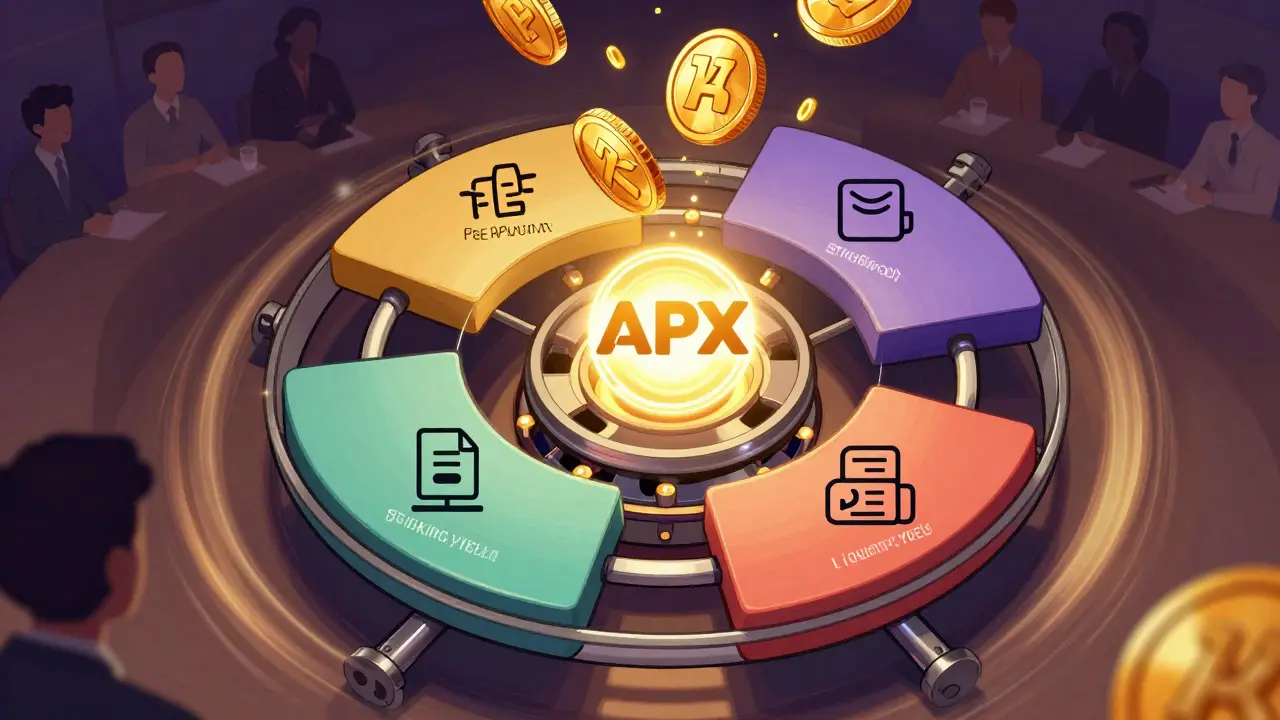
Holding a token is only valuable if it does something. The APX Token serves four primary functions within the ecosystem, creating demand beyond speculative buying.
- Fee Payment: You can pay trading fees on the V1 order book using APX tokens. This often comes with discounts compared to paying in USDT or ETH, incentivizing users to hold the native token.
- Trading Rewards: When you trade on the V2 on-chain perpetuals, you earn APX tokens as rewards. This effectively subsidizes your trading costs and boosts your returns if the token price appreciates.
- Staking and Yield Boosting: By staking APX in the DAO, you not only earn staking rewards but also boost your trading rewards. It’s a compounding effect designed to lock up supply and reduce sell pressure.
- Liquidity Pool Participation: In the V2 model, there is the ALP (Apollo Liquidity Pool). Providers who deposit stablecoins into this pool earn yields from trading fees plus additional APX rewards. This is particularly attractive because stablecoin LPs face less volatility risk than those providing volatile crypto pairs.
This multi-faceted utility creates a flywheel effect. Traders need APX for fees and rewards. Liquidity providers need APX for boosted yields. Governance participants need APX for voting power. Each group supports the value proposition of the others.
Governance: The APX DAO
Decentralization isn’t just about code; it’s about control. The APX DAO (Decentralized Autonomous Organization) allows token holders to vote on key protocol decisions. This includes adjusting fee structures, adding new trading pairs, and approving protocol upgrades.
By staking APX, you gain voting weight. This aligns the incentives of the community with the long-term health of the platform. If the DAO makes bad decisions, the token value drops, hurting everyone. If they make good decisions, volume increases, and the token benefits. It’s a direct line of accountability that centralized exchanges rarely offer.
Market Data and Supply Dynamics
Understanding the economics of a token is crucial for any investor. The total supply of APX is capped at 10 billion tokens. However, not all of these are circulating. As of mid-2026, the circulating supply sits around 44 million tokens, which is roughly 0.44% of the total. This low circulation percentage indicates that significant amounts of tokens are likely locked in vesting schedules, team allocations, or treasury reserves.
The initial launch happened on PancakeSwap in December 2021 at a price of $0.0004 USD. Since then, the market cap has fluctuated, hovering around the $10 million mark in recent periods. While this classifies it as a lower-cap asset compared to giants like Bitcoin or Ethereum, it also means there is room for growth if adoption increases. The remaining tokens are distributed across various sectors to ensure the ecosystem remains user-centric rather than dominated by early insiders.
| Metric | Value / Detail |
|---|---|
| Total Supply | 10 Billion APX |
| Circulating Supply | ~44.16 Million APX |
| Launch Date | December 21, 2021 |
| Supported Chains | BNB Chain, Ethereum, Arbitrum, zkSync, Base, Manta |
| Max Leverage | 1001x |
| Initial Price | $0.0004 USD |
Risks and Considerations
No investment is without risk, and DeFi derivatives are among the riskiest assets in the crypto space. Here is what you need to watch out for.
Smart Contract Risk: Even though APX Finance is audited, bugs can exist. If a vulnerability is found in the V2 on-chain contracts, funds could theoretically be drained. Always check for recent audit reports from reputable firms.
Leverage Danger: Offering 1001x leverage sounds exciting, but it’s a double-edged sword. A tiny movement in the wrong direction can liquidate your entire position. Most retail traders lose money using high leverage. Stick to lower leverage until you master the mechanics.
Token Dilution: With only 0.44% of tokens circulating, future unlocks from the treasury or team wallets could increase supply significantly. Keep an eye on the tokenomics roadmap to anticipate inflationary events.
Who Is APX For?
APX isn’t for everyone. If you are a passive holder looking to set it and forget it, this might not be your ideal pick unless you believe strongly in the governance aspect. It is primarily designed for:
- Active Traders: Those who want to trade perps without giving custody to a central entity.
- Liquidity Providers: Users with stablecoins looking for higher yields than standard savings accounts or simple lending protocols.
- DeFi Developers: APX provides an SDK, allowing other projects to build their own perpetual DEXs using APX’s infrastructure. This expands the ecosystem’s reach beyond just the main site.
In summary, APX represents a mature attempt to bring institutional-grade derivatives trading to the decentralized world. Its strength lies in its multi-chain presence, dual-engine architecture, and clear utility for the native token. Whether it succeeds long-term depends on its ability to maintain liquidity, secure its smart contracts, and continue innovating in a crowded DeFi landscape.
Is APX Finance safe to use?
Like all DeFi platforms, APX Finance carries smart contract risks. However, it utilizes established security practices, including audits and multi-signature wallets for treasury management. The V2 model is fully on-chain, offering transparency, while V1 uses a hybrid model for speed. Users should always start with small amounts and verify the latest audit status before committing significant capital.
What is the difference between V1 and V2 on APX?
V1 uses an order book model with off-chain matching and on-chain settlement, similar to traditional exchanges but decentralized. V2 uses a fully on-chain pool-to-peer model where trades are matched against liquidity pools. V1 is generally faster for execution, while V2 offers deeper decentralization and unique reward structures for liquidity providers.
Can I earn passive income with APX tokens?
Yes. You can stake APX in the DAO to earn staking rewards and boost your trading yields. Additionally, if you provide liquidity to the Apollo Liquidity Pool (ALP) using stablecoins, you earn a share of trading fees plus APX token incentives. This makes it attractive for yield seekers.
Which blockchains does APX support?
APX Finance is multi-chain, operating on BNB Chain, Ethereum, Arbitrum, zkSync Era, Base, and Manta Network. This allows users to trade with lower gas fees on Layer 2 solutions like Arbitrum and Base, or utilize the robust infrastructure of Ethereum and BNB Chain.
What is the maximum leverage available on APX?
APX Finance offers up to 1001x leverage on its perpetual contracts. While this provides significant opportunity for profit, it also drastically increases the risk of liquidation. Beginners are advised to use much lower leverage settings to manage risk effectively.
How do I buy APX tokens?
APX tokens can be purchased on major cryptocurrency exchanges that list them, such as Gate.io, LBank, and via decentralized exchanges like PancakeSwap. You will need a wallet compatible with the respective blockchain (e.g., MetaMask for Ethereum/Arbitrum/Base) to store and use the tokens.