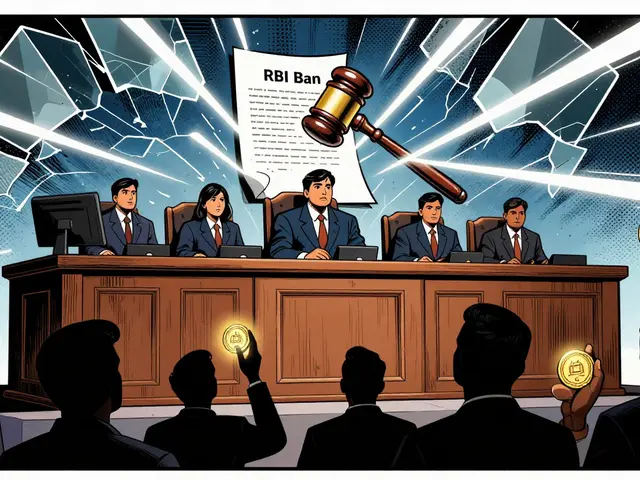
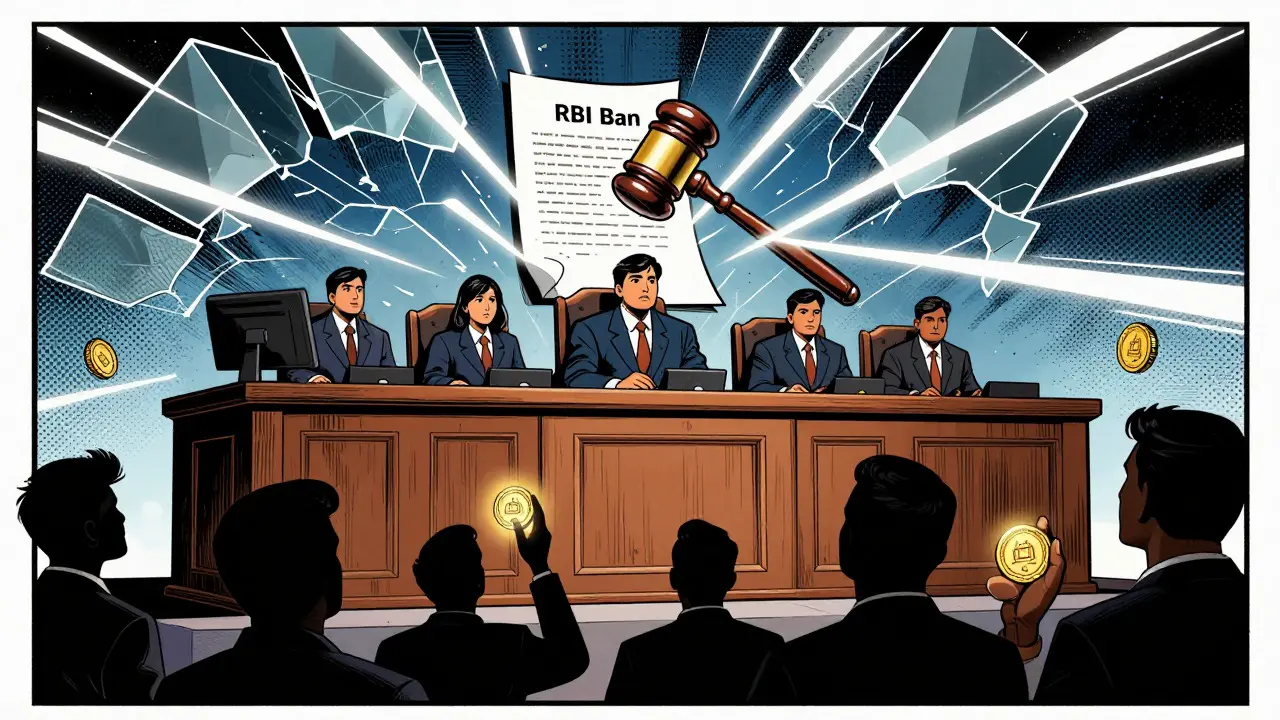
Imagine holding an asset that the government says is illegal to trade with banks, yet not explicitly banned by law. For millions of Indians, this was the confusing reality until the Supreme Court of India issued a landmark ruling in March 2020. This decision didn't just change the rules for Bitcoin holders; it fundamentally reshaped the financial landscape of the country. The court struck down the Reserve Bank of India's (RBI) blanket prohibition on cryptocurrency transactions, declaring it unconstitutional. But the story doesn't end there. As we move through 2026, the judicial stance has evolved from protecting trading rights to demanding comprehensive regulation. Understanding this shift is crucial for anyone navigating India's complex crypto ecosystem today.
The 2020 Watershed Moment: Striking Down the RBI Ban
To understand where we are now, we have to look back at the chaos of 2018. On April 6, 2018, the Reserve Bank of India (RBI) issued a circular titled 'Prohibition on dealing in Virtual Currencies (VCs)'. This directive effectively cut off the lifeblood of the Indian crypto market. It ordered all regulated financial entities-including banks, payment system providers, and non-banking financial companies-to stop providing services related to virtual currencies.
This meant no bank accounts for exchanges, no fiat deposits, and no withdrawals. Platforms like WazirX, CoinDCX, and ZebPay were left stranded. Users couldn't convert their rupees into Bitcoin or vice versa through legitimate banking channels. The industry argued this was disproportionate, especially since no specific legislation had banned cryptocurrencies themselves.
In March 2020, the Supreme Court agreed. In the case of Internet and Mobile Association of India v Reserve Bank of India, a five-judge bench declared the RBI’s circular ultra vires (beyond its powers). The court reasoned that the RBI could only regulate entities under its purview, not ban an activity entirely without legislative backing. They emphasized the principle of proportionality: if the goal was to protect consumers or prevent money laundering, less restrictive measures should have been used first. This judgment restored access to banking services for crypto traders and sparked a massive surge in adoption, with user registrations on major platforms jumping by 300-400% within months.
From Protection to Pressure: The 2025 Judicial Shift
If 2020 was about unlocking the doors, 2025 has been about asking why the house still lacks locks. By October 2025, the tone of the Supreme Court had shifted significantly. While the initial ruling protected the right to trade, the current focus is on the lack of a regulatory framework. During hearings involving cases like the bail petition of Shailesh Babulal Bhatt, accused of cryptocurrency-related fraud, Justices Surya Kant and N. Kotiswar Singh expressed frustration with the government's inaction.
The justices described unregulated Bitcoin trading as "nothing but a more polished form of Hawala," referring to the informal value transfer system often used for illicit funds. This wasn't a call to ban crypto again; rather, it was a stern warning. The court acknowledged that newer financial mechanisms are evolving globally and that banning them outright would be unwise. However, they criticized the central government for turning a "blind eye" to pressing regulatory needs. The message was clear: the judiciary will protect your right to hold assets, but it expects the legislature to create rules that ensure safety and prevent misuse.
| Jurisdiction | Regulatory Model | Key Characteristic | Tax Rate on Gains |
|---|---|---|---|
| India | Judicial Intervention + High Taxation | No specific crypto law; heavy reliance on income tax laws | 30% flat + 1% TDS |
| European Union | MiCA Framework | Comprehensive unified regulation for issuers and service providers | Varies by member state |
| United States | Agency Enforcement | SEC and CFTC define jurisdiction via enforcement actions | Capped at 37% (long-term capital gains) |
| China | Total Prohibition | Ban on trading and mining; promotion of CBDC | N/A (Illegal) |

The Tax Burden: Trading in a Grey Zone
While the Supreme Court cleared the path for banking, the government responded with a different kind of restriction: taxation. Currently, India imposes one of the highest tax rates on cryptocurrency profits in the world. Under the Finance Act 2022, which remains in effect in 2026, all profits from the transfer of virtual digital assets (VDAs) are taxed at a flat rate of 30%.
Here’s the kicker: you cannot offset losses. If you make ₹10 lakh profit on Bitcoin but lose ₹5 lakh on Ethereum, you still pay tax on the full ₹10 lakh. Additionally, there is a 1% Tax Deducted at Source (TDS) on every transaction above specified thresholds. This means for every trade, 1% of the value is deducted and sent to the government immediately. For active traders, this creates a significant cash flow challenge and makes high-frequency trading nearly unviable compared to jurisdictions with lower capital gains taxes.
This structure places India in a unique position. It is legally permissible to trade, but financially punitive. Experts argue that while the Supreme Court prevented a total ban, the tax regime acts as a soft deterrent. Many serious investors and startups have looked toward jurisdictions like Singapore, Switzerland, or the United Arab Emirates, where regulatory clarity and favorable tax structures foster innovation.

Practical Compliance for Investors and Exchanges
Operating in this environment requires diligence. For individual investors, the learning curve involves understanding that crypto is treated as a distinct asset class for tax purposes, separate from stocks or real estate. You must maintain detailed records of every transaction, including the date, time, price, and wallet addresses involved. Filing accurate returns with the Income Tax Department is mandatory, and failure to do so can lead to scrutiny.
For exchanges, the requirements are even stricter. Platforms must implement robust Know Your Customer (KYC) procedures and comply with Anti-Money Laundering (AML) norms. They must also integrate with the Financial Intelligence Unit (FIU) to report suspicious transactions. The absence of clear guidelines on Decentralized Finance (DeFi) and Non-Fungible Tokens (NFTs) adds another layer of complexity. Until specific regulations emerge, these sectors operate in a grey area, requiring users to exercise extreme caution and seek professional legal advice.
Future Outlook: The Push for Legislation
The ball is now in the government's court. The Cryptocurrency and Regulation of Official Digital Currency Bill, 2021, proposed banning private cryptocurrencies while supporting the development of a Central Bank Digital Currency (CBDC) by the RBI. However, this bill has not been enacted. The Supreme Court’s recent criticism suggests that the window for delay is closing.
We can expect future developments to focus on balancing consumer protection with innovation. A likely outcome is a framework that recognizes VDAs as property or assets, provides clear definitions for DeFi protocols, and potentially adjusts the tax structure to encourage compliance rather than evasion. Until then, the Supreme Court remains the guardian of digital asset rights in India, ensuring that while the government deliberates, citizens are not stripped of their financial freedoms.
Is cryptocurrency legal in India after the Supreme Court ruling?
Yes, cryptocurrency is legal to hold and trade in India. The Supreme Court struck down the RBI's 2018 ban in 2020, allowing banks to provide services to crypto exchanges. However, it is heavily regulated through high taxation (30% on profits) and strict KYC norms, though a comprehensive specific law is still pending.
What was the main reason the Supreme Court overturned the RBI ban?
The Court ruled that the RBI's circular was disproportionate and beyond its statutory powers. Since there was no specific legislation banning cryptocurrencies, the RBI could not impose a blanket ban on banking services. The Court emphasized the principle of proportionality, stating that less restrictive measures should be used to address potential risks.
How does the 30% crypto tax work in India?
Under current Indian tax laws, any profit made from selling or transferring virtual digital assets is taxed at a flat 30%. Unlike other investments, you cannot set off losses against profits. Additionally, a 1% TDS is deducted on transactions above certain thresholds, which impacts liquidity for traders.
Why did the Supreme Court compare crypto to Hawala in 2025?
Justices Surya Kant and N. Kotiswar Singh used this comparison to highlight the risks of unregulated trading. They were not calling for a ban but emphasizing the urgent need for a regulatory framework to prevent money laundering and fraud, noting that the lack of oversight allows illicit activities to flourish similar to the informal Hawala system.
Will the government ban cryptocurrency in the future?
A complete ban is unlikely given the Supreme Court's precedent and global trends. The Court has indicated that banning crypto outright would be unwise. Instead, the focus is on creating a balanced regulatory framework that protects consumers and ensures financial stability while acknowledging the technological benefits of digital assets.