You probably clicked on this article because you saw "SHREW" pop up in your wallet or heard whispers about a massive SHREW airdrop. Maybe you’re hoping to cash out free tokens just like everyone else did with Arbitrum or Optimism. But here is the cold, hard truth that might save you some serious time and disappointment: there was never an official SHREW airdrop. At least, not for the original Shrew project.
If you are holding SHREW tokens or hunting for them, you are likely dealing with one of two things: either you bought into the initial coin offering (ICO) back in 2021, or you are confusing it with a newer, unrelated meme coin or NFT project also using similar naming conventions. The original Shrew project promised to revolutionize loyalty points, connecting every store from your local bakery to global giants like Starbucks into one blockchain ecosystem. It sounded brilliant. In practice? It fizzled out before most people even got their hands on the app.
The Big Misconception: Was There Actually a SHREW Airdrop?
Let’s clear up the confusion right away. Extensive reviews of the project’s history, including data from CoinCodex and archived ICO documents, show zero evidence of a community airdrop campaign for the original Shrew token. When Shrew launched its token via the DX Sale launchpad between May and July 2021, 100% of the supply was sold during the fundraising period. There was no reserved allocation for early adopters, social media tasks, or Telegram communities.
This is where things get tricky. In the crypto world, names matter. You might be seeing activity related to "Sandshrew" or other tokens sharing the ticker or similar branding. For instance, Bitget listed a Sandshrew-related asset in April 2025, but comparative analysis shows this is a separate entity, likely tied to gaming or NFTs, not the original loyalty-focused Shrew. If you are looking for free tokens simply for holding ETH or participating in governance, the original SHREW didn’t offer that path. You had to buy in.
| Feature | Original Shrew Project | Typical Airdrop Project (e.g., Arbitrum) |
|---|---|---|
| Distribution Method | 100% ICO Sale | ICO + Community Airdrop |
| Free Token Allocation | None | Significant % of Supply |
| Primary Goal | Loyalty Point Interoperability | Network Security & Decentralization |
| Current Status (2026) | Dormant/Delisted | Active Ecosystem |
What Was SHREW Trying to Solve?
To understand why the lack of an airdrop matters, you need to know what SHREW actually was. Shrew was a blockchain-based universal loyalty rewards token designed to unify fragmented retail reward programs. The idea was simple yet ambitious: instead of having separate points for Amazon, Target, and your local coffee shop, you would earn SHREW tokens everywhere. Then, you could spend those SHREW tokens anywhere else in the network.
The project positioned itself as a solution to a $400 billion market inefficiency. Think about how many loyalty points go unredeemed every year. Billions, according to industry reports. Shrew wanted to fix this by creating a single currency linking each reward program across a multitude of stores. They partnered with Chainlink for price feed oracles and claimed potential integrations with payment processors like Visa or Mastercard. This would have allowed users to withdraw their SHREW balance directly to a debit card, effectively turning loyalty points into cash.
However, execution is everything in crypto. While the whitepaper looked solid, the actual product remained largely theoretical. Unlike successful competitors such as Brave Browser’s Basic Attention Token (BAT), which achieved 37 million monthly active users by integrating directly into a browser millions already used, Shrew lacked a functional consumer-facing application at scale.
The Rise and Fall of the SHREW Token
SHREW operated as an ERC-20 token on Ethereum. Its tokenomics were straightforward but controversial. It featured a 0% buy and transfer tax, which made it cheap to trade, but a hefty 10% sell tax. This structure often discourages long-term holders who want flexibility, pushing them toward platforms with lower exit costs.
Historically, the token showed extreme volatility typical of small-cap altcoins in the post-2021 bear market. Data from CoinCodex indicates an all-time high of roughly $0.075 in October 2022, followed quickly by a low of $0.074 shortly after. This minimal price movement over a short period suggests very low liquidity. By mid-2023, daily trading volumes on decentralized exchanges like PancakeSwap averaged less than $5,000. That is practically negligible for a project claiming to connect global retailers.
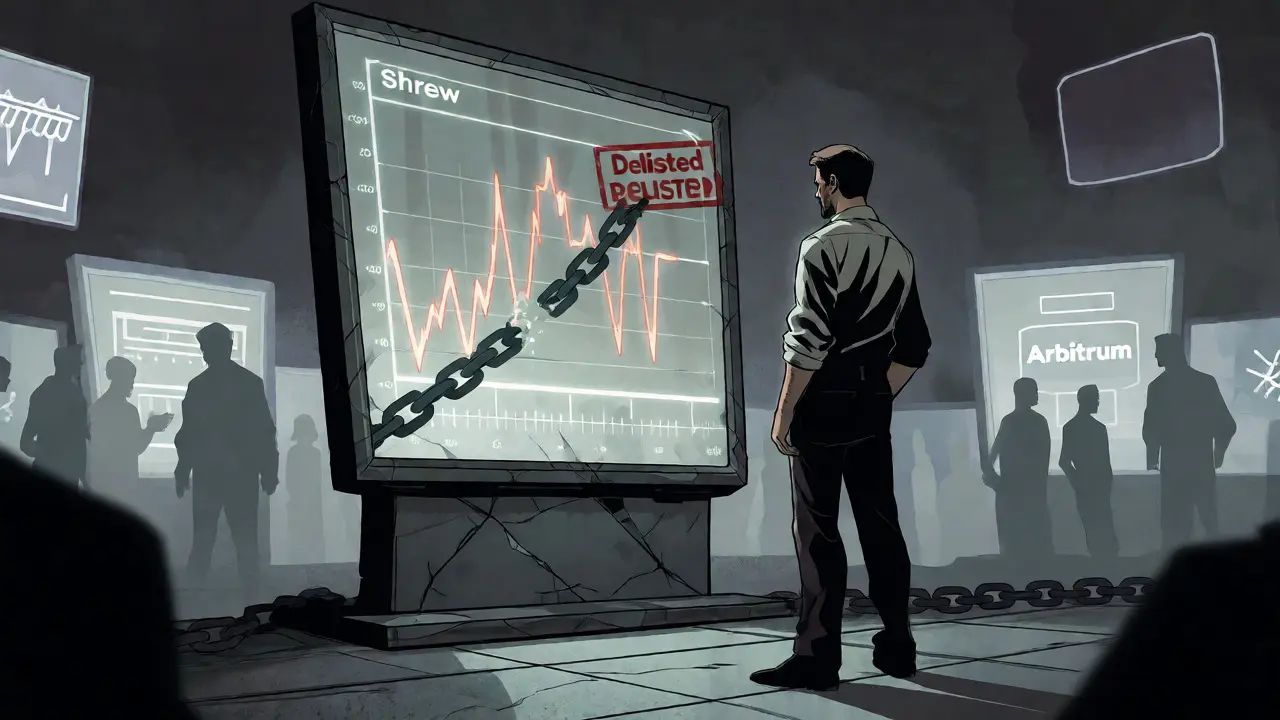
By Q1 2023, SHREW had been delisted from major centralized exchanges. The website became inaccessible in February 2023 due to DNS non-renewal, and social media accounts stopped posting meaningful updates around October 2022. As of late 2026, the project is effectively dormant. GitHub repositories show no significant code commits since the initial development phase, and the Telegram community has been silent except for automated messages.
Why Did the Project Fail?
Blockchain economist Dr. Alex Thorn from Galaxy Digital highlighted the core issue in a 2023 interview: universal loyalty tokens face a "chicken-and-egg" problem. Merchants won’t accept a new token unless customers demand it, and customers won’t use a token merchants don’t accept. Most projects fail to solve this bootstrapping challenge.
Shrew tried to bypass this by relying on traditional payment processor partnerships rather than direct merchant integration. Critics like Consensys strategist Maria Gomez pointed out that without showing existing merchant relationships, the value proposition was speculative. Compare this to Rakuten, which leveraged its existing e-commerce dominance to push its Super Points cryptocurrency to 11 million users. Shrew had no such anchor.
- No Working Product: Reviews from CoinTelegraph noted the absence of a working demo beyond whitepaper promises.
- Lack of Merchant Adoption: No verifiable data existed on participating retailers accepting SHREW.
- Regulatory Hurdles: SEC guidance in 2023 classified similar loyalty tokens as securities, adding compliance complexity.
- Community Disengagement: Trustpilot had zero reviews, and Reddit threads questioned if anyone had ever actually spent SHREW.
Is Your SHREW Worth Anything Today?
If you still hold SHREW tokens, you are likely sitting on a digital artifact rather than a liquid asset. With trading volume dropping below $100 daily by June 2023, selling large amounts would significantly impact the price. The token remains available on some decentralized exchanges, but the bid-ask spread is wide, meaning you will lose money on slippage.
Don’t expect a sudden revival. Messari’s 2023 Crypto Theses listed "universal loyalty tokens without merchant integration" as one of the top failed narratives. Shrew was cited specifically as a cautionary example. Unless a new team acquires the brand and rebuilds the infrastructure from scratch-something that hasn’t happened as of September 2026-the token’s utility remains near zero.
Confusion with Other "Shrew" Projects
Be careful when searching for news. You might see mentions of "Sandshrew" in recent listings on Bitget (April 2025). This is a different project, likely focused on gaming or NFTs, given the Pokémon-inspired name. Do not confuse this with the original Shrew loyalty token. Similarly, ensure you aren’t mixing it up with "Shiba Rewards," another token sharing the SHREW ticker but operating within the Shiba Inu ecosystem.
Always verify the contract address. The original Shrew ERC-20 contract differs from these newer iterations. If you are tracking an "airdrop" for a new Shrew-related token, check the official Twitter or Discord of that specific project, not the old Shrew website, which is dead.
Key Takeaways
- No Official Airdrop: The original SHREW token was distributed entirely through an ICO; there were no free distributions to the community.
- Project Dormancy: The Shrew project ceased active development and marketing by late 2022/early 2023.
- Liquidity Crisis: Trading volumes are negligible, making it difficult to sell large holdings without significant loss.
- Name Confusion: Be wary of new projects using similar names (like Sandshrew) that may have their own distinct airdrop campaigns unrelated to the original SHREW.
- Lesson Learned: Utility tokens require real-world adoption, not just good whitepapers. Without merchants, loyalty points remain abstract numbers.
Did Shrew have an official airdrop?
No, the original Shrew project did not conduct an official airdrop. All tokens were sold during its Initial Coin Offering (ICO) in 2021 via the DX Sale launchpad. There was no reserved supply for community distribution.
Is SHREW token still active?
As of 2026, the original SHREW project is considered dormant. Development halted in 2022, the website went offline in 2023, and trading volumes are extremely low. It is no longer listed on major centralized exchanges.
Can I still sell my SHREW tokens?
Yes, but with difficulty. SHREW is traded on decentralized exchanges like PancakeSwap. However, liquidity is very low, so selling large amounts may result in significant price slippage. Check current order books before placing a trade.
Is Sandshrew the same as SHREW?
No. Sandshrew appears to be a separate project, possibly related to NFTs or gaming, listed on exchanges like Bitget in 2025. It is distinct from the original Shrew loyalty token launched in 2021.
Why did the Shrew project fail?
The project failed primarily due to a lack of merchant adoption and a working consumer product. It struggled with the "chicken-and-egg" problem common in loyalty networks: merchants wouldn't join without users, and users wouldn't join without merchants.