

If you're a financial professional or an investor looking at the Gulf region, you've probably noticed a strange contradiction in Saudi Arabia. On one hand, the government is pushing blockchain for the future of banking. On the other, they've spent years telling banks and citizens to stay far away from Bitcoin. This isn't just a suggestion; it's a calculated regulatory wall. While the youth population is diving headfirst into digital assets, the official line from the top remains a strict "do not touch."
Quick Summary of the Saudi Crypto Landscape
- Institutional Ban: Financial institutions are strictly prohibited from trading or dealing in cryptocurrencies.
- Legal Status: No formal law bans individual ownership, but there is zero legal recognition or protection.
- Dual Strategy: The state bans public crypto but actively develops Central Bank Digital Currencies (CBDCs).
- Youth Adoption: Despite warnings, Saudi Arabia is one of the fastest-growing crypto markets in the region.
The Official Stance: Why the Warnings Exist
The crackdown didn't happen overnight. It started back in 2017 when the Saudi Arabian Monetary Authority (SAMA) is the central bank of Saudi Arabia, responsible for monetary policy and the supervision of the banking sector first raised red flags about the volatility and risks of virtual currencies. By December 2018, the tone shifted from "be careful" to "this is not allowed." A government committee declared virtual currencies as "illegal and unlicensed" within the Kingdom.
The Ministry of Finance is the government body responsible for the Kingdom's financial planning and fiscal policy jumped in during 2019, warning that since these assets aren't regulated by any official entity, anyone investing in them is doing so without any legal safety net. The core problem for the Saudi government is control. Cryptocurrencies operate on decentralized networks, which clashes with the highly centralized nature of the Kingdom's financial oversight.
Financial Institutions vs. Retail Users
It is critical to distinguish between what is "illegal" for a bank and what is "risky" for a person. For a licensed bank or investment firm, the Saudi Arabia crypto warning is an absolute directive. SAMA has made it clear that any entity using national symbols or the Kingdom's name to market digital currencies will face legal action. There is no "compliance checklist" for crypto because, in the eyes of the regulator, there is no legal way to comply.
For the average citizen, the situation is a gray area. You won't find a specific law that says "owning Bitcoin is a crime," but you also won't find any law that protects your assets if an exchange disappears. This creates a strange tension. Saudi Arabia is currently the region's second-largest crypto market, driven largely by a population where 63% are youth. They are using global exchanges and private wallets, effectively ignoring the warnings that their banks are forced to follow.
| Feature | Financial Institutions | Retail Individuals |
|---|---|---|
| Trading Activity | Strictly Prohibited | De Facto Common (High Risk) |
| Legal Protection | N/A (Not Allowed) | None |
| Regulatory Guidance | Direct SAMA Prohibitions | General Public Warnings |
| Compliance Framework | No framework exists | Self-managed / Unregulated |
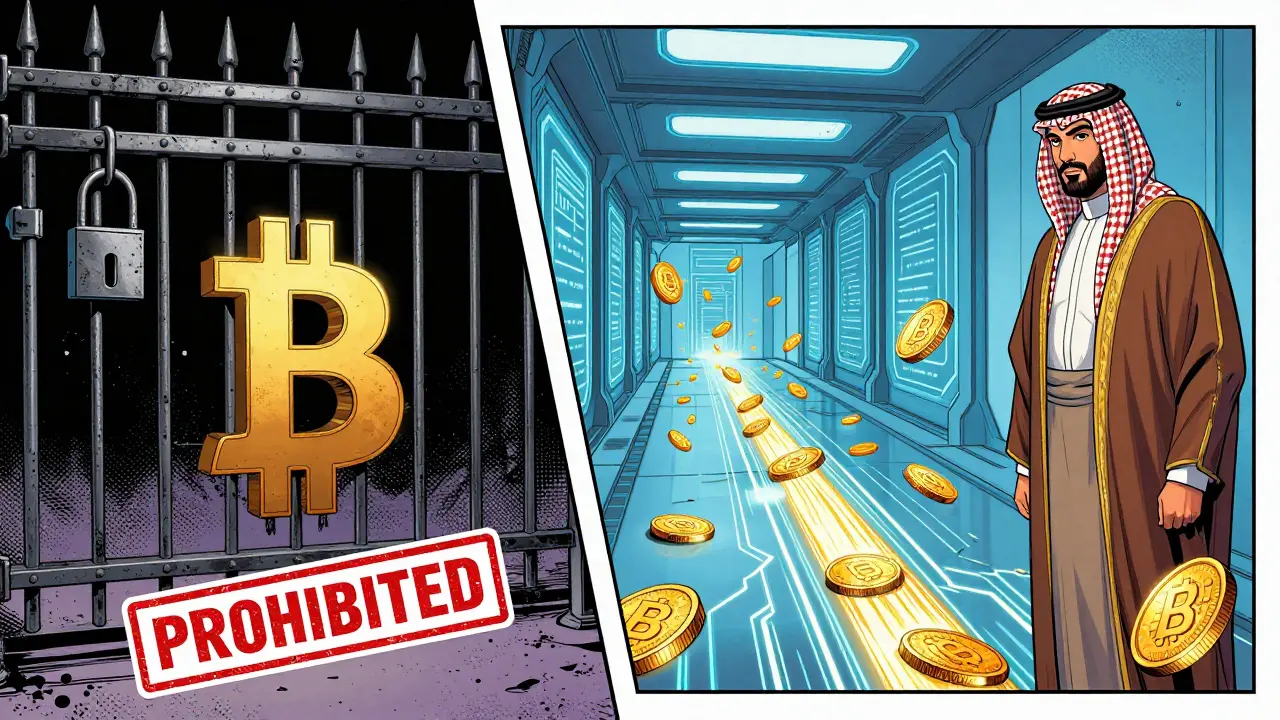
The "Dual Approach": Public Ban, Institutional Innovation
While the public warnings sound like a total ban, the government is actually obsessed with the tech behind the coins. This is where Blockchain is a distributed ledger technology that enables secure, transparent, and immutable record-keeping comes in. The Kingdom isn't against the technology; they are against the lack of control over the asset.
Take Project Aber is a joint central bank digital currency (CBDC) project between Saudi Arabia and the UAE to facilitate cross-border payments as an example. Launched in 2019, this project shows that Saudi Arabia wants the efficiency of digital tokens-faster settlements and lower costs-but only if the central bank holds the keys. They want a digital currency that behaves like a traditional currency, not a volatile asset like Bitcoin.
We're also seeing a push toward Tokenization is the process of converting rights to a real-world asset into a digital token on a blockchain. Major players like Goldman Sachs and Rothschild are exploring ways to turn bonds and trade finance instruments into tokens. This allows the Kingdom to modernize its financial infrastructure while keeping everything within the regulatory boundaries of SAMA.
Navigating the Legal Gray Areas
If you are trying to figure out the legal risk, you have to look at the Anti-Money Laundering Law (AML) is the legal framework established by Royal Decree to prevent the conversion of illegally obtained funds and the laws on combating terrorist financing. Neither of these laws explicitly mentions "crypto," but they use a very broad definition of "funds." This includes any "intangible assets or economic resources... obtained through electronic or digital systems."
This means that while you might not be arrested for owning a digital wallet, if those funds are linked to any suspicious activity, the government has a very wide legal net to catch you. The lack of formal legal recognition means you can't sue a crypto company in a Saudi court if they steal your funds, but the government can still use AML laws to investigate your digital holdings.

What This Means for the Future
Will Saudi Arabia eventually legalize crypto? It's possible, but it will likely happen in stages. They are currently in the "sandbox" phase-experimenting with CBDCs and tokenized bonds. The move toward a more open framework will depend on two things: Sharia compliance and financial stability. Some reports suggest a high-ranking religious leader issued a fatwa supporting Bitcoin, but the official state position hasn't shifted yet.
The most likely scenario is a tightly controlled environment. Instead of a free-for-all like you see in some other jurisdictions, Saudi Arabia will probably introduce a licensing regime where only approved "digital asset service providers" can operate, and only after they've proven they can meet strict AML and KYC (Know Your Customer) standards.
Is cryptocurrency illegal in Saudi Arabia?
It is complicated. There is no single law that makes owning cryptocurrency a crime for individuals, but the government has issued multiple warnings stating that virtual currencies are "illegal and unlicensed." For financial institutions, the ban is strict and explicit.
Can Saudi banks trade in Bitcoin?
No. The Saudi Arabian Monetary Authority (SAMA) has explicitly prohibited financial institutions from engaging in cryptocurrency trading or providing services related to digital assets.
What is Project Aber?
Project Aber is a collaborative effort between the central banks of Saudi Arabia and the United Arab Emirates to create a joint Central Bank Digital Currency (CBDC) to streamline cross-border payments between the two nations.
Are there any legal protections for crypto investors in Saudi Arabia?
No. Because cryptocurrencies are not legally recognized or regulated by SAMA or the Ministry of Finance, investors have no legal recourse if they lose funds to scams or exchange failures.
Why does the Saudi government dislike crypto but like blockchain?
The government values blockchain for its ability to increase efficiency, transparency, and security in official financial systems. However, they dislike public cryptocurrencies because they are decentralized, volatile, and bypass the central bank's control over the money supply.
Next Steps and Troubleshooting
If you are an institutional player looking to enter the Saudi market, avoid any product that claims to be a "crypto exchange" for the local market unless they have explicit, written authorization from SAMA. The safest bet is to focus on Tokenization and CBDC infrastructure, as these are the only areas where the government is currently welcoming innovation.
For individual users, the best approach is extreme caution. Since there is no legal framework, use hardware wallets to secure your assets and be aware that transferring large amounts of crypto to local bank accounts may trigger AML red flags, as banks are required to report suspicious activity to the authorities.

Benjamin Forg
April 23 2026typical state control just another way to track every single cent you spend via cbdcs while they tell you it is for efficiency the decentralized dream is dead if the central bank holds the keys it is just a digital panopticon and we are all walking right into it without a second thought
Gloris Young
April 23 2026It is really interesting to see how they balance tech and regulation. Very clear breakdown!
Yvette P
April 23 2026Oh sure, because nothing says "innovation" like a state-sponsored CBDC where the government can just flip a switch and freeze your assets based on a whim, but hey, let's all applaud the "efficiency" of Project Aber while the retail users get absolutely zero recourse in a legal vacuum because the regulatory arbitrage here is just breathtakingly cynical and frankly, if you think a
Larry Yang
April 23 2026The sheer banality of this regulatory approach is almost impressive in its rigidity. Imagine thinking you can stop a Gen Z population from using a private key just because SAMA says so. It's a quaint notion, really, imagining that a decree can override a mathematical protocol. The cognitive dissonance of wanting the blockchain benefits without the decentralization is just peak mid-wit energy.
Ali Tate
April 24 2026SAMA is basically playing a game of pretend with the tech while the real alpha is happening in the shadows. This whole "dual approach" is just a fancy word for hypocrisy and honestly who cares about the legal gray area when the US is the only place that actually matters for liquidity anyway
Eric Raines
April 25 2026Everyone keeps acting like this is some big mystery. It's just about power. The government doesn't want a currency they can't print or track. Period. I've seen this play out in a dozen other markets and it always ends the same way.
Guy Bianco
April 25 2026It would be prudent to remember that these transitions often take years to stabilize. :) For those entering the market, focusing on the infrastructure side as mentioned is a wise path forward.
Jennifer L
April 26 2026It is so heartbreaking to think of people losing their hard-earned money with no legal protecton at all! I truly hope the govvernment finds a way to protect the vunerable citizens who might get scammed by these unregualted platforms before it is too late for them! It is just such a trajeddy!
Gary Lingrel
April 27 2026why would anyone care about a "sandbox" phase when the reality is just more state surveillance 🙄 the irony of using AML laws to target digital assets while ignoring the actual corruption is just gold
Alex Wan
April 28 2026I must admit, I am quite struck by the sheer audasity of the youth population in the region to bypass these strictures! It is a testament to the irrepressible nature of technolgy and human curioSity, even in the face of such daunting regualtory walls!
praveen subbiah
April 28 2026While this is interesting, India is doing a much better job with its own digital currency initiatives and our scale is far more impressive than any small gulf project!
Mike Word
April 29 2026The mention of Sharia compliance is a key point. It would be interesting to see if that becomes the primary catalyst for a shift in policy over financial stability.
Matthew Morse
April 30 2026this whole thing is just a mess honestly who even reads the AML laws they are written to be vague on purpose so they can just grab whoever they want
Tara Aman
April 30 2026Let's stay positive! The move toward tokenization is a great bridge for those who want to keep things legal while still being innovative!