
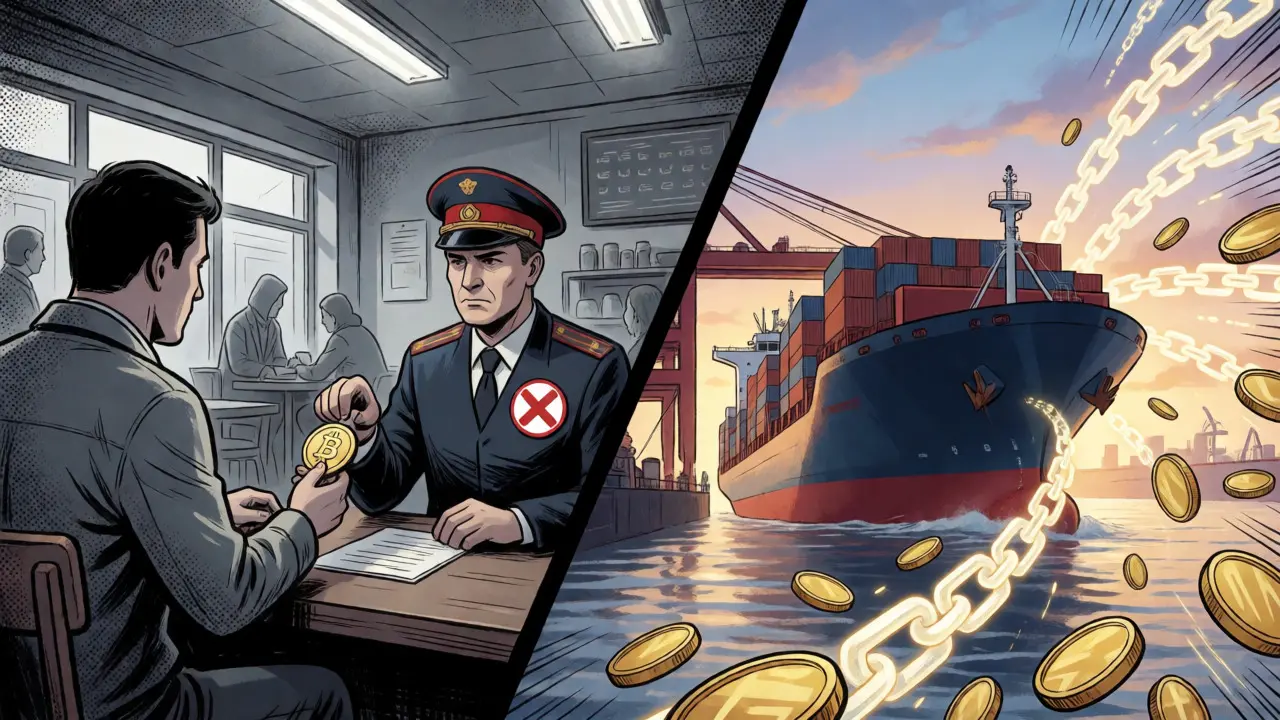
You might think you can buy Bitcoin with your Russian ruble and spend it on coffee in Moscow. But if you try that today, you’re breaking the law. Russia’s approach to digital assets is a tale of two systems: strict domestic control versus pragmatic international use. As of 2026, the landscape has settled into a complex "dual-track" reality. You cannot use crypto for daily purchases inside Russia, but you absolutely can use it to settle international trade deals. This isn’t just bureaucratic red tape; it’s a strategic maneuver to bypass Western financial sanctions while keeping the ruble firmly in charge of the domestic economy.
The Dual-Track System Explained
The core of current policy rests on the Experimental Legal Regime (ELR), which launched in 2024 as a three-year trial. Think of it as a sandbox where specific rules apply only to certain participants. Before this, the 2020 law legalized crypto ownership but banned its use as a payment method domestically. That ban remains fully active. If you pay for groceries with USDT in St. Petersburg, you are technically violating monetary sovereignty laws.
However, the ELR flipped the script for cross-border transactions. It allows selected exporters, importers, and qualified investors to use cryptocurrencies like Bitcoin or stablecoins to settle international invoices. This was designed explicitly to help Russian companies navigate around SWIFT restrictions. By 2025, this channel had processed roughly 1 trillion rubles in volume. It proves that while the government hates crypto at home, it loves crypto abroad when it helps keep trade flowing.
Who Can Actually Trade? The Qualified Investor Barrier
If you’re an average citizen wanting to dabble in crypto derivatives, good luck getting through the door without a hefty bank account. The Central Bank of Russia (CBR) has set extremely high bars for entry. To access regulated crypto products, such as Bitcoin futures offered by institutions like Sber or the Moscow Exchange, you must be classified as a "qualified investor."
What does that mean in practice? You need either:
- Assets worth over 100 million rubles.
- An annual income exceeding 50 million rubles.
This effectively locks out the middle class from formalized, low-risk crypto investment vehicles. In May 2025, when these products first became available to qualified investors, they purchased $16 million worth of exposure in the first month alone. The Finance Ministry wants to lower these thresholds to broaden market participation, but the Central Bank remains stubbornly opposed, fearing retail volatility could destabilize the financial system.

Domestic vs. International Usage Rules
The distinction between domestic and international usage is the most critical compliance point for any business operating in or with Russia. Here is how the rules break down in a practical scenario:
| Activity | Domestic (Within Russia) | International (Cross-Border) | Status |
|---|---|---|---|
| Payment for Goods/Services | Strictly Prohibited | Allowed via ELR | High Risk / Permitted |
| Holding Assets | Legal | Legal | Permitted |
| Trading on Foreign Exchanges | Common (Shadow Market) | N/A | Unregulated/Gray Area |
| Crypto Mining | Regulated & Licensed | Exportable Energy | Permitted with Conditions |
| Investment Funds Holding Crypto | Restricted | Planned Expansion (2026+) | Pending Approval |
Notice the gray area in the middle. While domestic exchanges were largely shut down or restricted, Russians still hold an estimated $25 billion in digital assets. Most of this happens on foreign platforms. The government hasn’t cracked down hard on individuals buying Bitcoin on Binance or similar offshore sites, but moving that money back into the Russian banking system requires careful navigation of anti-money laundering (AML) checks.
The Role of Infrastructure and Mining
You can’t have a functioning crypto ecosystem without infrastructure, and Russia is building it fast. Deputy Finance Minister Ivan Chebeskov confirmed in late 2025 that the state is prioritizing "homegrown infrastructure" for mining and related services. Why? Because relying on foreign tech stacks creates vulnerability.
Mining is actually one of the few areas where the state actively encourages growth, particularly in regions with excess energy capacity. President Putin has urged regions with idle power reserves to engage in mining, viewing it as a way to monetize surplus electricity. This aligns with the broader goal of using crypto exports to balance trade deficits. However, miners must operate within licensed frameworks, reporting their activities to ensure they aren’t facilitating illicit capital flight.

Compliance and Reporting Obligations
Don’t let the "shadow market" vibe fool you-the tax authorities are watching. If you move more than 600,000 rubles in cryptocurrency transactions, you are required to declare it to the tax service. Failure to do so can trigger audits under recent anti-fraud amendments.
Banks are also tightening up. They are mandated to implement robust KYC (Know Your Customer) procedures, especially for peer-to-peer transfers that look like crypto trades. If you send large sums to random accounts frequently, expect your bank to ask questions. The Central Bank has issued methodological recommendations specifically targeting P2P patterns used to circumvent official exchange channels. Basically, if it looks like a duck (crypto trade) and quacks like a duck (unusual P2P flow), the bank will treat it like a duck.
Future Outlook: What Happens After 2027?
The Experimental Legal Regime is scheduled for review after its three-year trial period ends in 2027. Current signals suggest the Central Bank is softening slightly. Reports from October 2025 indicated the CBR is studying Bitcoin as a potential hedge against fiat debasement-a huge shift from their previous outright hostility. Additionally, there are strong indications that investment funds will be allowed to include crypto in their portfolios by 2026.
If the ELR continues to successfully facilitate trillions in rubles of trade, we might see permanent legislation that keeps the international doors open while potentially relaxing some domestic holding rules. But don’t expect full legalization of crypto payments for daily goods anytime soon. The ruble’s status as the sole legal tender is non-negotiable for now.
Key Takeaways
- No Domestic Payments: You cannot legally buy coffee or rent an apartment with Bitcoin in Russia.
- International Loophole: Use the ELR framework for cross-border settlements; it’s working well for trade.
- Wealth Test Required: Access to regulated crypto derivatives requires massive assets or income.
- Tax Visibility: Transactions over 600k rubles must be declared; banks monitor P2P flows closely.
- Mining is State-Supported: Licensed mining in energy-rich regions is encouraged for export revenue.
Can I buy Bitcoin with rubles in Russia?
Yes, you can buy Bitcoin using rubles, but typically through foreign exchanges or P2P markets since domestic centralized exchanges are restricted. However, you cannot use that Bitcoin to make payments for goods and services within Russia.
Is crypto mining legal in Russia?
Yes, crypto mining is legal and regulated. Miners must obtain licenses and comply with reporting requirements. The government encourages mining in regions with surplus energy to boost export revenues.
What is the Experimental Legal Regime (ELR)?
The ELR is a temporary regulatory framework introduced in 2024 that allows specific entities (exporters, importers, qualified investors) to use cryptocurrencies for international settlements while maintaining strict bans on domestic crypto payments.
Do I need to pay taxes on crypto gains in Russia?
Yes. Individuals and organizations must declare cryptocurrency transactions exceeding 600,000 rubles to tax authorities. Profits from crypto sales are subject to standard income tax rates.
Can regular Russians invest in Bitcoin ETFs?
Not directly through domestic funds yet. Only "qualified investors" (those with >100M rubles in assets or >50M rubles income) can currently access regulated crypto derivatives like futures. Regular retail access via funds is expected to expand by 2026.