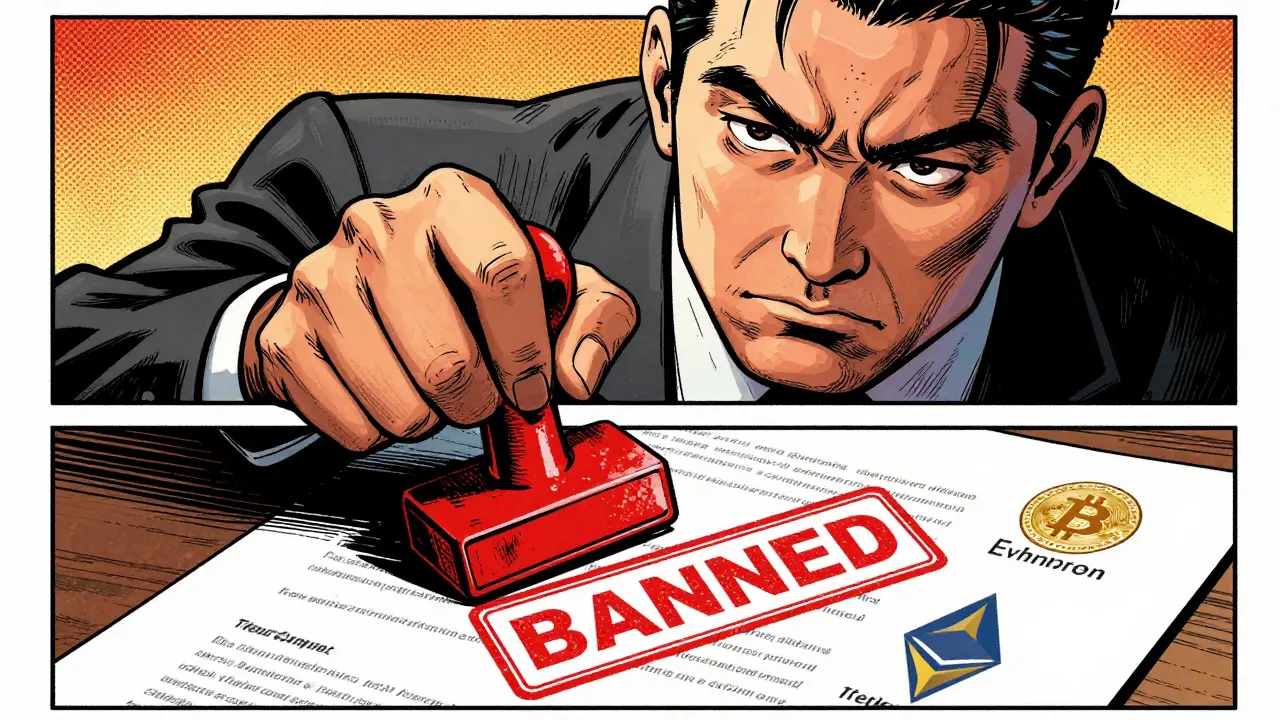
If you are holding Bitcoin or Ethereum and thinking about visiting mainland China, you need to know one thing immediately: it is illegal. As of mid-2026, cryptocurrency restrictions in China are not just strict; they are absolute. The government has moved from warning citizens to actively criminalizing almost every aspect of private digital asset ownership, trading, and mining.
This isn't a gray area anymore. It’s a hard line. For years, the narrative was that China was cracking down on speculation but loved blockchain technology. Today, the distinction is sharper than ever. While the state pushes its own digital currency with aggressive force, private cryptocurrencies like Bitcoin are treated as illicit financial instruments. Understanding this landscape is critical for anyone doing business in Asia, traveling to the region, or simply trying to understand where the global crypto market stands when the world's second-largest economy says "no."
The Timeline of Total Prohibition
To understand why the rules are so tight today, you have to look at how fast things changed. China didn’t always hate crypto. In fact, during the early days, it was home to some of the biggest mining operations and exchanges in the world. But the mood shifted dramatically starting in 2017.
Here is how the crackdown evolved:
- 2017: The People's Bank of China (PBOC) banned Initial Coin Offerings (ICOs) and shut down domestic cryptocurrency exchanges. This was the first major signal that the government viewed crypto as a threat to financial stability.
- 2021: The regulations tightened significantly. A joint notice by ten regulatory agencies declared all cryptocurrency-related business activities illegal. This included trading, payment services, and even marketing. Mining was also explicitly banned due to energy consumption concerns.
- June 1, 2025: The final nail in the coffin. A comprehensive ban was implemented that legally prohibits individual ownership and transacting in any form of cryptocurrency. This escalated previous rules from banning *businesses* to effectively making *holding* crypto a violation of law.
The shift from "banning exchanges" to "banning ownership" is massive. It means you can’t just say, "I’m not trading, I’m just holding." Under the current framework, possession itself is part of the prohibited activity chain.
What Is Actually Illegal? A Breakdown
You might think you’re safe if you keep your coins in a cold wallet and never sell them. Think again. The 2025 ban covers a wide spectrum of activities. Here is what falls under the hammer:
| Activity | Status | Consequence |
|---|---|---|
| Trading (Buying/Selling) | Illegal | Confiscation of assets, fines |
| Mining | Illegal | Equipment seizure, criminal charges |
| Individual Ownership | Illegal | No legal protection, potential confiscation |
| Payment Settlement | Illegal | Ban on using crypto for goods/services |
| ICO/Token Issuance | Illegal | Criminal fraud charges |
| Marketing/Promotion | Illegal | Fines, platform shutdowns |
Even providing information intermediation services-like running a website that tracks crypto prices-is prohibited. The government wants to eliminate the entire ecosystem, not just the financial transactions. If you are a foreigner living in Shanghai or Beijing, these rules apply to you too. There is no exemption for tourists or expats. The courts have consistently ruled that any gains from crypto activities are "illicit proceeds" subject to immediate confiscation.
Blockchain vs. Crypto: The State’s Double Standard
One of the most confusing parts of Chinese policy for outsiders is the claim that "we love blockchain, we hate crypto." Is this genuine, or just PR spin? It’s a bit of both.
The Chinese government views blockchain technology as a tool for control and transparency. They want the distributed ledger capabilities for supply chain tracking, government record-keeping, and industrial efficiency. But they reject the decentralized financial aspect because it bypasses state control.
When officials talk about the risks of cryptocurrency, they cite money laundering, capital flight, and financial instability. When they talk about blockchain, they cite innovation and economic modernization. This distinction allows them to continue investing billions into blockchain infrastructure while simultaneously shutting down every Bitcoin miner in the country. It’s a calculated move to centralize digital power rather than distribute it.
The Rise of the Digital Yuan (e-CNY)
If private crypto is out, what is in? The answer is the Digital Yuan, also known as e-CNY. This is the Central Bank Digital Currency (CBDC) issued by the People's Bank of China.
The e-CNY is a digital form of the physical Renminbi (RMB). Unlike Bitcoin, it is centralized, fully backed by the state, and offers zero anonymity to users. Every transaction is visible to the authorities.The push for e-CNY is aggressive. Pilot tests have expanded across dozens of cities, covering everything from retail purchases to cross-border payments. The goal is clear: replace cash and private digital assets with a state-monitored digital currency. By outlawing Bitcoin and Ethereum, the government removes competition for the e-CNY. You don’t have a choice between Bitcoin and the Digital Yuan; you only have the Digital Yuan.
This strategy serves three main purposes:
- Financial Control: The state can track spending habits and enforce monetary policy directly.
- Anti-Money Laundering: Since every transaction is linked to an identity, illicit flows are easier to detect.
- Global Influence: China aims to use the e-CNY to challenge the US dollar’s dominance in international trade.
Hong Kong: The Exception That Proves the Rule
If you hear news about crypto thriving in China, it’s likely coming from Hong Kong. It is crucial to distinguish between mainland China and Hong Kong. They operate under different legal frameworks.
In May 2025, Hong Kong passed the Stablecoin Bill, solidifying its position as a regulated hub for digital assets. This allows licensed entities to issue and trade stablecoins within the territory. However, this does not mean mainland residents can easily access these markets. Cross-border restrictions remain tight, and mainland authorities strictly prevent capital from flowing into Hong Kong’s crypto sector without approval.
For a mainland citizen, moving crypto funds to Hong Kong to trade is still a high-risk activity that violates mainland laws. The "one country, two systems" model creates a loophole for international businesses setting up offices in HK, but it doesn’t grant freedom to average individuals on the mainland.
Penalties and Real-World Consequences
What happens if you get caught? The penalties are severe and escalating.
Administrative penalties include heavy fines and confiscation of all crypto assets. But it can go further. If your activities are deemed "illegal fundraising" or "financial fraud," you face criminal charges. This often applies to people who organize trading groups, run informal exchanges, or promote crypto investments on social media.
A key point for investors: if you are scammed, you have no recourse. Chinese courts will not help you recover stolen crypto. In fact, judicial interpretations from 2022 reinforced that contracts involving cryptocurrency are void. If you lend money to someone for a crypto investment and they disappear, the court will likely rule that your initial agreement was illegal, denying your claim. The system prioritizes public order over private dispute resolution in this sector.
Future Outlook: Will the Ban Lift?
Many hope that as crypto becomes more mainstream globally, China will soften its stance. The reality is bleak. As of June 2026, there are no signs of reversal. The government’s commitment to the e-CNY and financial sovereignty suggests that the ban on private cryptocurrencies is permanent.
The escalation from partial restrictions in 2017 to total prohibition in 2025 indicates that policymakers view decentralized assets as an existential threat to their economic model. Until the digital yuan achieves full global adoption or the geopolitical landscape shifts drastically, expect the firewall around crypto in China to remain impenetrable.
Is it illegal to own Bitcoin in China in 2026?
Yes. As of the June 2025 ban, individual ownership and transacting in cryptocurrencies like Bitcoin are illegal in mainland China. Possession is considered part of the prohibited activity, and assets can be confiscated.
Can foreigners trade crypto while visiting China?
No. The ban applies to all individuals within mainland China, regardless of nationality. Tourists and expats are subject to the same laws as citizens. Engaging in trades can lead to fines and confiscation.
What is the difference between the e-CNY and Bitcoin?
The e-CNY is a centralized digital currency issued by the Chinese government, fully backed by the state and monitored for transactions. Bitcoin is a decentralized, private cryptocurrency with no central authority. China promotes the e-CNY while banning Bitcoin.
Is crypto mining allowed in China?
No. Cryptocurrency mining has been explicitly illegal since 2021 due to energy consumption concerns. Authorities actively shut down mining facilities and seize equipment.
Does Hong Kong have the same crypto bans as mainland China?
No. Hong Kong operates under a different legal system and has implemented regulated frameworks for stablecoins and crypto trading. However, mainland residents cannot freely access these markets due to capital controls.
Will China unban crypto in the future?
It is highly unlikely. The government’s focus on the digital yuan (e-CNY) and financial control suggests the ban on private cryptocurrencies is a long-term, permanent policy.