

Imagine buying a digital asset today and selling it next year for double the price. In most of Europe, you’d owe a significant chunk of that profit to the government. But if you are in Germany, that entire gain could be completely tax-free. This isn't a loophole or a temporary glitch. It is a deliberate, codified policy designed to encourage long-term investment in digital assets. For millions of investors, understanding this rule is the difference between keeping your hard-earned profits and handing over nearly half to the tax office.
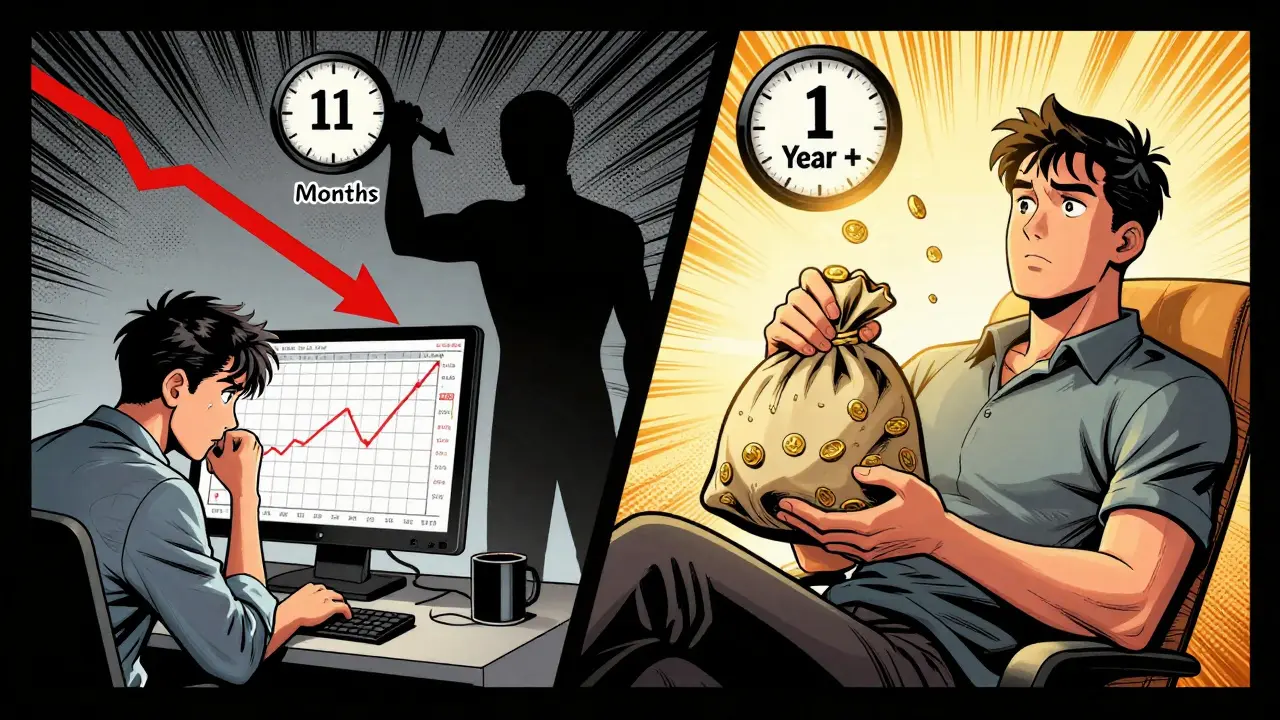
The core of this advantage lies in a specific section of the German Income Tax Act known as Section 23 EStG. This law treats cryptocurrencies not as stocks or traditional securities, but as private assets-similar to how you might treat gold coins or rare stamps. The rule is simple but strict: if you hold a cryptocurrency for more than one year before selling, swapping, or spending it, any capital gain is exempt from income tax. There is no cap on the amount you can make. Whether you turn €100 into €1,000 or €10,000 into €1,000,000, the tax bill remains zero.
The One-Year Holding Period Rule
The clock starts ticking the moment you acquire the asset. If you buy Bitcoin on January 1st at 10:00 AM, you must wait until exactly January 1st of the following year at 10:01 AM to sell it without triggering taxes. This precision matters because the German tax authorities, specifically the Federal Central Tax Office (BZSt), require exact dates for compliance. A sale even one day early moves the transaction into taxable territory.
This rule applies to all types of crypto assets. It covers major coins like Bitcoin and Ethereum, as well as smaller altcoins, stablecoins, and non-fungible tokens (NFTs). The classification is broad, ensuring that almost any digital asset you hold falls under this protective umbrella, provided you respect the time limit.
- Acquisition Date: The day you receive the crypto in your wallet counts as day zero.
- Disposal Date: The day you sell, swap, or spend the crypto triggers the event.
- Calculation: You must calculate the duration down to the minute to ensure it exceeds 365 days.
Short-Term Gains and the €1,000 Allowance
What happens if you need to sell before the one-year mark? You don't automatically face a massive tax bill. Germany offers a safety net for small traders through an annual tax-free allowance. As of 2024, this threshold was raised to €1,000 per year. If your total short-term crypto gains in a calendar year do not exceed this amount, you pay nothing.
If your gains surpass €1,000, however, the entire profit becomes subject to your personal income tax rate. These rates are progressive, ranging from 14% for lower incomes up to 45% for high earners. On top of that, there is a Solidarity Surcharge of 5.5% on the tax amount. This means a high-income earner could see their effective tax rate climb to nearly 47%. This steep gradient creates a powerful incentive to stick to the long-term strategy whenever possible.
| Country | Long-Term Tax Rate | Short-Term Tax Rate | Annual Exemption |
|---|---|---|---|
| Germany | 0% | 14% - 45% + Surcharges | €1,000 |
| France | 30% Flat Rate | 30% Flat Rate | None |
| United Kingdom | 10% - 20% | 10% - 20% | £3,000 |
| Portugal | 0% (Subject to Change) | 28% | None |
Record-Keeping Requirements
You cannot simply claim everything is tax-free because you think you held it long enough. The burden of proof lies with you. To comply with German tax law, you must maintain meticulous records of every transaction. This includes the exact date and time of purchase, the amount spent, the exchange rate at that moment, and the corresponding data for when you disposed of the asset.
For investors using dollar-cost averaging (DCA) strategies, where they buy small amounts regularly, this can get complicated. Each purchase has its own holding period. Selling some of your holdings might trigger taxes on the older units while leaving newer units still within the tax-free window. Tracking this manually is error-prone and risky. Many German investors turn to specialized software like Blockpit or CoinTracker to automate these calculations. These tools connect to your exchanges and wallets, generating reports that align with BZSt requirements.
Complex Scenarios: Staking and DeFi
The one-year rule works smoothly for simple buy-and-hold strategies. Things get murkier with active participation in the ecosystem. Activities like staking, lending, or providing liquidity in decentralized finance (DeFi) protocols introduce new variables. Currently, there is no specific guidance from the BZSt on whether earning rewards extends or resets the holding period.
In practice, tax experts often advise treating staking rewards as separate income events rather than part of the original principal. This means the reward itself might be taxed as income when received, regardless of how long you hold it. Similarly, swapping one token for another in a DeFi pool is considered a disposal of the first asset and an acquisition of the second. If the first asset was held for less than a year, that swap triggers a taxable event. Because of this ambiguity, many users report frustration and recommend consulting a professional accountant for complex DeFi portfolios.
Audits and Penalties
The German tax authority does not ignore crypto. While the rules are favorable, enforcement is real. The Finanzamt (tax office) conducts audits, particularly targeting large transactions or inconsistencies in reported income. If you fail to report short-term gains that exceed the €1,000 allowance, the penalties can be severe. Fines can reach up to 40% of the unpaid tax, plus interest.
To protect yourself, keep all documentation readily available. This includes exchange statements, wallet addresses, and transaction hashes. Digital trails are permanent, so your records should be too. Using reputable exchanges that provide detailed export files makes this process much easier than trying to reconstruct history from memory.
Future Outlook and EU Pressure
Germany’s stance is currently stable, but the broader European landscape is shifting. The introduction of the MiCA Regulation (Markets in Crypto-Assets) aims to harmonize rules across the EU. While MiCA focuses heavily on consumer protection and market integrity, it may eventually influence tax policies. Some analysts predict pressure for tax harmonization by 2027-2030, which could potentially alter Germany’s generous exemptions. However, as a major economic power, Germany has significant leverage to maintain policies that attract innovation and investment. For now, the framework remains unchanged, offering a clear path for tax-efficient investing.
Does the zero-tax rule apply to all cryptocurrencies?
Yes, the exemption under Section 23 EStG applies to all cryptocurrencies classified as private assets. This includes Bitcoin, Ethereum, altcoins, stablecoins, and NFTs. The key requirement is holding the asset for more than one year before disposal.
What happens if I sell my crypto after 11 months?
If you sell after 11 months, the gain is considered short-term. You can realize up to €1,000 in profit tax-free each year. Any profit above this threshold is added to your annual income and taxed at your marginal income tax rate, plus the solidarity surcharge.
How do I calculate the holding period accurately?
The holding period begins at the exact moment of acquisition (purchase receipt in your wallet) and ends at the moment of disposal (sale or swap). You must calculate this duration precisely. For example, buying on Jan 1 at 10:00 AM requires waiting until Jan 1 of the next year at 10:01 AM to qualify for the exemption.
Are staking rewards tax-free after one year?
Generally, no. Staking rewards are typically treated as income when received, not as capital gains from the original asset. Therefore, they are subject to income tax regardless of how long you hold the resulting tokens. Consult a tax professional for specific advice on DeFi activities.
Will Germany change its crypto tax laws soon?
There are no announced changes to the one-year exemption rule through 2025. However, EU-wide regulations like MiCA may create pressure for harmonization in the future. Investors should stay informed but can currently rely on the existing favorable framework.