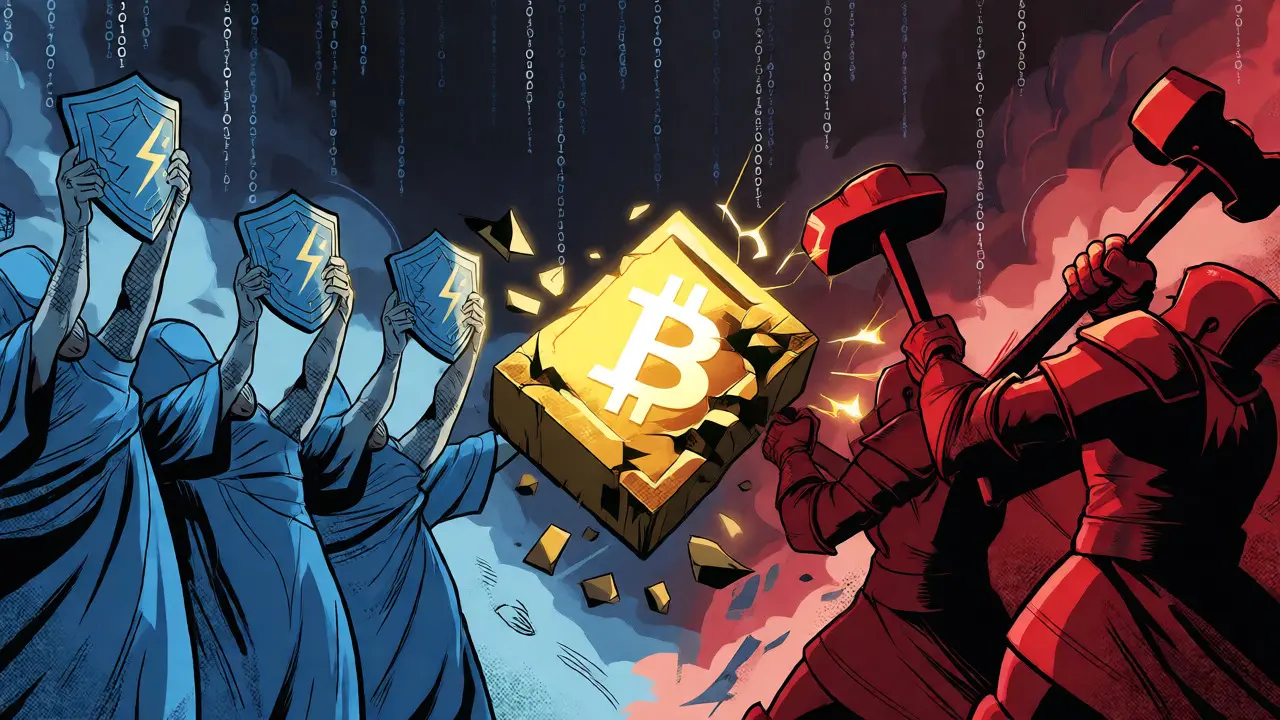
Imagine you own a house. One day, half the residents decide the roof is too small to keep everyone dry during a storm, while the other half insists the current design preserves the building's structural integrity. They can't agree. So, they split the property in two. That’s essentially what happened with Bitcoin. It wasn’t just code updates; it was a philosophical divorce that created entirely new cryptocurrencies. If you’ve ever wondered why there are so many versions of Bitcoin floating around, or if you’re trying to figure out which one actually solves the "slow and expensive" problem, this breakdown cuts through the noise.
The Core Disagreement: Speed vs. Security
To understand the forks, you have to look at the original problem. By 2017, Bitcoin was struggling. Transaction fees were spiking, and confirmation times were dragging because the network had a strict limit: blocks could only hold about 1 megabyte of data. This bottleneck meant the network could process roughly seven transactions per second. For a system designed to be "electronic cash," that’s painfully slow compared to Visa’s thousands.
The developer community split into two camps. One group, often aligned with Bitcoin Core, believed keeping blocks small preserved decentralization. They argued that anyone should be able to run a node on a home computer without needing massive storage drives. Their solution? Keep the base layer lean and handle volume on a "second layer," like the Lightning Network.
The other camp said, "No way." They argued that scaling up by increasing block size was the true path to Satoshi Nakamoto’s vision of cheap, fast payments for everyone. This disagreement didn’t stay in chat rooms; it led to the first major hard fork.
Bitcoin Cash (BCH): The First Big Split
In August 2017, the dissenters launched Bitcoin Cash (BCH). The technical change was simple but controversial: they increased the block size limit from 1 MB to 8 MB (later raised to 32 MB). The goal was straightforward-more space per block means more transactions processed simultaneously, leading to lower fees and faster confirmations.
| Feature | Bitcoin (BTC) | Bitcoin Cash (BCH) | Bitcoin SV (BSV) |
|---|---|---|---|
| Block Size Limit | ~1 MB (SegWit effective ~4MB) | 32 MB | 128 MB+ (Uncapped potential) |
| Primary Goal | Digital Gold / Store of Value | Peer-to-Peer Electronic Cash | Global Enterprise Data Ledger |
| Scaling Strategy | Second Layer (Lightning) | On-Chain Scaling | Massive On-Chain Scaling |
| Governance Style | Distributed Consensus | Community Driven | Led by Craig Wright |
BCH gained traction quickly. People liked the idea of paying for coffee with crypto without waiting ten minutes or paying $5 in fees. However, the peace didn’t last long. Within the BCH community, a new argument emerged. Some felt 32 MB wasn’t enough. They wanted to go bigger, much bigger, to handle enterprise-level data loads.
Bitcoin SV (BSV): The War for Satoshi’s Soul
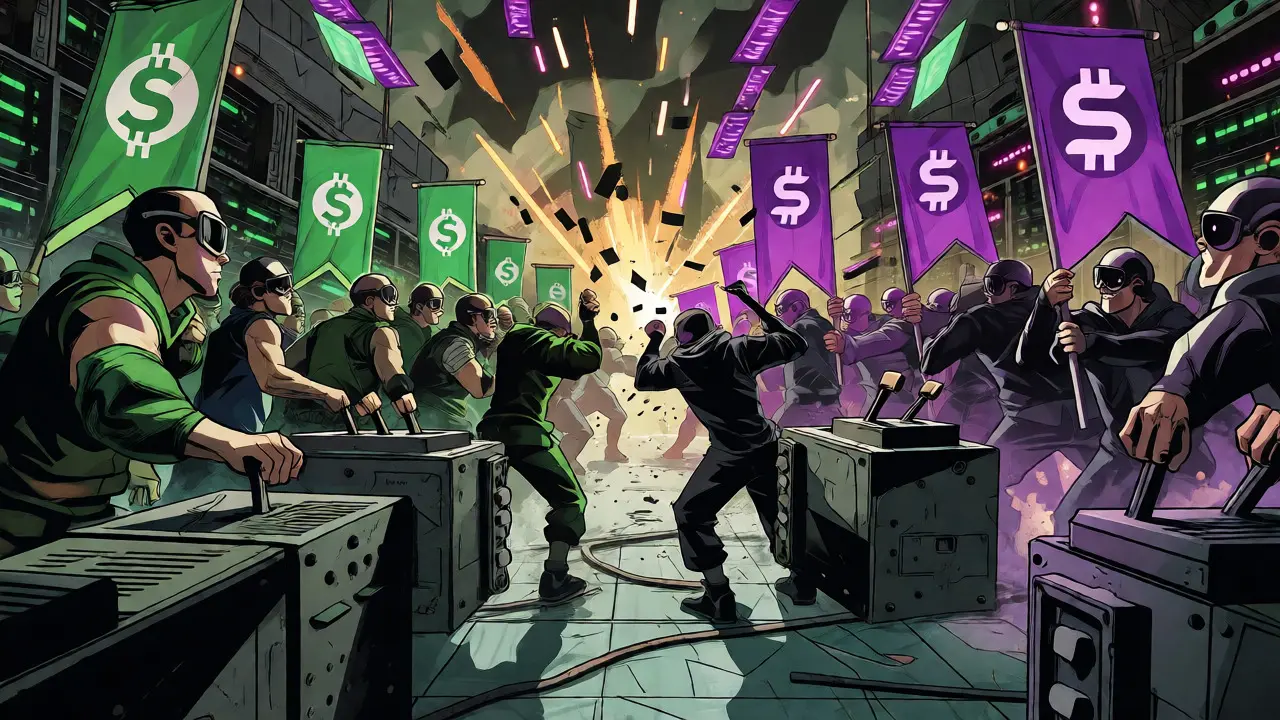
By late 2018, tensions within Bitcoin Cash boiled over. A faction led by Craig Wright, a controversial computer scientist who claims to be Satoshi Nakamoto, pushed for even larger blocks and the removal of certain scripting restrictions. They believed that to truly replace global payment systems, the blockchain needed to handle millions of transactions daily, not just thousands.
This resulted in the creation of Bitcoin SV (BSV) in November 2018. "SV" stands for "Satoshi Vision." The team argued that BCH had strayed from the original protocol by adding complexity. BSV stripped away some features and raised the block size cap to 128 MB, with the theoretical ability to grow indefinitely. They also removed limits on OP_RETURN transactions, allowing users to store arbitrary data directly on the chain.
The launch wasn’t quiet. It triggered a "hash war." Since BTC, BCH, and BSV all use the same SHA-256 mining algorithm, miners could switch their hardware between chains instantly. Miners were incentivized to attack both chains to prove dominance. Research from BitMEX showed that miners lost millions of dollars in profits during this chaotic period. Eventually, replay protection mechanisms helped stabilize the networks, but the damage to BSV’s reputation was significant due to its tight association with Wright’s contentious persona.
Real-World Performance: Did It Work?
You might assume that bigger blocks automatically mean better performance. In theory, yes. In practice, it’s complicated. After the splits, transaction volumes told an interesting story. Bitcoin remained the dominant asset for value transfer. In mid-2019, Bitcoin commanded over 85% of the adjusted transfer value among these three assets. Why? Because people still viewed BTC as digital gold-a secure, scarce asset-rather than just a payment rail.
BCH and BSV did see lower median transaction values, often between $1 and $10, reflecting their focus on small payments. But here’s the kicker: neither chain consistently used its full capacity. Despite having 32 MB or 128 MB blocks available, the daily average block sizes often hovered well below Bitcoin’s effective capacity. This suggests that demand for high-volume on-chain transactions wasn’t as explosive as the proponents predicted. Most users simply didn’t need to store gigabytes of data on a public ledger, or they preferred the established liquidity of Bitcoin.
Security also became a differentiator. Bitcoin has the largest hash rate in the world, making it incredibly resistant to 51% attacks. BCH and BSV, while secure, have significantly less mining power. At one point six months post-fork, BCH had nearly five times the hash power of BSV. This disparity matters. If a single entity controls more than 50% of a smaller network’s mining power, they can rewrite recent history, double-spend coins, and disrupt trust. Bitcoin’s sheer size makes such an attack prohibitively expensive, whereas smaller forks carry higher inherent risk.

Why Should You Care About These Forks?
If you’re holding Bitcoin, do you need to worry about BCH or BSV? Generally, no. Your BTC remains BTC. However, understanding forks helps you grasp how cryptocurrency governance works. Unlike traditional companies where a CEO makes decisions, crypto communities vote with their code and their computing power. When consensus breaks, the network splits.
For investors, these forks represent different bets on the future of money. Buying BTC is a bet on scarcity and institutional adoption. Buying BCH is a bet that everyday payments will eventually move fully on-chain. Buying BSV is a bet that massive enterprise data solutions will find a home on a scalable blockchain. Each path carries different risks. BSV, for instance, faces skepticism due to its leadership controversies. BCH competes with newer, faster chains like Solana or Ethereum Layer 2s.
It’s also a lesson in volatility. During the hash wars, prices swung wildly. If you held BCH when BSV forked off, you likely received an equal amount of BSV tokens for free. Many people sold them immediately, impacting market supply. Knowing how forks work ensures you don’t accidentally lose access to new assets or get confused about which wallet supports which chain.
Key Takeaways
- Forks happen when consensus fails: They are not bugs; they are features of decentralized governance.
- Technical differences matter: Block size impacts speed and cost but also affects decentralization and security.
- Adoption doesn’t follow technology alone: Despite larger blocks, BCH and BSV haven’t displaced Bitcoin’s dominance in value transfer.
- Security scales with hash rate: Smaller networks are more vulnerable to attacks, requiring careful monitoring.
- Philosophy drives development: The debate isn’t just about code; it’s about whether Bitcoin should be a store of value or a medium of exchange.
What is a hard fork in cryptocurrency?
A hard fork is a fundamental change to a blockchain's protocol that makes previously invalid blocks and transactions valid, or vice-versa. All nodes and users must upgrade to the new software version. If they don't, they become separated from the rest of the network, effectively creating two separate blockchains running parallel histories.
Is Bitcoin Cash safer than Bitcoin?
Bitcoin is generally considered safer due to its significantly higher hash rate. A higher hash rate makes it exponentially more expensive and difficult for any single entity to perform a 51% attack. While Bitcoin Cash is secure, its lower mining power makes it theoretically more vulnerable than Bitcoin, though still robust against most realistic threats.
Did I get free Bitcoin Cash when it forked?
Yes, if you held Bitcoin in a private wallet (where you control the keys) before the August 2017 fork, you were entitled to an equal amount of Bitcoin Cash. Similarly, holders of BCH before the November 2018 fork received Bitcoin SV. Exchanges handled this differently, so always check your specific provider's policy.
Why did Bitcoin SV fork from Bitcoin Cash?
The BSV team believed Bitcoin Cash had not gone far enough in scaling. They wanted to remove certain scripting opcodes and increase block sizes further to support enterprise-level applications and massive data storage, claiming this was closer to Satoshi Nakamoto's original vision of a global electronic cash system.
Which Bitcoin fork is the most popular now?
Bitcoin (BTC) remains the most popular by market capitalization, liquidity, and adoption. Among the forks, Bitcoin Cash (BCH) typically maintains a larger user base and developer activity compared to Bitcoin SV (BSV), largely due to BSV's controversy surrounding its leadership and claims regarding Satoshi Nakamoto's identity.