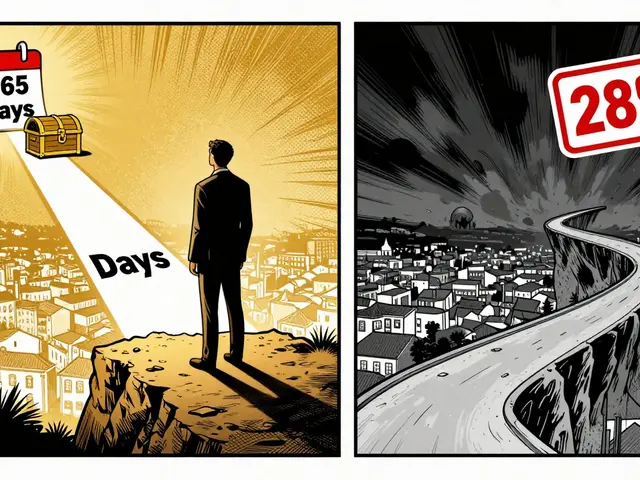

Remember when Portugal was the ultimate paradise for crypto investors? For years, holding Bitcoin or Ethereum there meant zero taxes on your profits. That golden era ended in 2023. Today, if you sell your digital assets too quickly, you pay a flat 28% short-term crypto tax. But here is the good news: if you have the patience to hold, that profit can still be completely tax-free.
The rules have shifted from "pay nothing" to "pay only if you trade like a day trader." This change aligns Portugal with broader European Union standards while keeping it attractive for long-term holders. If you are living in Lisbon or planning to move there, understanding this split between short-term speculation and long-term investment is critical. One wrong calculation on your holding period could cost you thousands of euros.
How the 28% Rate Works: The 365-Day Rule
The core of Portugal’s current cryptocurrency taxation rests on a simple timeline: one year. The Portuguese tax authority, Autoridade Tributária e Aduaneira (AT), defines a "short-term" asset as any cryptocurrency held for less than 365 days. If you buy Bitcoin today and sell it 364 days later, the profit is taxable at a flat rate of 28%. If you wait until day 366, that same profit becomes exempt from personal income tax.
| Holding Period | Tax Treatment | Rate Applied |
|---|---|---|
| Less than 365 days | Taxable Capital Gain | Flat 28% |
| More than 365 days | Tax Exempt | 0% |
| Professional Trading Activity | Business Income | Progressive (14.5% - 53%) |
This distinction forces a strategic choice. Are you a speculator trying to catch quick market swings, or are you an investor building wealth over time? The tax code treats these two behaviors very differently. The 28% rate applies to all disposals within that first year, including converting crypto to fiat currency (like Euros) and, in many cases, swapping one cryptocurrency for another.
When 28% Is Too High: The Progressive Tax Option
You might assume the 28% flat rate is always the worst-case scenario. Surprisingly, for some high earners, it is actually a safety net. Portuguese taxpayers have a unique option: they can choose to add their short-term crypto gains to their total annual income instead of paying the flat 28%.
Why would you do that? Because Portugal uses a progressive income tax system. If your total income (salary plus crypto gains) falls into lower brackets, your effective tax rate might be significantly lower than 28%. However, if you are already earning a high salary, adding crypto gains pushes you into higher brackets. In 2024, the top marginal income tax rate reached 48% for income exceeding €81,199. Once you hit those upper tiers, the government mandates aggregation, meaning you cannot opt for the 28% flat rate anymore. You must pay the higher progressive rate.
For most average residents, the math is simple: compare your expected effective income tax rate against 28%. If your marginal tax bracket is below 28%, aggregating your gains saves you money. If it is above, stick to the flat rate. Always run the numbers before filing.
Passive Income: Staking, Lending, and DeFi Rewards
Earning interest on your crypto counts as income, not just capital gains. Whether you are staking Ethereum, providing liquidity on a decentralized finance (DeFi) protocol, or lending USDT on a platform, Portugal taxes these rewards immediately upon receipt.
These passive income streams fall under the same 28% flat tax regime, provided you are not classified as a professional trader. The key difference here is timing. With capital gains, you pay when you sell. With staking rewards, you pay when the reward hits your wallet. You must calculate the value of those tokens in Euros on the exact day you receive them. That value becomes your taxable base.
If you are actively managing large pools of liquidity or running a node farm as a primary business, this income shifts categories. It becomes business income, subject to the progressive rates mentioned earlier. For the casual holder earning a few percent APY, the 28% flat rate is the standard rule.
Are You a Professional Trader?
This is the gray area that causes the most headaches. Portugal does not have a strict numerical definition for "professional trader," but the tax authorities look at specific behavioral patterns. If your crypto activities resemble a job, you lose the benefit of the 28% flat rate and the long-term exemption entirely.
Factors that trigger professional status include:
- Frequency: Executing dozens or hundreds of trades per month.
- Sophistication: Using complex derivatives, margin trading, or algorithmic bots.
- Primary Income: Crypto profits constitute your main source of livelihood.
- Infrastructure: Operating from a dedicated office space with specialized software.
If you fit this profile, your profits are treated as business revenue. You will file using Anexo B instead of Anexo G. Your tax rate will depend on your total income, ranging from 14.5% to 53%, plus social security contributions. This classification is subjective, so keeping detailed records of your strategy and intent is crucial if the AT ever audits you.
Filing Your Taxes: The Portal das Finanças
Reporting crypto in Portugal requires precision. You will use the online platform, Portal das Finanças, to submit your Modelo 3 (the main income tax return). Depending on your activity, you need to attach specific annexes:
- Anexo G: Used for capital gains. Here, you separate assets held for less than 365 days (taxable at 28%) from those held longer (exempt). You must list each transaction with purchase date, sale date, amount, and price in Euros.
- Anexo E: Used for passive income. Report staking, lending, and mining rewards here. These are taxed at the flat 28% rate.
- Anexo B: Reserved for professional traders. Treat your crypto business like any other commercial enterprise.
The biggest challenge is record-keeping. You need the exchange rate in Euros for every single transaction. Using crypto tax software that integrates with major exchanges can automate this process, ensuring you don't miss a single staking reward or small swap.

The End of the NHR Advantage
For years, the Non-Habitual Resident (NHR) program was a massive draw for crypto investors moving to Portugal. Under NHR, foreign-sourced income could often be taxed at a flat 20% rate or even exempted, depending on the specific treaty and income type. This made the effective crypto tax rate much lower than the standard 28%.
However, the NHR program closed to new applicants in January 2024. If you were already enrolled before that date, you enjoy the benefits for ten years. If you are moving to Portugal in 2026, you face the standard tax rules. There is no special discount for newcomers. This shift levels the playing field but removes a significant incentive for high-net-worth individuals relocating specifically for tax optimization.
How Portugal Compares to Europe
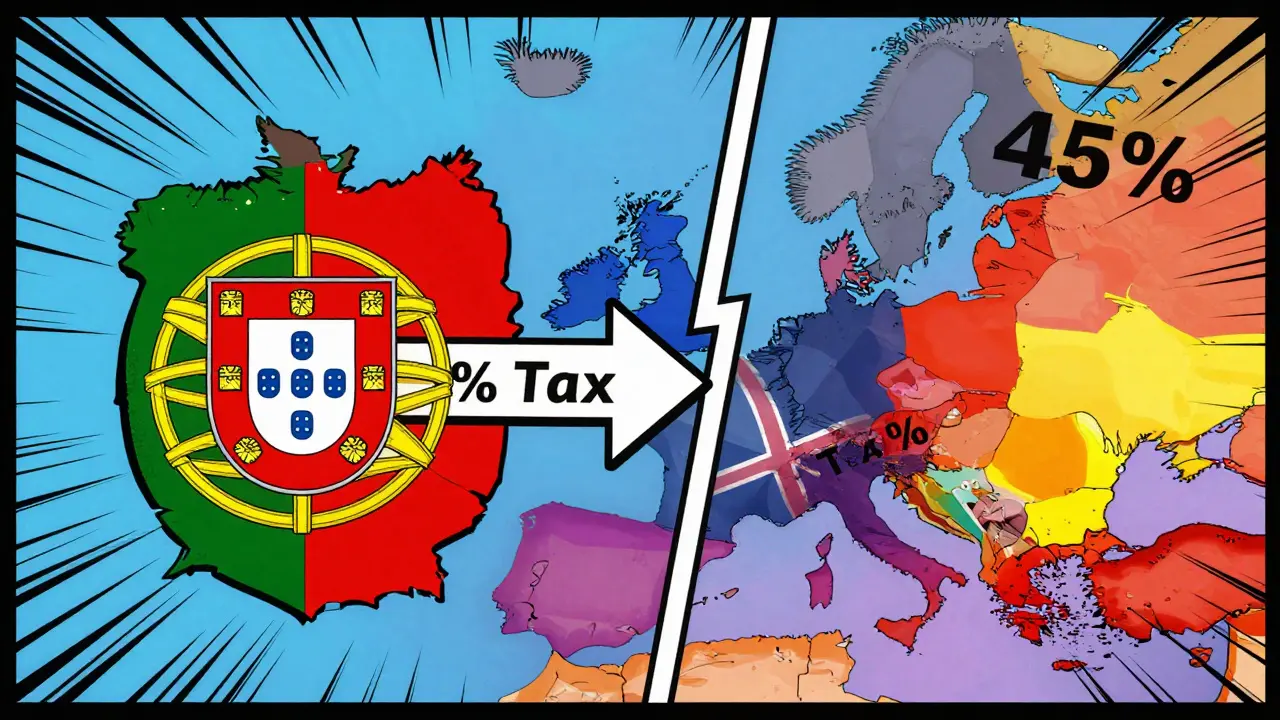
Despite the 28% short-term tax, Portugal remains competitive within the European Union. Let’s look at the neighbors:
- Germany: Taxes crypto gains as income up to 45% if held under one year. After one year, it is tax-free. Similar structure to Portugal, but higher potential rates for high earners.
- France: Applies a flat 30% tax (including social charges) on all crypto gains, regardless of how long you hold them. No long-term exemption.
- United Kingdom: Treats crypto as capital gains (up to 20%) or income (up to 45%). No specific holding period exemption for capital gains.
- Spain: Taxes gains as savings income at rates between 19% and 28%. No complete exemption for long-term holdings.
Portugal’s complete exemption for assets held over a year is its strongest selling point. While Germany offers a similar break, France and the UK do not. For someone willing to HODL, Portugal is arguably the best jurisdiction in Western Europe.
Practical Tips for Minimizing Your Tax Bill
You don’t need to be a lawyer to optimize your taxes, but you do need discipline. Here are three actionable strategies:
1. Calendar Your Sales: Use a spreadsheet or app to track exactly when you bought each coin. Set reminders for day 365. Selling on day 364 costs you 28% of your profit. Waiting one more day saves you that entire amount. The ROI on waiting 24 hours is infinite.
2. Harvest Losses: If you have lost money on a short-term trade, you can offset those losses against your gains. If you made €10,000 on a short-term Bitcoin trade but lost €2,000 on a short-term altcoin trade, you only pay tax on the net €8,000. Keep records of your losers; they are valuable.
3. Choose the Right Annex: Before filing, calculate both scenarios. Add your crypto gains to your salary and see what your effective tax rate is. If it’s lower than 28%, file them together. If it’s higher, keep them separate in Anexo G. Do not guess; calculate.
Is crypto tax-free in Portugal in 2026?
It depends on how long you hold. Cryptocurrency gains are tax-free if you hold the asset for more than 365 days. If you sell within 365 days, you pay a 28% tax on the profit. Passive income like staking is generally taxed at 28% regardless of holding period.
Do I pay tax on staking rewards in Portugal?
Yes. Staking rewards are considered passive income and are taxed at a flat rate of 28% when received. You must declare the value of the rewards in Euros on the day they enter your wallet using Anexo E.
What happens if I am a professional crypto trader?
If the tax authorities classify you as a professional trader, your profits are treated as business income. You lose the 28% flat rate and the long-term exemption. Instead, you pay progressive income tax rates ranging from 14.5% to 53%, plus social security contributions.
Can I offset crypto losses against gains?
Yes. You can offset short-term capital losses against short-term capital gains. This reduces your taxable base. Ensure you report both the gains and losses accurately in Anexo G to reflect the net position.
Is the NHR program still available for crypto investors?
No, the NHR program closed to new applicants in January 2024. Existing beneficiaries retain their status for ten years, but new residents moving to Portugal in 2026 must follow the standard tax rules, including the 28% short-term crypto tax.
Which form do I use to declare crypto gains?
Most individual investors use Anexo G attached to the Modelo 3 return. Use Anexo E for passive income like staking. Professional traders use Anexo B to declare business income.