You’re watching a Bitcoin miner’s dashboard. The hash rate is climbing, fans are screaming, and suddenly-boom-a new block is found. But what actually changed in that split second to make the difference between failure and success? It wasn’t a change in network difficulty, transaction fees, or even the timestamp. It was one tiny number called the nonce.
In the world of blockchain mining, especially Proof-of-Work (PoW) systems like Bitcoin, there are several variables at play. Most people focus on the big picture: electricity costs, hardware efficiency, and market price. But under the hood, miners are juggling a specific set of data points inside something called the block header. Understanding how the nonce differs from these other variables isn't just academic trivia; it explains why mining is essentially a high-speed guessing game rather than a complex strategic puzzle.
The Block Header: Where the Magic Happens
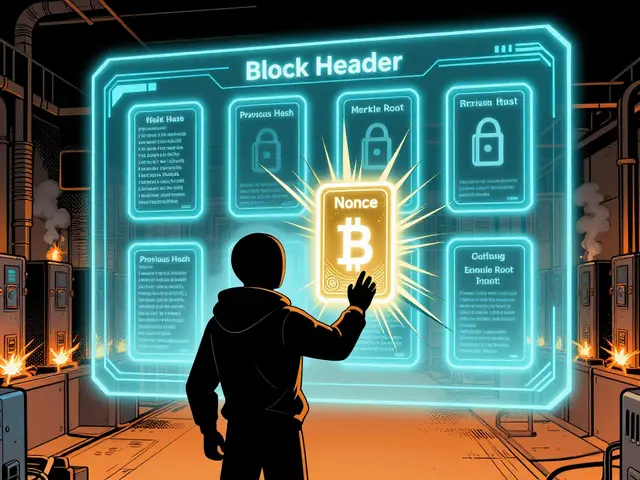
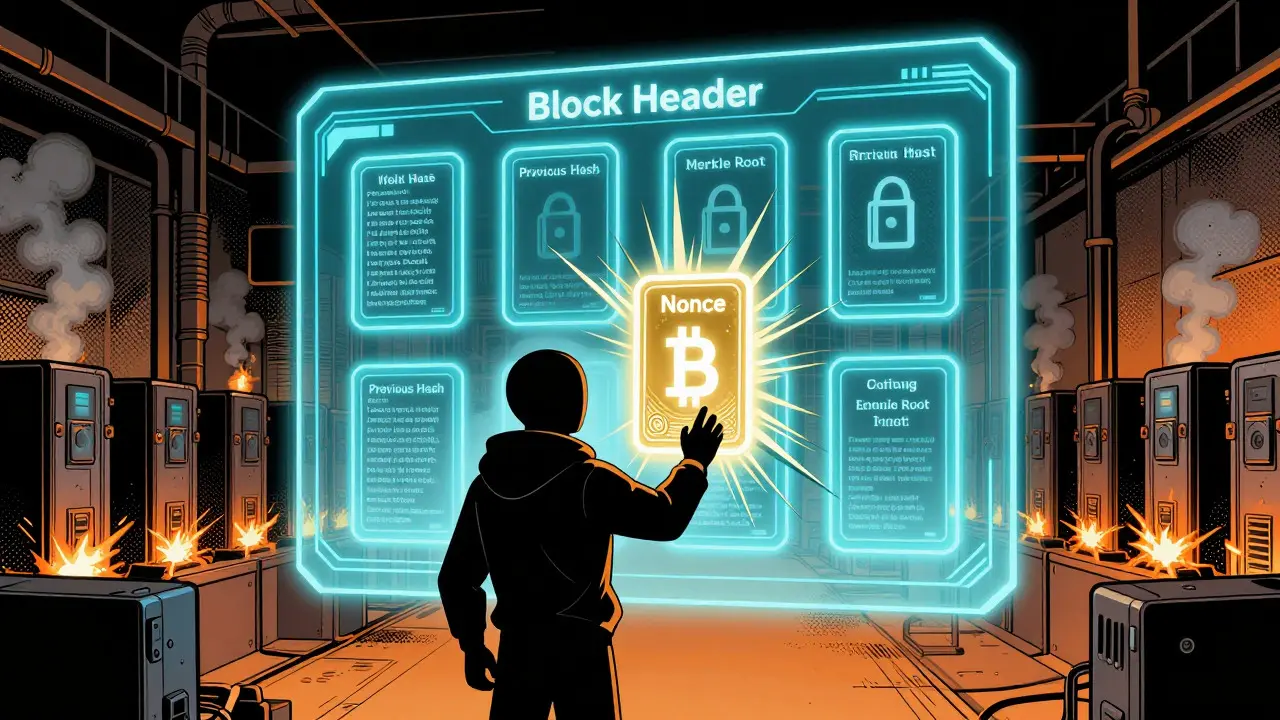
To understand the nonce, you first need to look at where it lives. Every block in a Bitcoin chain has a "header." Think of this as the ID card for that block. This header contains six critical pieces of information:
- Block Version: A number indicating which software rules were used to create the block.
- Previous Hash: The cryptographic fingerprint of the last block in the chain, linking them together.
- Merkle Root: A summary of all transactions included in this specific block.
- Timestamp: The current time when the miner started working on the block.
- Bits (Difficulty Target): A compressed representation of how hard the puzzle is right now.
- Nonce: A 32-bit number that miners can change freely.
Five of these six fields are either fixed by history (previous hash), determined by the network state (difficulty), or derived from user activity (Merkle root). The nonce is the only field that belongs entirely to the miner. It is their lever. Their tool. Their chance to win.
What Exactly Is a Nonce?
The word "nonce" comes from the phrase "number used once." In cryptography, it prevents replay attacks by ensuring each message is unique. In Bitcoin mining, it serves a similar but distinct purpose: uniqueness through brute force.
A nonce is a 32-bit integer. That means it can hold any value from 0 to 4,294,967,295 (roughly 4.3 billion). When a miner starts working on a block, they take the block header, plug in a nonce starting at zero, run it through the SHA-256 hashing algorithm twice, and check if the resulting hash is lower than the network's difficulty target. If it is, they’ve won. If not, they increment the nonce to 1, try again, then 2, then 3, and so on.
This process happens billions of times per second on modern ASIC machines. The nonce is the variable input that changes the output hash completely. Change one bit in the nonce, and the resulting hash looks nothing like the previous attempt. This sensitivity is what makes Proof-of-Work secure.
| Variable | Controlled By | Frequency of Change | Role in Mining |
|---|---|---|---|
| Nonce | Miner | Billions per second | Primary solver of the PoW puzzle |
| Difficulty Target | Network Protocol | Every 2,016 blocks (~2 weeks) | Sets the bar for winning |
| Merkle Root | Miner (via tx selection) | Per block candidate | Summarizes transactions |
| Timestamp | Miner | Once per block attempt | Validates timing constraints |
| Transaction Fees | Users & Miner Selection | Per block | Profit incentive, not part of hash calculation directly |
The Nonce vs. Difficulty Target
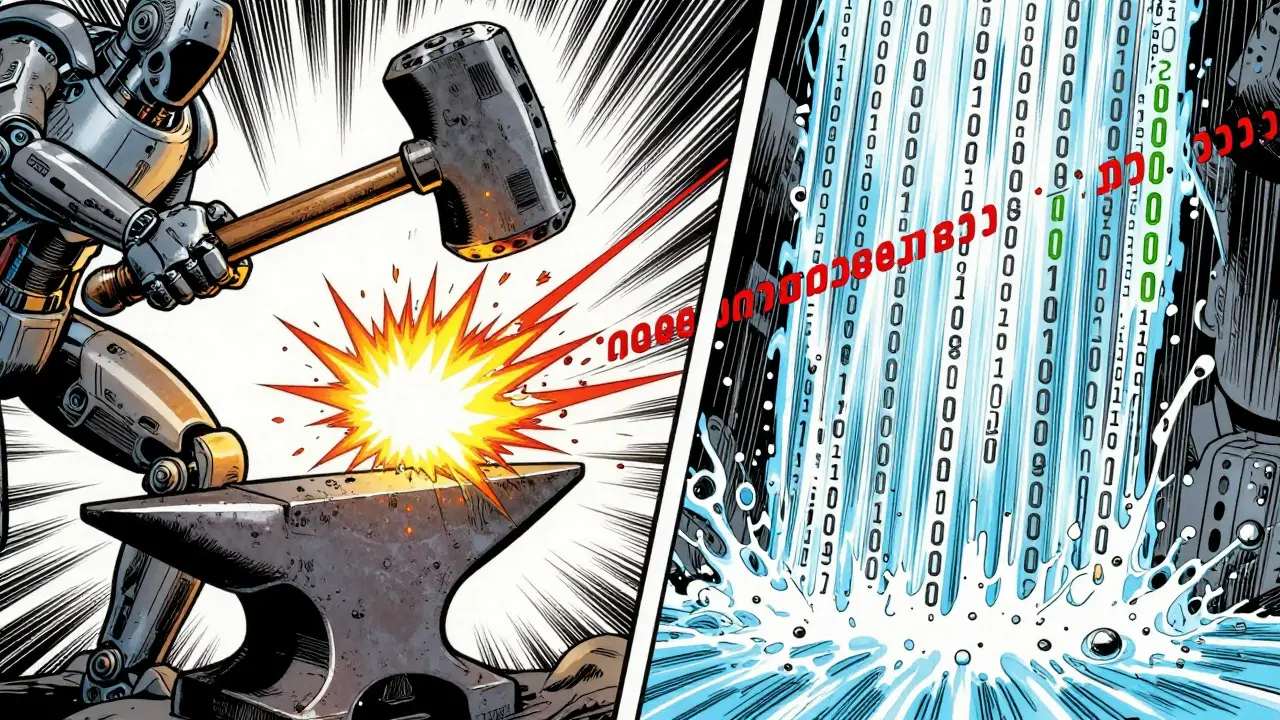
If the nonce is the hammer, the difficulty target is the nail. You can swing the hammer as fast as you want, but the size of the nail determines how much effort it takes to drive it in.
The difficulty target is not chosen by miners. It is adjusted automatically by the Bitcoin protocol every 2,016 blocks, which takes roughly two weeks. If blocks are being found too quickly (say, every 8 minutes instead of 10), the network increases the difficulty. If they’re too slow, it lowers it. This mechanism ensures a steady issuance rate of new bitcoins regardless of how many miners join or leave the network.
For an individual miner, the difficulty target is a constant during their session. They cannot tweak it. They cannot negotiate with it. They can only hope their computational power allows them to find a valid nonce before someone else does. This creates a pure meritocracy based on speed and energy consumption.
The Nonce vs. Merkle Root and Transactions
Here’s where things get interesting. While the nonce is the primary variable, miners do have some control over the Merkle root. The Merkle root is a hash that represents all the transactions in a block. By choosing which transactions to include, a miner changes the Merkle root.
Why would a miner care about this? Profit. Miners prioritize transactions with higher fees. So, they build a "candidate block" filled with the most lucrative transactions available in the mempool (the waiting area for unconfirmed transactions). Once that block template is built, the Merkle root is calculated and locked into the header.
However, changing the Merkle root doesn't help you solve the puzzle faster. It only affects your potential reward. Once the block template is set, the miner goes back to grinding away at the nonce. If they exhaust all 4.3 billion nonce values without finding a solution, they don't give up. Instead, they might slightly alter the block template-perhaps swapping out a low-fee transaction for another one-to generate a new Merkle root. This gives them a fresh set of 4.3 billion nonces to try. This technique is known as "extra nonce" usage, often implemented via coinbase inputs, because the standard 32-bit nonce space runs out almost instantly on powerful hardware.
The Nonce vs. Timestamp
The timestamp is another variable in the header, but it’s tightly constrained. It must be close to the current network time. If a miner sets the timestamp too far in the future, nodes will reject the block. If it’s too old, it might also be rejected depending on the node’s clock settings.
Historically, miners could manipulate timestamps slightly to extend the window for testing nonces. However, modern consensus rules are strict. The timestamp is essentially a static value during the active mining phase of a single block attempt. It provides context for the block’s creation but offers little leverage compared to the nonce.

Why the Nonce Dominates Mining Strategy
Because the nonce is the only variable that can be incremented rapidly and independently of external factors, it dictates the design of all mining hardware. Application-Specific Integrated Circuits (ASICs) are built solely to calculate SHA-256 hashes as fast as possible. They don't analyze transactions. They don't adjust difficulty. They just churn through nonces.
This leads to a simple reality: mining success is largely a function of luck multiplied by speed. You can optimize your transaction selection for maximum profit, but if you don't find the correct nonce, you earn nothing. This is why mining pools exist. Individual miners rarely find a block alone because the odds are astronomically low. Pools combine their hash power, share the workload of testing nonces, and distribute rewards proportionally.
As we move further into the post-halving era (with the next halving occurring in 2024, reducing block rewards to 3.125 BTC), the importance of transaction fees grows. Yet, even here, the nonce remains king. Without solving the proof-of-work puzzle via the nonce, those transaction fees remain unclaimed. The economic incentives shift, but the mechanical core of mining stays the same.
Practical Implications for Miners
For anyone running mining operations, understanding this distinction clarifies where to invest resources. Optimizing software to select better transactions improves revenue per block, but optimizing hardware to test more nonces per second improves the probability of winning a block. In a competitive landscape, the latter usually takes precedence unless you are operating at such a massive scale that marginal gains in fee optimization become significant.
Furthermore, this structure ensures decentralization in theory. Since the nonce requires no special knowledge-just raw computation-anyone with access to hardware can participate. There is no secret formula, no insider trading, and no complex algorithmic advantage. Just math, physics, and persistence.
Can a miner choose their own difficulty?
No. The difficulty target is set globally by the Bitcoin network every 2,016 blocks. Individual miners must accept the current difficulty and compete against others using the same standard.
What happens when the nonce reaches its maximum value?
When the 32-bit nonce hits 4,294,967,295, miners typically change another part of the block header, such as the timestamp or the coinbase transaction data, to create a new Merkle root. This resets the nonce counter to zero, providing a fresh range of possibilities to test.
Is the nonce random or sequential?
It can be either. Many mining algorithms start at zero and increment sequentially. Others may use pseudo-random patterns to avoid collisions in pool environments. The order doesn't affect the outcome since every hash result is equally likely to be valid.
Do transaction fees affect the nonce calculation?
Indirectly, yes. Transaction fees influence which transactions are included in the block, which changes the Merkle root. A different Merkle root means a different starting point for the nonce search. However, the fees themselves are not part of the mathematical hash calculation alongside the nonce.
Why is the nonce important for security?
The nonce ensures that creating a valid block requires significant computational work. This "Proof of Work" makes it prohibitively expensive for attackers to rewrite history, as they would need to recalculate nonces for all subsequent blocks faster than the rest of the network.