
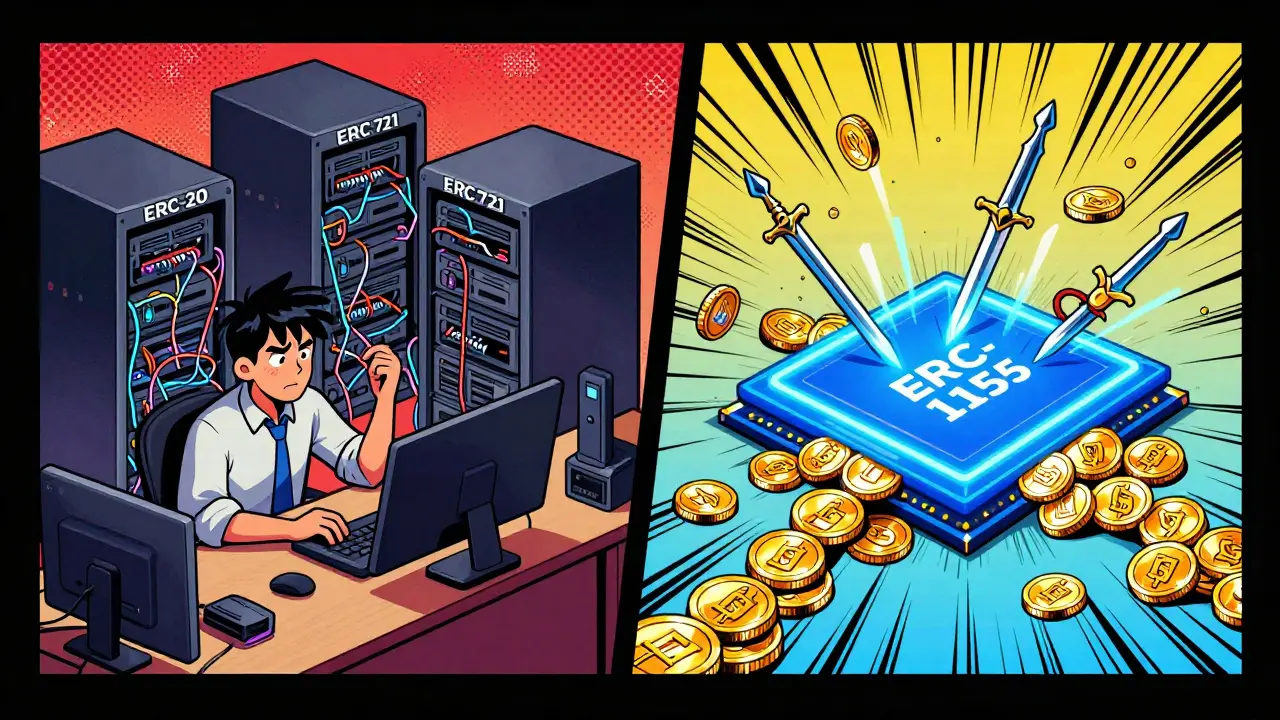
Imagine you are building a video game. You need gold coins that players can trade with each other. You also need unique swords that have special stats. Finally, you want to offer limited-edition armor sets where only 100 copies exist in the world. In the early days of blockchain, this would mean writing three completely separate smart contracts. One for the coins (using ERC-20, a standard for fungible tokens like currency), one for the swords (using ERC-721, the original standard for non-fungible tokens or NFTs), and maybe another variation for the armor. This approach is messy, expensive, and slow.
This is exactly the problem that ERC-1155, a multi-token standard for the Ethereum blockchain that allows a single smart contract to manage multiple types of tokens simultaneously was designed to solve. Proposed in 2018 by Witek Radomski from Enjin, ERC-1155 lets developers put all these different asset types into one single contract. It handles fungible tokens, non-fungible tokens, and even semi-fungible tokens without breaking a sweat. If you are looking to understand how modern blockchain games and marketplaces work efficiently, understanding this standard is essential.
How ERC-1155 Works Under the Hood
To grasp why ERC-1155 is so powerful, you first need to look at how it tracks ownership. Older standards like ERC-20 track balances simply as "Address A has 100 tokens." ERC-721 tracks it as "Address A owns Token ID #5." ERC-1155 combines these approaches using a two-dimensional mapping structure. It looks like this: `address => token ID => balance`.
Each type of item in your contract gets a unique number, called a uint256 token ID. Let’s say Token ID 1 represents Gold Coins. Token ID 2 represents a Legendary Sword. Token ID 3 represents a Common Shield. When Alice sends Bob 50 Gold Coins, the contract updates the balance for Address Bob, Token ID 1. When she sends him the Legendary Sword, it updates the balance for Address Bob, Token ID 2. The key difference here is flexibility. For the sword, the balance might just be 1 (meaning he owns it). For the gold, the balance could be 50,000. The same function handles both scenarios.
This architecture eliminates the need to deploy new contracts every time you release a new item. Instead of launching a new contract for every new skin or weapon in a game, you just mint a new Token ID within the existing ERC-1155 contract. This saves on deployment costs and keeps the user experience cleaner, since all assets live under one contract address.
The Gas Fee Advantage: Why Batch Transfers Matter
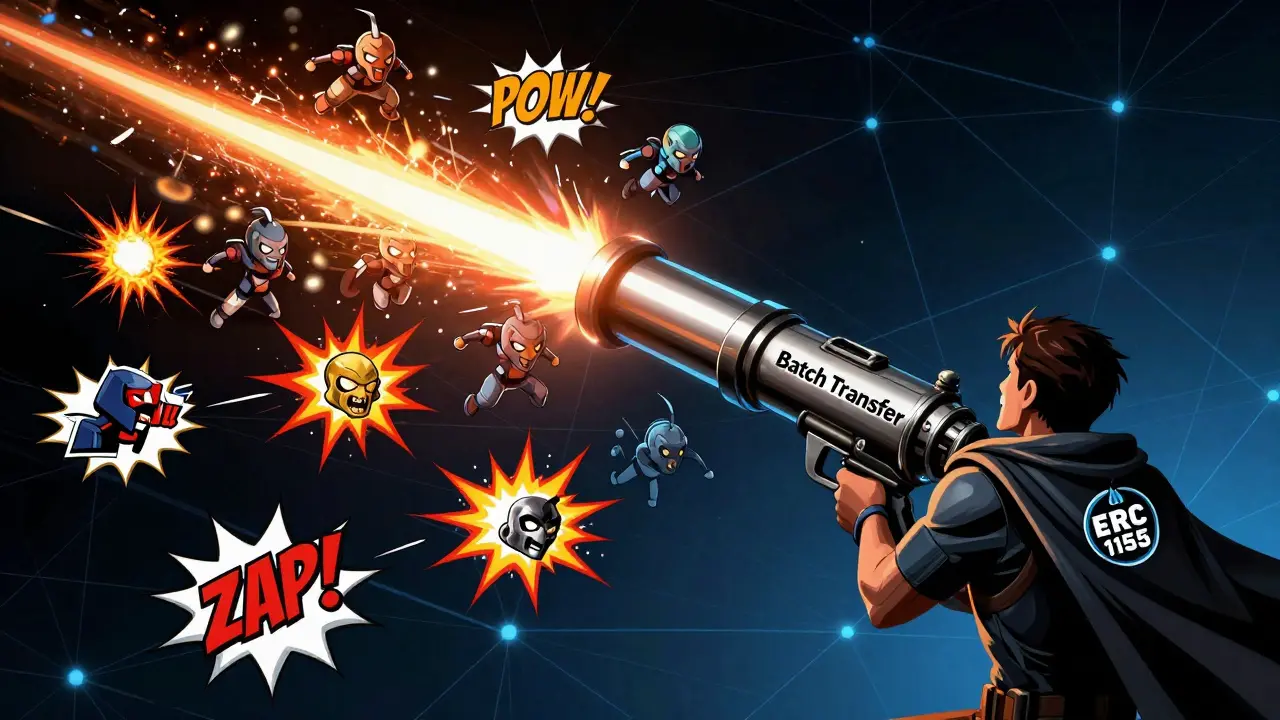
If there is one reason developers love ERC-1155, it is gas efficiency. On Ethereum, every operation costs gas, which is paid in ETH. When you transfer tokens using older standards, each transfer is a separate transaction. If you want to send someone 10 different items, you pay the base cost of a transaction 10 times over.
ERC-1155 introduces batch transfers. This feature allows you to send multiple different token IDs to multiple different addresses in a single transaction. According to analysis by OpenZeppelin, transferring 10 different tokens via an ERC-1155 batch transfer costs approximately 115,000 gas. Doing the same thing with separate ERC-20 or ERC-721 transfers would cost over 450,000 gas. That is a reduction of nearly 75% in transaction costs.
For gamers, this means trading five items with a friend doesn’t feel like paying a toll booth fee for every single item. For platforms, it means they can process thousands of trades per second without clogging up the network. Enjin reported in a 2022 case study that their Minecraft plugin used ERC-1155 to manage over 1.2 million in-game asset transfers with 92% lower gas costs compared to using separate legacy contracts.
| Feature | ERC-20 | ERC-721 | ERC-1155 |
|---|---|---|---|
| Token Type | Fungible only | Non-Fungible only | Fungible, Non-Fungible, Semi-Fungible |
| Contract Deployment | One per token type | One per collection | One for all assets |
| Batch Transfers | No | No | Yes (Major gas savings) |
| Metadata Storage | Per contract | Per token ID | Per token ID |
| Best For | Currencies, Governance | Art, Unique Collectibles | Gaming, Marketplaces, Complex Economies |
Semi-Fungible Tokens: The Hidden Gem
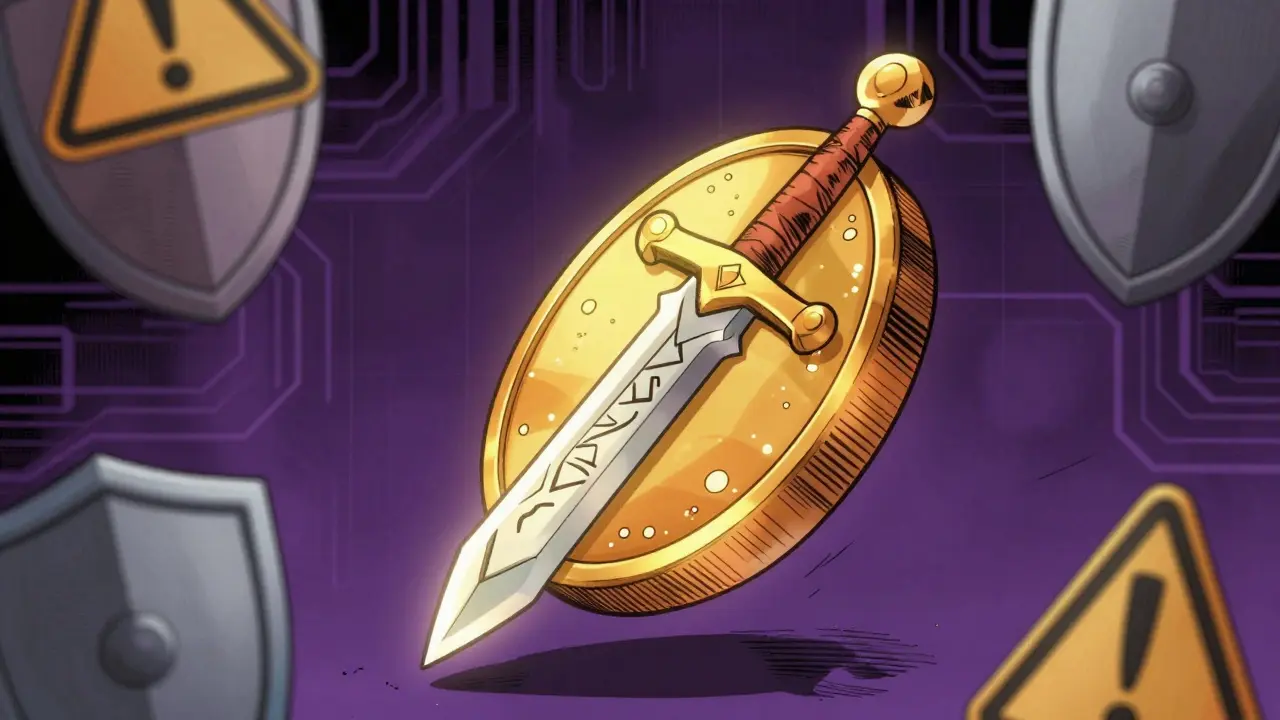
While most people talk about fungible (identical) and non-fungible (unique) tokens, ERC-1155 shines brightest with semi-fungible tokens. These are tokens that act like regular currency until a specific condition is met, at which point they become unique. Think of concert tickets. Before the event, all tickets for Section A are identical; you can swap one for another easily. But once the event happens, or if the ticket is signed by the artist, it becomes a unique collectible with its own history and value.
In a gaming context, imagine a box of potions. All healing potions have Token ID 5. They are fungible. But if a player uses a potion in a legendary quest, the system can flag that specific instance or create a derivative token ID that represents the "Used Legendary Potion," making it non-fungible. This dynamic behavior is difficult to achieve with ERC-20 or ERC-721 alone but is native to the ERC-1155 design philosophy.
Security Considerations and Implementation Risks
Efficiency comes with complexity, and complexity brings security risks. Because ERC-1155 contracts are more complex than simple ERC-20 tokens, they require careful coding. Security researcher Roman Semenov identified vulnerabilities in early implementations, particularly around the `safeTransferFrom` function. If a developer fails to properly handle the return values of this function, attackers can exploit the contract to drain funds or steal assets.
An audit by OpenZeppelin in 2022 found that 68% of popular ERC-1155 contracts had at least one moderate-severity issue related to access control or input validation. Compare this to 52% for ERC-721 contracts. The main culprit? Developers often copy-paste code without fully understanding the hook mechanisms, specifically the `onERC1155Received` callback. This hook ensures that when tokens are sent to a smart contract (like a marketplace or wallet), the receiving contract actually knows how to handle them. If this isn't implemented correctly, tokens can get stuck forever.
To mitigate these risks, always use established libraries like OpenZeppelin’s ERC1155 implementation, which accounts for 89% of deployments according to Etherscan data. Never write a custom token standard from scratch unless you have a team of professional auditors reviewing your code. Additionally, ensure your metadata URIs are hosted on decentralized storage like IPFS to prevent link rot, which can render your NFTs invisible or worthless if the central server goes down.
Who Should Use ERC-1155?
Not every project needs ERC-1155. If you are creating a simple governance token or a basic cryptocurrency, stick with ERC-20. It is simpler, has better tooling support, and is universally understood by wallets and exchanges. If you are an artist selling a single series of digital paintings, ERC-721 remains the industry standard with broader marketplace compatibility.
However, if you fall into these categories, ERC-1155 is likely your best bet:
- Game Developers: You need to manage inventory systems with hundreds of item types, currencies, and unique loot drops. The batch transfer capability is crucial for player-to-player trading.
- Marketplace Platforms: If you are building a platform that sells both physical goods (represented as NFTs) and loyalty points (fungible tokens), managing them in one contract simplifies the backend significantly.
- Loyalty Programs: Brands issuing points that can be redeemed for unique experiences benefit from the semi-fungible nature of the standard.
According to DappRadar, 73% of new blockchain gaming projects now use ERC-1155 as their primary token standard, up from 41% in 2021. This shift highlights the standard's dominance in sectors requiring complex asset management.
Getting Started with Development
If you are a developer ready to implement ERC-1155, start with the OpenZeppelin Contracts library. It provides a robust, audited base contract that handles the heavy lifting of balance tracking and transfer logic. The learning curve is estimated at 15-25 hours for developers already familiar with Solidity and ERC-20/721 standards.
Key steps include defining your token IDs carefully. Since there is no standardized mint function in the ERC-1155 specification, you must decide how new tokens are created. Will anyone be able to mint? Only the owner? Or will it be automated based on in-game actions? Plan this out before writing code. Also, prioritize testing your batch transfer functions. Simulate high-volume transactions to ensure your gas optimizations are working as expected and that your metadata endpoints can handle the load.
Is ERC-1155 better than ERC-721 for NFTs?
It depends on your use case. ERC-721 is better for pure art collections because it has wider support across all major marketplaces and simpler metadata handling. ERC-1155 is superior for gaming and ecosystems where users hold many different types of items, as it drastically reduces gas fees through batch transfers and allows mixing fungible and non-fungible assets in one contract.
Can I convert an ERC-20 token to ERC-1155?
You cannot directly "convert" a deployed contract. However, you can create a bridge mechanism where users deposit their ERC-20 tokens into a vault contract, which then mints equivalent ERC-1155 tokens to their address. This is common in cross-chain bridges or when migrating legacy assets to newer standards.
Why do some wallets not show my ERC-1155 tokens?
While major wallets like MetaMask and Trust Wallet support ERC-1155, some older or specialized wallets may not display them correctly if they don't recognize the contract address or if the metadata URI is unreachable. Ensure your token URI returns valid JSON data pointing to your image and attributes. If the wallet still doesn't show it, try adding the contract address manually if the wallet supports custom token imports.
What are semi-fungible tokens?
Semi-fungible tokens are assets that behave like fungible tokens (interchangeable) in some contexts but become non-fungible (unique) in others. An example is a set of trading cards where all cards of the same type are identical until one is autographed, making that specific card unique. ERC-1155 natively supports this by allowing balances greater than 1 for certain token IDs while restricting others to 1.
Is ERC-1155 secure?
The standard itself is secure, but implementations vary. Many exploits in 2020-2021 were due to developers incorrectly implementing the `safeTransferFrom` function or failing to validate inputs. Using trusted libraries like OpenZeppelin and getting a professional audit significantly reduces risk. Always verify that receiving contracts properly implement the `onERC1155Received` hook to prevent tokens from being sent to incompatible addresses.
Christina Pearce
May 31 2026Thanks for breaking this down so clearly. The part about batch transfers saving gas really clicked for me, especially since I've been trying to figure out why my test transactions were costing so much with separate ERC-20 and ERC-721 contracts.
Barclay Chantel
May 31 2026Oh, look at you, praising the latest shiny blockchain toy. It's almost as if people think 'efficiency' in a Ponzi scheme makes it less of a scam. Typical American optimism applied to digital nothingness.
Miss Masquer
June 2 2026I have to say that while the technical explanation is quite thorough, I find myself wondering how this might impact smaller developers who are not necessarily well-versed in Solidity or the complexities of smart contract security, which seems to be a significant barrier to entry for many creative individuals who wish to explore these new frontiers of digital asset management without having to hire expensive auditors right from the start.
Joshua Alcover
June 3 2026The epistemological framework underlying ERC-1155 necessitates a rigorous examination of its ontological implications within the decentralized ecosystem. One must consider the hegemonic dominance of Ethereum and whether such standards serve to consolidate power structures rather than democratize access to financial instruments, thereby creating a pseudo-decentralized facade that masks the centralization of control among elite developer cohorts.
Diana Morris
June 3 2026stop overthinking it just use openzeppelin and move on already everyone knows erc1155 is better for games why are we still debating this like its some deep philosophical question it saves gas thats it
Dianne Wright
June 4 2026i mean obviously you dont know what youre talking about because i read three articles on this last week and trust me when i say the security risks are way bigger than they let on but sure keep using it if you want your tokens stuck forever lol
saradee dee
June 8 2026Wow! This is amazing information. I never knew that one contract could handle so many different types of items at once. It sounds like magic for game developers. Thank you for sharing this wonderful knowledge with us all today.
Craig Swanson
June 8 2026You need to listen up because if you are building any serious gaming platform and you are not using ERC-1155 you are wasting money and time and frankly you are doing it wrong stop making excuses and start optimizing your contracts now.
Bill Gunn
June 8 2026Hey folks! 👋 Just wanted to chime in that the batch transfer feature is literally a game-changer (pun intended 🎮). I implemented this for a card game project last year and the gas savings were insane. Plus, handling both gold coins and unique cards in one contract made the UI so much cleaner for users. Highly recommend checking out the OpenZeppelin docs if you're diving in! 🚀💸
Dana Rapoport
June 9 2026It is interesting to consider the long-term implications of standardizing multi-token systems. While efficiency is paramount, one must also ponder the user experience aspect. Does consolidating assets simplify the wallet interface enough to justify the learning curve for average consumers?
Hadleigh Edwards
June 9 2026I have always believed that technology should serve to simplify our lives and not complicate them further with unnecessary layers of abstraction that only serve to confuse the average user who just wants to play their game without worrying about gas fees or contract addresses so this approach seems like a step in the right direction towards a more seamless and integrated digital experience for everyone involved in the ecosystem.
mark valmart
June 10 2026pretty solid writeup man. i was struggling with the metadata uri part until i saw this. thanks for clarifying that ipfs is the way to go to avoid link rot. saved me from a headache.
Crystal Davis
June 11 2026The analysis provided here is superficial at best. It ignores the critical failure modes of the `onERC1155Received` hook which remains the single largest vector for exploit in current implementations. Furthermore, the claim of 75% gas reduction is highly context-dependent and often misleading when considering network congestion periods. A true expert would delve deeper into the bytecode optimization levels.
trisya hazriyana
June 12 2026yeah sure whatever erc1155 is great until you realize nobody actually uses it properly and then you end up with a bunch of broken wallets and confused users so enjoy your jargon heavy explanation while the rest of us deal with the reality of bad implementation
Debbie Lewis
June 13 2026I see a lot of strong opinions here. I just stick to ERC-721 for my art drops because the marketplace support is just easier. But I can see why gamers would prefer this. Seems like a niche tool for specific needs rather than a universal replacement.
Eric Grosso
June 14 2026so does this mean i can send my friends 5 diff items in one tx? that sounds cool. im kinda new to this stuff so idk if im missing something but the gas savings seem realy important right now with eth being so expensiv.
Edith Mair
June 15 2026Can someone clarify if the semi-fungible aspect requires additional logic beyond the standard minting function? I am trying to understand if the transition from fungible to non-fungible is automatic based on balance or if it requires explicit state changes in the contract.
Sam Dashti
June 15 2026Imagine a world where your digital sword isn't just a jpeg but a functional asset with stats, tradable alongside your gold, all without paying a toll booth fee every time you swing it. That's the beauty of ERC-1155, folks. It’s not just code; it’s liberation from the shackles of inefficient legacy standards.
Joe Clements
June 17 2026Hi everyone, just wanted to say that this article really helped me understand the difference between the token standards. I was confused about why I needed multiple contracts before. Thanks for the clear examples with the game items!
Rosie Morris
June 18 2026i love how this explains the gas savings. its crazy how much we pay for simple transfers sometimes. glad there is a better way now. hope more devs switch to this soon so we dont have to wait so long for transactions to go thru.
lorna erni
June 20 2026Let's get real here, if you are not using ERC-1155 for your next game project you are leaving money on the table. Stop being lazy and start integrating this standard because the community is moving forward and you will be left behind if you cling to outdated methods.