Remember the summer of 2021? It was the golden era of crypto airdrops. If you were active on CoinMarketCap is a leading cryptocurrency data and information platform that tracks market prices, volume, and supply for thousands of digital assets., you likely saw the buzz around Peanut.Trade is a decentralized finance protocol designed to balance prices between centralized and decentralized exchanges to reduce slippage and maximize trader gains. Also known as Peanut Protocol, it operates under the ticker symbol NUX.. The promise was simple: join a few Telegram groups, follow some Twitter accounts, and get free tokens. But what actually happened with that NUX token is the native utility token of the Peanut.Trade ecosystem, used for governance, staking, and fee discounts within the protocol.? And more importantly, is there any value left in those wallets today?
If you’re digging through your old wallet history or wondering if you missed out on a hidden gem, you’ve come to the right place. We’re breaking down exactly how the Peanut airdrop worked, who qualified, and the harsh reality of where the NUX token stands in mid-2026.
The Core Mechanism: What Is Peanut.Trade?
Before we talk about free money, let’s understand what you were getting. Peanut isn’t just another meme coin or a vague community token. It was built to solve a specific problem in Decentralized Finance (DeFi) is a financial system built on blockchain technology that eliminates intermediaries like banks, allowing peer-to-peer lending, borrowing, and trading.: price inefficiency.
When you trade on a Automated Market Maker (AMM) is a type of decentralized exchange that uses liquidity pools and algorithms to determine asset prices instead of traditional order books. like Uniswap, you often face high slippage. This means if you try to buy a large amount of a token, the price moves against you before your trade executes. You end up paying more than expected. Peanut aimed to fix this by acting as a price balancer.
Here is how the architecture works:
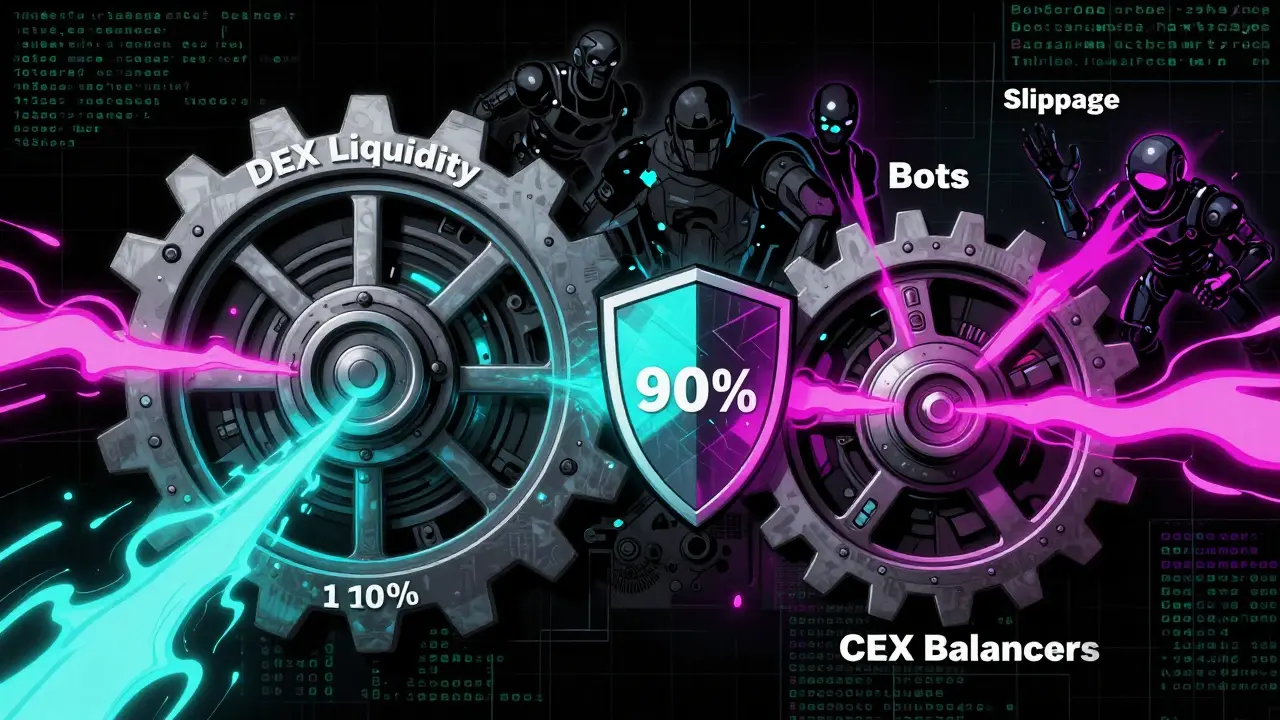
- 90% Allocation: Most of the assets are placed directly into DEX liquidity pools (like Uniswap).
- 10% Allocation: A smaller portion goes into an intermediary mechanism. This part actively monitors and balances prices between the DEX and Centralized Exchanges (CEXs).
- Bot Protection: The protocol includes measures to stop predatory bots from front-running trades-a common tactic where bots see your pending transaction and buy the asset first, driving up the price you pay.
In theory, this setup reduces risk and maximizes gains for regular traders. In practice, execution matters more than theory, especially in the volatile crypto market.
Airdrop Mechanics: How Did It Work?
The main distribution event happened in August 2021. It wasn’t a random giveaway; it was a structured marketing campaign hosted on CoinMarketCap. Here is the exact breakdown of what participants needed to do to qualify.
| Requirement / Detail | Specific Action or Value |
|---|---|
| Total Pool Size | 71,000 NUX tokens (valued at ~$22,000 USD at the time) |
| Number of Winners | 2,000 selected participants |
| Max Reward Per User | 35.50 NUX tokens |
| Watchlist Requirement | Add NUX to main CoinMarketCap watchlist |
| Social Media Tasks | Join Telegram group (t.me/peanuttrade) and announcement channel (t.me/peanutann); Follow Twitter (@PeanutTrade) |
| Registration | Complete the official form on CoinMarketCap |
| Distribution Date | August 27 - August 31, 2021 |
You might be asking, "Did I need to hold any other coins?" No. This was purely engagement-based. They wanted eyes on their social channels and users watching their token metrics. By requiring you to add NUX to your watchlist, they ensured that even after receiving the tokens, you would keep checking the price, creating organic interest.
Tokenomics and Vesting: The Fine Print
Receiving the tokens was only half the battle. Understanding when you could actually sell them is crucial. Peanut implemented a strict vesting schedule during its Token Generation Event (TGE) is the moment when a new cryptocurrency token is created and distributed on the blockchain, marking its official launch. on February 15, 2021.
Here is how the supply was released:
- Immediate Unlock: Only 3.5% of the total supply was unlocked at launch.
- Linear Vesting: The remaining 96.5% was released daily over 700 days (about 23 months). Some allocation pools had a slightly longer 750-day unlock period.
This structure is typical for projects trying to prevent early dumping. If all tokens were available day one, insiders could sell everything and crash the price. However, for airdrop recipients, this meant that while you received your 35.50 NUX in August 2021, the broader market supply was still trickling in, which puts downward pressure on the price over time.
Current Status of NUX in 2026
This is the part that hurts. If you held your 35.50 NUX tokens from 2021 until today, June 2026, here is the reality check.
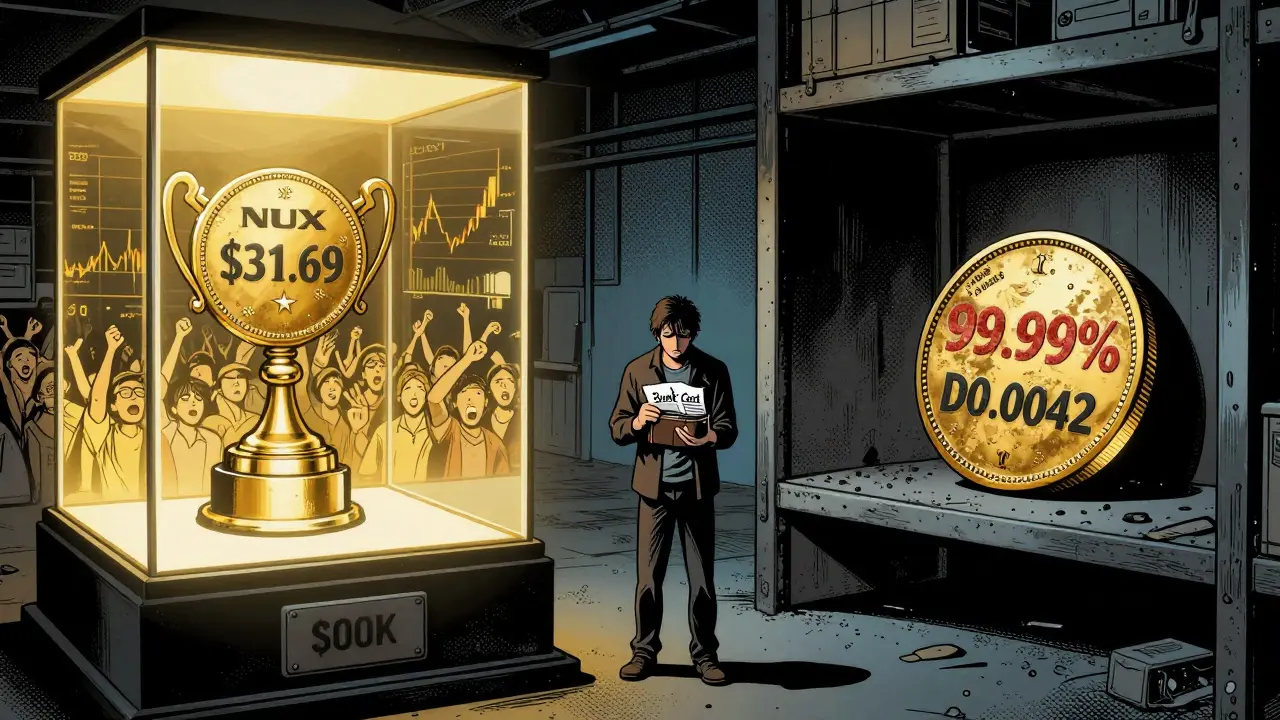
At its peak, NUX traded at an all-time high of $31.69 per token. That means your maximum airdrop reward was worth roughly $1,128 USD at the height of the bull market. Today, NUX is trading around $0.0042. Your same 35.50 tokens are now worth approximately $0.15.
That represents a decline of nearly 99.99%. Let’s look at the current market data to understand why:
- Market Cap: Approximately $210,000 USD. This is micro-cap territory, indicating very low liquidity and high risk.
- Circulating Supply: 50,000,000 NUX.
- Trading Volume: Around $66,000 - $103,000 USD per 24 hours. While not dead, this volume is too thin for significant institutional interest.
- Primary Exchange: Gate.io remains the most active venue, with smaller volumes on LATOKEN and Uniswap V2.
Why the drop? Several factors contributed. First, the broader crypto market corrected sharply after May 2021. Second, many DeFi protocols launched during that hype cycle failed to sustain user adoption once the easy money dried up. Third, competition from newer, more efficient AMMs and cross-chain bridges made Peanut’s specific value proposition less unique.
Price Predictions: Hype vs. Reality
If you search for "NUX price prediction," you’ll find wildly conflicting data. It’s important to read these with extreme skepticism.
Some automated models, like those from CoinLore, project NUX could reach $1.80 in 2026 or even $28.52 by 2041. These models rely heavily on historical patterns from previous bull markets. They assume that because Bitcoin went up, everything else will follow suit exponentially. This is dangerous thinking for a token that has lost 99.9% of its value.
Conversely, conservative analysts like CoinCodex and CoinDataFlow predict NUX will remain below $0.01 through late 2025 and into 2026. Their technical analysis shows weak momentum indicators (RSI around 52, flat moving averages). For a hypothetical $1,000 investment, they estimate a profit of less than $7 over several months. Essentially, they see no significant growth potential in the near term.
The truth likely lies closer to the conservative estimates. Without a major catalyst-such as a partnership with a top-tier exchange, a significant upgrade to the protocol, or a resurgence in demand for its specific price-balancing service-NUX lacks the fuel to reverse such a steep decline.
Should You Participate in Future Peanut Events?
There is no active airdrop for Peanut.Trade as of 2026. The 2021 campaign is closed. However, if you are considering buying NUX now or engaging with the project again, ask yourself these questions:
- Utility Check: Do you actually use the Peanut protocol to trade? If not, why are you holding the token?
- Liquidity Risk: With a market cap under $250k, can you easily sell your tokens without crashing the price further?
- Opportunity Cost: Could that capital perform better in established blue-chip assets or newer, higher-potential DeFi projects?
For most investors, the answer is no. The airdrop was a successful marketing stunt for 2021, but the token itself has not delivered long-term value. Treat any remaining NUX in your wallet as a sunk cost. Don’t throw good money after bad hoping for a miracle reversal.
Frequently Asked Questions
Is the Peanut.Trade (NUX) airdrop still open in 2026?
No, the primary airdrop campaign conducted via CoinMarketCap concluded in August 2021. Winners were announced and rewards distributed between August 27 and August 31, 2021. There are no current active airdrop programs for NUX as of mid-2026.
How much was the NUX airdrop worth originally?
The total pool was valued at approximately $22,000 USD, consisting of 71,000 NUX tokens. Individual winners received up to 35.50 NUX each. At the time of distribution, this translated to roughly $11 per winner based on the average pool valuation, though the token peaked later at much higher prices.
Where can I buy or sell NUX tokens today?
The primary trading venue for NUX is Gate.io, which handles the majority of the trading volume. You may also find listings on LATOKEN and Uniswap V2 (on the Ethereum network). Be aware that liquidity is low, so expect higher slippage when trading larger amounts.
What is the current price of NUX?
As of June 2026, NUX is trading at approximately $0.0042. This represents a decline of 99.99% from its all-time high of $31.69. The market capitalization is roughly $210,000 USD.
Did the NUX airdrop require me to hold any other cryptocurrencies?
No. The 2021 CoinMarketCap airdrop did not require holding ETH, BTC, or any other tokens. Eligibility was based on engagement tasks: adding NUX to your CoinMarketCap watchlist, joining Telegram groups, following Twitter, and completing a registration form.
Is Peanut.Trade safe to use?
While the protocol aims to reduce slippage and protect against bots, all DeFi platforms carry inherent risks, including smart contract vulnerabilities and impermanent loss. Given the low trading volume and market cap of NUX, users should exercise extreme caution and never invest more than they can afford to lose.