Blockchain Authentication: How Decentralized Identity Keeps Your Data Safe
When you log into a website, you’re handing over your identity to someone else — a company, a server, a database that could be hacked tomorrow. Blockchain authentication, a system that uses decentralized ledgers to verify identity without relying on central servers. Also known as decentralized identity, it lets you own your digital proof of who you are — no middleman needed. This isn’t science fiction. It’s already being used to secure patents, verify licenses, and protect crypto exchange keys. And unlike passwords that get leaked or reset every few months, blockchain-based identity can’t be stolen in bulk because there’s no single database to break into.
At its core, blockchain authentication ties your identity to a cryptographic key pair — one public, one private. You keep the private key safe (on your phone or hardware wallet), and the public key gets recorded on a blockchain. When you need to prove you’re you, you sign a message with your private key. Anyone can check that signature against the public key on the chain — and know it’s real. No username. No password. No company holding your data. This is how smart contracts automate trust: they don’t just execute payments, they verify who you are before allowing access to a service, a document, or even a digital asset.
Companies like Kraken and Coinbase use hardware security modules — physical devices that store private keys offline — to protect user funds. That’s the same principle, just scaled up. Governments are testing it too: Switzerland’s Crypto Valley lets you pay taxes in Bitcoin because the system knows who you are, not because they trust your bank. Patent offices in the U.S. and EU now use blockchain timestamps to prove who invented what and when — no more waiting years for legal paperwork. Even your NFTs rely on this: if you can’t prove you own the wallet that bought the art, you don’t own the art.
So why isn’t everyone using it yet? Because it’s not always simple. You need to understand key management. Lose your private key, and you lose access forever — no customer support can help you. That’s why tools like BloctoSwap and Cloud HSMs exist: they make it easier to manage your identity without putting it at risk. And as regulations like the Payment Services Act and VARA licensing requirements tighten, more platforms will be forced to adopt this model. You won’t just log in with a password anymore — you’ll prove your identity with a signature.
Below, you’ll find real examples of how blockchain authentication is being used — from patent protection to exchange security, from smart contract enforcement to fighting scams. No fluff. Just how it works, where it’s working, and what you need to know to stay safe in a world where your identity is your most valuable asset.
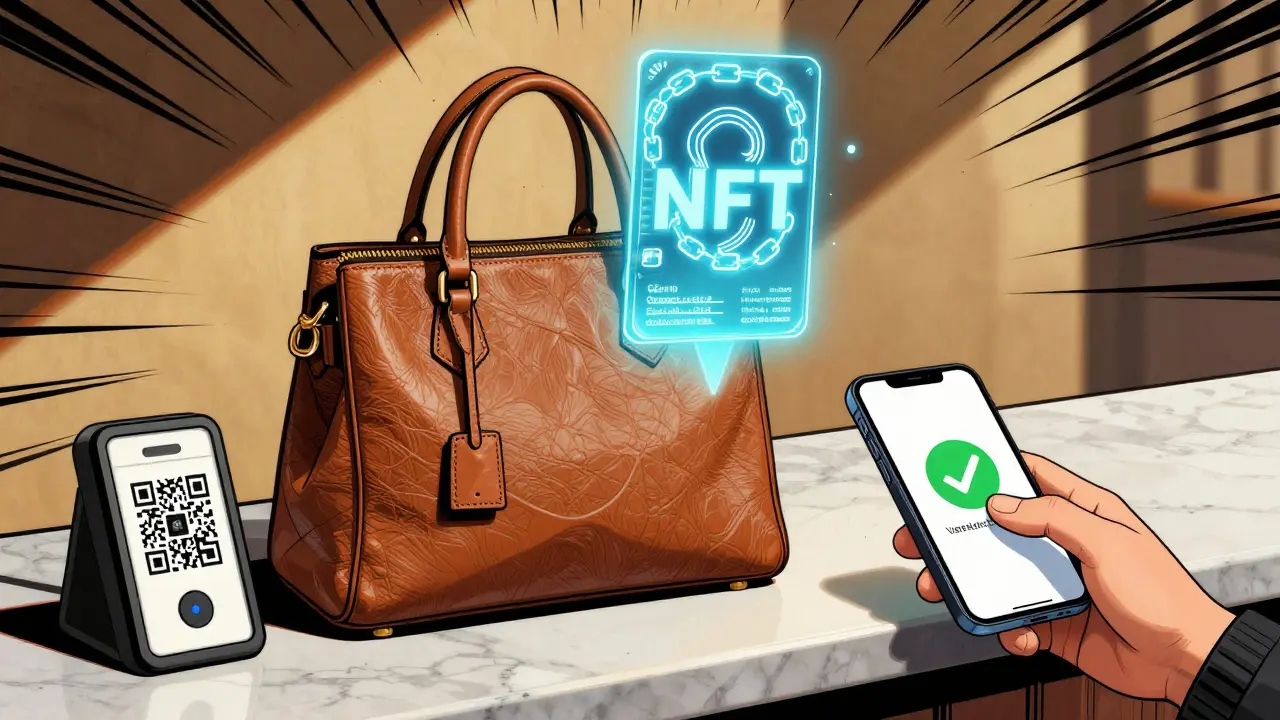
NFTs are transforming how we prove a product is real. By linking physical items to unchangeable digital certificates on the blockchain, they stop counterfeits, track origins, and build consumer trust like never before.