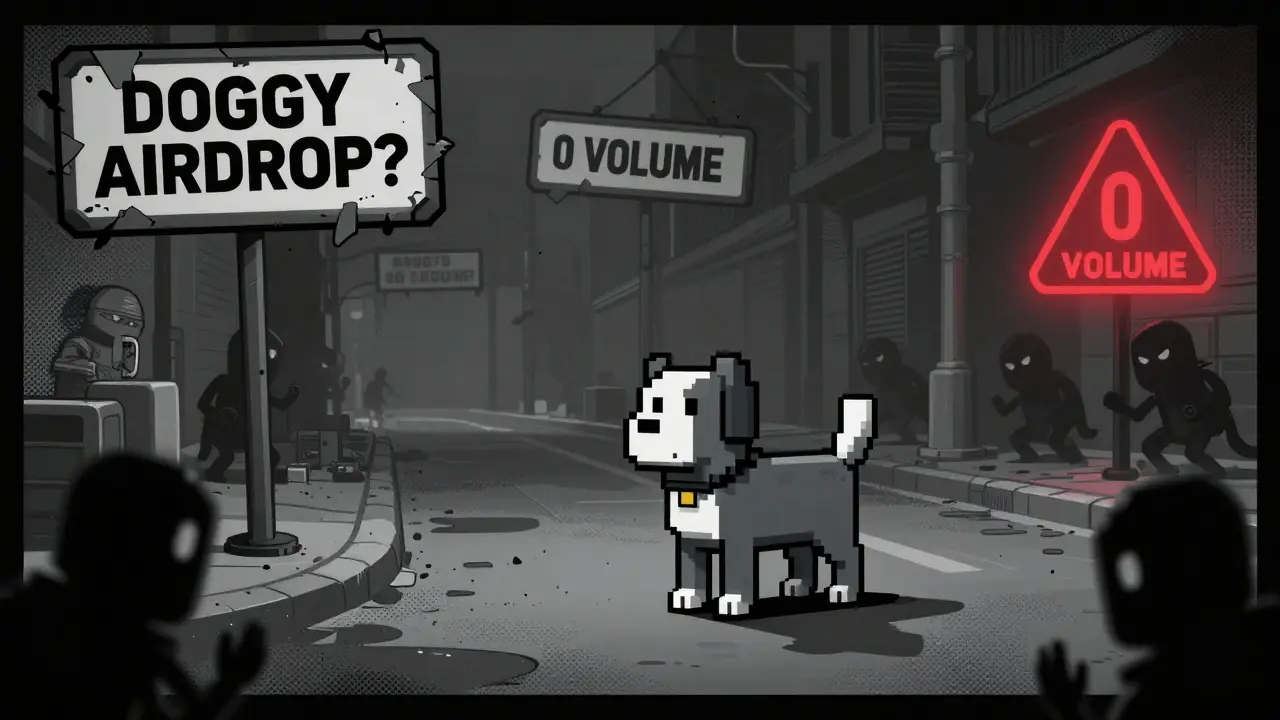
DOGGY token: What it is, where it trades, and why meme coins like it thrive
When you hear DOGGY token, a meme-driven cryptocurrency on BNB Chain with no team, no whitepaper, and no real-world use case. Also known as DOGGY coin, it exists purely because people believe in it—like a digital inside joke that turned into a trading pair. There’s no CEO, no roadmap, no product. Just a logo, a supply limit, and a Discord full of people posting dog memes at 3 a.m. That’s the whole business model.
DOGGY token isn’t alone. It’s part of a bigger group of coins—like Wise Monkey (MONKY), a BNB Chain meme coin built on the "Three Wise Monkeys" theme and Hinagi (HINAGI), a low-cap token with $0 trading volume and a $32K market cap—that survive on hype, not fundamentals. These coins don’t solve problems. They mirror culture. They’re the TikTok trends of crypto: loud, fast, and gone before you blink. Their value isn’t in tech—it’s in community, timing, and FOMO. If 10,000 people suddenly decide to buy DOGGY because a YouTuber posted a meme, the price spikes. If the hype dies? It crashes. No warning. No recovery plan.
These tokens run on BNB Chain, a fast, low-cost blockchain built by Binance for DeFi and meme coins. That’s why you’ll find DOGGY on decentralized exchanges like PancakeSwap, not on Coinbase or Kraken. You need a wallet, some BNB for gas, and the courage to gamble. No KYC. No customer support. If you lose your keys, you lose your DOGGY. There’s no one to call. No refund. That’s the trade-off for freedom—and risk.
People buy DOGGY not because they think it’s worth $100 tomorrow. They buy it because they think someone else will pay $100 for it tomorrow. That’s speculation. That’s the meme coin game. And it’s working—for some. The same way a $100 bill can be worth $200 if someone else wants it, a DOGGY token can spike 500% in a day. But it can also drop to zero just as fast. No one’s auditing the contract. No one’s holding reserves. It’s all code, community, and chaos.
Below, you’ll find real posts about similar tokens—what worked, what failed, and what to watch out for. Some are warnings. Some are stories. None are financial advice. But they’re all true.
There is no DOGGY airdrop - it's a dead NFT project often confused with DOGS, the real dog-themed crypto airdrop. Learn the difference, avoid scams, and find real opportunities in 2025.